Gabon
A slice of Central African rainforest sitting right on the equator, where roughly 88% of the land is still forest and elephants occasionally wander onto the beach. Gabon banked its oil money on keeping the wild wild.
WHAT THE FLAG MEANS ◢
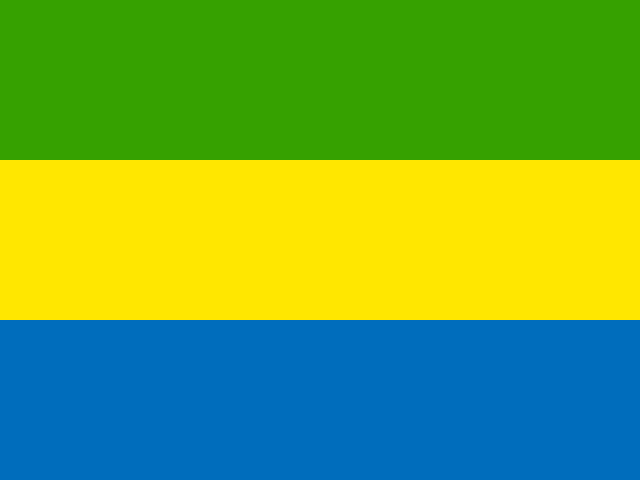
Three equal horizontal bands of green, yellow and blue. Gabonese law defines the flag by those colours and their arrangement alone: Article 1 of the constitution promulgated on 19 December 2024 names the tricolour flag 'green, yellow, blue' in three horizontal bands of equal dimension and assigns the colours no meaning, as did Article 2 of the 1991 constitution before it. The reading in general use comes from Gabon's foreign ministry, which gives green as the equatorial forest along with fertility and agricultural wealth, yellow as the equator crossing the country together with the sun, mineral wealth and Gabonese hospitality, and blue as the sea, the country's many watercourses, the sky and peace.
Source: affaires-etrangeres.gouv.ga
Gabon FACTS ◢
| Capital | Libreville |
|---|---|
| Continent | Africa |
| Population | 2,593,130 (2025) |
| Area | 267,667 km² |
| Population density | 10/km² |
| Currency | Central African CFA franc (XAF) |
| Official language | French |
| Calling code | +241 |
| Internet TLD | .ga |
| Time zone | UTC+01:00 |
| Drives on the | Right |
| ISO codes | GA / GAB |
DID YOU KNOW? ◢
- Around 88% of the country is covered in rainforest, and 11% of its land is protected national parks.
- Loango National Park is famous for its 'surfing hippos' and forest elephants that stroll along the Atlantic beaches.
- The equator runs directly through the country.
- It's one of the last strongholds of the western lowland gorilla and the forest elephant.
Gabon QUICK ANSWERS ◢
What is the capital of Gabon?
The capital of Gabon is Libreville.
What is the population of Gabon?
Gabon had a population of 2,593,130 in 2025.
What currency does Gabon use?
Gabon uses the Central African CFA franc (XAF).
What languages are spoken in Gabon?
The official language of Gabon is French.
Think you know your flags? Play Flag Daily → · Browse all countries →
MORE ON THE FLAG ◢
Search for the Gabon flag and every page gives the same three-line answer: green for the forest, yellow for the equator and the sun, blue for the sea. That reading is neither invented nor unofficial. It is simply not in any Gabonese law that can be read today.
The constitutional article defining the flag names the colours, says the bands are horizontal and equal, and stops. The symbolism is published elsewhere in the state, on two separate government sites, and that version is longer than the one that gets quoted.
Key Takeaways
- The constitution adopted by referendum and promulgated on 19 December 2024 defines the national emblem as the tricolour flag, "green, yellow, blue", in three horizontal bands of equal dimension. It assigns the colours nothing.
- The 1991 constitution carried that same sentence at Article 2. The 2024 text moved it to Article 1 and changed not a word.
- The state publishes a fuller version of that meaning, on both the foreign ministry's symbols page and the Presidency's: yellow also carries mineral wealth and hospitality, blue also carries the rivers, the sky and peace. The three-line reading itself is older than either page.
- Today's flag dates from law 54/60 of 9 August 1960, eight days before independence. The one it replaced had the French tricolour in the top band and a much narrower yellow stripe.
- National Flag Day falls on 9 August, the anniversary of that law, under a decree of 2 December 2009.
What do the colours on the Gabon flag mean?
The fullest official statement sits on the foreign ministry's national symbols page, "Fondements et symboles", published on 7 October 2011. It gives one sentence to each band:
- "Le vert, symbole de la forêt équatoriale qui couvre la majorité du territoire, évoque la fertilité et la richesse agricole." Green is the equatorial forest covering most of the territory, and it evokes fertility and agricultural wealth.
- "Le jaune, symbole de l'Equateur qui traverse le territoire d'ouest vers l'est évoque le soleil, la richesse minière et l'hospitalité légendaire de la population gabonaise." Yellow is the equator crossing the territory from west to east, and it evokes the sun, mineral wealth and the legendary hospitality of the Gabonese people.
- "Le bleu, symbole de la mer qui baigne les côtes du Gabon, représente aussi les nombreux cours d'eaux qui sillonnent le pays, le ciel et l'image de paix que reflète le Gabon." Blue is the sea washing Gabon's coasts, and it also represents the many watercourses running through the country, the sky, and the image of peace Gabon reflects.
That is not one ministry's private wording. The Presidency's own "Symboles nationaux" page carried the same three sentences, differing only in how one word is written, l'Equateur against l’équateur, until the page stopped resolving: the live URL has returned a 404 since some point between September 2024 and April 2025, and the text is readable in the Internet Archive's capture of 30 November 2022. Whatever else it is, this is the Gabonese state's standard account of its own flag.
Set it beside the version in circulation and you can see what fell away. Forest, equator, sun and sea survived. Fertility, farming, minerals, hospitality, rivers, sky and peace did not.
The geography holds up. The equator crosses the country, as it crosses São Tomé and Príncipe offshore, and the forest runs on into Equatorial Guinea and Gabon's other neighbours.
Does Gabonese law say what the colours stand for?
No Gabonese law that can be read today assigns them a meaning, and the two older emblem laws, which are not in the online archive, are dealt with below. The constitution promulgated on 19 December 2024 heads its opening article Article Premier. Here is the entire provision, as published in the Journal Officiel: "L’emblème national est le drapeau tricolore, « vert, jaune, bleu », à trois bandes horizontales, d’égale dimension." The national emblem is the tricolour flag, "green, yellow, blue", with three horizontal bands, of equal dimension.
One sentence, sitting between a clause on equality before the law and a clause naming the national anthem. It fixes the colours and the geometry and nothing else: no shade of green, no shade of blue, no proportion, no meaning.
The wording is not new. The 1991 constitution, which the Journal Officiel still publishes, carried the identical sentence at Article 2. Gabon rewrote its constitution in what the preamble calls the spirit of 30 August 2023, a date the same text marks each year as the fête de la libération, submitted the draft to a referendum, and promoted the flag clause to the head of the document without editing it.
Two older laws survive in the citations printed at the top of Gabonese decrees: "Vu la loi n°35/59 du 29 juin 1959 déterminant l'emblème, la devise et le sceau de la République", and "Vu la loi n°54/60 du 9 août 1960 modifiant l'emblème national gabonais". Both are named in the 2009 decree creating Flag Day and again in a 2018 decree on producing the republic's symbols.
Neither text is in the Journal Officiel's online archive, which does not reach back that far. That is the limit on what can be said about the colours' meaning, as well as on what can be said about the 1959 design: the only part of law 54/60 anyone has transcribed names shades rather than meanings, and what follows about the 1959 flag rests on records kept by others.
Where did the short version come from?
Not from the government symbols pages, which is the tempting answer. The three-line reading was in print in English reference works long before them, and Flags of the World records two of those works. Eve Devereux's Identifying Flags (1994) gives the colours as the forest, the equator that crosses the country, and the sea, seventeen years ahead of the ministry page. Whitney Smith, writing in 1975, put it differently and more narrowly, thirty-six years ahead of it: "The blue and gold stripes emphasize that Gabon is a maritime nation through which the equator runs".
So the short version is not a truncation of the government text. It is older than the government text, and the government text reads like an expansion of it.
The Gabonese state does gloss these three colours in one other place, and that place is not the flag. The arms adopted on 15 July 1963, drawn by the Swiss heraldist and vexillologist Louis Mühlemann, carry the Gabonese flag on the ship in the blazon, and the Presidency's page reads their enamels straight: "Les émaux représentent la forêt équatoriale (sinople), le soleil (or) et l'océan (azur). Les besans d'or montrent l'abondance minérale du pays." The enamels represent the equatorial forest, the sun and the ocean, and the gold roundels show the country's mineral abundance.
Forest, sun, ocean, minerals. It is the same vocabulary as the flag gloss, attached to a different emblem, and it carries no more authority than the flag gloss does. It too sits on a web page, published by the Presidency rather than in the Journal Officiel.
Why did the Gabon flag change in 1960?
Because the first version was built around France, and independence removed the reason for it.
Flags of the World reproduces the text of the 1959 law, sourced to the vexillologist Jos Poels, and it describes something quite unlike the flag flying now. The top band took five twelfths of the depth, split down the middle: "Against the flag pole - (the) colours of the (French) Community (of Nations), at the fly - light Irish green." Golden yellow took two twelfths, royal blue the remaining five.
The Community is the French Community, and every account that identifies those colours, from Crampton to Devereux to Smith, calls them the French flag.
| Feature | Flag of 29 June 1959 | Flag adopted 9 August 1960 |
|---|---|---|
| Instrument | law of 29 June 1959, numbered 35/59 in Gabonese decrees and 36/59 in the Flags of the World transcription | law 54/60 |
| French tricolour | fills the hoist half of the top band | removed |
| Band depths | five, two and five twelfths | three equal thirds |
| Shades named in the law | light Irish green, golden yellow, royal blue | the same three, on Christopher Southworth's reading of Article One of law 54/60 |
| Time in use | thirteen months, on its own two dates, though Flags of the World's summary line says less than a year | since 1960 |
Take the tricolour out, widen the middle band from two twelfths to four, and you have the flag Gabon flies today. As independence redesigns go it is economical: nothing added, one thing removed, one stripe grown. The result is a flag that is easy to have seen and hard to place, which is what Flag Daily is for: it shows you one flag and gives you three guesses at the country.
The same page records Crampton's The World of Flags giving the 1959 depths as four, one and four, and placing the tricolour in the canton rather than across the hoist half of the band. The two records disagree on the arithmetic and on how far the French flag reached, and agree on the change.
Why does Gabon celebrate its flag on 9 August?
Because that is the date on the 1960 law, and a decree says so in as many words. Decree 0860/PR/MCJSL, signed on 2 December 2009, cites law 35/59 and law 54/60 among its visas and then provides: "Il est institué en République Gabonaise, une Journée Nationale du Drapeau, célébrée le 9 août de chaque année." A National Flag Day is instituted in the Gabonese Republic, celebrated on 9 August each year.
The Presidency's account of the seventeenth edition, held on 9 August 2026 under the theme "Un Drapeau, une Nation unie : ensemble, bâtissons le Gabon nouveau", repeats the reference to law 54/60 and describes a ceremony of allegiance to the flag, performed that year by the neighbourhood chiefs of Greater Libreville. The same page records the day itself as celebrated simultaneously in the fifteen arrondissements, with the Place de l'Indépendance as the main site, and in every provincial capital.
Gabon therefore marks two dates eight days apart: the flag on 9 August, and independence on 17 August, which the constitution sets as the national day.
What rules govern the Gabonese flag?
The ones that exist are about its form and its treatment, never about its meaning. The form rule is the constitutional sentence quoted above, three horizontal bands of equal dimension; everything else is about how the flag may be made and how it must be treated.
Criminal law backs it up. Article 218 of the penal code enacted as law 042/2018 punishes anyone who has, by words, writing, gestures or any other means, "outragé le drapeau de la République Gabonaise, l’Hymne National, le Sceau, les armoiries ou tout autre symbole de la République" with up to a year in prison and a fine of up to five million francs, or one of those two penalties alone. The code says only "francs"; the currency in force is the Central African CFA franc.
The enforcement is not theoretical. Flags of the World records a communiqué issued on 7 August 2011, two days before that year's Flag Day, in which the interior minister ordered table flags charged with the national arms withdrawn from sale and warned the hawkers selling them. The communiqué, as reported by Gabonews and translated by Ivan Sache, restates the specification: "the flag of the Gabonese Republic is made of three stripes of equal dimensions placed horizontally", green at the top, golden yellow, azure blue, and "The national flag should not be charged with any writing or motif."
It then gives a proportion, and gets it wrong. "La largeur d'une bande doit être égale à trois fois sa longueur" makes a band's width three times its length, which would produce a square flag, if largeur is read as the horizontal dimension and longueur as the vertical. That is the reverse of their usual sense, as Sache notes. A state that has never legislated a ratio, correcting the public on the ratio, in a sentence that does not parse geometrically, is a fair summary of the whole subject.
Is the flag 3:4 or 2:3?
Both shapes are drawn, and nothing in force decides between them.
Flags of the World carries a statement from Christopher Southworth: "I have a copy of Law No. 54/60 of 9 August 1960 and can confirm that the ratio of the flag of Gabon is 3:4 (although whether it is actually used in practice remains open to debate)." That is a rare shape for a national flag, and the debate he leaves open is real. The same page reports 2:3 in ordinary Gabonese use, with 3:5 and 7:10 versions also recorded, as Hervé Calvarin reported at the 27th International Congress of Vexillology.
Since the 2024 constitution gives no proportion, a Gabonese flag drawn 2:3 breaks no rule anyone can point to. The shades wander for the same reason: the Album des Pavillons and the Olympic flag manuals between them give the blue as Pantone 285, 293, 072 and 660, and Željko Heimer noted in 2001 that reproductions run from a light greyish blue to something close to navy.
Frequently asked questions
What do green, yellow and blue mean on Gabon's flag?
Gabon's foreign ministry gives green as the equatorial forest, yellow as the equator and the sun, blue as the sea, and the Presidency published the same text. Both add more to each colour: fertility and agriculture for green, mineral wealth and hospitality for yellow, rivers, sky and peace for blue. No Gabonese law that can be read today assigns them a meaning: the 1959 and 1960 emblem laws are not in the Journal Officiel's online archive, and the only part of law 54/60 anyone has transcribed names shades, not meanings.
When did Gabon adopt its current flag?
On 9 August 1960, under law 54/60, which modified the national emblem. Independence followed eight days later. Gabonese decrees signed decades afterwards still cite that law by number and date.
Did the Gabonese flag ever carry the French flag?
Yes, for about thirteen months between June 1959 and August 1960, and the yellow stripe was far narrower than it is now. The accounts differ on where exactly the French flag sat: the transcribed law text puts the French Community colours in the hoist half of the top band, with green holding only the fly half, while Crampton puts them in the canton.
Why is Gabon's National Flag Day on 9 August?
A decree signed on 2 December 2009 fixed the date, naming the 1960 emblem law in its citations. The Presidency held the seventeenth edition on 9 August 2026, with ministers, the defence and security commands and the diplomatic corps present.
Is insulting the Gabonese flag a criminal offence?
It is. Under Article 218 of the penal code enacted as law 042/2018, outraging the flag or another symbol of the republic by words, writing, gesture or any other means carries up to a year in prison, a fine of up to five million francs, or one of the two.
Sources
- Journal Officiel de la République Gabonaise, Loi référendaire N° 002-R/2024 du 19/12/2024 portant Constitution de la République Gabonaise - retrieved 14 August 2026.
- Journal Officiel de la République Gabonaise, Constitution de la République Gabonaise, loi n°3/91 du 26 mars 1991 modifiée - retrieved 14 August 2026.
- Journal Officiel de la République Gabonaise, Décret N° 0860/PR/MCJSL du 02/12/2009 instituant une Journée Nationale du Drapeau - retrieved 14 August 2026.
- Journal Officiel de la République Gabonaise, Décret N° 000158/PR/MJDHGS du 04/06/2018 déterminant les modalités de production des sceaux et des autres symboles de la République - retrieved 14 August 2026.
- Journal Officiel de la République Gabonaise, Loi N° 042/2018 portant Code Pénal - retrieved 14 August 2026.
- Ministère des Affaires Étrangères et de la Coopération, Fondements et symboles - retrieved 14 August 2026.
- Présidence de la République Gabonaise, Symboles nationaux - read from the Internet Archive capture of 30 November 2022. The live page returns 404 as at 14 August 2026; the Internet Archive CDX index shows a last successful capture on 16 September 2024 and a first 404 capture on 15 April 2025.
- Présidence de la République Gabonaise, 17e édition de la Journée nationale du Drapeau - retrieved 14 August 2026.
- Flags of the World, Gabon - Pre-Independence Flags - retrieved 14 August 2026.
- Flags of the World, Gabon - retrieved 14 August 2026.
PLAY ANOTHER →
One thing that happened today in history. Every day, a new one.
TODAY IN HISTORYDAILYGuess the CountryThree clues, three guesses. Work out where in the world it is.
THREE CLUESDAILYDaily CodeA short message, hidden in a different cipher every day.
ONE CIPHER A DAYDAILYDaily CryptogramOne quote, one scrambled alphabet. Crack it before tomorrow.
CRACK THE QUOTE