
Seychelles
An archipelago of 115 islands scattered across the Indian Ocean, Seychelles is home to the coco de mer - the plant that produces the largest and heaviest seed on Earth.
WHAT THE FLAG MEANS ◢
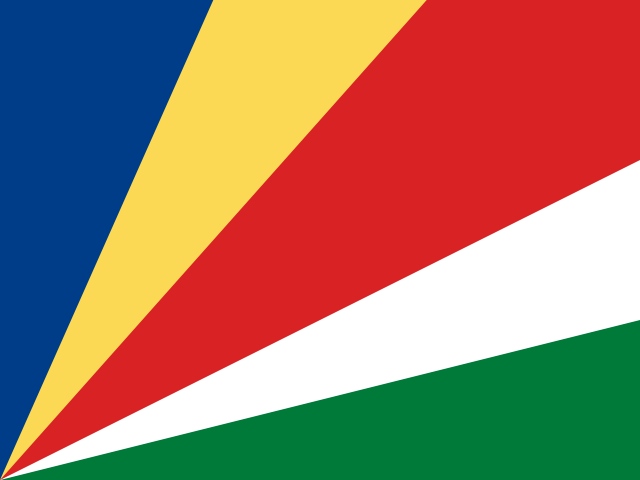
Five oblique bands of blue, yellow, red, white and green radiating from the lower hoist corner. Article 3 of the constitution provides only that there shall be a National Flag as prescribed by an Act, and the Act it defers to prescribes the design by a printed illustration and four colour values, without describing any of it in words or assigning any of it a meaning. The government publishes the reading separately: the oblique bands for a dynamic country moving into the future, blue for the sky and the sea, yellow for the sun that gives light and life, red for the people and their determination to work for the future in unity and love, white for social justice and harmony, and green for the land and natural environment.
Seychelles FACTS ◢
| Capital | Victoria |
|---|---|
| Continent | Africa |
| Population | 122,730 (2025) |
| Area | 459 km² |
| Population density | 267/km² |
| Currency | Seychellois rupee (SCR) |
| National languages | Creole, English, French |
| Calling code | +248 |
| Internet TLD | .sc |
| Time zone | UTC+04:00 |
| Drives on the | Left |
| ISO codes | SC / SYC |
DID YOU KNOW? ◢
- The coco de mer palm produces the world's largest and heaviest seed, which can weigh over 15 kilograms.
- Aldabra Atoll, a UNESCO World Heritage Site, hosts one of the world's largest populations of giant tortoises.
- It's the only country in the world with its capital, Victoria, located on the granitic islands rather than a mainland.
- Its inner islands are among the oldest oceanic islands on Earth, made of ancient granite rather than coral or volcano.
Seychelles QUICK ANSWERS ◢
What is the capital of the Seychelles?
The capital of the Seychelles is Victoria.
What is the population of the Seychelles?
The Seychelles had a population of 122,730 in 2025.
What currency does the Seychelles use?
The Seychelles uses the Seychellois rupee (SCR).
What languages are spoken in the Seychelles?
The Seychelles designates no official language. The national languages of the Seychelles are Creole, English and French.
Think you know your flags? Play Flag Daily → · Browse all countries →
MORE ON THE FLAG ◢
The blue, yellow, red, white and green bands on the Seychelles flag do have official meanings, and the readings set out higher up this page are the government's own. What they cannot tell you is where they come from, because they are not in the flag's law and never have been.
The National Symbols Act, which is the instrument the constitution points at, prescribes the flag in one sentence that describes nothing. It says the flag "shall be of the design set out in Part I of the Schedule", and Part I of the Schedule is a printed picture of the flag with four colour values underneath it. The Schedule supplies no wording for the shapes, no ratio and no reading of any element.
Those readings come from somewhere else entirely: a flag code published by the Ministry of Foreign Affairs and Tourism in 2021. And the man who drew the flag in 1996 gives two of the five colours a different meaning again.
Key Takeaways
- The National Symbols Act 1996 prescribes the flag by reproducing an illustration and listing four ink values. It assigns no meaning to any element.
- The colour meanings in general circulation are the Ministry of Foreign Affairs and Tourism's flag code of 2021, which also supplies the geometry the Act omits.
- Philip Uzice, who designed the flag aged 28, is reported as reading red as progress and white as peace and harmony. The ministry's red is the people's determination and its white is social justice and harmony.
- Article 3 of the constitution names five national symbols. The Act names four, and three of the constitution's five are not among them.
- The flag took effect on 18 June 1996. The 8 January 1996 date that circulates is in no Seychellois instrument, and is reported as the day the Bill reached a Gazette supplement.
| Flag | Flown | The instrument, and its own date | How that instrument fixes the design | What that instrument says the colours mean |
|---|---|---|---|---|
| White saltire, blue and red | June 1976 to June 1977 | National Flag and Armorial Bearings Act, Cap. 138, in force from 29 June 1976 | No description at all. The design is left to a presidential order | Nothing. The instrument is silent |
| Red over green, white wavy band | June 1977 to June 1996 | Statutory Instrument 71 of 1977, in force from 5 September 1977, under Cap. 138 | One sentence of description | Nothing. The instrument is silent |
| Five oblique bands | June 1996 to now | National Symbols Act, Cap. 145A, in force from 18 June 1996 | An illustration and four colour values | Nothing. The instrument is silent |
The Seychelles flag law is one sentence and a picture
The whole of the Act's treatment of the flag is section 3, and it reads: "The National Flag of the Republic shall be of the design set out in Part I of the Schedule."
Part I is headed NATIONAL FLAG, carries a reproduction of the flag, and then gives this, under the heading Colour Indicators:
- Blue: "Magnenta 70%, Cyan 100%, Pantone Reference 294"
- Yellow: "Magenta 20%, Yellow 100%, Pantone Reference 122"
- Red: "Magenta 100%, Yellow 100%, Pantone Reference 1795"
- Green: "Cyan 100%, Yellow 100%, Pantone Reference 356"
That is the entire specification. The misspelling of magenta on the first line is in the consolidated text as published, and it is repeated in Part IV.
Four values for a five-banded flag. White has no entry at all, which follows from what these values are: they are printing values, and in that system white is unprinted paper rather than a mixture. The white band is fixed only by the bands on either side of it.
There is no ratio in the Act either. The one-to-two proportion that Britannica and the flag archives give for this flag is nowhere in the statute. It has to be recovered from outside the Act, either by measuring the Schedule's picture or from the ministry's own table of flag sizes, which runs from a nine by four and a half inch table flag up to a twenty-four by twelve foot flag at the Lavwa Lanasyon monument on Mahe. Every one of those eight sizes is exactly twice as long as it is wide.
The four values have travelled, though. Flags of the World relays the Olympic flag manuals for Beijing 2008 and London 2012 as giving Seychelles PMS 294, 122, 1795 and 356, which is the Act's list exactly, and records no fifth value for the white in either. That silence is worth something, because the same page does record a white entry where a source carries one: it gives Vexilla Mundi's list as running blue, red, yellow, PMS White and green.
Only one sentence anywhere in the Schedule describes a shape on the flag, and it sits in the part about the President's Standard rather than the part about the flag. Part IV says the arms are positioned "equidistant from top and bottom edges of the red triangle". That is the only place the law names an element of the design, and it uses the name as though it had already been established, which it has not.
The Act is not vague in every direction. Section 7 makes it an offence to insult the flag, and fixes the penalty at "a fine of R25,000 and to imprisonment for 5 years". The 1976 Act it repealed had capped the same offence at two years. A state can be exact about punishing disrespect to a symbol while declining to say what the symbol stands for.
The colour meanings are official, and they are not in the law
The readings are published, and they are the government's. They are simply published somewhere other than the statute book.
The Ministry of Foreign Affairs and Tourism issued a 53-page flag code in 2021, Guidelines on Specifications and Correct Usage of the Seychelles' National Symbols. Its section 2.2.1 says: "The National Flag is made up of five oblique bands of blue, yellow, red, white and green, radiating from the bottom of the hoist side of the flag. The oblique bands symbolise a dynamic country moving into the future."
That last clause carries more than it looks. The bands carry a meaning of their own, separate from the colours they are filled with, and they are the only part of the design other than the colours to be given one.
Then the colours, in the ministry's own words:
- "Blue: represents the sky and the sea that surrounds us."
- "Yellow: represents the sun which gives light and life."
- "Red: represents the people and their determination to work for the future in unity and love."
- "White: represents social justice and harmony."
- "Green: represents the land and natural environment."
The same document supplies the geometry the Act leaves out, at section 2.2.3: "The proportions of the blue, yellow and red colours along the top length of the flag is at a ratio of 1:1:1. This is the same for the red, white, green colours on the fly side." Its colour table is introduced as being given "In accordance with the National Symbols Act", and it silently repairs the Act's spelling of magenta.
None of this is a late invention. Less than three months before the flag was first hoisted, the vexillological archive Flags of the World published a dispatch that Bruce Berry says he received from the South African Embassy in Victoria and confirmed with the Seychelles Consul in Johannesburg. Dated 27 March 1996, it reports that the coming flag is "made up of five oblique bands of blue, yellow, red, white and green (from left to right) representing a dynamic young country moving into a new future", and then gives the five colour readings. They are identical in substance to the ministry's twenty-five years later and close in wording, with the verbs the only real movement: the dispatch has the blue depict, the yellow be for, the red symbolise, the white represent and the green depict, where the flag code has all five represent.
So the meanings were settled before the flag flew, and were circulating diplomatically under three months ahead of it. They were never written into the Act that Parliament passed in the same year.
If you would rather test whether you can recognise this flag than argue about what it means, Flag Daily shows one flag a day and gives you three guesses at the country.
The man who drew the flag gives two colours a different meaning
The ministry names the designer. The flag was "designed and conceptualised by Mr. Philippe Uzice in 1996", and it is the product of "a nationwide competition launched in 1996, with the aim of creating new symbols which would better represent the Third Republic".
In June 2018 the state-owned Seychelles Nation ran an interview with him, spelling him Philip Uzice. He was 28 when he designed it, and he had submitted half a dozen designs after researching the history of Seychelles. Of his method he told the paper in 1996, before the flag was hoisted: "I inspected the flags of several other countries and I wanted ours to stand out among those of other nations".
On the colours themselves, what the paper reports him saying is not what the ministry publishes. The Nation gives it as indirect speech rather than as his words, so it is quoted here as the paper's own sentence: "Commenting on the different colours of the flag, Mr Uzice said blue represents the sky and the sea, yellow the sun giving light and life, red represents progress, white is for peace and harmony and lastly green is for the land and natural environment."
Blue, yellow and green match. Red differs outright: the ministry's red is the people and their determination, the designer's is progress. White half-differs. Both readings end in harmony, but the ministry's begins with social justice and the designer's with peace.
Neither is wrong, because no instrument makes either binding. When the meanings live in publications rather than in law, that is the result: two state-published sources, one of them the designer himself, and no text that settles between them.
The same interview records that he is not happy about his own position either. He told the paper that "All I wanted was some sort of recognition for my work", that he thought he should at least be a guest at the ceremonies where his flag is raised, and that a great many Seychellois do not know who designed it.
Article 3 promises five symbols and the Act delivers four
The constitution of 1993 handles the flag in one sentence. Article 3, headed National symbols, says: "There shall be a Public Seal, a National Flag, a National Anthem, a National Emblem and a National Motto, each of which shall be as prescribed by an Act".
Count the list: five symbols. Now count the Act that answers it. The National Symbols Act prescribes the National Flag, the Armorial Bearings, the National Anthem and the President's Standard. Four, and the President's Standard is not one of the five the constitution asks for, while the Public Seal, the National Emblem and the National Motto are never named in the Act at all.
The gap could be read as formal rather than real. The Armorial Bearings can stand as the emblem, and the ribbon beneath them carries a motto, blazoned into the 1976 Act as "FINIS CORONAT OPVS" and rendered by the ministry as "The End Crowns the Work". But an instrument written to satisfy a constitutional list would normally use the list's own words, and this one does not.
The ministry has taken the Act's count rather than the constitution's. Its flag code opens by saying that, "Based on the National Symbols Act 1996 [CAP 145A]", Seychelles "prides itself on four National Symbols", and it then lists the flag, the Armorial Bearings, the anthem and the President's Standard. Its preface counts them the same way without mentioning the Act at all: "Each of the National Symbols (of which there are four)".
The consolidation has its own rough edges. Its interpretation section defines the flag as the one "referred to in section 3; 4", and defines the Armorial Bearings by a clause that runs straight into the definition of the anthem.
The text used here has one limit to state plainly. It is consolidated only to 30 June 2012, and the Seychelles Legal Information Institute records a later amendment of 16 August 2022 as not yet applied: the Statute Law Revision (Miscellaneous Amendments) (No. 2) Act 2022, whose title marks it as a tidying statute rather than a rewrite. Its text is served as a file that would not load, so it has not been read here.
Seychelles has had three flags, and the law barely described the first two
Seychelles became independent on 29 June 1976, and the National Flag and Armorial Bearings Act took effect the same day. It is worth reading for how little it does.
The Act blazons the arms in full heraldic language, down to the "Female Coco de Mer Palm (Lodoicea maldivica)" and the "Giant Tortoise (Testudo gigantea)". For the flag it gives no description whatsoever. It declares the flag by pointing at an event, and leaves the design and description to a presidential order in the Gazette: the President "may, bo order, notify in the Gazette the design and description of the National Flag", the typo for by order being the published transcription's own.
That first flag was a white saltire on a field of two colours. Flags of the World, citing six reference works, records it as a "White saltire dividing triangles of blue (top and bottom) and red (hoist and fly)", which is how the ministry's own retrospective illustration shows it too. That archive contradicts itself on the point, a note on its country page putting the blue at the hoist and fly instead, and the ministry's illustration is what decides it. Writing in Britannica, Whitney Smith went further: he called it almost exactly the same as the flag of the Australasian United Steam Navigation Company, whose ships had called at the islands early in the twentieth century, and prefaced the observation with "Perhaps not coincidentally".
It lasted a year, to the day. On 5 June 1977 President James Mancham was deposed while abroad, and at the independence anniversary twenty-four days later the flag of the party that had taken power replaced the national one, minus the yellow sun the party flag bore at its centre. The law caught up on 5 September 1977, when Statutory Instrument 71 of 1977 finally used the power the 1976 Act had granted and notified a design. Its entire description of the national flag is: "Horizontal bands of union Flag Red over two tones of dark leaf-green separated by white undulating band."
Nearly nineteen years of national flag, and that sentence is all the law ever said about it. It names no meaning at all, and it fixes the red by calling it union Flag Red, which reads as the red of the British Union Flag and is an unexpected reference point for a flag first flown twenty-four days after a coup.
By then the Act's own definition had been rewritten. In its final consolidated form, section 2(1) declares that "The flag unfurled by the President at the celebrations to mark the the first anniversary of the independence of Seychelles shall be the National Flag", the doubled the being the published transcription's own. That is the flag flown at the celebrations of 29 June 1977. An Act that took effect on 29 June 1976 cannot originally have referred to an anniversary a year in the future, so that definition was written in afterwards. The chapter's own header lists four instruments, Act 14 of 1976 and then Act 23 of 1976, Decree 9 of 1977 and Decree 57 of 1978, without saying which of the later three did what. None of them could be opened for this article, so which one rewrote the definition is left open here. What is on the record is a state defining its national flag as whatever was run up the pole on a particular morning.
The colour readings you will find for both of those flags, red for revolution and green for agriculture, blue and red for the two main political parties, appear in foreign reference works and hobbyist archives and in no Seychellois source found for this article. Seychelles is not alone in leaving the question open, though it arrives there by an unusual route. As this site's explainer on the flag of the Comoros sets out from the text, the Comorian constitution describes that flag element by element and still assigns not one element a meaning.
Was the Seychelles flag adopted in January or in June 1996?
Both dates circulate, and only one of them is attached to the right event.
The Act's own commencement, printed at the head of the chapter, is 18 June 1996. That was then National Day, chosen because it marks what President James Michel later described as "the adoption in 1993 of the Constitution of the Third Republic". 18 June is now marked as Constitution Day, still with a flag-raising: State House opened the 2026 celebrations with one at the Lavwa Lanasyon monument. The ministry dates the new anthem, the modified arms and the first use of the President's Standard to that same day, and Britannica has the flag itself hoisted on it.
The rival date, 8 January 1996, is the one Wikipedia gives for the flag's adoption, citing a 2009 DK flag reference rather than anything Seychellois. It appears in no instrument opened for this article, and there is exactly one traceable account of where it comes from. Flags of the World records a contributor, Christopher Southworth, who says he worked from a copy of the "National Symbols Bill, 1996 (Bill No. 2 of 1996)" and reported in March 2004 that it was "published in a Supplement to the Official Gazette of 8 January 1996, and effective 18 June 1996".
On that one account, 8 January 1996 is the day the Bill appeared in a Gazette supplement, more than five months before anything took effect. No other source opened for this article has seen that supplement, so the explanation is offered rather than proved. The other half is certain: the Act is dated 18 June 1996, and no Seychellois text opened for this article attaches the flag to January at all.
Frequently asked questions
What do the five colours on the Seychelles flag mean?
The Ministry of Foreign Affairs and Tourism's 2021 flag code assigns them: blue for the sky and the sea, yellow for the sun which gives light and life, red for the people and their determination to work for the future in unity and love, white for social justice and harmony, and green for the land and natural environment. The oblique bands themselves are said to symbolise a dynamic country moving into the future. None of these meanings appears in the National Symbols Act or in the constitution.
Who designed the flag of Seychelles?
Philip Uzice, named as Philippe Uzice in the ministry's flag code, designed it in 1996. The ministry says the flag is the product of a nationwide competition launched that year to create symbols for the Third Republic. He was 28, and he submitted half a dozen designs. The state-owned Seychelles Nation, which interviewed him in 2018, quotes him from 1996 saying he had inspected the flags of several other countries because he wanted Seychelles' to stand out.
When was the current Seychelles flag adopted?
It took effect on 18 June 1996, the commencement date printed on the National Symbols Act, and the ministry dates the new anthem, the modified arms and the first use of the President's Standard to that same day. The 8 January 1996 date that reference works and Wikipedia give appears in no Seychellois instrument. The one traceable explanation for it, recorded by a Flags of the World contributor who says he worked from a copy of the Bill, is that the Bill was published in a supplement to the Official Gazette that day.
Does Seychellois law say what the flag looks like?
Not in words. Section 3 of the National Symbols Act says only that the flag shall be of the design set out in Part I of the Schedule, and that Schedule is an illustration with four printing values beneath it: Pantone 294, 122, 1795 and 356. No ratio, no angles and no band widths are prescribed. The one descriptive phrase anywhere in the Act is a reference to the red triangle, and it sits in the Part on the President's Standard rather than the Part on the flag.
How many flags has Seychelles had since independence?
Three. A white saltire with blue and red triangles from June 1976, a red and green flag divided by a white wavy band from June 1977, and the present five-band design from June 1996. The ministry's flag code illustrates all three side by side. The first was raised at independence, and the second twenty-four days after the coup of 5 June 1977.
Sources
- Republic of Seychelles, National Symbols Act, Chapter 145A (Act 3 of 1996), consolidated to 30 June 2012, via the Seychelles Legal Information Institute, whose index gives the chapter as 145 where the consolidated text is headed CHAPTER 145A. The live page returned a 404 in August 2026. Read from the Internet Archive capture of 6 December 2025 and retrieved 27 August 2026.
- Republic of Seychelles, Constitution of the Republic of Seychelles, Chapter 42, article 3, via SeyLII. Read from the Internet Archive capture of 30 October 2025, retrieved 27 August 2026.
- Republic of Seychelles, National Flag and Armorial Bearings Act, Chapter 138, with Statutory Instrument 71 of 1977, via SeyLII. Read from the Internet Archive capture of 16 July 2019, retrieved 27 August 2026.
- Republic of Seychelles, Statute Law Revision (Miscellaneous Amendments) (No. 2) Act, 2022 (Act 18 of 2022), via SeyLII, cited for its existence and title only. Its text is served as a file that failed to load from both the live site and the Internet Archive capture of 7 August 2025, retrieved 27 August 2026.
- Ministry of Foreign Affairs and Tourism, Guidelines on Specifications and Correct Usage of the Seychelles' National Symbols (2021) - retrieved 27 August 2026.
- Seychelles Nation, The man behind the Seychelles flag, 16 June 2018 - retrieved 27 August 2026.
- State House Seychelles, The Historical Context Of June 18 National Day, 1 August 2012 - retrieved 27 August 2026.
- State House Seychelles, Constitution Day celebrations commence with flag-raising ceremony at Monument Lavwa Lanasyon, 18 June 2026 - retrieved 27 August 2026.
- Flags of the World, Seychelles, Seychelles (1976 - 1977) and Seychelles (1977-1996) - retrieved 27 August 2026.
- Flag of Seychelles, Wikipedia - cited only as the place the 8 January 1996 date circulates, and not relied on for any claim. Retrieved 27 August 2026.
- Whitney Smith, flag of Seychelles, Encyclopaedia Britannica. Blocked to direct access, so read from the Internet Archive capture of 22 August 2026, retrieved 27 August 2026.
PLAY ANOTHER →
Three clues, three guesses. Work out where in the world it is.
THREE CLUESDAILYDaily TriviaFive questions a day. Everyone gets the same five.
FIVE QUESTIONSDAILYDaily CodeA short message, hidden in a different cipher every day.
ONE CIPHER A DAYDAILYDaily CryptogramOne quote, one scrambled alphabet. Crack it before tomorrow.
CRACK THE QUOTE