
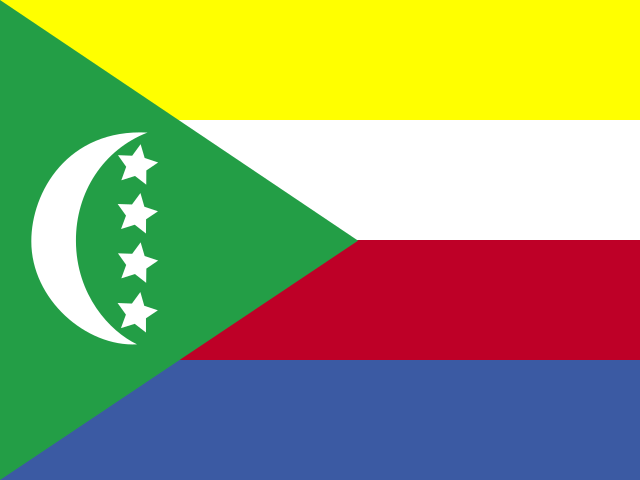
Comoros
An Indian Ocean archipelago that governs three volcanic islands and claims a fourth, the Comoros perfumes the world with ylang-ylang and grows much of the vanilla that flavours it.
WHAT THE FLAG MEANS ◢
Four horizontal stripes of yellow, white, red and blue, with a green triangle at the hoist bearing a white crescent and four white stars. The constitution describes the design without assigning meanings; the stripes and stars are conventionally read as the four islands - Mwali (Moheli), Maore (Mayotte), Ndzuwani (Anjouan) and Ngazidja (Grande Comore) - and the crescent and green as Islam. Mayotte is administered by France and claimed by the Comoros.
Comoros FACTS ◢
| Capital | Moroni |
|---|---|
| Continent | Africa |
| Population | 882,847 (2025) |
| Area | 1,861 km² |
| Population density | 474/km² |
| Currency | Comorian franc (KMF) |
| Official languages | Arabic, Comorian, French |
| Calling code | +269 |
| Internet TLD | .km |
| Time zone | UTC+03:00 |
| Drives on the | Right |
| ISO codes | KM / COM |
DID YOU KNOW? ◢
- It's one of the world's leading producers of ylang-ylang, a flower prized by the perfume industry.
- Mount Karthala, on the main island, is one of the world's most active volcanoes.
- It's among the few nations to sit across both the African Union and the Arab League.
- The rare coelacanth, a fish once thought extinct for millions of years, was rediscovered in its waters.
Comoros QUICK ANSWERS ◢
What is the capital of the Comoros?
The capital of the Comoros is Moroni.
What is the population of the Comoros?
The Comoros had a population of 882,847 in 2025.
What currency does the Comoros use?
The Comoros uses the Comorian franc (KMF).
What languages are spoken in the Comoros?
The official languages of the Comoros are Arabic, Comorian and French.
Think you know your flags? Play Flag Daily → · Browse all countries →
MORE ON THE FLAG ◢
The flag of the Union of the Comoros carries four horizontal stripes and four white stars, and the count is doing work. Comorian law names four islands as national territory. Three are governed from Moroni. The fourth is Maoré in Comorian and Mayotte in French, and it has been a French department since 2011.
So the flag is a claim as much as a design, and the constitution says so in plain words. Its preamble commits the country to "faire du retour de l'Ile de Mayotte dans son ensemble naturel, une priorité nationale": to make the return of the Island of Mayotte to its natural whole a national priority.
What the constitution never does is say what any of it means. Article 9 describes the stripes, the triangle, the crescent and the stars in careful detail, and assigns not one of them a symbolism.
Key Takeaways
- Article 9 of the constitution in force describes the flag element by element and gives no element a meaning.
- Every Comorian constitutional text since 1977 has put four stars on the flag, and not one has said what they are for.
- Article 6 names the four islands Comorian-first: Mwali (Mohéli), Maoré (Mayotte), Ndzuwani (Anjouan) and Ngazidja (Grande Comore).
- A transitional article calls France's administration of Mayotte an occupation. The 2009 text it replaced spoke only of the situation preventing the island from rejoining.
- Mayotte's own voters rejected independence 8,783 to 5,110 in 1974 and backed becoming a French department 41,160 to 2,055 in 2009.
| The claim | Where it is written | What it actually establishes |
|---|---|---|
| Four stripes, yellow to blue top down | Constitution art. 9, 2018 wording | The geometry, and nothing about meaning |
| Four white stars along a crescent | Every constitution since 1977 | The count has never changed |
| Four islands are national territory | Constitution art. 6, and the preamble | Mayotte is claimed in the text itself |
| Mayotte is a French department | French decision of 29 March 2009, created 31 March 2011 | The claim is not currently effective |
What does Comorian law say about the Comoros flag?
Article 9 of the constitution of 23 December 2001, as revised in 2009, 2013 and 2018, makes the flag an instrument of sovereignty. With the seals and the anthem it is one of "les symboles de l'Union des Comores et de la souveraineté nationale". Then it describes the thing:
"Le drapeau national est composé de quatre bandes horizontales de largeur égale, superposées, disposées dans le sens de la longueur, de couleur, jaune, blanche, rouge et bleue, en partant du haut vers le bas. Un triangle isocèle vert prend appui sur le coté [sic] de la hampe. Un croissant blanc y figure, quatre étoiles blanches alignées d'un bout à l'autre du croissant."
Four horizontal bands of equal width, superposed and arranged lengthwise, yellow, white, red and blue from the top down. A green isosceles triangle rests on the flagpole side, bearing a white crescent and four white stars aligned from one end of the crescent to the other.
That is the whole provision. It fixes the stripe order, the equal widths, the triangle's placement and the stars' arrangement, and says nothing about what any of them stand for. The same article hands the seal of the state to ordinary legislation and does not do the same for the flag, so there is no implementing statute to look in either.
Do the Comoros flag's stripes stand for the four islands?
Almost every account of this flag says so, and the constitution does not.
The four islands appear three articles earlier. Article 6 says the territory of the Union is composed of "des îles et îlots de Mwali (Mohéli), Maoré (Mayotte), Ndzuwani (Anjouan) et Ngazidja (Grande Comore)", each in Comorian with the French name in brackets. That list runs in the same order as the stripes run down the flag, yellow to blue, and the parallel is the whole basis of the popular reading.
It is a reading, though, not an assignment. Nothing in Article 6 mentions the flag, and nothing in Article 9 mentions the islands. The Presidency's own state-symbols gallery gives the mapping no words either: it publishes the national flag beside the four island flags and captions them rather than explaining them.
Two of those island flags do line up with the stripes in a way that is hard to dismiss, and they do it by colour rather than by the point-counts that sort the stars on Australia's flag. Ngazidja's, the largest island and the one Moroni sits on, is deep blue with a white crescent and four white stars. Ndzuwani's is the same design in red. Blue and red are the fourth and third stripes, which is about as close as the official record comes to confirming what everybody assumes.
Why is Mayotte on the flag of a country that does not govern it?
Because Comorian law treats the island as national territory that is temporarily out of reach, and says so three times over.
Article 6 lists Maoré among the islands and islets making up the Union. Article 7 forbids the state from parting with any of them: "L'État ne peut aliéner aucune parcelle du territoire national" - it may not alienate any parcel of the national territory. And the transitional provisions leave a chair empty. Article 122 reads: "Les Institutions de Maoré seront mises en place dès que prendra fin l'occupation de cette île." The institutions of Maoré will be established as soon as the occupation of this island comes to an end.
The claim is older than the flag it now sits on. The Loi fondamentale of 23 April 1977 declared the archipelago "un et indivisible", one and indivisible, and listed four islands with Maoré at the head, spelled Mahoré in that text. The 1996 constitution listed the same four as autonomous territorial entities, again with Maoré first.
What changed when the flag article was rewritten in 2018?
Two things, and the second is easy to miss.
Until the revision approved by referendum on 30 July 2018, the flag lived in Article 1 beside the anthem and the motto, in one crowded sentence: "L'emblème national est jaune, blanc, rouge, bleu, un croissant blanc tourné vers la droite et 4 étoiles blanches alignées d'un bout à l'autre du croissant dans un triangle isocèle en fond vert." That names the four colours without saying they are stripes, which way up they go, or how wide they are. For more than sixteen years the constitution described its own emblem less exactly than a flag catalogue would. The 2018 text supplied the geometry and dropped the one detail the old wording had: that the crescent is turned to the right.
The other change is in the transitional article. The 2009 text put it diplomatically, promising institutions for Maoré within six months of the day "où prendra fin la situation qui empêche cette île de rejoindre effectivement l'Union des Comores", when the situation preventing this island from effectively rejoining the Union comes to an end. The 2018 wording drops both the circumlocution and the deadline and calls it an occupation. The same revision put Mayotte's return into the preamble, which the 2001 and 2009 preambles never mentioned.
What does France say, and what does the UN say?
Mayotte's own electorate has answered the question more than once, and always the same way.
The first answer came with independence itself. On 22 December 1974 the islands voted for independence in a consultation organised by French law 74-965 of 23 November 1974, and the archipelago-wide result was 154,184 for to 8,853 against. The Mayotte column of the same count ran the other way: 5,110 for, 8,783 against.
That column mattered because the ballots were read island by island. Paris had passed law 75-560 of 3 July 1975 subordinating independence to a constitution that "devra être approuvée, île par île", one that must be approved island by island. When the Comorian chamber of deputies declared independence on 6 July 1975, France recognised the three islands where the Yes vote had won and organised a fresh consultation in Mayotte.
Four more consultations followed in Mayotte between 1975 and 2009, and France reads all of them as consent. The French Cour des comptes, auditing the last of them in 2016, notes that departmentalisation "a été approuvée par 95,2 % des suffrages exprimés lors de la consultation des électeurs de Mayotte organisée le 29 mars 2009", and that the Department of Mayotte was created on 31 March 2011. The official proclamation of that result records 41,160 votes for and 2,055 against, from 43,831 ballots on a roll of 71,420.
The United Nations General Assembly reads the archipelago's total instead, in resolution 31/4 of 21 October 1976. Its operative paragraph opens "Condemns and considers null and void the referendums of 8 February and 11 April 1976 organized in the Comorian island of Mayotte by the Government of France", reasoning that the archipelago had voted as a whole in December 1974 for independence "in conditions of political unity and territorial integrity". It calls the arrangement "the occupation by France of the Comorian island of Mayotte".
So the dispute is not two sets of ballots. It is one count read at two scales. France reads Mayotte's column; the Assembly reads the archipelago's total, and the phrase "political unity and territorial integrity" is precisely a rejection of counting island by island. The flag adjudicates nothing. It counts to four. Worth remembering the next time France and the Comoros turn up in the same round of a daily flag game.
Does the crescent on the Comoros flag stand for Islam?
Nothing in Comorian constitutional law says it does, though the surrounding text makes the association hard to resist.
The crescent and the four stars have survived every redesign since 1977. The 1977 text put them in white on a red field over a green lower third, the stars arranged "en losange", in a lozenge. The 1978 constitution reduced the flag to plain green "frappé au centre d'un croissant et de quatre étoiles de couleur blanche", charged at the centre with a crescent and four white stars. The 1996 version kept that, added the name of Allah above and the name of Muhammad below, and closed with "Les autres caractéristiques du drapeau sont fixées par la loi", leaving the rest of the design to ordinary legislation. The 1999 Constitutional Charter carried the existing emblems forward unchanged.
So the 1996 flag bore an explicit religious inscription, and even that text did not say the crescent meant anything. The current preamble commits the country to "une seule religion (Islam Sunnite)", a single religion, Sunni Islam, and the 2001 preamble spoke of drawing from Islam the permanent inspiration of the rules governing the Union. Read together, the conventional gloss looks reasonable. It is still a gloss. For the version of this puzzle with no flag to lean on, three clues and three guesses works the other way round.
Frequently asked questions
What do the four stars on the Comoros flag mean?
They are universally read as the four islands of the archipelago, but no Comorian constitution has ever said so. Article 9 of the constitution in force describes four white stars aligned along a white crescent and assigns them no meaning, and neither did the flag provisions of 1977, 1978, 1996, 2001 or 2009. The reading comes from Article 6, which lists exactly four islands as national territory.
Which island does each stripe on the Comoros flag stand for?
The usual mapping runs yellow for Mwali (Mohéli), white for Maoré (Mayotte), red for Ndzuwani (Anjouan) and blue for Ngazidja (Grande Comore), following the order in which Article 6 of the constitution lists the islands. That article never mentions the flag, so the pairing is inferred from the matching order rather than stated anywhere in law.
Why does the Comoros flag include Mayotte?
Because Comorian law treats Mayotte, or Maoré, as national territory under foreign administration. Article 6 lists it among the islands and islets making up the Union, the preamble makes its return a national priority, and Article 122 promises it institutions as soon as what the text calls the occupation of the island comes to an end. France governs Mayotte as a department, formally created on 31 March 2011 after a local vote in 2009.
What does the green on the Comoros flag mean?
No Comorian constitutional text says. The current Article 9 records only that a green isosceles triangle rests against the flagpole side, and the 1996 constitution described a green flag bearing the names of Allah and Muhammad without explaining the colour. The association is conventional, and what most accounts lean on is the preamble, which names Sunni Islam as the country's single religion.
When was the current Comoros flag adopted?
The four-stripe design entered law with the constitution creating the Union of the Comoros, approved by referendum on 23 December 2001, whose first article named the emblem's four colours, the crescent and the four stars. Flag references frequently give 7 January 2002 instead. No Comorian constitutional text carries that date, and none records a promulgation instrument for the 2001 constitution at all, where the 2009 revision is expressly promulgated by decree 09-066/PR of 23 May 2009. The precise stripe geometry was written down only in the revision approved on 30 July 2018.
Sources
- Cour suprême de l'Union des Comores, Constitution de l'Union des Comores du 23 décembre 2001, révisée en 2009, 2013 et 2018 (PDF, via ILO NATLEX) - preamble and arts. 6, 7, 9, 122 - retrieved 12 August 2026.
- Présidence de l'Union des Comores, Symboles de l'Etat - national flag, seal and the four island flags - retrieved 12 August 2026.
- Digithèque MJP, Université de Perpignan, Union des Comores, Constitution 2001 - preamble and art. 1 - retrieved 12 August 2026.
- Digithèque MJP, Université de Perpignan, Comores, Constitution 2009 - preamble, arts. 1 and 44, and the promulgation note - retrieved 12 August 2026.
- Digithèque MJP, Université de Perpignan, earlier Comorian flag provisions: Loi fondamentale du 23 avril 1977 arts. 1 and 3, Constitution du 1er octobre 1978 art. 2, Constitution du 20 octobre 1996 arts. 1 and 2, Charte constitutionnelle du 6 mai 1999 art. 1 - retrieved 12 August 2026.
- Digithèque MJP, Université de Perpignan, Comores, référendum constitutionnel du 30 juillet 2018 - referendum question and result - retrieved 12 August 2026.
- United Nations General Assembly, resolution 31/4, Question of the Comorian island of Mayotte, adopted 21 October 1976, at p. 10 of Resolutions adopted by the General Assembly at its thirty-first session, 31/1 to 31/39 (PDF; the volume is filed under its closing resolution number) - retrieved 12 August 2026.
- Digithèque MJP, Université de Perpignan, Consultation sur l'accession des Comores à l'indépendance, 22 décembre 1974 - results for the archipelago and for Mayotte, and the terms of French laws 74-965 of 23 November 1974 and 75-560 of 3 July 1975 - retrieved 12 August 2026.
- Légifrance, Décision du 29 mars 2009 proclamant les résultats de la consultation des électeurs de Mayotte du 29 mars 2009 - retrieved 12 August 2026.
- Cour des comptes (France), La départementalisation de Mayotte: une réforme mal préparée (PDF synthesis, January 2016) - retrieved 12 August 2026.
PLAY ANOTHER →
Five questions a day. Everyone gets the same five.
FIVE QUESTIONSDAILYDaily CryptogramOne quote, one scrambled alphabet. Crack it before tomorrow.
CRACK THE QUOTEDAILYOn This DayOne thing that happened today in history. Every day, a new one.
TODAY IN HISTORYDAILYDaily CodeA short message, hidden in a different cipher every day.
ONE CIPHER A DAY