
Sierra Leone
A West African nation on the Atlantic coast, Sierra Leone takes its name from Portuguese for 'lion mountains', and its capital Freetown was founded as a home for formerly enslaved people.
WHAT THE FLAG MEANS ◢
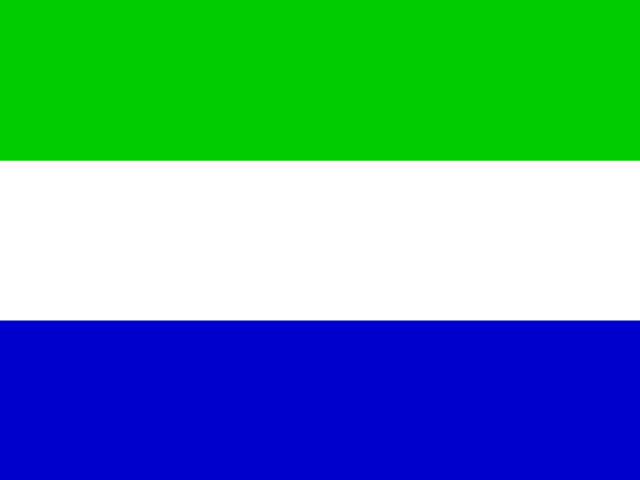
Three horizontal bands of green, white and blue. Section 3 of the constitution declares the flag and describes it as exactly that, three horizontal stripes from top to bottom, and fixes the normal size for official use at nine units across to six units down; it assigns the colours no meaning. They are conventionally read as green for the resources of the country and its people, notably agriculture and the mountains, white for unity and justice, and blue for the aspiration to contribute to world peace through the natural harbour at Freetown.
Source: sierra-leone.org · constituteproject.org · britannica.com · parliament.gov.sl · thegazette.co.uk · checked 2026-08-27
Sierra Leone FACTS ◢
| Capital | Freetown |
|---|---|
| Continent | Africa |
| Population | 8,819,794 (2025) |
| Area | 71,740 km² |
| Population density | 123/km² |
| Currency | Leone (SLE) |
| Official language | English |
| Calling code | +232 |
| Internet TLD | .sl |
| Time zone | UTC±00:00 |
| Drives on the | Right |
| ISO codes | SL / SLE |
DID YOU KNOW? ◢
- Its name comes from the Portuguese 'Serra Leoa', meaning 'lion mountains', a nod to the hills above Freetown.
- Freetown was founded in the late 1700s as a settlement for formerly enslaved people.
- One of the largest natural harbours in the world lies at Freetown, on the estuary of the Sierra Leone River.
- Tiwai Island is a wildlife sanctuary sheltering one of the highest concentrations of primate species anywhere.
Sierra Leone QUICK ANSWERS ◢
What is the capital of Sierra Leone?
The capital of Sierra Leone is Freetown.
What is the population of Sierra Leone?
Sierra Leone had a population of 8,819,794 in 2025.
What currency does Sierra Leone use?
Sierra Leone uses the Leone (SLE).
What languages are spoken in Sierra Leone?
The official language of Sierra Leone is English.
Think you know your flags? Play Flag Daily → · Browse all countries →
MORE ON THE FLAG ◢
Ask what the Sierra Leone flag means and the answer comes back in the same three parts: green for agriculture and the mountains, white for unity and justice, blue for the natural harbour at Freetown and the hope of contributing to world peace.
None of that is in Sierra Leonean law. The country's constitution declares the flag, describes it in one sentence and fixes the proportion it should be flown at, and then says nothing at all about what the colours stand for. The reading has an author, and he was neither the government nor a Sierra Leonean.
The whole of the law describing the flag runs to seventy words, and it is worth setting beside the meaning it never gives.
Key Takeaways
- Section 3 of the Constitution of Sierra Leone, 1991 declares the flag, gives its design and sets its normal size for official use at nine units across to six units down. It assigns the colours no meaning.
- Encyclopaedia Britannica's reading of the three colours carries the byline of Whitney Smith, whose bio line there reads Former Director, Flag Research Center, Winchester, Massachusetts.
- Neither of the two 1961 independence instruments mentions a flag, an ensign, arms or a seal. The earliest official document found that names the flag at all is a British Royal Warrant of 10 April 1961 creating an independence medal, whose ribbon takes its green, white and blue "in the colours of the Sierra Leone national flag".
- Section 3 of the Constitution of Sierra Leone, 1978 already declared the flag in the same terms, thirteen years before the current constitution.
- Beyond the design and that proportion the constitution fixes nothing: no shade of any colour, and no statement anywhere that the flag's three stripes are equal in width.
| Instrument | Date | What it says about the flag |
|---|---|---|
| Sierra Leone Independence Act 1961 (UK) | 1961 | Nothing. The word flag does not appear in it |
| Sierra Leone (Constitution) Order in Council, 1961 (UK) | in force immediately before 27 April 1961 | Nothing. No flag, ensign, arms or seal in 61 pages |
| Royal Warrant instituting the Sierra Leone Independence Medal | given 10 April 1961 | Names the ribbon green, white and blue, of equal width, in the colours of the national flag |
| Constitution of Sierra Leone, 1978, s. 3 | 14 June 1978 | Declares the flag, gives the design and the proportion, assigns no meaning |
| Constitution of Sierra Leone, 1991, s. 3 | 1 October 1991 | The same, in almost the same words |
Who assigns Sierra Leone's flag colours their meanings?
A named individual, in a reference work, and not the Sierra Leonean state.
Encyclopaedia Britannica's article on the flag of Sierra Leone is written by Whitney Smith, the American vexillologist whose bio line there reads "Former Director, Flag Research Center, Winchester, Massachusetts". His account of the three stripes reads: "Its three horizontal stripes stood, respectively, for the resources of the country and its people, notably agriculture and the mountains (green); unity and justice (white); and the aspiration to contribute to world peace, especially through the use of its unique natural harbour at Freetown (blue)."
It is a careful sentence, and it is worth reading closely, because it claims less than a three-item list of it would. Smith gives green the resources of the country and its people, with agriculture and the mountains as examples of those resources rather than as the whole of the meaning. His blue is one idea rather than two, since the harbour is named as the means by which Sierra Leone might contribute to world peace rather than as a second thing the colour stands for.
Smith is a specialist, and he is not the state. Britannica's page carries his byline and a Britannica fact-check, and its own structured data dates the article to 2001. Nothing in it cites a Sierra Leonean instrument, a government publication or a designer's note, and nothing in it claims to.
What section 3 of the constitution actually says
Very little, and the little it says is precise.
The Constitution of Sierra Leone, 1991 opens with three short sections on the republic and its symbols. Section 1 declares the republic. Section 2 says the "Public Seal of the Republic shall be such a device as Parliament shall prescribe". Section 3 is headed "The National Flag and National Anthem", and it splits neatly in two.
The flag half is subsection (1). Paragraph (a) says "The Flag of which the design is described in paragraph (b) hereof is hereby declared to be the National Flag of Sierra Leone." Paragraph (b) supplies that design: "The design of the Flag shall be from the top of the Flag to the bottom thereof, three horizontal stripes of green, white and blue." Paragraph (c) adds that "The normal size of the Flag for official use shall be in the proportion of nine units across to six units down."
The anthem half is subsection (2), and it is one line: "The National Anthem of the Republic shall be such as Parliament shall prescribe."
So the constitution treats its three symbols three different ways. The seal it delegates to Parliament. The anthem it delegates to Parliament. The flag it fixes itself, in the constitutional text, with a description a draughtsman could work from. The flag is the only national symbol the document takes into its own hands, and having taken it, it says nothing about meaning.
The flag turns up once more, in the duties of the citizen at section 13, which requires every citizen to "abide by this Constitution, respect its ideals and its institutions, the National Flag, the National Anthem and authorities and offices established or constituted under this Constitution or any other law". That is a duty of respect. It explains nothing.
Nothing in the 1961 independence instruments mentions a flag
Sierra Leone became independent on 27 April 1961, and the flag was hoisted that day. The two instruments that made independence happen do not mention it.
The Sierra Leone Independence Act 1961 is the United Kingdom Act that gave the country fully responsible status within the Commonwealth. The Sierra Leone (Constitution) Order in Council, 1961 was made at Windsor Castle on 14 April 1961, laid before Parliament the same day, and came into operation immediately before 27 April 1961. It runs to sixty-one printed pages and carries the independence constitution as its schedule.
Read end to end, neither text contains the word flag. Neither contains ensign, arms, seal, emblem or anthem either. Whatever authority put three stripes on a pole in Freetown that April, it was not either of those documents.
The earliest Sierra Leonean text that can be opened and that describes the flag is the Constitution of Sierra Leone, 1978, which commenced on 14 June 1978. The 1978 Act's section 3 carries the same marginal note, the same shape and the same design words, "three horizontal stripes of green, white and blue", and the same nine-to-six proportion.
Between 1961 and 1978 there is a gap this article cannot close. The 1978 Act repeals the Constitution of Sierra Leone Act, 1971 by name, and Sierra Leone became a republic on 19 April 1971, the date the United Kingdom's own Sierra Leone Republic Act 1972 uses when it settles which law continued in force. That 1971 Act is not held by SierraLII, the national legal information institute, nor by the Sierra Leone Web's archive of the laws, nor by the Internet Archive, and it could not be read here. Whether it carried a flag section, and whether anything between 1961 and 1971 did, is an open question rather than a settled one.
The one 1961 document that does mention the flag is a medal warrant
It turned up in a search for something else, and it is the earliest official document found anywhere that names the Sierra Leone national flag.
The Colonial Office's notice is dated 26 April 1961 and it was printed in the London Gazette of 28 April, announcing that the Queen had issued a Warrant under the Royal Sign Manual. The Warrant itself is older than the notice: its attestation reads "Given at Our Court at St. James's on the 10th day of April, One Thousand Nine Hundred and Sixty-one", and the name under it is Iain Macleod's, "By Her Majesty's Command".
Its subject is not the flag. The Warrant recites "the need to mark the great constitutional change which has resulted in the independence of Sierra Leone" and creates a decoration, "The Sierra Leone Independence Medal", for the armed forces and police. The reverse of the medal was to carry "the Sierra Leone Coat of Arms" inside the inscription "Sierra Leone Independence, 27th April, 1961".
The flag appears in the clause about the ribbon. The medal was to hang from a ribbon of "three vertical stripes, green, white and blue, of equal width, in the colours of the Sierra Leone national flag", with "the green stripe being worn farthest from the left shoulder".
Three things follow from that, and none of them is small.
The flag was settled before it was flown, and the Warrant fixes how long before: seventeen days. A Crown instrument dated 10 April 1961 refers to the Sierra Leone national flag as a thing that already exists, whose colours and their order can be relied on to specify a ribbon. Whatever process produced the design had finished by then.
It is also careful in a way that is easy to misread, and worth reading slowly. Its "of equal width" governs the ribbon's three vertical stripes. What the ribbon takes from the flag is the colours and their order, not their proportions, and the ribbon's stripes run vertically where the flag's run across. So the Warrant does not say the flag's own bands are equal, and neither does anything else: section 3 of the 1978 constitution and section 3 of the 1991 constitution each give the three stripes, their order and the proportion, and stop.
And it explains nothing either. A document written to specify a ribbon had every reason to say what the colours were for, and it does not. The oldest official naming of these three colours is as bare of meaning as the constitutions that came after it.
Nine units across to six units down
The proportion is the one hard number the constitution supplies, and it is written in an unusual way.
Nine across to six down reduces to three to two. Turned round into height against width it is 2 to 3, and 2 to 3 is the figure Britannica prints, calling it a width-to-length ratio. The constitution declines to reduce it, and it also declines to make it absolute: what is fixed is the "normal size of the Flag for official use", which leaves both unusual sizes and non-official use outside the rule.
What the constitution does not do is fix a colour, or say that the three bands are equal. The 1961 medal warrant says equal of its ribbon; section 3 gives the stripes, their order and the proportion, and nothing else.
There is no shade named, no colour standard cited, no Pantone or textile reference anywhere in section 3 of the 1991 constitution, and no Sierra Leonean instrument that can be opened supplies one. Green, white and blue are the whole of the specification, which means that two Sierra Leone flags flown side by side can be different greens and both be constitutionally correct.
That vagueness is more common than people expect, and it is one reason flags are harder to draw from memory than to recognise. Recognition only needs the arrangement, which is why a game like Flag Daily, where one flag a day is shown and you get three guesses at the country, is a fairer test of what you actually know than trying to reproduce a design.
What flew over Sierra Leone before 1961
A British Blue Ensign, and for most of that period a badge that was not really Sierra Leone's at all.
Britannica's account of the colonial period is blunt about it. Only the badge in the ensign carried any local symbolism, and even that was shared: "the same design was used (except for the initials of each territory displayed at the bottom) by the Gold Coast, Lagos, and Gambia colonies." The badge itself "displayed mountains in the background and an elephant and oil palm tree in the foreground." Four West African territories, one picture, four sets of initials.
A distinct emblem arrived in 1914, when Sierra Leone obtained a coat of arms of its own, also approved as a flag badge on the ensign. Smith describes it as showing the old British Union Jack, an oil palm tree, and an African saluting a vessel arriving from the high seas, with a Latin motto, "Auspice Britannia liber", which Britannica renders as "Free under the protection of Britain".
Set beside that ensign, the 1961 flag is a clearing of the field. No canton, no badge, no motto, no reference to another country, and no picture to argue about. Three stripes and nothing else. The Gold Coast, which had flown the same shared badge, is now Ghana, and its flag went the other way: a black star, centred on the middle band.
The green stripe has a subject, and the blue stripe has one idea
Two things, and both change the claim.
The first is the green. Smith's phrase is "the resources of the country and its people, notably agriculture and the mountains". Agriculture and the mountains are examples inside a wider idea, and the wider idea includes the people. Compress the clause down to its two examples and the stripe loses its subject.
The second is the blue, and this one matters more. Smith gives it one meaning, "the aspiration to contribute to world peace, especially through the use of its unique natural harbour at Freetown". The harbour is the instrument of the aspiration. Rendered as a list, harbour and peace become two separate readings sitting side by side, which is a different claim from the one the sentence makes.
An explanation with no instrument behind it survives only as wording, so wording recopied loosely stops meaning what it meant. When the only support for a reading is one author's sentence, the sentence is worth quoting rather than paraphrasing.
Does any Sierra Leonean source explain the colours?
Nothing that could be found, and the search was not a casual one.
The national anthem was checked first, because a state that leaves its colours unexplained in law sometimes explains them in a song. Sierra Leone does not. The Parliament of Sierra Leone publishes the anthem and the National Pledge together as a single document, and neither text mentions the flag or any of its colours. The anthem's nearest approach is a line of scenery, "The hills and the valleys re-echo our cry". The pledge asks a citizen to "Always work for her unity peace, freedom and prosperity", which uses two of the words the white stripe is popularly given, in a text that is not about the flag.
The government's own web estate was checked next, host by host, through the Internet Archive's index of the addresses it has captured. The national portal at gov.sl, the Parliament of Sierra Leone and State House between them list more than ninety thousand archived addresses, and not one of those addresses is the address of a national-symbols, flag or coat-of-arms page. The portal's own "Know Sierra Leone" page exists and is an empty template. State House's live search returns twenty-nine results for the word flag: twenty-three news stories and six office or programme pages, and no symbols page among them.
The legal side is as bare. SierraLII, the national legal information institute, lists no flag, seal, anthem or emblem instrument of any year, and neither does the Sierra Leone Web's index of the laws or of the colonial ordinances. Section 2 and section 3(2) of the 1991 constitution both hand a symbol to Parliament to prescribe, and no Act prescribing either the seal or the anthem surfaced in any of those indexes.
One more attribution is worth naming as unverified. A commonly repeated line has the flag designed by the College of Arms in London. No address in the College of Arms' entire Internet Archive URL index contains the word Sierra. A Gazette search across 1959 to 1963 for Sierra Leone with each of the terms arms, Armorial Ensigns and Royal Warrant returns no grant of armorial bearings and no flag notice, and the only Warrant concerning Sierra Leone that any of them turns up is the medal one. Britannica, which supplies the colour reading, names no designer at all. None of that disproves the attribution, and no web search could: the College's output is largely printed. It does mean no record of it could be opened here, and a claim repeated without a document behind it should be labelled as one.
Frequently asked questions
What do the colours of the Sierra Leone flag mean?
Encyclopaedia Britannica gives green the resources of the country and its people, notably agriculture and the mountains; white unity and justice; and blue the aspiration to contribute to world peace through the natural harbour at Freetown. That reading carries the byline of the vexillologist Whitney Smith, and no Sierra Leonean law or government publication that can be found states it.
Section 3 of the Constitution of Sierra Leone, 1991 describes the flag in full and assigns the colours nothing at all.
Does Sierra Leone's constitution say what the flag means?
No. Section 3 of the Constitution of Sierra Leone, 1991 declares the flag, gives its design as three horizontal stripes of green, white and blue from top to bottom, and sets its normal size for official use at nine units across to six units down. It stops there, and no other section of that constitution supplies a meaning.
The same was true of the Constitution of Sierra Leone, 1978, whose section 3 says it in almost the same words.
When was the Sierra Leone flag adopted?
It was hoisted at independence on 27 April 1961, and it was settled before that. Neither the Sierra Leone Independence Act 1961 nor the Sierra Leone (Constitution) Order in Council, 1961 contains the word flag, but a Royal Warrant given on 10 April 1961, creating the Sierra Leone Independence Medal, specifies the medal ribbon "in the colours of the Sierra Leone national flag" and names them green, white and blue.
The earliest Sierra Leonean legal text that can be opened and that describes the flag is the Constitution of Sierra Leone, 1978.
What are the official proportions of the Sierra Leone flag?
Nine units across to six units down, which is three to two, or 2 to 3 read down against across. That is the same statement as Britannica's width-to-length ratio of 2 to 3. Section 3 of the Constitution of Sierra Leone, 1991 states it as the normal size of the flag for official use rather than as an absolute rule, and it fixes nothing else about the flag's appearance beyond the stripes and their order.
No shade of green, white or blue is specified anywhere in Sierra Leonean law that can be opened, so no colour standard governs how the stripes are printed or woven.
Who designed the Sierra Leone flag?
The design is commonly attributed to the College of Arms in London, and no record of that attribution could be verified for this article. No address in the College's Internet Archive URL index contains the word Sierra, a Gazette search across 1959 to 1963 turns up no grant of armorial bearings and no flag notice, and Encyclopaedia Britannica's article on the flag names no designer. None of that disproves it; it means the attribution is repeated without a document behind it.
Treat the attribution as unconfirmed rather than as documented.
Sources
- Parliament of Sierra Leone, The Constitution of Sierra Leone, 1991 (Act No. 6 of 1991), sections 1, 2, 3 and 13, published in full by the Sierra Leone Web - retrieved 27 August 2026.
- Constitute Project, Sierra Leone's Constitution of 1991 with Amendments through 2013, used as a second independent rendering of section 3 - retrieved 27 August 2026.
- Parliament of Sierra Leone, The Constitution of Sierra Leone, 1978 (Act No. 12 of 1978), section 3, published by the Sierra Leone Web - retrieved 27 August 2026.
- The National Archives, Sierra Leone Independence Act 1961 (1961 c. 16), King's Printer PDF of the Act as enacted - retrieved 27 August 2026.
- The National Archives, The Sierra Leone (Constitution) Order in Council, 1961 (SI 1961/741), King's Printer PDF, 61 pages including the independence constitution - retrieved 27 August 2026.
- The London Gazette, issue 42341, 28 April 1961, pages 3164 and 3165, the Colonial Office notice of the Royal Warrant instituting the Sierra Leone Independence Medal, given 10 April 1961 - retrieved 27 August 2026.
- The National Archives, Sierra Leone Republic Act 1972 (1972 c. 1), for the date on which Sierra Leone became a republic - retrieved 27 August 2026.
- Parliament of Sierra Leone, National Anthem and National Pledge, read from the Internet Archive capture of 18 November 2016 - retrieved 27 August 2026.
- Whitney Smith, flag of Sierra Leone, Encyclopaedia Britannica. britannica.com refuses automated retrieval, so this was read from the Internet Archive capture of 14 July 2026 - retrieved 27 August 2026.
- Internet Archive, Wayback Machine CDX index, queried per host for gov.sl, parliament.gov.sl, statehouse.gov.sl and college-of-arms.gov.uk, and the source of the captures behind the Britannica and Parliament of Sierra Leone entries - retrieved 27 August 2026.
- SierraLII, Legislation of Sierra Leone, the national legal information institute's index, searched for flag, seal, anthem and emblem instruments - retrieved 27 August 2026.
- Sierra Leone Web, Laws of Sierra Leone and Colonial Ordinances, searched for the same - retrieved 27 August 2026.
PLAY ANOTHER →
One quote, one scrambled alphabet. Crack it before tomorrow.
CRACK THE QUOTEDAILYDaily TriviaFive questions a day. Everyone gets the same five.
FIVE QUESTIONSDAILYGuess the CountryThree clues, three guesses. Work out where in the world it is.
THREE CLUESDAILYDaily CodeA short message, hidden in a different cipher every day.
ONE CIPHER A DAY