
Singapore
A city, an island and a country all at once, Singapore transformed a swampy port into one of the world's richest nations - with a skyline crowned by a rooftop infinity pool and a supertree-filled garden.
WHAT THE FLAG MEANS ◢
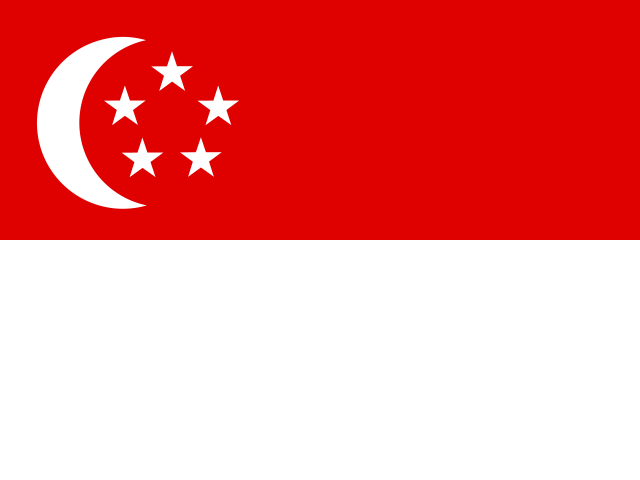
Two equal horizontal sections of red over white, with a white crescent moon beside five white stars arranged in a circle in the canton at the top left. The National Symbols Act 2022 assigns a meaning to every element in its First Schedule: red for universal fellowship and equality, white for pervading and everlasting purity and virtue, the crescent moon for a young nation on the ascendant, and the five stars for the nation's ideals of democracy, peace, progress, justice and equality.
Singapore FACTS ◢
| Capital | Singapore |
|---|---|
| Continent | Asia |
| Population | 6,111,175 (2025) |
| Area | 744 km² |
| Population density | 8,214/km² |
| Currency | Singapore dollar (SGD) |
| Official languages | English, Malay, Mandarin, Tamil |
| Calling code | +65 |
| Internet TLD | .sg |
| Time zone | UTC+08:00 |
| Drives on the | Left |
| ISO codes | SG / SGP |
DID YOU KNOW? ◢
- It's one of only a few sovereign city-states in the world, packing an entire country into a single city.
- Changi Airport features the world's tallest indoor waterfall, a seven-storey cascade called the Rain Vortex.
- It's home to the world's first night zoo, the Night Safari, open after dark.
- The national symbol, the Merlion, is a mythical creature that's half lion, half fish.
Singapore QUICK ANSWERS ◢
What is the capital of Singapore?
The capital of Singapore is Singapore.
What is the population of Singapore?
Singapore had a population of 6,111,175 in 2025.
What currency does Singapore use?
Singapore uses the Singapore dollar (SGD).
What languages are spoken in Singapore?
The official languages of Singapore are English, Malay, Mandarin and Tamil.
Think you know your flags? Play Flag Daily → · Browse all countries →
MORE ON THE FLAG ◢
Democracy, peace, progress, justice and equality: five stars, five ideals, and Singapore puts the whole list in its statute book rather than leaving it to custom.
What is easy to miss is that the statute book changed. On 1 August 2023 the National Symbols Act 2022 repealed the law that had governed the flag since 1959, and the sentence explaining the red band came out different. Where the old text read "The red colour symbolises universal brotherhood and equality of man", the new one reads "Red symbolises universal fellowship and equality". The five stars kept their five ideals word for word. The red did not keep its words.
The reason is one sentence in the Bill's own Explanatory Statement. Neither of the two Second Reading speeches the ministry published mentions it at all.
Key Takeaways
- The current instrument is the National Symbols Act 2022, First Schedule, Part 1, in force since 1 August 2023.
- The Act gives a meaning to every element: the red, the white, the crescent and the five stars.
- The red band's gloss was reworded. The Bill's Explanatory Statement says the description "is updated so as to be gender neutral".
- From 2004 until 2023 the meanings sat in subsidiary legislation, in Rules made under the 1959 Act. The 1959 Act itself never described the flag at all.
- The Constitution of the Republic of Singapore does not mention the flag anywhere.
| Element | Wording repealed in 2023 | Wording in force now |
|---|---|---|
| Red | "The red colour symbolises universal brotherhood and equality of man." | "Red symbolises universal fellowship and equality." |
| White | "The white colour signifies pervading and everlasting purity and virtue." | "White signifies pervading and everlasting purity and virtue." |
| Crescent moon | "a young nation on the ascendant" | "a young nation on the ascendant" |
| Five stars | "democracy, peace, progress, justice and equality" | "democracy, peace, progress, justice and equality" |
| Where it lived | Second Schedule to the Rules, subsidiary legislation | First Schedule to the Act, primary legislation |
What do the five stars on Singapore's flag stand for?
They stand for five ideals, and what the statute adds to any popular account of them is that it names the list itself and then stops. Paragraph 2 of Part 1 of the First Schedule to the National Symbols Act 2022 sets out the whole reading in three sentences: "Red symbolises universal fellowship and equality. White signifies pervading and everlasting purity and virtue. The crescent moon represents a young nation on the ascendant, and the 5 stars stand for the nation’s ideals of democracy, peace, progress, justice and equality."
That is the entire official gloss. There is no sixth meaning waiting somewhere else, and there is no clause qualifying any of it.
Paragraph 1 of that same Part of the Act's First Schedule handles the geometry, and it is worth reading beside the meaning for how little it fixes: "The National Flag of Singapore consists of 2 equal horizontal sections, red above white. In the canton is a white crescent moon beside 5 white stars arranged in a circle. The ratio of the width to the length is 2:3."
Section 2 of the National Symbols Act 2022 defines "canton" for the purpose, as "the top left quarter of the obverse of the flag". So the arrangement is legislated as well as the elements: the stars sit in a circle, and the flag is fixed at two units of width to three of length.
The sentence that changed, and the sentence that explains it
The National Symbols Bill was introduced and read the first time on 2 August 2022, and was read a second time and passed on 13 September 2022. Its Explanatory Statement runs through the Bill part by part, and when it reaches the First Schedule it adds a line that the rest of the paragraph does not need: "The description of the symbolism of the National Flag is updated so as to be gender neutral."
That is the whole justification on the public record, and it is enough. The phrase it replaced, "universal brotherhood and equality of man", is 1959 English. The replacement, "universal fellowship and equality", is the same idea with the two gendered words taken out.
The change was in the Bill from introduction, not added later in committee. Both the Bill as first published and the Act as passed carry "fellowship".
What makes it easy to miss is that nothing in the material the ministry published flagged it. The Minister of State's opening speech on 13 September 2022 listed the Bill's "three key changes", and the wording of the Schedule was not one of them. The closing speech, answering Mr Louis Ng, who had asked what the new power to amend the Schedules might be used for, restated that member's own observation back to him: "As Mr Ng pointed out, the National Symbols and their official meanings are well-established and widely recognised by Singaporeans". The Bill re-glossing the flag's principal colour was on the table in the same sitting.
One gap worth declaring: the full parliamentary report for 13 September 2022 was not reachable. The Singapore Parliament Reports service answers its own report endpoint with a server error for that sitting, so everything quoted from that sitting is the ministry's own published text of the two Second Reading speeches. Whether any member raised the change from the floor is therefore not something this article can say.
Singapore's 1959 Act never described the flag. The Rules under it did
The Singapore State Arms and Flag and National Anthem Ordinance, which the statute book later carried as the Singapore Arms and Flag and National Anthem Act 1959 and which this article calls the 1959 Act, was passed on 11 November 1959 and commenced on 30 November 1959. By its final revised edition, the one in force until the repeal, it had exactly two sections: a short title, and a power for the President to make rules "to prescribe the manner in which and the places and times at which the Arms and Flag of Singapore may be displayed, exhibited, flown or used".
That is all. The Act never described the flag, never named a colour, and never assigned a meaning to anything, and its legislative history lists revised editions and no amending Act, so nothing of the kind was added later either. Everything a reader would think of as the law on the flag lived in the Rules made under section 2 of it.
The ministry said as much in Parliament: "Under the SAFNA Act, the description of the National Anthem, State Crest and National Flag are all already set out in subsidiary legislation."
The version of those Rules that was revoked in 2023 dates from 2003 and commenced on 1 January 2004, and it is the Second Schedule to those Rules that carried the old description and the old gloss. The statutes register's own history of them begins there, so what any earlier set of rules said is not something that can be checked from it. So the practical effect of the 2022 Act is not only a change of words. It moved the description of Singapore's flag out of subsidiary legislation and into the Schedule of an Act of Parliament.
How much that strengthens its footing is worth pinning down, because the same Act keeps the door open. Section 13 of the National Symbols Act 2022, the provision a member questioned during the Bill's passage, lets the President amend any of that Act's Schedules by Proclamation in the Gazette, in relation to any aspect or description of a national symbol or presidential symbol. No vote is required. What the move changed is where the words live, not who can change them.
Only one thing has amended that Schedule since, and it used exactly that power. A Proclamation under section 13, gazetted on 10 October 2025, corrected one Malay word in the National Pledge. The flag's Part has not been touched.
Why Toh Chin Chye argued against red and white
The design came out of a committee, and the committee chairman spent some of his effort trying to talk the Cabinet out of the colours the flag ended up with.
The National Heritage Board's account puts then Deputy Prime Minister Dr Toh Chin Chye in charge of a committee formed in 1959 to create a flag to replace the Union Jack, "which had flown over the island for nearly 140 years from 1819 to 1959". To avoid a clash with an existing state, he went through the flags of the countries then represented at the United Nations and put several options to Cabinet.
His objection is recorded in his own words, in an oral history interview held by the National Archives of Singapore and quoted by the Heritage Board: "I had produced prototypes with different colours for the Cabinet to decide. I explained to them why we cannot use red and white, white and red. White above red is the flag of Poland. Red above white is the flag of Indonesia."
He lost that argument, and the resemblance he predicted is real. Indonesia's flag is red above white in the same two horizontal bands, and Poland's flag is the same pair inverted. What separates Singapore's from both is the canton. The crescent and five stars are the whole distinguishing mark, which is what makes this one fair game for a guessing round such as Flag Daily, where you get one flag a day and three guesses at the country.
The Legislative Assembly endorsed the red and white flag on 18 November 1959, together with the State Crest and the National Anthem. It was unveiled on 3 December 1959 at the installation of Encik Yusof bin Ishak as the first Malayan-born Yang di-Pertuan Negara, in the City Hall Chambers, and shown publicly for the first time on the City Hall steps.
What the law does not say: no point count, no Pantone, no constitutional mention
Three absences are worth naming, because all three get filled in by sources that are not the law.
The stars have no legislated point count. The Schedule says "5 white stars arranged in a circle" and stops. Nothing in the Act or the Regulations fixes how many points each star has.
The Act sets no colour standard. It names red and white and gives no shade, no reference and no printing value. The Pantone numbers that circulate are real but they are guidance, not statute: the Heritage Board's own page says the flag "must be produced in its true colours (Pantone 032 and Pantone White) and proportions, in the ratio of 2 (width): 3 (length)", and the ratio half of that sentence is in the Schedule while the Pantone half is not. Searching the full text of the National Symbols Regulations 2023 returns no Pantone value anywhere.
The Constitution says nothing. A full-text search of the Constitution of the Republic of Singapore for the word "flag" returns no hits at all, and searches for the anthem, the crest and national symbols return nothing either. The Republic of Singapore Independence Act 1965 does not mention the flag either. The frequent statement that the flag was adopted as the national flag on independence in 1965 is not backed by any provision in either of those two instruments. What happened instead is that the 1959 legislation carried on.
The crescent and stars are reused across the National Symbols Act
The flag is the parent design for several of the other symbols in the same Act, and the Act says so rather than leaving it to be inferred.
The National Coat of Arms, in Part 4 of the Act's First Schedule, is "a shield emblazoned with a white crescent moon and 5 white stars against a red background", supported by a lion and a tiger over a banner reading "Majulah Singapura". The Act then states the derivation directly: "The colours and elements of the shield are based on the National Flag of Singapore." The lion represents Singapore, the tiger its historical links with Malaysia.
The Presidential Standard is even more explicit. Part 1 of the Act's Second Schedule says it "is based on the canton of the National Flag of Singapore", at the same 2:3 ratio. The President's flag is the national flag's top left quarter, enlarged.
The Presidential Coat of Arms takes them a third time. Part 2 of the same Schedule sets a shield "crowned by a crescent moon and 5 stars, and encircled by an orchid wreath", and says of it that "The red and white colours, and the crescent moon and 5 stars, are based on the National Flag of Singapore."
The two seals inherit them in turn. The public seal "consists of the National Coat of Arms of Singapore encircled by the words" naming the Republic, and the seal of the President is built the same way on the Presidential Coat of Arms. So the crescent and the five stars run through most of what the Act declares, and only in the flag's own Part does the Act say what they mean.
The state's own flag page still carries the repealed wording
Singapore's public-facing guidance on the flag is the National Heritage Board page that the ministry's 2023 press release points readers to. It is a careful page. It names the governing law correctly, saying the use and display of the flag "is governed by the National Symbols Act 2022 and Regulations, which came into effect on 1 August 2023".
Its meaning paragraph has not caught up. It still reads "Red stands for universal brotherhood and equality of man". That is not quite the sentence the Act replaced, which was the Rules' "The red colour symbolises universal brotherhood and equality of man". The page has taken the shorter subject of the Act now in force and kept "brotherhood and equality of man", the words Parliament removed on the date the same page names further down, under its guidelines heading.
The same page also carries two different lists of the five ideals, in two different registers. Its history section, describing the ideas Dr Toh had for the design in 1959, says the five stars "would stand for the five core principles of democracy, justice, peace, prosperity and equality". Its meaning section, describing the flag as it is, lists "democracy, peace, progress, justice and equality". The Schedule says progress. Where a heritage page and a Schedule differ, the Schedule is the flag's meaning and the page is an account of it.
What 2023 changed for anyone who actually flies the flag
The rewritten gloss travelled with a much larger loosening, and with heavier penalties. Both came out of a review the Government ran before the Bill: the ministry began engaging citizens on the framework governing the National Symbols in September 2020, over a two-year period, and the Citizens' Workgroup for National Symbols was convened in 2021. The Minister of State told Parliament the feedback "called for greater flexibility in the use of the National Symbols, as well as greater clarity on appropriate use and higher safeguards against misuse".
Under the National Symbols Regulations 2023, an image of the flag can be applied to attire for non-commercial purposes all year round without the minister's approval. During the National Day celebrations period from 1 July to 30 September, the flag can be displayed on a building with no flagpole and no night illumination, put on a motor vehicle other than a hearse, and used commercially or decoratively without approval. The minister can also allow that flagpole-free display outside the National Day period, which under the old Rules would have required the legislation itself to be amended.
None of that is a licence to be disrespectful. The attire, commercial and decorative reliefs each carry the condition on their face that the use "does not give rise to disrespect to the National Flag", and regulation 5 makes it a standalone offence to knowingly do an act in relation to the flag where "the act is disrespectful to the National Flag", with a fine of up to $30,000, up to six months' imprisonment, or both.
The safeguards moved the other way at the same time. Regulation 15(1) states that "A person must not knowingly produce or display a flag that distorts or otherwise modifies the design of the National Flag", with a fine of up to $10,000, up to six months' imprisonment, or both. The comparison worth making is ceiling to ceiling. Section 2 of the 1959 Act let its Rules prescribe penalties "which penalties shall not exceed a fine of $1,000", and that Act's legislative history lists revised editions and no amending Act. Section 14(2)(d) of the 2022 Act sets the equivalent ceiling for its regulations at "a fine of $30,000 or imprisonment for a term not exceeding 6 months or both".
Frequently asked questions
What do the five stars on the Singapore flag mean?
The five stars stand for five ideals named in law: democracy, peace, progress, justice and equality. The list is in paragraph 2 of Part 1 of the First Schedule to the National Symbols Act 2022, which says the "5 stars stand for the nation’s ideals of democracy, peace, progress, justice and equality". That wording was carried over unchanged from the Rules the Act replaced in 2023.
What does the crescent moon on Singapore's flag represent?
A young nation on the ascendant. That is the whole of what the National Symbols Act 2022 assigns it, in the same paragraph that glosses the colours and the stars, and the phrase survived the 2023 rewrite word for word. The Act does not connect the crescent to any religion, and no Singaporean instrument opened for this article does.
Did Singapore change the meaning of its flag?
Singapore changed what one element means. The description of the red band moved from "universal brotherhood and equality of man" to "universal fellowship and equality" when the National Symbols Act 2022 came into force on 1 August 2023, and the Bill's Explanatory Statement says the description "is updated so as to be gender neutral". Nothing that the white band, the crescent or the five stars stand for changed: the crescent and star clauses are word for word what the repealed Rules said, and the white clause opens "White signifies" where the Rules opened "The white colour signifies", with the rest of it untouched.
Why does Singapore's flag look like Indonesia's?
Both are two equal horizontal bands of red above white. Toh Chin Chye, who chaired the 1959 design committee, raised exactly that objection to Cabinet and named both Indonesia and Poland. The Legislative Assembly endorsed the red and white design on 18 November 1959 regardless. The difference is the canton: Singapore adds a white crescent moon and five white stars in the top left quarter, and Indonesia's flag has no device on it at all.
What colours and proportions is the Singapore flag officially?
The National Symbols Act 2022 fixes the proportions at a width to length ratio of 2:3 and names the colours only as red and white, with no shade reference. The Pantone 032 value widely quoted comes from the National Heritage Board's guidelines on use, not from the Act or the National Symbols Regulations 2023, neither of which specifies any colour standard.
Sources
- Attorney-General's Chambers of Singapore, Singapore Statutes Online, National Symbols Act 2022, First and Second Schedules - retrieved 26 August 2026.
- Attorney-General's Chambers of Singapore, Singapore Statutes Online, National Symbols Bill (Bill 21 of 2022), Explanatory Statement - retrieved 26 August 2026.
- Attorney-General's Chambers of Singapore, Singapore Statutes Online, Singapore Arms and Flag and National Anthem Rules (Cap. 296, R 1), 2004 Ed., Second Schedule - retrieved 26 August 2026.
- Attorney-General's Chambers of Singapore, Singapore Statutes Online, Singapore Arms and Flag and National Anthem Act 1959, 2020 Revised Edition - retrieved 26 August 2026.
- Attorney-General's Chambers of Singapore, Singapore Statutes Online, National Symbols Regulations 2023 (S 536/2023) - retrieved 26 August 2026.
- Attorney-General's Chambers of Singapore, Singapore Statutes Online, Constitution of the Republic of Singapore - retrieved 26 August 2026.
- Attorney-General's Chambers of Singapore, Singapore Statutes Online, Republic of Singapore Independence Act 1965 - retrieved 26 August 2026.
- Ministry of Culture, Community and Youth, Second Reading of National Symbols Bill (Opening Speech) - retrieved 26 August 2026.
- Ministry of Culture, Community and Youth, Second Reading of National Symbols Bill (Closing Speech) - retrieved 26 August 2026.
- National Heritage Board, National Flag - retrieved 26 August 2026.
- National Heritage Board, Roots, Singapore flag, Singapore, 1960-1980 - retrieved 26 August 2026.
PLAY ANOTHER →
One thing that happened today in history. Every day, a new one.
TODAY IN HISTORYDAILYDaily CryptogramOne quote, one scrambled alphabet. Crack it before tomorrow.
CRACK THE QUOTEDAILYDaily CodeA short message, hidden in a different cipher every day.
ONE CIPHER A DAYDAILYGuess the CountryThree clues, three guesses. Work out where in the world it is.
THREE CLUES