
Solomon Islands
A scatter of nearly a thousand islands in the South Pacific, the Solomon Islands trade in rainforest, reefs and some of the most consequential naval history of World War II.
WHAT THE FLAG MEANS ◢
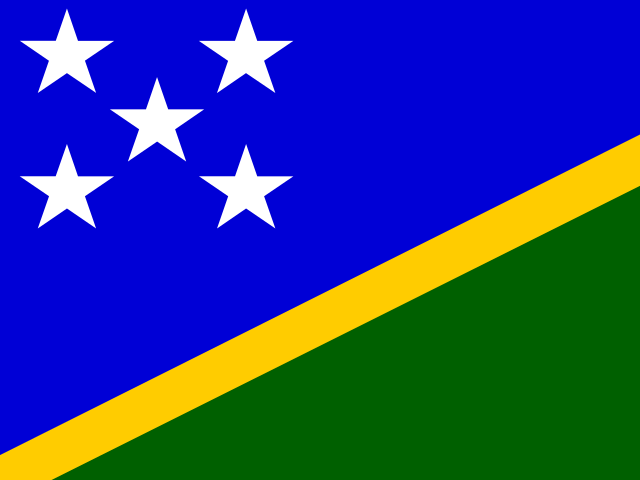
A thin yellow diagonal stripe divides the flag into an upper blue triangle bearing five white stars and a lower green triangle. The constitution has no flag provision. The blue is conventionally read for the water, the green for the land and the yellow for the sun; the five stars originally stood for the five administrative districts of 1977, and the country now has nine provinces, so the count no longer tracks them.
Solomon Islands FACTS ◢
| Capital | Honiara |
|---|---|
| Continent | Insular Oceania |
| Population | 838,645 (2025) |
| Area | 28,400 km² |
| Population density | 30/km² |
| Currency | Solomon Islands dollar (SBD) |
| Official language | English |
| Calling code | +677 |
| Internet TLD | .sb |
| Time zone | UTC+11:00 |
| Drives on the | Left |
| ISO codes | SB / SLB |
DID YOU KNOW? ◢
- The nation is made up of roughly 1,000 islands spread across the Pacific.
- Guadalcanal was the site of a pivotal WWII campaign, and the waters off it are nicknamed 'Ironbottom Sound' for the ships sunk there.
- Most people speak Solomon Islands Pijin as a common tongue, though around 70 distinct languages are spoken across the archipelago.
- Some communities historically used shell money, strings of polished shells, as currency.
Solomon Islands QUICK ANSWERS ◢
What is the capital of the Solomon Islands?
The capital of the Solomon Islands is Honiara.
What is the population of the Solomon Islands?
The Solomon Islands had a population of 838,645 in 2025.
What currency does the Solomon Islands use?
The Solomon Islands uses the Solomon Islands dollar (SBD).
What languages are spoken in the Solomon Islands?
The official language of the Solomon Islands is English.
Think you know your flags? Play Flag Daily → · Browse all countries →
MORE ON THE FLAG ◢
A question about a national flag usually has an instrument behind it somewhere. A constitution describes the thing, or a statute does, or a regulation fixes the colours to a printing standard.
Solomon Islands appears to have none of that for its flag, and the reason it is worth saying carefully is that it has something for its arms. The Armorial Bearings Act came into force on 6 June 1978, a month before independence. It protects the coat of arms, making it an offence to display or sell a copy without the Minister's written permission, and it never uses the word flag.
What it does not do is describe the arms. Its section 2 defines them as the Armorial Bearings "as published by the Minister in the Gazette after the commencement of this Act", so even the symbol Solomon Islands did legislate for is drawn somewhere the statute book does not reach. A reader who wants to know what the five stars stand for gets nothing from either. The law supplies a number instead, in the statute that enumerates the provinces, and that number is nine.
Key Takeaways
- The word flag does not appear in the Constitution of Solomon Islands, checked in two independent copies.
- The one national-symbols Act in the consolidated statute book protects the coat of arms and does not describe it.
- The Provincial Government Act's schedule names nine provinces.
- Nothing found in Solomon Islands law fixes the flag's colours, proportions or star count.
- What the law does fix nearby is the date of Independence Day, 7 July.
| Instrument | Where it was checked | What it says about the flag |
|---|---|---|
| Constitution of Solomon Islands | Consolidated text, PacLII, and a Comparative Constitutions Project copy | Nothing; zero occurrences of the word |
| Consolidated statute book | All 22 alphabetical index pages, 188 Act titles | Nothing; the only national-symbols Act is about the arms |
| Armorial Bearings Act 1978 | Read in full | Nothing; zero occurrences of the word |
| Sessional legislation | The F and N index pages of 447 documents | No flag Act under either letter |
| Provincial Government Act | The schedule headed PROVINCIAL BOUNDARIES | Nothing about the flag; nine provinces |
| Public Holidays Act | The schedule | Nothing about the flag; Independence Day is 7 July |
The constitution never uses the word
The Constitution of Solomon Islands came into force at independence in 1978 and is the country's founding instrument. Read the whole of it and the word flag does not appear once.
Nor does emblem, nor anthem, nor national symbol. That is not a case of a provision being thin, or of a symbolism clause being left out of an otherwise descriptive article. There is no article at all. The subject is simply absent from the document.
To be sure the absence was in the instrument rather than in one copy of it, the check was run twice, against two independently produced texts: the consolidated version published by the Pacific Islands Legal Information Institute, which runs to over 220,000 characters, and the copy distributed by the Comparative Constitutions Project. Both return nothing.
The institute's own site refuses connections from this machine, so its texts were read from Internet Archive captures taken in January and February 2025. The Sources block below gives the capture date for each.
A constitution leaving the flag to statute is an ordinary arrangement, and on its own it would say nothing. It is the next step that matters.
The coat of arms has a statute and no flag statute was found
The Pacific Islands Legal Information Institute publishes the consolidated legislation of Solomon Islands, describing it as reprints authorised by the Attorney General. Its index says the database holds 224 documents, and it offers an alphabetical page for every letter from A to W except K, which is unlinked, as are X, Y and Z. That is twenty-two pages.
Those twenty-two were retrieved and read, every one of them. Between them they name 188 Acts. Searching those titles for flag, armorial, arms, ensign, standard, crest, badge, seal, emblem, symbol, anthem, honour, insignia and coat returns exactly two: the Armorial Bearings Act and the Firearms and Ammunition Act. Not one title contains the word flag.
The Armorial Bearings Act is the one that matters, and it is short. Its long title is "AN ACT TO DECLARE THE ARMORIAL BEARINGS OF SOLOMON ISLANDS, TO PROHIBIT THE UNAUTHORISED USE THEREOF AND FOR MATTERS CONNECTED THEREWITH AND INCIDENTAL THERETO". It is Act 11 of 1978, and the text read here is Chapter 136 of the 1996 Edition of the Laws of Solomon Islands, which gives its commencement as 6 June 1978.
Despite the long title, the Act declares nothing. Section 2 says that "the Armorial Bearings" means the Armorial Bearings of Solomon Islands "as published by the Minister in the Gazette after the commencement of this Act". There is no blazon in it and no schedule. The text retrieved is an extraction rather than the original PDF the same page offers, so it cannot rule out an image, but a definition pointing at a Gazette notice is not the drafting of an Act that carries its own picture. The Act protects a design it points at rather than one it sets out. The Gazette notice it points at was not sought for this article, which is a gap in the same place as the flag: whatever describes either symbol is published somewhere neither legislation database carries.
What it does set out is the prohibition. Section 3 makes it an offence, without the Minister's written permission, to display the Armorial Bearings in public, to sell or expose or possess them for sale, to make them for any of those purposes, or to use them in connection with any business, trade, calling or profession, and it reaches anything so closely resembling them as to lead to the belief that it is them. The fine is one thousand dollars, section 3(3) adds a power of forfeiture, and section 4 requires the Director of Public Prosecutions' consent before any prosecution.
The word flag does not occur in it, and neither does any national symbol other than the arms. So Solomon Islands has a statute protecting one of its symbols and, in everything searched for this article, none protecting the other.
The date is worth a note of its own. The Act commenced on 6 June 1978, a month before independence on 7 July, and on that earlier date the Parliament the constitution created did not yet exist: under the Independence Order the elected members of the existing Legislative Assembly became members of Parliament on the appointed day. Nothing retrieved here gives the date the Act was passed.
The same institute publishes a separate database of sessional legislation, 447 documents, for checking whether a consolidated reprint has been overtaken. Its index pages for F and N, which is where a Flag Act or a National Flag Act would be listed, do not name one either.
That is a finding and a set of limits, and they are worth keeping apart. The finding: the one Act named for a national symbol is about the arms, and no Act named for the flag appears in either index.
The limits are six. What was searched in the index was titles, not texts, so a flag provision buried inside an Act about something else would not have been caught; against that, flag, ensign, emblem and anthem return zero occurrences across every full text retrieved for this article, which is five instruments and the subsidiary legislation printed with one of them. A consolidated database is a secondary publication. The sessional check covered two letters rather than all of them. Subsidiary legislation was not swept as a class, though the Armorial Bearings Act is marked as having none. Neither database is the Gazette, and the Armorial Bearings Act shows exactly why that matters, since the design it protects is defined by a Gazette notice that neither database indexes. And the institute's site refuses connections from this machine, so everything was read from Internet Archive captures rather than live.
Five stars, nine provinces
There is one number in Solomon Islands law worth setting beside the five stars, and it does not match them.
Solomon Islands has a statute that enumerates its provinces. The Provincial Government Act carries a schedule headed PROVINCIAL BOUNDARIES, made under its section 3, which sets out each province and defines its area by latitude and longitude.
The schedule names nine: Western, Isabel, Central, Guadalcanal, Malaita, Makira Ulawa, Temotu, Choiseul, and Rennell and Bellona. Several of the boundary descriptions are drawn from "the boundary between Solomon Islands and Papua New Guinea", so the schedule that counts the provinces is also the one that fixes where the country stops and Papua New Guinea starts.
Three amendment notes are printed against the schedule: 15 of 1986 section 14, 3 of 1991 section 2, and 8 of 1992 section 2. A marginal note records that a provision was amended, not what the amendment did, so what those three establish is that Parliament came back to this schedule three times, not that the count changed each time.
The schedule has a third column too, headed Existing Authority, naming the assembly for each province, and three of those names do not match the province beside them. Isabel province is paired with the Santa Isabel Provincial Assembly, Central with the Central Islands Provincial Assembly, and Temotu with the Eastern Islands Provincial Assembly. So even inside the one instrument that enumerates them, the units have two sets of names.
Five stars, nine provinces, and nothing in either instrument connecting them. Five stars and nine provinces cannot be matched one to one, and the statute is no help with the difference, because the statute is not talking about the flag.
What is left holding up the colours
The flag itself is easy to describe and impossible to cite. A blue upper section carrying five white stars, a green lower section, and a thin yellow diagonal band dividing the two.
That description is of the object as it is flown, not of a text, because there is no text. Any published account of what the blue, the green and the yellow stand for is attributable to whoever wrote it down, and not to the Solomon Islands state, because the state has not written one down anywhere that could be found.
A country with a flag statute can be quoted against itself: the words are there, and a wrong gloss can be shown to be wrong. A country without one cannot. There is nothing here to check a claim against, so a disagreement about what these colours mean has no place to go.
It also leaves open the specific things a flag law usually fixes: a colour standard, a Pantone or British Standard reference, a ratio of height to length, a number of points per star, a rule about which way the diagonal runs. None of those was found, so anything asserted about them comes from observation of flags in use rather than from an instrument.
What Solomon Islands law does fix nearby
Two provisions in the statute book sit close to the subject without touching it, and both are worth having.
The Public Holidays Act carries a schedule of the days, and it fixes the national day precisely, giving "Independence Day" as "7th July" (the schedule sets an em dash between the two, which house style here does not reproduce). It is the one thing in this article's vicinity that a Solomon Islands Act does state in terms.
The same schedule still lists "The day appointed for the celebration of the Anniversary of the Birthday of the Sovereign", which is a reminder of something the flag itself does not show. Solomon Islands is a Commonwealth realm, and there is no Union flag in the canton of its own. That absence is a design decision no instrument found for this article records, in a country whose head of state its statute book does.
If you want to find out whether you could pick this flag out of a line-up of Pacific designs, a daily flag round gives you three guesses at one flag, and three written clues and no flag at all takes the stars away entirely.
Frequently asked questions
What do the five stars on the Solomon Islands flag mean?
No Solomon Islands instrument found for this article says. The constitution never uses the word flag; the one national-symbols Act in the consolidated statute book is the Armorial Bearings Act 1978, which protects the coat of arms, does not describe it, and never mentions the flag. No flag Act appears in the sessional database's F or N pages either.
Tying the stars to the country's provinces runs into a counting problem: the schedule to the Provincial Government Act, which is where Solomon Islands law does enumerate its provinces, names nine.
How many provinces does Solomon Islands have?
The schedule to the Provincial Government Act, headed PROVINCIAL BOUNDARIES and made under section 3, names nine and defines each by latitude and longitude: Western, Isabel, Central, Guadalcanal, Malaita, Makira Ulawa, Temotu, Choiseul, and Rennell and Bellona. The schedule's own marginal notes record that it has been amended three times, by Acts of 1986, 1991 and 1992.
Does the Solomon Islands constitution describe the flag?
No. The word flag does not appear in it, and neither does emblem, anthem or national symbol. The check was run against two independently published texts of the same instrument, the consolidated version from the Pacific Islands Legal Information Institute and the Comparative Constitutions Project copy, and both return zero occurrences.
What are the official colours of the Solomon Islands flag?
Nothing found in Solomon Islands law specifies them. No flag Act appears in either legislation index to carry a colour standard, so there is no schedule fixing a Pantone, British Standard or RAL reference, a ratio, or a number of points per star. Any figure quoted for those comes from observation or from a secondary compilation rather than from an instrument found for this article.
When is the Solomon Islands national day?
The schedule to the Public Holidays Act fixes Independence Day as 7 July. The same schedule lists the anniversary of the Sovereign's birthday, Solomon Islands being a Commonwealth realm, though its flag carries no Union flag in the canton.
Sources
- Pacific Islands Legal Information Institute, Constitution of Solomon Islands, consolidated legislation - read in full and found to contain no occurrence of flag, emblem, anthem or national symbol. Read from the Internet Archive capture of 24 February 2025, the site being unreachable directly on the day of writing. Retrieved 26 August 2026.
- Pacific Islands Legal Information Institute, Solomon Islands Consolidated Legislation - the alphabetical index, all 22 pages, database last updated 5 May 2025. Retrieved 26 August 2026 from the Internet Archive capture of 27 October 2025 and its sibling captures of the letter pages.
- Pacific Islands Legal Information Institute, Solomon Islands Sessional Legislation - the index and its F and N pages, database last updated 10 October 2025. Retrieved 26 August 2026 from the Internet Archive capture of 11 October 2025 and its sibling captures of the letter pages.
- Pacific Islands Legal Information Institute, Armorial Bearings Act - Act 11 of 1978, read in full and found to contain no occurrence of the word flag. Retrieved 26 August 2026 from the Internet Archive capture of 29 January 2025.
- Pacific Islands Legal Information Institute, Provincial Government Act - section 3 and the schedule headed PROVINCIAL BOUNDARIES. Retrieved 26 August 2026 from the Internet Archive capture of 29 January 2025.
- Pacific Islands Legal Information Institute, Public Holidays Act - the schedule. Retrieved 26 August 2026 from the Internet Archive capture of 29 January 2025.
- The Solomon Islands Independence Order 1978, printed with the constitution in the same PacLII document - sections 4(1) and 9(2), for the appointed day and for the existing Legislative Assembly. Retrieved 26 August 2026.
- Comparative Constitutions Project via constituteproject.org, Solomon Islands's Constitution of 1978 with Amendments through 2018 - used only as the second, independent copy for the negative check. Retrieved 26 August 2026.
PLAY ANOTHER →
A short message, hidden in a different cipher every day.
ONE CIPHER A DAYDAILYOn This DayOne thing that happened today in history. Every day, a new one.
TODAY IN HISTORYDAILYDaily CryptogramOne quote, one scrambled alphabet. Crack it before tomorrow.
CRACK THE QUOTEDAILYDaily TriviaFive questions a day. Everyone gets the same five.
FIVE QUESTIONS