
Suriname
The smallest sovereign country in South America, Suriname is a Dutch-speaking outlier where rainforest blankets most of the land and cultures from four continents share the same streets.
WHAT THE FLAG MEANS ◢
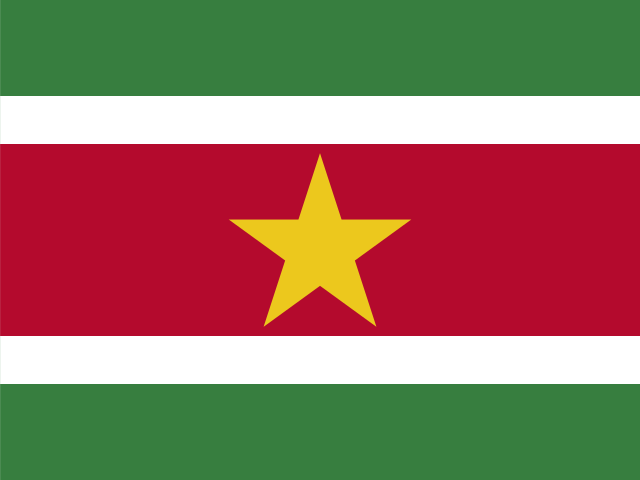
Five horizontal bands of green, white, red, white and green, the red band double the width of the greens and four times that of the whites, with a single yellow five-pointed star at the centre. The government's own description of the flag gives the green for the country's fertility and its hopeful expectation, the white for justice and freedom, the red for love that leads to deeds and for progressiveness, and the star for the unity of the nation and a golden future.
Suriname FACTS ◢
| Capital | Paramaribo |
|---|---|
| Continent | South America |
| Population | 639,850 (2025) |
| Area | 163,270 km² |
| Population density | 4/km² |
| Currency | Surinamese dollar (SRD) |
| Official language | Dutch |
| Calling code | +597 |
| Internet TLD | .sr |
| Time zone | UTC-03:00 |
| Drives on the | Left |
| ISO codes | SR / SUR |
DID YOU KNOW? ◢
- It's the smallest country in South America by both area and population.
- It's the only country in the Americas where Dutch is the official language.
- More than 90% of the country is covered by tropical rainforest.
- Its population blends Indian, Javanese, African, Indigenous, Chinese and European heritage in one small nation.
Suriname QUICK ANSWERS ◢
What is the capital of Suriname?
The capital of Suriname is Paramaribo.
What is the population of Suriname?
Suriname had a population of 639,850 in 2025.
What currency does Suriname use?
Suriname uses the Surinamese dollar (SRD).
What languages are spoken in Suriname?
The official language of Suriname is Dutch.
Think you know your flags? Play Flag Daily → · Browse all countries →
MORE ON THE FLAG ◢
The short reading of Suriname's flag in this page's flag summary is close to the state's own words rather than to somebody's later guess, for the green, the white and the red. The star is the exception: what the Surinamese government actually assigns it is not the unity of the country's ethnic groups. The government publishes a fuller version of that reading, and a version of it has been in print since the week the flag was adopted.
What is missing is the place you would expect to find it. Suriname has had two constitutions since independence, in 1975 and 1987, and the 1987 text has been amended twice. Neither constitution mentions the flag. Not the colours, not the star, not the word.
The flag itself was assembled by a committee out of the entries still standing in a public competition, in the last weeks before independence, and the artist whose design it was built on refused to have anything to do with the result.
Key Takeaways
- The colour meanings are the government's own. They were printed as the official description of the flag in November 1975, and the state portal carries them still, in an altered wording.
- Neither of Suriname's constitutions describes the flag. The 1975 text and the 1987 text as amended in 1992 and 2023 are silent on it.
- The red band is specified as a mixture, six parts carmine to four parts vermilion. The orange went in as a concession to an opposition party that objected to the flag's colours.
- One word carries most of the change since 1975. Renewal occurs three times in the version online and not once in the 1975 printing. Sacrifice was added to the star clause as well, three times over, and the wisdom the 1975 text gave the white bands has gone.
- The competition drew 269 flag designs and never produced a winner. The commission built the flag out of two of its three finalists, and the artist who supplied the bands disowned it.
Where the official colour meanings actually come from
The Surinamese government portal publishes the description under three headings: Kleuren, Maten, Symboliek. Colours, measurements, symbolism.
The symbolism section is the part worth reading closely, because it is more specific than the summaries that circulate. Green is given a double job: "Het groen symboliseert de vruchtbaarheid van Suriname met zijn vele mogelijkheden; tevens verbeeldt deze kleur de hoopvolle verwachting, het nieuwe Suriname." The green stands for Suriname's fertility with its many possibilities, and also for hopeful expectation, the new Suriname.
White is justice first, then freedom: "Het wit symboliseert de gerechtigheid; het verbeeldt ook de vrijheid." The white bands are then given a structural role rather than a symbolic one, joining the green of the country's possibilities to "het (helder) rood van de vernieuwing door de daden van de natie", the red of the renewal wrought by the nation's deeds.
Red is not simply progress. The portal's text divides the band in two, giving "het helderoranje (vermiljoenrood) als symbool van de vernieuwing", the bright orange as a symbol of renewal, and the carmine to love that leads to deeds, before calling the band as a whole progressiveness. The star gets two ideas at once: "De ster symboliseert de eenheid van de natie en het geel staat als symbool van de opoffering." The star stands for the unity of the nation, and the yellow for sacrifice.
That reading is not new. The same four lettered clauses ran in the Paramaribo weekly De Vrije Stem on 19 November 1975, under the heading SYMBOLIEK, in the same report in which the paper announced that the government had submitted "de ontwerplandsverordening tot vaststelling en bescherming van de vlag van Suriname" to the Staten van Suriname, and introduced what followed as "de officiële beschrijving van de vlag van Suriname".
Most of the reading comes through the fifty years between the two printings intact: fertility, hope, justice, freedom, love that leads to deeds, progressiveness, and the unity of the nation with its golden future.
What the government's symbolism has gained since 1975, and the one thing it lost
Set the two printings side by side and one Dutch word does most of the work. Vernieuwing, renewal, occurs three times in the version online, twice inside the red clause alone, and does not occur in the 1975 one at all.
It is in the white clause first. Where 1975 has the white bands joining the green to "het rood van de daden van de natie", the red of the nation's deeds, the portal has "het (helder) rood van de vernieuwing door de daden van de natie", the red of the renewal wrought by those deeds.
It is in the red clause twice more. The portal makes the bright orange "als symbool van de vernieuwing", a symbol of renewal, and then makes renewal the object of the striving as well: what the nation never lets up in pursuing is "de vernieuwing van mens en samenleving", the renewal of man and society.
The 1975 red clause has neither, and it is worth reading in full, because it shows what the split replaced. It says "In het rood wordt de liefde die tot daden leidt", the red expresses the love that leads to deeds, and then "Het symboliseert de progressiviteit, het streven om zich met de daad te blijven inzetten voor het vaderland", it symbolises progressiveness, the striving to go on committing oneself in deed to the fatherland. Two meanings, both given to the undivided band. Neither pigment is named, and the striving is for the fatherland rather than for any renewal.
The second addition is sacrifice, and the 1975 clause on the star has none of it. That clause is two sentences long. The first reads "De gele ster symboliseert de eenheid van de natie en de gerichtheid op de gouden toekomst"; the second has the nation drawing strength from the star's light "zich met vertrouwen in eigen kunnen te blijven inzetten voor land en volk", to go on committing itself to land and people with confidence in its own ability.
The portal turns that first sentence into two and puts sacrifice in all three it ends up with. The yellow stands "als symbool van de opoffering", as a symbol of sacrifice. The star then signifies "de opofferende eensgezindheid", a sacrificing unanimity. And the light gives the nation strength "zich opofferingen te getroosten", to bear sacrifices. Three occurrences online, none in 1975.
One reading has gone the other way. The 1975 clause on the white bands calls them the bands "van de gerechtigheid en de wijsheid", of justice and wisdom. The portal has freedom in that position. Freedom is not the newcomer there: the sentence immediately before it gives the white justice and freedom in both printings. What has gone is wisdom. It is the one reading in the 1975 symbolism with no counterpart in the modern text, once the fatherland of the red clause is set against the land en volk that both printings keep in the star clause.
The renewal matters more than it looks, because the vermilion in that band was not a design decision. It was a political concession, made in parliament, and the wording published later gives the pigment a symbolism the wording published at the time did not.
Two caveats on the comparison. The first is the scan. The 1975 side rests on a Delpher scan of a newspaper, and the clauses quoted here carry artefacts of the kind scanning produces: a broken line inside uitgedrukt, a stray mark before progressiviteit, sfer for ster in the star clause, a clause letter dropped into the middle of the white clause. None of them touches the wording, and the 1975 quotations here follow Rob Bertijn's transcription in the Dutch flag journal Vlag! in autumn 2025, which prints those passages cleanly and presents them as the official publication's.
The second caveat is Bertijn himself. He agrees with the newspaper word for word once those artefacts are discounted, including at every point where both part company with the portal, and since he worked from newspaper archives the two may be one witness rather than two.
Neither of Suriname's constitutions describes the flag
Neither constitution mentions the flag, and no amendment to either has added it.
The constitution of 1975 was approved by the Staten van Suriname on 19 November 1975 and came into force on independence day. It runs to 156 articles plus additional articles. It opens with fundamental rights rather than with national symbols, and the words vlag, wapen and volkslied appear in it nowhere.
The constitution of 1987, as consolidated after the amendment of 1992 and published by De Nationale Assemblée, does the same thing. Its Chapter I is headed De Souvereiniteit and covers the republic, the territory, nationality, and the state's duties towards society. The first paragraph of its article 1 says only that "De Republiek Suriname is een democratische Staat gebaseerd op de souvereiniteit van het volk en op eerbiediging en waarborging van fundamentele rechten en vrijheden." There is no symbols article to follow it, the 1992 amending act does not add one, and neither does the amendment of 25 October 2023.
One account does read the other way and is worth meeting head on. Bertijn writes that the new constitution was carried unanimously on 19 November, "waardoor ook de vlag officieel is geworden", whereby the flag also became official. Taken literally that would make the constitution the flag's instrument. It cannot be: the text of that constitution, searched end to end, does not contain the word vlag. The likelier reading is the loose one, that the flag went through in the same week as the constitutional package, and the Dutch press of the following days put the flag's own approval on Friday 21 November, at the Staten's last public sitting before independence.
So the familiar shape of a flag article, where a constitution describes the design and then either interprets it or conspicuously declines to, does not exist here at all. Suriname's constitutional law simply never takes up the subject.
That leaves the 1975 official description carrying the whole weight, so it is worth being precise about what that document is. It accompanied a bill rather than forming an article of a constitution, and its symbolism reads like an explanation rather than a rule.
The criminal code protects the flag and never describes it
Article 176a of the Wetboek van Strafrecht makes it an offence to insult the flag: "Hij die zich in het openbaar, mondeling of bij geschrift of afbeelding opzettelijk op een voor nationale gevoelens krenkende wijze uitlaat over de vlag van Suriname, wordt gestraft met gevangenisstraf van ten hoogste zes maanden." Anyone who publicly and deliberately expresses himself about the flag of Suriname in a manner offensive to national feeling faces up to six months. Article 176b of the same code extends that to distributing writings or images containing such an expression.
The code's own footnotes date both. They were inserted by G.B. 1959 no. 105 and amended by G.B. 1975 no. 160, which is to say the insertion arrived with Suriname's first flag and the amendment with its second. The 1975 competition advertisement names what was being replaced. It calls the arms and the flag the symbols fixed "bij landsverordening van 8 december 1959", by the ordinance of 8 December 1959, and gives two gazette numbers for that ordinance, 104 and 105, without saying which did what. The criminal code's footnote puts the flag-insult articles in no. 105.
There is one more mention, far away in the shipping offences: article 473 of the same code punishes "De schipper die de Surinaamse vlag voert, wetende dat hij daartoe niet gerechtigd is", a skipper who flies the Surinamese flag knowing he is not entitled to.
Between them, those articles say who may not fly the flag and who may not mock it. None of them says what it looks like. The instrument that established it, the 1975 ordinance whose title pairs vaststelling with bescherming, establishment with protection, could not be obtained for this article, which therefore asserts no gazette number for it.
Why the red band is not quite red
Suriname's centre band is often described as bright red, and the official text writes it that way, as "(helder) rood". The recipe underneath is stranger. The government's own colour clause specifies it as a mixture: "De (helder) rode kleur is samengesteld uit vier delen helderoranje (vermiljoenrood) en zes delen karmijnrood (Geranium)."
Four parts bright orange to six parts carmine. The reason that mixture is written down at all is an argument in parliament.
During the marathon sitting of 16 and 17 November 1975, the opposition leader Jagernath Lachmon objected that the proposed flag carried only the colours of the four governing parties. Bertijn quotes the complaint: "Groen voor de NPS, wit voor de Javaanse KTPI, rood voor de PNR en geel voor de KPS". Lachmon's own party, the VHP, had orange, and orange was not there. The debate got heated enough that a VHP member of the Staten shouted "Deze vlag moet worden verscheurd en vertrapt!", that the flag should be torn up and trampled.
Prime Minister Henck Arron told a closed sitting of the house that the colours were the governing parties' only by coincidence and that their meaning "anders moet worden verstaan", had to be understood differently. Orange was then added anyway, by dissolving it into the red.
The Dutch correspondent J. F. van den Broek reported the outcome from Paramaribo for NRC Handelsblad on 22 November 1975: the chosen design carried its yellow star not on a plain red field but on an orange-tinged vermilion one, "om de Vooruitstrevende hervormingspartij (VHP) te gerieven", to accommodate the VHP. He could see the orange in it and said so in print.
Everything else in the measurements is ordinary geometry. The flag is two units high to three long, the five bands run 2:1:4:1:2 from top to bottom, and the star's circumscribed circle has a radius equal to the width of a green band, which is half the width of the red one. The colour clause gives mixtures for green, red and yellow, and says nothing at all about the white.
| Band | Official composition | Size in the official measurements |
|---|---|---|
| Green, top and bottom | nine parts chrome green to one part white | 2 each |
| White, two bands | no composition given | 1 each |
| Red, centre | four parts bright orange (vermilion) to six parts carmine (geranium) | 4 |
| Yellow star | twelve parts chrome yellow to one part white | circle radius equal to a green band's width |
The competition that never declared a winner
The Arron government advertised for designs in March 1975; Bertijn dates the call to 3 April, but the advertisement itself survives in De Vrije Stem of 22 March. It gave its reason as the coming independence, said the symbols fixed by the ordinance of 8 December 1959 had to be replaced, and it set one constraint on the flag's shape: entrants had to bear in mind "dat de vlag RECHTHOEKIG moet zijn", that the flag had to be rectangular.
The government announced on 30 May 1975 that 269 flag designs had come in, along with 69 for a coat of arms. A commission chaired by the political scientist Evert Azimullah, with artists and educators on it, was appointed to advise, the field was cut at some point to twenty-one, and three designs were still in play on 7 October, forty-nine days before independence, with nobody yet able to say what the flag would look like.
The first of the three had a red triangle on green with the green lozenge and star of the coat of arms on it. Removing the lozenge left a yellow star on a red triangle, at which point the design looked too much like Guyana's and was dropped. The second had five bands in the proportions 2:1:4:1:2 with the coat of arms on a white panel, green and yellow alternating around a red centre, so far as the garbled colour list in the account can be read. The third, by the artist and trade unionist Jack Pinas, had the same five-band proportions in green, white, red, white and green, with a black five-pointed star on a white disc.
Attention turned to Pinas's design, and the trouble started with the star. When the commission asked whether his flag could be altered, he said that if anyone touched his artistic work he would go to court, and Bertijn records his reason for the black: "hij had het zwart juist gekozen omdat het geen heraldieke kleur was", he had chosen black precisely because it was not a heraldic colour.
Arron himself intervened. A compromise on a white star was reached, "omdat wit de verzameling is van alle kleuren", because white is all the colours together. That did not survive either. The American vexillologist Whitney Smith, who happened to be in Suriname and had sent the country an unsolicited flag design back in 1967, advised against white, "omdat een witte ster bij heldere hemel in een tropenland zou lijken alsof er iets uit de vlag is geknipt", because under a clear sky in a tropical country a white star would look as though something had been cut out of the flag. He recommended yellow, as on his own 1967 proposal.
With time running out, the commission settled it by taking the yellow star from the first design, the one it had already discarded, and putting it on Pinas's bands. Pinas was presented with the result and told the yellow was there because the KPS, also in government, would otherwise have no colour in the flag. He distanced himself from it. No prize was ever awarded: as Bertijn puts it, "de commissie heeft nooit een winnaar gepresenteerd" and strictly speaking there was not one. Azimullah, as Bertijn quotes him from De Ware Tijd of 3 February 2005, was blunter still: "In feite is het een commissievlag." It is in fact a committee flag.
The Staten approved it unanimously at their last public sitting before independence, on Friday 21 November 1975 by the Dutch reports of the following Saturday. That date reaches us through a badly scanned paragraph, so it is worth saying it is corroborated rather than plainly read: the flag was still awaiting a plenary sitting "later deze week" on 18 November, and by 22 November the Dutch correspondents in Paramaribo were reporting the marathon over and the flag carried. Pinas was asked to raise the new flag for the first time in the Surinamestadion on 25 November and turned the invitation down; a police sub-lieutenant, Frank Jong Loy, did it instead. Pinas died in 2016, aged 91, still not counting the flag as his design.
What the yellow star stands for, and what it replaced
The star is commonly described as standing for the unity of Suriname's ethnic groups. The official text does not say that. It says the unity of the nation and, in both its printings, a golden future. Sacrifice belongs to the modern version alone.
The distinction matters, because the flag Suriname threw away in 1975 was the one built on ethnic groups. The 1959 design was a white field carrying five stars in different colours, one for each population group, linked by an ellipse.
Before that flag there had been nothing of Suriname's own at all. The colony sailed under the Dutch West India Company's flag until the company was wound up in 1792 and under the Dutch tricolour after that, apart from the years of British rule during the French occupation of the Netherlands; from 1816 it was a colony of the newly formed Kingdom of the Netherlands. When a candidate for the Staten asked in January 1946 whether Suriname should have a flag of its own, the reporter covering the meeting noted that the question drew no sign of approval at all.
The 1959 flag was never popular. By 1967 the prime minister of the day, Johan Pengel, was telling a press conference that the white background did not work and that stars depicting the population groups brought a radical element into the flag, so that the unity of the Surinamese people could not be expressed. The 1975 competition call put its own aim as making the symbols acceptable to national feeling.
Read against that, one star for the unity of the nation answers five stars for five groups. The popular ethnic reading quietly puts the old flag's idea back into the new one.
One further detail comes from the first president. The government portal cites Johan Ferrier's Laatste gouverneur, eerste president (1975) for the star's orientation having been debated too, and for two of its points being deliberately turned downwards: "met beide benen stevig op de grond", with both feet firmly on the ground.
The proportions are the part worth remembering if you ever have to place the flag quickly: 2:1:4:1:2 from top to bottom, and a star whose circumscribed circle has a radius equal to the width of a green band, so the circle's diameter is exactly the height of the red band. The measurements also require the gap above the star's top point to equal the gaps below its two lowest ones, which is what centres it in the band. Anyone who wants to practise picking flags apart on detail like that can do it in Flag Daily.
Frequently asked questions
What do the colours of the Suriname flag mean?
According to the official description published by the Surinamese government, green stands for the country's fertility and its many possibilities and for hopeful expectation of a new Suriname, white for justice and freedom, red for love that leads to deeds and for progressiveness, and the yellow star for the unity of the nation and a golden future. Those readings were printed as the official description of the flag in November 1975 and are still on the government portal, whose wording has changed since.
Who designed the flag of Suriname?
Officially no single person is credited, and no prize was ever awarded. A government commission chaired by Evert Azimullah built the flag out of two of its three finalists, taking the five bands and their proportions from a design by the artist Jack Pinas and the yellow star from an entry it had already discarded. Pinas had drawn a black star, was not consulted about the change, and disowned the result.
When was the flag of Suriname adopted?
The Staten van Suriname approved it unanimously at their last public sitting before independence, which the Dutch press of 22 November 1975 placed on Friday 21 November, and it was first raised at midnight on 25 November 1975, the moment Suriname became independent. The competition that produced it had opened only in March of the same year.
Does Suriname's constitution describe the flag?
No. Neither the constitution of 1975 nor the constitution of 1987 as it stands after the amendments of 1992 and 2023 mentions the flag anywhere. Surinamese statute does take the flag up elsewhere: the ordinance that established it in 1975 was titled for its establishment and its protection, and the criminal code punishes insulting the flag and flying it without entitlement without ever describing it.
Why is the red band on Suriname's flag wider than the others?
The five bands are specified in the proportions 2:1:4:1:2 from top to bottom, so the red is twice the height of each green band and four times the height of each white one. That layout came from the competition entries themselves rather than from any later rule, and the red's mixture of carmine and vermilion was settled in parliament as a concession to an opposition party whose colour was orange.
Sources
- Government of the Republic of Suriname, Suriname: Surinaamse Vlag - the official description of the flag's colours, measurements and symbolism. Retrieved 27 August 2026.
- De Nationale Assemblée, Grondwet van de Republiek Suriname (S.B. 1987 no. 116, as amended by S.B. 1992 no. 38) - full Dutch text, 186 articles. Retrieved 27 August 2026.
- Grondwet.sr, Grondwet voor de Republiek Suriname 1975 (S.B. 1975 no. 2) - facsimile of the independence constitution as published in the Staatsblad. The same collection carries the amending acts of 1992 (S.B. 1992 no. 38) and 2023 (S.B. 2023 no. 157). Retrieved 27 August 2026.
- De Nationale Assemblée, Wetboek van Strafrecht (G.B. 1911 no. 1, as amended) - articles 176a, 176b and 473. Retrieved 27 August 2026.
- De Vrije Stem, "Nieuwe vlag zal 25 nov. wapperen", with the KLEUREN, MATEN and SYMBOLIEK sections, 19 November 1975, via Delpher. Retrieved 27 August 2026.
- De Vrije Stem, government competition advertisement for a new flag and coat of arms, 22 March 1975, via Delpher. Retrieved 27 August 2026.
- J. F. van den Broek, "Suriname heeft nu vlag, grondwet en 'overgangspresident'", NRC Handelsblad, 22 November 1975, via Delpher. Retrieved 27 August 2026.
- De Waarheid, report of the Staten van Suriname's unanimous approval of the flag at their last public sitting before independence, 22 November 1975, via Delpher. Retrieved 27 August 2026.
- Het Vrije Volk, "Lachmon: onze kleur zit niet in de vlag", 18 November 1975, via Delpher - the closed house meeting, and the flag still due in plenary later that week. Retrieved 27 August 2026.
- Rob Bertijn, "Chaotische toestanden rond de keuze van de vlag van Suriname", Vlag! 37, Nederlandse Vereniging voor Vlaggenkunde, autumn 2025, pp. 6-14. Retrieved 27 August 2026.
- Waterkant, Oorspronkelijke ontwerper Surinaamse vlag overleden, 17 September 2016. Retrieved 27 August 2026.
PLAY ANOTHER →
Three clues, three guesses. Work out where in the world it is.
THREE CLUESDAILYOn This DayOne thing that happened today in history. Every day, a new one.
TODAY IN HISTORYDAILYDaily CryptogramOne quote, one scrambled alphabet. Crack it before tomorrow.
CRACK THE QUOTEDAILYDaily TriviaFive questions a day. Everyone gets the same five.
FIVE QUESTIONS