
Switzerland
A mountain-locked confederation of four languages that famously stays out of other people's wars, Switzerland turns cheese, chocolate and precision watches into national institutions.
WHAT THE FLAG MEANS ◢
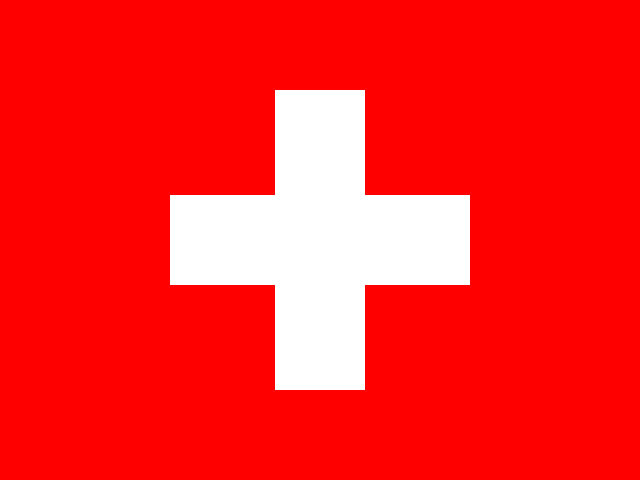
A bold white equal-armed cross on a red square, one of only two square national flags in the world. The cross has been carried on Swiss field ensigns since the 14th century, but federal law has defined the square flag only since 2017, and that law fixes the cross's proportions and the red in seven colour systems while giving none of it a meaning. Federal law separately prescribes a rectangular Swiss flag for use at sea.
Switzerland FACTS ◢
| Capital | Bern |
|---|---|
| Continent | Europe |
| Population | 9,092,436 (2025) |
| Area | 41,291 km² |
| Population density | 220/km² |
| Currency | Swiss franc (CHF) |
| Official languages | French, German, Italian, Romansh |
| Calling code | +41 |
| Internet TLD | .ch |
| Time zone | UTC+01:00 |
| Drives on the | Right |
| ISO codes | CH / CHE |
DID YOU KNOW? ◢
- It has four official languages: German, French, Italian and Romansh.
- It has maintained a policy of armed neutrality and has not fought a foreign war in over two centuries.
- The Large Hadron Collider, the world's biggest particle accelerator, runs in a ring beneath the Swiss-French border.
- The Red Cross was founded in Geneva, and its flag is the Swiss flag with the colours reversed.
- Swiss residents eat more chocolate per person than almost any other nation.
Switzerland QUICK ANSWERS ◢
What is the capital of Switzerland?
The capital of Switzerland is Bern.
What is the population of Switzerland?
Switzerland had a population of 9,092,436 in 2025.
What currency does Switzerland use?
Switzerland uses the Swiss franc (CHF).
What languages are spoken in Switzerland?
The official languages of Switzerland are French, German, Italian and Romansh.
Think you know your flags? Play Flag Daily → · Browse all countries →
MORE ON THE FLAG ◢
Switzerland's constitution does not mention its flag. Not the cross, not the colours, not the square. Search the Federal Constitution of 1999 as it stands today for the words Fahne, Flagge, Wappen, Schweizerkreuz or Hoheitszeichen and every one of them returns nothing.
That is not the interesting part. The interesting part is that until very recently, no federal instrument defined the square flag either. The coat of arms has been fixed in federal law since 1889, and the flag Swiss seagoing vessels fly since 1953. The square flag flown on land was fixed for the first time by the Coat of Arms Protection Act of 21 June 2013, which came into force on 1 January 2017.
So the answer to what the Swiss flag means has an unusual shape. The law that finally described it is exact to a degree few flag statutes reach, down to seven separate colour systems for the red. Across all of it, and across the 144-page dispatch that argued for it, no element of the flag is assigned a meaning at all.
Key Takeaways
- The Federal Constitution contains no flag provision. The square flag is governed by the Coat of Arms Protection Act (SR 232.21), in force since 1 January 2017.
- Article 3 of that Act is the first federal definition of the flag flown on land. Its own dispatch says, of the position before it, that such a definition was lacking.
- The Act's Annex 2 fixes the red in seven colour systems, including Pantone 485 C and hex #FF0000, and its Article 1 fixes the cross's arms at one sixth longer than wide.
- Nothing in the Act, in the ordinance made under it, or in the dispatch behind it says what the cross or the colours stand for. The Federal Council's dispatch calls the white cross "ein ursprünglich christliches Symbol" and stops there.
- The reference work that dispatch relies on records three competing explanations for where the cross came from, and settles on none of them.
| Instrument | Date | What it fixes about the flag | What it says the flag means |
|---|---|---|---|
| Federal Constitution (SR 101) | 1999, as in force | Nothing. The words do not appear. | Nothing |
| Federal Decree on the federal coat of arms | 12 December 1889, repealed 2017 | The coat of arms, not the flag | Nothing |
| Maritime Navigation Act, art. 3 and Annex I | 1953, annex replaced 2017 | The flag at sea, and from 2017 its red | Nothing |
| Coat of Arms Protection Act, arts. 1 to 3 and Annexes 1 and 2 | in force 1 January 2017 | The cross's proportions, the square field, the red | Nothing |
| Geneva Convention I, art. 38 | 1949 | Nothing about the Swiss flag itself | Names the federal colours as the emblem the red cross inverts |
Switzerland had no legal definition of its flag on land until 2017
Article 3 of the Coat of Arms Protection Act, SR 232.21 in the classified compilation of Swiss federal law, is two short sentences and a reservation. The first reads: "Die Schweizerfahne zeigt ein Schweizerkreuz in einem quadratischen Feld." The Swiss flag shows a Swiss cross in a square field. The second makes the pattern illustrated in Annex 2 authoritative for form, colour and proportions.
The Federal Council's dispatch of 18 November 2009, which carried the bill to parliament, introduces that article with a sentence worth reading twice: "Artikel 3 Absatz 1 definiert die Schweizerfahne (Flagge). Heute fehlt eine solche Definition." Article 3 paragraph 1 defines the Swiss flag. Today such a definition is lacking.
That sentence is doing precise work, and the precision is worth spelling out, because a reader can find material that looks like it contradicts it.
The first is between the flag and the coat of arms. The arms had been defined by the Federal Decree of 12 December 1889, and the 2013 Act carried that definition forward into its own Article 2 while repealing the decree outright. The flag had never been defined. It had simply been flown.
The second is between defining a flag and adopting one. The Federal Department of Foreign Affairs says on its own flag page that "Die Schweizerfahne wurde 1848 offiziell zum Hoheitszeichen der Schweiz erklärt", the Swiss flag was officially declared Switzerland's ensign in 1848. That claim and the dispatch's are compatible. A state can adopt an ensign without writing down what it looks like, and on the Federal Council's account in 2009 that is exactly what Switzerland had done and gone on doing.
The Act's own commentary is equally clear that defining it changed nothing in substance. The dispatch's sentence on Article 3 runs "Mit der gesetzlichen Definition ändert sich materiell nichts" and then gives the examples: the flag could still be modified in advertising, its square boundary allowed to flow into other graphic elements, or rendered wavy or in other proportions, provided the conditions for claiming Swiss origin were met.
Why is the Swiss flag square? The Federal Council answered in writing
The question people actually type about this flag has an official answer, and it fits in one sentence.
The dispatch's sentence begins "Da die Schweizerfahne auf ein militärisches Feldzeichen zurückgeht" and ends "hat sie eine quadratische Form", with a cross-reference to its own note on Article 1 in between. Because the Swiss flag goes back to a military field ensign, it has a square form.
The dispatch then explains why parliament was being asked to legislate a shape at all. The square is described as a "von den rechteckigen Fahnen anderer Staaten abweichende quadratische Form", a square form departing from the rectangular flags of other states, and the Federal Council argues the departure is worth protecting on two grounds: Swiss citizens identify with the square dimensions, and abroad the shape has become an accepted tradition with distinctive force. That is a trademark argument, and the dispatch around it is franker still. Its worked example is a Swiss cross on a "Joghurtbecher", a yoghurt pot, and its point about the pot is that the Act makes it lawful: the newly permitted commercial use "stellt das Kreuz der Schweizer Wirtschaft unter klar vorgegebenen Voraussetzungen bewusst als Marketinginstrument zur Verfügung", deliberately places the cross at the disposal of the Swiss economy, on clearly prescribed conditions, as a marketing instrument. A law that hands a national symbol to industry as a marketing instrument is exactly the law you would expect to fix its geometry to seven colour systems and say nothing about its meaning. Symbolism never enters it.
Annex 2 turns the shape into arithmetic. A tick scale runs along the diagram's top and right edges, reading 6, 7, 6, 7, 6 on both axes, which makes the field 32 units square and the cross 20 by 20 within it. Each arm is 7 units long by 6 wide, and 7 is one sixth more than 6, exactly what the Act's Article 1 states in words.
The Act fixes the red seven different ways, and does not make you use any of them
Annexes 1 and 2 both close with the same block, headed "Farbdefinition Rot": CMYK 0 / 100 / 100 / 0, Pantone 485 C / 485 U, RGB 255 / 0 / 0, hex #FF0000, Scotchcal 100-13, RAL 3020 Verkehrsrot, NCS S 1085-Y90R.
Before 2017 there was no legal shade of Swiss red. The dispatch is candid about how the gap was papered over. The absence of a precise rule had caused uncertainty in the graphics industry and a stream of enquiries. The dispatch then reports the workaround in a sentence that opens "Als Notlösung", as a stopgap: the federal printing and materials office of the day issued a colour recommendation for printed matter. The values now in the annexes are taken from the "Corporate Design der Schweizerischen Bundesverwaltung" handbook, first issued in 2005, with further current colour systems added.
That precision comes with limits that are easy to miss. One is in the commentary on the Act's Article 1: "Es besteht keine Verpflichtung, das Schweizerkreuz nur in dieser definierten Form zu verwenden." There is no obligation to use the Swiss cross only in this defined form. The dispatch's own example is Switzerland Tourism, which may go on rendering the cross as an edelweiss.
The other is stated for the arms and follows the same logic: "Das Wappen darf wie bisher auch in anderen Rotfarbtönen verwendet werden." Other shades of red remain permissible. The colour definition exists as a yardstick for judging whether a sign is confusable with the official one. It does not require everything Swiss to be #FF0000.
The cross belongs to everyone. The shield belongs to the state
The reason a flag statute exists at all in Switzerland is a commercial one, and it produced a split that reads oddly until you see the logic.
Article 8 reserves the Swiss coat of arms, the cross set in a shield, to the public body it belongs to. Article 10 says the flags and other ensigns of the Confederation, the cantons, districts, circles and communes may be used, unless the use is misleading or offends public order, morals or applicable law.
The dispatch states the outcome plainly in its summary. The arms of the Confederation may in principle be used only by the Confederation or its units, whereas "Die Schweizerfahne und das Schweizerkreuz hingegen dürfen künftig von allen verwendet werden": the Swiss flag and the Swiss cross may in future be used by anyone who meets the conditions for using the designation Switzerland.
The precision runs the same way. For the flag, the dispatch says Annex 2 settles the ratio between cross and flag: "Dabei wird das Grössenverhältnis zwischen dem Schweizerkreuz und der Fahne festlegt." For the coat of arms it says the cross's own measurements are fixed too, but the opposite about the ratio: "während das Grössenverhältnis zwischen Kreuz und Schild nicht geregelt ist", while the ratio between cross and shield is not regulated. The dispatch says that in its commentary on the very paragraph that carries the risk. Article 2 paragraph 2 makes the pattern depicted in Annex 1 authoritative for form, colour and proportions, which might be read as fixing the ratio by depiction, and Annex 1 has no ratio to supply: it shows no tick scale and no dimension of any kind, where Annex 2 carries 6, 7, 6, 7, 6 on both axes. The enacted text points the same way. Kopp, writing in 2011, recorded both ratios as unfixed, and for the shield he still would be right.
So the square flag is open and the triangular shield is closed. Firms that had used the shield legitimately for decades got a two-year window under Article 35 to apply to the Federal Department of Justice and Police to carry on, on proof of at least thirty years of uninterrupted and unchallenged use and a protectable interest.
Three origins for the white cross, and the government's own source picks none
The dispatch's history of the cross is footnoted, in its entirety, to one article in the Historical Dictionary of Switzerland: "Schweizerkreuz", by Peter F. Kopp. Open that article and it declines, almost immediately, to answer the question.
Its second sentence is "Zur Herkunft dieses Kreuzes, eines ursprünglich christl. Symbols, liegen drei Deutungen vor", and it then lists them. On the origin of this cross, an originally Christian symbol, three readings exist. The first derives it from the Theban Legion, whose cult was widespread in the Burgundian kingdom. The second derives it "von der ab dem 12. Jh. nachgewiesenen Reichssturmfahne", from the imperial war banner attested from the 12th century. The third derives it from "den Arma Christi, den Leidenswerkzeugen Jesu", the instruments of Christ's Passion, venerated particularly in central Switzerland and which the original cantons were supposedly permitted to affix to the red blood banner from 1289.
No verdict is offered between them. What the Federal Council took from that paragraph, and put in its dispatch to parliament, was the four-word clause calling the cross an originally Christian symbol. None of the three hypotheses travelled with it.
The dictionary is firmer about what the cross was for. Two bands sewn crosswise were worn as a recognition mark on clothing by the Bernese at Laupen in 1339. Of the mark generally, and without tying the statement to that battle, Kopp adds "Es unterschied sich vom roten St. Georgskreuz der Österreicher und dem burgund. Andreaskreuz": it was distinguishable from the Austrians' red cross of St George and the Burgundian cross of St Andrew. The clause is undated, and it finishes by naming Maximilian I, who reigned from 1486, so it will not carry a reading of what the mark meant at Laupen.
The foreign ministry adds something to that. Its flag page says the white cross on red at Laupen "das Zusammengehen der Waldstätte (Uri, Schwyz, Unterwalden und Luzern) und des Kantons Bern symbolisierte", symbolised the coming together of the forest cantons and Bern.
The two are not in conflict about what the mark was for. The ministry gives Kopp's function itself in the very next paragraph, under a heading reading "Ein militärisches Symbol": "Das «Schweizer Kreuz» wurde also zuerst im Krieg verwendet, damit sich die Kämpfer auf dem Schlachtfeld erkannten", the Swiss cross was first used in war so that the fighters could recognise each other on the battlefield. The ministry has taken the fact and added symbolism on top of it, without marking which half is which.
That is the asymmetry worth having, and the next section documents the same page handling the same reference work with the same lack of marking. The reference work the Federal Council relies on does not settle where the cross came from, and assigns the mark no meaning, only a function. The ministry assigns it one the reference work does not.
The same article notes why there was no common symbol to draw on: "Da jeder Kanton souverän war, besass die alte Eidgenossenschaft also kein gemeinsames Wappen." Because every canton was sovereign, the old Confederacy had no common coat of arms at all. A country with no shared arms until the 19th century and no legal definition of its flag until the 21st is behaving consistently.
A live government page credits 1889 to the wrong body, and so does the encyclopaedia it took it from
The 1889 instrument is where the cross's proportions were settled, and it is worth naming precisely, because two Swiss sources name it loosely.
Annex 3 of the Coat of Arms Protection Act repeals, by name, the "Bundesbeschluss vom 12. Dezember 1889 betreffend das eidgenössische Wappen". A Bundesbeschluss is an act of the Federal Assembly, and the dispatch says so directly: the definition of the Swiss coat of arms is the one "im Bundesbeschluss von 1889 von der Bundesversammlung festgelegt wurde", laid down by the Federal Assembly.
The foreign ministry's flag page credits it to the executive instead, twice, in a caption reading "Am 12. November 1889 legte der Bundesrat das Schweizer Wappen fest" and in body text reading "Neunundvierzig Jahre später, 1889, präzisierte der Bundesrat, dass die vier gleich langen Arme des Kreuzes um ein Sechstel länger als breit sein müssten".
That second sentence is almost word for word the Historical Dictionary's, which has "1889 präzisierte der Bundesrat, dass die vier gleich langen Arme des aufrechten, frei schwebenden Kreuzes um ein Sechstel länger als breit sein müssten". So the ministry did not invent the attribution. It took it from the reference work the Federal Council's own dispatch is footnoted to.
The dispatch shows the correction being made. On the same page as that footnote it writes the identical fact, in Kopp's own vocabulary and clause order, with the subject swapped out: "1889 wurde mit dem Bundesbeschluss betreffend das Eidgenössische Wappen präzisiert", in 1889 it was specified by the Federal Decree on the federal coat of arms. Same verb, same "aufrechten, frei schwebenden Kreuzes", same one-sixth clause. The drafters were working from Kopp and put the instrument in place of the executive. The ministry, sixteen years later, did not.
The day and month are the ministry's own addition; Kopp gives the year only. Fedlex, the federal law portal, catalogues the decree at 12 December 1889 and, separately, a "Botschaft des Bundesrates an die Bundesversammlung, betreffend das eidgenössische Wappen. (Vom 12. November 1889.)", to which the same record gives a publication date of 16 November. November is when the Federal Council wrote to parliament. December is when parliament decided.
Switzerland's other flag is a rectangle
Article 3 paragraph 3 of the Coat of Arms Protection Act reserves three other regimes: the Maritime Navigation Act, the Aviation Act and the Military Act. The first of those defines a second Swiss flag, and it is not square.
Article 3 of the Maritime Navigation Act of 23 September 1953, SR 747.30, provides that only Swiss seagoing vessels may fly the Swiss flag and that they fly no other, and makes the pattern in Annex I authoritative for form, colour and proportions. That annex is a rectangle, annotated across its lower edge with the expression A = 1,5 B: length one and a half times height, or 3:2. The cross is built to the same ratio as the square flag rather than to the same scale: its annex works in a relative b, arms of b+1/6b by b, where the square flag's works in absolute ticks of 6 and 7. The "1/2 A" measure centres it on the flag's mid-length.
Work the two annexes out and the crosses turn out to be proportionally identical in height. On the square flag the cross stands 20 units in a 32-unit field. At sea it stands 10/3 of b in a field 16/3 of b high. Both come to exactly five eighths.
Only the red was touched in 2017. The dispatch notes that the existing definition of the Swiss flag at sea stays unchanged as to form and proportions, and is supplemented only in respect of the colour red.
The foreign ministry names the sea flag and two further departures from the square: Swiss athletes parade at the Olympic Games under a rectangular banner, and the air force carries a roundel with a white cross on a red ground. It dates the sea flag to 1941 and its rectangular definition to 1953, and the Act corroborates both ends. Its transitional article still refers to flag rights granted under a Federal Council decree of 9 April 1941, and the dispatch's statement that form and proportions were left unchanged in 2017 establishes that the pre-2017 annex was already the rectangle.
If flags at sea are the part you want more of, the Nautical Flag Alphabet is the full A to Z signal chart, one flag per letter.
A 1949 treaty calls the Red Cross emblem a tribute to Switzerland
Switzerland is the depositary of the Geneva Conventions, and the first of them makes the connection explicit. Article 38 of the Geneva Convention for the Amelioration of the Condition of the Wounded and Sick in Armed Forces in the Field, of 12 August 1949, which Switzerland publishes as SR 0.518.12, opens: "Par hommage pour la Suisse, le signe héraldique de la croix rouge sur fond blanc, formé par interversion des couleurs fédérales, est maintenu comme emblème et signe distinctif du Service sanitaire des armées."
In tribute to Switzerland, the heraldic sign of the red cross on a white ground, formed by inverting the federal colours, is retained as the emblem and distinctive sign of the medical service of armed forces. The German text of the same article calls it "das durch Umstellung der eidgenössischen Farben gebildete Wappenzeichen".
The 2009 dispatch reaches for the same relationship when it explains why the Red Cross statute could not simply be folded into the new Act: the sign of the Red Cross is formed "zu Ehren der Schweiz durch Umstellung der Farben des Schweizerkreuzes", in Switzerland's honour by inverting the colours of the Swiss cross, which makes the two signs closely related and is why the humanitarian emblem keeps absolute protection under its own statute while the national flag was opened up.
So the one place a Swiss federal colour is given a stated significance, it is given it by international humanitarian law, about a different flag.
No Swiss instrument gives the red or the white a meaning
Every Swiss instrument read for this article could have assigned one, and not one of them does. The Federal Constitution never mentions the flag. The Coat of Arms Protection Act defines its geometry and its colour values across three articles and two annexes and interprets none of them. The ordinance made under it, the Wappenschutzverordnung of 2 September 2015, SR 232.211, deals with jurisdiction, filings and the register, and never touches meaning. The 144-page dispatch behind the Act contains one symbolic statement about the flag in its entirety, and it is the four words already quoted: the through white cross is "ein ursprünglich christliches Symbol", originally a Christian symbol.
Nothing anywhere explains the red field.
The readings that do circulate come from the foreign ministry's page, and both are about the cross rather than the colours. The first is the one already quoted, that at Laupen the cross symbolised the coming together of the forest cantons and Bern. The second is modern: the Swiss cross, that page says, recalls the connection between the four parts of the country and "symbolisiert die Kraft der Tradition und den Pluralismus der Schweiz", symbolises the force of tradition and Switzerland's pluralism. The same page opens by calling the flag "das Ergebnis eines reinen Zufalls", the result of pure chance.
A ministry page is a real state source and that reading is worth having. It is not the same thing as a provision, and on this flag nobody has written the provision. Denmark's flag has the opposite problem, a meaning everyone can recite attached to a date nobody can document: the Dannebrog's legend is 1219 and its evidence starts around 1380.
The two-square-flags claim survives, but neither state writes the shape down
Switzerland and Vatican City both fly square national flags, so the count itself is not in dispute, and a Swiss federal source asserts it: the foreign ministry's page states in a caption that "Die Schweizer Flagge ist neben der vatikanischen die einzige quadratische Nationalflagge", the Swiss flag is, alongside the Vatican's, the only square national flag.
What is odd is that neither country puts the shape into words.
Switzerland gets closest. Article 3 of its Act says "quadratischen Feld", a square field, and Annex 2 supplies the grid. The Vatican does not get there at all. Article 24 of its Fundamental Law of 31 July 2026 gives the flag as two vertically divided fields, yellow at the hoist and white, the white charged with the tiara and keys, "il tutto secondo il modello che forma" the annex to the law, all according to the model that Annex A forms. No proportion is stated, and the seven-page PDF the Governatorato publishes of that law contains no images and does not reproduce Annex A. The Governatorato's separate page describing the flag, "un drappo bipartito di giallo" and white, states no proportions either.
And Switzerland itself keeps a rectangular flag in force for use at sea, in a federal act, with its own annex. The tidy version of the claim is tidier than the law.
Frequently asked questions
What does the Swiss flag mean?
No Swiss legal instrument assigns the Swiss flag a meaning. The Federal Constitution does not mention the flag at all, and the Coat of Arms Protection Act that has defined it since 1 January 2017 fixes the cross's proportions, the square field and seven values for the red without interpreting any of them.
The nearest thing to an official reading is the Federal Council's dispatch of 18 November 2009, which describes the through white cross as originally a Christian symbol, and the Federal Department of Foreign Affairs' flag page, which reads the cross as recalling the connection between the four parts of the country and symbolising the force of tradition and Switzerland's pluralism. Neither reads the colours.
Why is the Swiss flag square?
Because it descends from a military field ensign. That is the Federal Council's own explanation, given in the 2009 dispatch that proposed defining the flag: since the Swiss flag goes back to a military field ensign, it has a square form.
The dispatch adds a second, practical reason for writing the shape into law: the square departs from other states' rectangular flags, Swiss citizens identify with it, and abroad it has become a recognised tradition with distinctive force worth protecting against imitation.
What are the official colours of the Swiss flag?
White and red, and the red is a benchmark rather than a requirement: the dispatch states that the coat of arms may still be used in other shades of red and that there is no obligation to use the Swiss cross only in its defined form. Subject to that, Annexes 1 and 2 of the Coat of Arms Protection Act fix the red in seven systems: CMYK 0 / 100 / 100 / 0, Pantone 485 C / 485 U, RGB 255 / 0 / 0, hex #FF0000, Scotchcal 100-13, RAL 3020 Verkehrsrot and NCS S 1085-Y90R.
Those values were new in 2017. Before then the shade had no legal definition, and the federal printing office's colour recommendation for printed matter stood in as what the dispatch calls a stopgap.
Is the Swiss flag always square?
No. Federal law keeps a rectangular Swiss flag for use at sea: Article 3 of the Maritime Navigation Act of 23 September 1953 makes Annex I authoritative, and that annex sets the flag at A = 1,5 B, three units long to two high.
The Coat of Arms Protection Act expressly reserves the maritime, aviation and military regimes, and the foreign ministry names two further departures in practice, the rectangular banner Swiss athletes parade under at the Olympic Games and the air force roundel.
Is the Red Cross flag the Swiss flag reversed?
The colours are inverted, and a treaty says so. Article 38 of the first Geneva Convention of 1949 states that in tribute to Switzerland the heraldic sign of the red cross on a white ground, formed by inverting the federal colours, is retained as the emblem of the medical service of armed forces.
They are not interchangeable signs. The Red Cross emblem keeps absolute protection under its own statute, while the Swiss flag itself was opened up in 2017 to anyone entitled to claim Swiss origin.
Telling the two apart at a glance is a different skill from reading either statute, and a more entertaining one: Flag Daily shows one flag a day and gives you three guesses at the country.
Sources
- Bundesgesetz über den Schutz des Schweizerwappens und anderer öffentlicher Zeichen (Wappenschutzgesetz, WSchG), SR 232.21, Fedlex, the publication platform of Swiss federal law. Consolidated version as at 1 January 2017. Articles 1, 2, 3, 8, 10 and 35, and Annexes 1, 2 and 3. The German, French and Italian HTML and the official PDF-A, whose Annex 1 and Annex 2 diagrams are images, were downloaded and saved beside this draft. The diagrams are transcribed in
annex-transcriptions.txt. Retrieved 21 August 2026. - Botschaft zur Änderung des Markenschutzgesetzes und zu einem Bundesgesetz über den Schutz des Schweizerwappens und anderer öffentlicher Zeichen, BBl 2009 8533, Swiss Federal Council, 18 November 2009. The 144-page dispatch. The commentary on Articles 1, 2 and 3 at pages 8620 to 8623 supplies the flag's history, the reason for the square, the origin of the colour values and the statement that no definition of the flag then existed. Retrieved 21 August 2026.
- Entwurf: Bundesgesetz über den Schutz des Schweizerwappens und anderer öffentlicher Zeichen, BBl 2009 8693, the draft bill as laid before parliament, checked against the enacted text to confirm Article 3 passed substantially as proposed. Retrieved 21 August 2026.
- Bundesgesetz über die Seeschifffahrt unter der Schweizer Flagge, SR 747.30, Fedlex. Article 3 and Annex I, in the consolidated version as at 1 July 2026. The annex is an image and is transcribed beside this draft. Retrieved 21 August 2026.
- Bundesverfassung der Schweizerischen Eidgenossenschaft, SR 101, Fedlex, consolidated version as at 3 March 2024. The German and French texts were downloaded and searched: Fahne, Flagge, Wappen, Schweizerkreuz, Hoheitszeichen, drapeau, armoiries, croix and pavillon each occur zero times. Retrieved 21 August 2026.
- Verordnung über den Schutz des Schweizerwappens und anderer öffentlicher Zeichen (Wappenschutzverordnung, WSchV), SR 232.211, Fedlex, consolidated version as at 1 July 2025. Checked for any interpretive provision. It contains none. Retrieved 21 August 2026.
- Genfer Abkommen zur Verbesserung des Loses der Verwundeten und Kranken der bewaffneten Kräfte im Felde, SR 0.518.12, Fedlex. Article 38, read in the authentic French text and in the German translation Switzerland publishes as depositary. Retrieved 21 August 2026.
- Peter F. Kopp, "Schweizerkreuz", Historisches Lexikon der Schweiz, version of 28 October 2011. This is the article the Federal Council's dispatch footnotes for its entire account of the cross, at note 84. The live site answers a Cloudflare block to curl, to WebFetch and to a headless browser alike, so it was read from the Wayback Machine capture of 20 April 2019 of that exact URL, fetched with the
id_modifier and decoded from the iso-8859-1 the page declares. The capture is saved beside this draft. Retrieved 21 August 2026. - Fedlex catalogue records for the two 1889 documents, the decree at eli/oc/11/334_311_334 and the message at eli/fga/1889/4_630__, queried from the Fedlex SPARQL endpoint and saved beside this draft as
fedlex-1889-catalogue.jsonandfedlex-1889-decree-record.json. They give the Bundesbeschluss a document date, publication date and entry into force of 12 December 1889, the historical reference RO 11 311, and a date of ceasing to be in force of 1 January 2017 on a repeal decision of 21 June 2013. They title the Federal Council's message "(Vom 12. November 1889.)" and give it a publication date of 16 November 1889. Retrieved 21 August 2026. - Die Schweizerfahne: ein Plus für das Land, Federal Department of Foreign Affairs, About Switzerland, published 19 January 2026. The source of the 1848 ensign claim, the attribution of the 1889 decision to the Federal Council, the pluralism reading of the cross, the square-flag claim and the list of departures from the square. The page returns HTTP 403 to command-line clients and was read with a headless browser. The rendered HTML is saved beside this draft. Retrieved 21 August 2026.
- Legge Fondamentale dello Stato della Città del Vaticano del 31 luglio 2026, Governatorato dello Stato della Città del Vaticano. Article 24 describes the flag and defers its model to Annex A. The published PDF runs to seven pages, ends at the signature, and contains no images, so Annexes A, B and C are not reproduced in it. Downloaded and saved beside this draft. Retrieved 21 August 2026.
- Bandiera, Governatorato dello Stato della Città del Vaticano. The Vatican's own descriptive page on its flag, cited here for what it does not say: it gives the design and the history and states no proportions. Read with a headless browser and saved beside this draft. Retrieved 21 August 2026.
The Federal Decree of 12 December 1889 on the federal coat of arms, and the Federal Council's message of 12 November 1889 that preceded it, could not be opened in full. Both are catalogued in Fedlex, which points for the text to amtsdruckschriften.bar.admin.ch, the scanned-publications service of the Swiss Federal Archives, and that host does not answer from this machine to curl or to a headless browser. The Wayback Machine does not hold a capture of it either. Nothing in this article rests on the unopened originals: the dates come from the Fedlex catalogue records, and the Act's Article 1 states a cross definition that the dispatch says corresponds to the 1889 decree's.
PLAY ANOTHER →
One quote, one scrambled alphabet. Crack it before tomorrow.
CRACK THE QUOTEDAILYDaily TriviaFive questions a day. Everyone gets the same five.
FIVE QUESTIONSDAILYGuess the CountryThree clues, three guesses. Work out where in the world it is.
THREE CLUESDAILYDaily CodeA short message, hidden in a different cipher every day.
ONE CIPHER A DAY