
Tanzania
Home to Africa's tallest mountain and one of its greatest wildlife spectacles, Tanzania is where the Serengeti's wildebeest run and Kilimanjaro's snows sit almost on the equator.
WHAT THE FLAG MEANS ◢
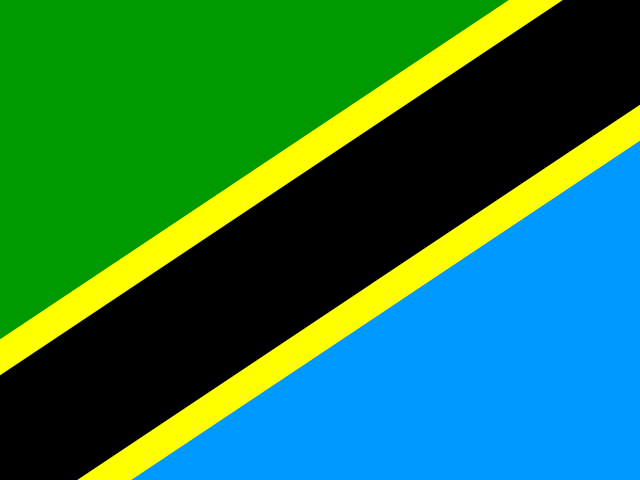
A field split by a black diagonal band edged in two narrower bands, which the flag law calls golden, with a green triangle at the upper hoist and a blue triangle at the lower fly. The constitution has no flag provision. The design is prescribed instead by the National Emblems Act, which describes it and assigns no element a meaning. Tanzania's school curriculum reads the green for the land and its natural vegetation, the black for people of African origin, the blue for the sea, the lakes and the rivers, and the narrow bands, which it calls yellow, for mineral resources.
Tanzania FACTS ◢
| Capital | Dodoma |
|---|---|
| Continent | Africa |
| Population | 70,545,865 (2025) |
| Area | 947,303 km² |
| Population density | 74/km² |
| Currency | Tanzanian shilling (TZS) |
| Official languages | English, Kiswahili |
| Calling code | +255 |
| Internet TLD | .tz |
| Time zone | UTC+03:00 |
| Drives on the | Left |
| ISO codes | TZ / TZA |
DID YOU KNOW? ◢
- Mount Kilimanjaro is the highest mountain in Africa and the tallest free-standing mountain on Earth.
- The Serengeti hosts the great migration, where over a million wildebeest move in a vast annual loop.
- The islands of Zanzibar were once the world's leading producer of cloves.
- Olduvai Gorge here has yielded some of the oldest known human ancestor fossils, earning it the nickname 'the cradle of humankind'.
- Lake Tanganyika, on its border, is the second-deepest freshwater lake in the world.
Tanzania QUICK ANSWERS ◢
What is the capital of Tanzania?
The capital of Tanzania is Dodoma.
What is the population of Tanzania?
Tanzania had a population of 70,545,865 in 2025.
What currency does Tanzania use?
Tanzania uses the Tanzanian shilling (TZS).
What languages are spoken in Tanzania?
The official languages of Tanzania are English and Kiswahili.
Think you know your flags? Play Flag Daily → · Browse all countries →
MORE ON THE FLAG ◢
Green for the land and its vegetation, gold for mineral wealth, black for the people, blue for the ocean and the lakes. That is the set of readings almost every account of Tanzania's flag gives, in almost that order.
Tanzania's own flag statute contains none of it.
The National Emblems Act, Chapter 10 of the Laws of Tanzania, describes the flag in a single sentence, prints a black and white line drawing with the colour names lettered into it, and stops. It never says what any colour stands for. The constitution does not mention the flag at all, in either of its languages. The meanings are real and they are somebody's, but the somebody is not the statute.
Key Takeaways
- The flag is prescribed by the First Schedule to the National Emblems Act, Chapter 10, which describes the design and assigns no element a meaning.
- The Act calls the two narrow bands golden. The word yellow appears nowhere in it.
- Section 3 dates the flag to 26 April 1964, which is Union Day. The 30 June 1964 date in circulation appears in no Tanzanian instrument found here.
- The Constitution of 1977 contains no flag provision, checked in the official English revision and in the Kiswahili text.
- Tanzania's own state schoolbook does supply meanings for the four colours, and its wording differs from the version in general circulation.
| Colour | The Act's word for it | The state schoolbook's reading | Whitney Smith's reading in Britannica |
|---|---|---|---|
| The upper portion | green | the land and the natural vegetation | the rich agricultural resources of the land |
| The lower portion | blue | the sea, lakes and rivers, within and around Tanzania | the Indian Ocean |
| The central band | black | the presence of people of African origin | the majority population of the country |
| The two outer bands | golden | mineral resources in the country, given as njano, yellow | mineral wealth, in the narrow yellow borders |
Which law actually prescribes Tanzania's flag?
One Act, and it is not called a flag act. The National Emblems Act, Chapter 10, is described in its own long title as "An Act to prescribe the national flag, the coat of arms and the public seal and to control and regulate their use."
Its section 3 does the prescribing, and it does it by pointing somewhere else: "With effect from the 26th April 1964, the National Flag of the United Republic of Tanzania shall be of the description specified in the first Schedule."
Everything the law says about how the flag looks is in that schedule, and the schedule is short. It is one sentence of prose followed by a drawing.
The Act is not obscure or hard to reach. The text in circulation is the revision made under the supervision of the Attorney General's Office and current to 31 July 2002, published by the Tanzanian legal information institute both as a web text and as a downloadable PDF. The Ministry of Home Affairs, which is the ministry the Act's own interpretation section makes responsible, hosts that same file on its own website. Both were read end to end for this article, the web text and the PDF, and neither carries a word about symbolism.
That silence is not unusual for the region. Kenya's flag is legislated in much the same way, as a schedule whose real content is a figure rather than a sentence.
Why Tanzania's flag law is dated 1964 and was passed in 1971
Section 3 gives the flag effect from 26 April 1964. Parts I and II of the Act, which are the flag and the coat of arms, commenced on 7 May 1971.
The explanatory note printed with the consolidated text sets out why: "This Act is a consolidation of the National Flag and Coat of Arms Act No. 15 of 1971 and the Public Seal Act (R.L. Cap. 504). Parts I and II relate to the national flag and coat of arms and came into force on the 7th May 1971."
So a statute of 1971 reaches back seven years and declares what the flag had already been since 1964. The date it reaches back to is Union Day. A judgment of the High Court of Tanzania puts it plainly in passing, noting that "26th April each year is a Union Day", the anniversary of the joining of Tanganyika and Zanzibar that the constitution's Second Schedule records as the Act of Union between Tanganyika and Zanzibar of 1964.
Which leaves the date everybody prints. The English Wikipedia article says the combined design "was adopted on 30 June 1964", and footnotes it to a British reference work of 2009 rather than to anything Tanzanian. No Tanzanian instrument found here carries that date. The Act says 26 April. Whitney Smith, writing the Britannica entry, says the two flag traditions were melded "in early July", which is a third answer again.
Nor could the constitutive act be located in the gazette. The Government Gazette runs for 1962 and 1964 held in the Open Gazettes archive, 42 issues and 74 issues, were downloaded and searched, and neither contains a notice creating or describing the flag.
The issue of 30 June 1964 was opened specifically, since that is the date in circulation. It is a one-page Gazette Extraordinary whose only content is a notice that three Appropriation Acts had been enacted and, in its own words, "are published in the Supplement to this number of the Gazette". The archive index for 1964 lists no supplements at all.
Three things stop that from being a finding of absence. Those runs are the main gazette only, and their legal supplements, which is where Acts and subsidiary legislation were printed, are not in the archive. The collection holds neither 1961 nor 1963 nor 1971, which are the year of Tanganyika's independence, the year before the union, and the year of the Act itself. And the scans are 1960s two-column newsprint whose extracted text is visibly imperfect, so a mangled word could have hidden a hit.
The honest position is that the earliest instrument reachable from here is the 1971 Act, and that it backdates itself.
What the schedule says, and what it leaves out
The whole of the legal description reads: "A rectangular flag divided into two equal portions diagonally from the right-hand upper corner to the left-hand lower corner; the upper portion of green colour and the lower portion of blue colour; the dividing bands being of golden, black and golden collars; the two golden bands of equal size and smaller than the central black band; of the following design:"
Then the drawing. It is a line drawing with no colour in it at all: a rectangle, four parallel diagonals, and the words GREEN, GOLDEN, BLACK, GOLDEN and BLUE hand-lettered into the five zones they name.
Read what that leaves unfixed. There is no ratio. There is no width for any band, only the relative rule that the two golden ones are equal to each other and narrower than the black. There is no shade, no colour standard and no reference to any colour system, because the plate the Act reproduces is monochrome and does the naming in words.
The schedule also has a small oddity worth noting rather than resolving. Its heading in the consolidated text is "First Schedule (Section 12)", and section 12 of the Act is the provision about authenticating the public seal. The section that actually invokes the Act's First Schedule is section 3.
One more piece of the wording repays attention. The phrase is "golden, black and golden collars". Collars, not colours. It reads as a typesetting slip, though no earlier printing of the schedule could be reached to check it against, and it is what the text prints.
The constitution does not mention the flag at all
This is a negative claim, so it was tested rather than inherited.
Two complete texts were searched. The first is the official English revision of the Constitution of the United Republic of Tanzania of 1977, Chapter 2 of the Laws, with amendments to the Fourteenth of 2005 and published under the Laws Revision Act. The second is the Kiswahili text, Katiba ya Jamhuri ya Muungano wa Tanzania ya Mwaka 1977, in the edition circulated on Tanzanian government sites.
The English text returns no occurrence of flag, emblem, symbol or anthem. The Kiswahili text returns no occurrence of bendera, nembo or wimbo. Not in the preamble, not in the articles, not in the schedules.
The First Schedule to the constitution lists the twenty-two Union Matters, the subjects reserved to the union government, and the national flag is not among them either. That list runs from the constitution and the government of the United Republic through foreign affairs, defence, police, citizenship, higher education and civil aviation to the Court of Appeal and the registration of political parties.
So the flag has exactly one statutory home, and it is an ordinary Act of Parliament. The National Emblems Act is not one of the laws the constitution's Second Schedule shields behind a two-thirds majority.
So who does assign the four colours a meaning?
Two answers, and it is worth keeping them apart.
The first is Tanzanian and official, and it is not in a statute. The Tanzania Institute of Education, the government body that writes the national curriculum, teaches the meanings in its Standard IV history and ethics book. Its flag passage opens by counting them: "Bendera ina rangi nne ambazo zinatambulisha Taifa letu", the flag has four colours which identify our nation.
Then it takes them one at a time. Of the black it says "Rangi nyeusi inawakilisha alama ya uwepo wa watu wenye asili ya Kiafrika", which renders as the black colour representing the presence of people of African origin. Of the green, "Rangi ya kijani inawakilisha ardhi na uoto wa asili", the land and the natural vegetation. Of the yellow, "Rangi ya njano inawakilisha uwapo wa rasilimali za madini nchini", the presence of mineral resources in the country. The blue it gives as the wealth of water, naming the sea, the lakes and the rivers both inside the country and surrounding it.
The second answer is foreign, older and far more widely copied. Whitney Smith, formerly director of the Flag Research Center, wrote the Britannica entry, and its sentences are the ones the English repetitions closely follow: "The majority population of the country is symbolized by the black stripe, while green suggests the rich agricultural resources of the land." And: "Mineral wealth is reflected in the narrow yellow borders, while the Indian Ocean is symbolized by blue."
Notice what happens to the black between the two. The Tanzanian textbook says people of African origin. Smith says the majority population. A third version, still in wide circulation, narrows it to the Swahili people specifically, and no Tanzanian source found here says that. That wording is what the CIA World Factbook's Tanzania entry carried in the Internet Archive capture of 9 January 2021, where the gloss runs "black the native Swahili people". The Factbook itself is gone: three of its country URLs were tried for this article and all three answered a redirect to one CIA notice, dated 4 February 2026, saying the publication "has sunset".
That narrowing is worth resisting, because Tanzania's own foreign ministry, in the country profile it used to publish, counted more than 120 local languages spoken in the country. That page is old enough to name Jakaya Kikwete as the sitting president, so treat the number as a long-standing official estimate rather than a current count. The black band in a union flag is an unlikely place for the state to have singled out one of them, and the Tanzanian text does not.
Golden or yellow, and why the Act's word matters
The Act says golden. It says it three times in one sentence, and the drawing says it twice more.
Popular descriptions say yellow, or gold. So does the Tanzanian state when it is teaching rather than legislating: the schoolbook's word for the band is njano, the ordinary Kiswahili word for yellow.
The same book shows the two words being treated as one colour, and it does it twice on one page. Listing the elements of the coat of arms, it writes "rangi ya dhahabu (njano)", the colour of gold with yellow supplied in brackets. Explaining the same element further down the same page, it reverses them: "Rangi ya njano (dhahabu)", the yellow colour with gold in brackets. Neither word is subordinate to the other, and this is a government textbook.
The gap only opens because the governing instrument is a monochrome drawing. Nothing in the Act pins a hue, so the colour word is left to carry what a colour standard would carry elsewhere, and the word in the law is golden.
Another African diagonal shows how differently this can be done. The Republic of the Congo's flag is also officially wordless about what it means, but its founding law was gazetted with a dimensioned plate. Tanzania's schedule has no dimensions at all.
The two flags that went into Tanzania's
The union of April 1964 joined two states that already had flags, and both are visible in the result.
Smith's account of the Tanganyika side is that the independence movement was led by the Tanganyika African National Union, whose flag was a horizontal tricolour of green, black and green, and that the British authorities suggested modifying the party flag for use as a national flag subsequent to independence on 9 December 1961, with yellow fimbriations added at that time.
Zanzibar's side is shorter and more turbulent. Smith records a red flag under Arab rule, a black, yellow and blue flag flown by the government that took power on 12 January 1964, and then a new national flag introduced the following month by the ruling Afro-Shirazi Party and similar, in Smith's account, to the party's own: horizontal blue, black and green stripes with a narrow white vertical stripe at the hoist.
That Zanzibar flag is where the familiar Tanzanian readings appear to start. Smith gives its stripes as standing for the sea, the people and the land respectively, with the white for peace. Sea, people, land. Three of the four readings that get attached to Tanzania's flag today are already there, attached to a different flag, in the account of the same author.
The two flags also went on coexisting. A trade mark notice in the gazette of 2 October 1964 makes a registration conditional on a flag device not being used in the colours of "the National Flag of the Republic of Tanganyika" or of the flag of the union. More than five months after the union, the trade marks registry was still policing both.
What the law does about the flag today
Three things, and none of them is symbolic.
Section 5 lets the flag be changed without Parliament: "The President may, by Proclamation, amend the First or the Second Schedule to this Act to modify the National Flag or, as the case may be, the Coat of Arms." The design is in a schedule rather than in a section of the Act, which is what makes that reachable.
Section 6 bans commercial use. No person may use the flag or any likeness of it as a trade mark, in advertising, on goods for sale, or on any article used for a purpose the Minister has not approved. The Minister may exempt people or classes of article, and the exemption power gets used: a run of National Flag and Coat of Arms (Exemption) Instruments made under it appears in the statute book across 2002 to 2008.
Section 7 makes it an offence to act, speak or publish "with intent to insult or bring into contempt or ridicule the National Flag". Both offences carry the same penalty in the text consolidated to 2002: a fine not exceeding twenty thousand shillings, or up to two years, or both.
There is also a rewrite under way. In March 2025 the Government Printer, speaking about the misuse of national symbols, set out that same penalty of two years or a fine or both, and then added that "sheria hii ya mwaka 1964 ipo kwenye mchakato wa kubadilishwa", which renders as this law of 1964 being in the process of being changed. He names no title and no number, so whether he means this Act is not stated, though the penalty he had just described is the one sections 6 and 7 carry. What is worth noticing is the year he reaches for. The Act's flag provisions commenced in 1971, the date those provisions give the flag is 1964, and 1964 is the year the official responsible for printing the national symbols calls the law by.
If you want to test how much of a flag you actually carry in your head, Flag Daily puts one up each day and gives you three guesses at the country. Tanzania's is one of the easier ones, because a diagonal is rare. Naming the colour the law uses for those two narrow bands is a harder question than it looks.
Frequently asked questions
What do the colours of the Tanzanian flag mean?
The statute that prescribes the flag assigns them no meaning. The National Emblems Act describes the design and stops, and the constitution does not mention the flag at all. The readings in circulation come from elsewhere: Tanzania's own state curriculum body teaches black for the presence of people of African origin, green for the land and natural vegetation, blue for the sea, lakes and rivers, and yellow for mineral resources, while the widely copied English version follows Whitney Smith's Britannica entry.
Does Tanzania's constitution describe the flag?
It does not mention the flag anywhere. The official English revision of the 1977 constitution and the Kiswahili text were both searched in full, and neither contains flag, emblem, symbol or anthem in English, or bendera, nembo or wimbo in Kiswahili. The flag is prescribed instead by the First Schedule to the National Emblems Act, Chapter 10.
Is the band on the Tanzanian flag gold or yellow?
The law says golden. The Act's First Schedule uses that word for the two narrow bands, and the drawing printed with it letters the word GOLDEN into both. Tanzanian teaching materials use njano, the ordinary Kiswahili word for yellow, and one government textbook writes the coat of arms colour as the colour of gold with yellow in brackets after it. The Act fixes no shade, so the word is all there is.
When was the flag of Tanzania adopted?
Section 3 of the National Emblems Act gives it effect from 26 April 1964, which is Union Day. Parts I and II of that Act, which are the flag and the coat of arms, only commenced on 7 May 1971, so the statute backdates the flag by seven years. The 30 June 1964 date that Wikipedia gives appears in no Tanzanian instrument found for this article.
Which flags was the Tanzanian flag made from?
It combines elements of the flags of Tanganyika and Zanzibar, the two states that united in April 1964. Whitney Smith's account has Tanganyika's flag derived from the green, black and green tricolour of the Tanganyika African National Union with yellow fimbriations added around independence in December 1961, and Zanzibar's from a national flag of blue, black and green that the Afro-Shirazi Party introduced in February 1964, similar to the party's own.
Sources
- Government of Tanzania, National Emblems Act, Chapter 10, consolidated to 31 July 2002 under the supervision of the Attorney General's Office, published by TanzLII and Laws.Africa - retrieved 27 August 2026 from the Internet Archive capture of 8 August 2024, the live page being behind a security challenge. The Ministry of Home Affairs, the ministry responsible under the Act, hosts the same PDF - retrieved 27 August 2026.
- National Audit Office of Tanzania, The Constitution of the United Republic of Tanzania of 1977, Chapter 2 of the Laws, official revised English version to the Fourteenth Amendment of 2005 - retrieved 27 August 2026.
- National Prosecutions Service of Tanzania, Katiba ya Jamhuri ya Muungano wa Tanzania ya Mwaka 1977 - retrieved 27 August 2026.
- Taasisi ya Elimu Tanzania (Tanzania Institute of Education), Historia ya Tanzania na Maadili, Standard IV pupil's book, pages 153 to 155 - retrieved 27 August 2026.
- Ofisi ya Waziri Mkuu (Prime Minister's Office of Tanzania), Wananchi Wakumbushwa kuhusu matumizi sahihi ya alama za Taifa, 20 March 2025 - retrieved 27 August 2026.
- Open Gazettes, Gazette of the United Republic of Tanganyika and Zanzibar, Vol. XLV No. 60, 2 October 1964, page 653, General Notice No. 2309, and the complete 1962 and 1964 gazette runs - retrieved 27 August 2026.
- Whitney Smith, flag of Tanzania, Encyclopaedia Britannica - retrieved 27 August 2026 from the Internet Archive capture of 9 December 2025, the live site being unreachable from here.
- Flag of Tanzania, English Wikipedia - retrieved 27 August 2026, and cited only as evidence of what is in circulation and of how that article sources its own date, never as an authority on any fact stated here. Its footnote for 30 June 1964 is Dorling Kindersley, Complete Flags of the World (Penguin, 2009), page 96.
- TanzLII, search results for Union Day and public holidays, including Unilever Tea Tanzania Limited v Esther J. Reuben, High Court of Tanzania, 27 April 2023 - retrieved 27 August 2026. The same search index supplied the list of National Flag and Coat of Arms (Exemption) Instruments of 2002 to 2008.
- Ministry of Foreign Affairs and East African Cooperation of Tanzania, Tanzania Country Profile - the live page now reads "Sorry! This Section is Being Updated!", so this was retrieved 27 August 2026 from the Internet Archive capture of 22 January 2025. The capture carries the language count and no reading of the flag's colours.
- CIA World Factbook, Tanzania entry, Internet Archive capture of 9 January 2021 - retrieved 27 August 2026, and cited only for the wording that capture carries. Three of its country URLs were requested on 27 August 2026 and each answered a 302 to the CIA's sunset notice, dated 4 February 2026; the response headers are saved beside this draft. The Factbook is not relied on for any fact about the flag.
PLAY ANOTHER →
Three clues, three guesses. Work out where in the world it is.
THREE CLUESDAILYDaily TriviaFive questions a day. Everyone gets the same five.
FIVE QUESTIONSDAILYOn This DayOne thing that happened today in history. Every day, a new one.
TODAY IN HISTORYDAILYDaily CryptogramOne quote, one scrambled alphabet. Crack it before tomorrow.
CRACK THE QUOTE