
Republic of the Congo
The Republic of the Congo straddles the Equator on Central Africa's Atlantic coast, most of it blanketed in dense rainforest that shelters gorillas and forest elephants along the great Congo River.
WHAT THE FLAG MEANS ◢
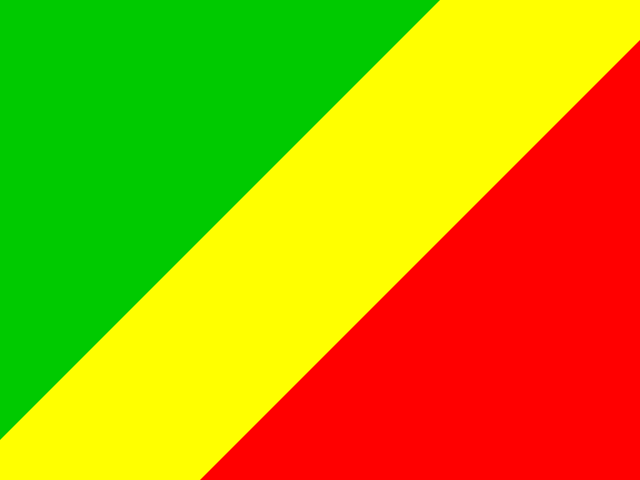
Divided diagonally by a yellow band rising from the lower hoist to the upper fly, with a green triangle at the hoist and a red triangle at the fly. These are the Pan-African colours, though no Congolese law or constitution assigns them a meaning - they are conventionally read as the forests, friendship and the struggle for independence, and the official Congolese readings of them differ.
Republic of the Congo FACTS ◢
| Capital | Brazzaville |
|---|---|
| Continent | Africa |
| Population | 6,484,437 (2025) |
| Area | 342,000 km² |
| Population density | 19/km² |
| Currency | Central African CFA franc (XAF) |
| Official language | French |
| Calling code | +242 |
| Internet TLD | .cg |
| Time zone | UTC+01:00 |
| Drives on the | Right |
| ISO codes | CG / COG |
DID YOU KNOW? ◢
- Much of the country is covered by rainforest, part of the Congo Basin - the world's second-largest tropical forest after the Amazon.
- Its Nouabalé-Ndoki National Park protects large populations of western lowland gorillas and forest elephants.
- The Congo River, which forms part of its border, is the deepest river in the world.
- The Equator runs directly through the country.
- Brazzaville, its capital, sits directly across the river from Kinshasa - one of the closest pairs of capital cities in the world.
Republic of the Congo QUICK ANSWERS ◢
What is the capital of the Republic of the Congo?
The capital of the Republic of the Congo is Brazzaville.
What is the population of the Republic of the Congo?
The Republic of the Congo had a population of 6,484,437 in 2025.
What currency does the Republic of the Congo use?
The Republic of the Congo uses the Central African CFA franc (XAF).
What languages are spoken in the Republic of the Congo?
The official language of the Republic of the Congo is French.
Think you know your flags? Play Flag Daily → · Browse all countries →
MORE ON THE FLAG ◢
Ask what the green, yellow and red of the Republic of the Congo's flag stand for and you will be given an answer. Forests, friendship, struggle. It is worth knowing where that answer is not: not in the law that created the flag, not in the act that restored it, and not in the constitution in force today.
All three describe the flag and stop. One of them describes it very precisely indeed, in metres and centimetres. On what any of it means, they say nothing.
This is Congo-Brazzaville, the smaller of the two Congos, and not DR Congo across the river. The meanings are real, and they are somebody's: two Congolese government websites supply them, and the two do not agree with each other.
Key Takeaways
- The flag was fixed by Loi constitutionnelle n° 8 of 18 August 1959 and gazetted a month later. That law assigns the colours no meaning.
- The gazette printed a dimensioned plate of the flag beneath the law: 1 m 80 by 1 m 20, with the yellow band cutting 0 m 60 off each long edge. The drawing, not the wording, is what shows the diagonal rising.
- It was abolished by the constitution of 30 December 1969, gazetted the following January, which put a bright red flag with crossed palms, a hoe and hammer and a star in its place.
- It was restored on 17 May 1991, not 10 June, by an act of the Conférence nationale souveraine that quoted the 1959 law back into force.
- The Presidency's own symbols page and the Congolese embassy in Canada publish two different readings of the colours. Neither cites an instrument.
| Instrument | Date | What it does to the flag | Where it stops |
|---|---|---|---|
| Loi constitutionnelle n° 8 | 18 Aug 1959 | Creates it: two right-angled triangles, diagonal yellow band, green at the staff | Geometry and a spearhead, plus a dimensioned plate on the same page |
| Constitution of the People's Republic, art. 5 | 30 Dec 1969 | Abolishes it: bright red, palms, a crossed hoe and hammer, a star | Description of the new emblem |
| Acte n° 002-91-PCN-RG, art. 1 | 17 May 1991 | Restores it, by naming and re-quoting the 1959 law | The 1959 wording, verbatim |
| Acte fondamental, art. 2 | 4 June 1991 | Carries it into the transitional constitution | Geometry, finial dropped |
| Constitution, art. 3 | 25 Oct 2015 | Keeps it, in the wording still in force | Geometry, plus a promise of a law |
Five instruments across fifty-six years, and not one of them says what the colours are for.
What does Congo-Brazzaville's constitution say about the flag?
Article 3, in three sentences. The Secrétariat Général du Gouvernement publishes the text adopted by referendum on 25 October 2015 as the constitution in force. It has been amended once since, by Loi constitutionnelle n° 2-2022 of 7 January 2022, which rewrote article 157 on states of emergency and left the symbols alone.
Article 3 reads: "L’emblème national est le drapeau tricolore, vert, jaune, rouge. De forme rectangulaire, il est composé de deux triangles rectangles de couleur verte et rouge, séparés par une bande jaune en diagonale, le vert étant du côté de la hampe. La loi précise les dimensions, les tons des couleurs et les autres détails du drapeau national."
The national emblem is the green, yellow and red tricolour: rectangular, two right-angled triangles of green and red separated by a diagonal yellow band, the green on the staff side, with the law to specify the dimensions, the tones of the colours and the other details.
That last clause is a promise, and a repeated one. The same sentence appears in article 6 of the People's Republic constitution of 1973, where it applies to the red flag rather than this one, in article 2 of the 1992 constitution and in article 5 of the 2002 one, each time deferring the flag's measurements and shades to a law.
Whether a law ever answered it has been reported three different ways. On Flags of the World, a contributor wrote in 2005 that he had been unable to locate any legislation on the flag; a second wrote in 2024 that he had found no colour specification law; and in 2014 a third reported finding the 1959 specification and gave its measurements. The three do not actually disagree. The dimensions were published in 1959, the tones never were, and a null result about one contributor's own search is not evidence that nothing exists.
It shows in the shades. In the same page's tabulation of published values, the Album des Pavillons gives Pantone 347c for the green, while the Beijing 2008 and London 2012 Olympic flag manuals both give 355.
Do the green, yellow and red of the Congo flag mean anything officially?
No instrument gives them a meaning. Two arms of the Congolese state do, and they part company on all three colours.
The Presidency of the Republic's national symbols page reads the flag as intentions rather than things. Green "est le symbole de l'espérance dans l'avenir économique et social du pays", the symbol of hope in the country's economic and social future. Yellow is "le symbole de la volonté d'union et du traditionnel sens de l'hospitalité légendaire du Congo", the will to unity and Congo's legendary sense of hospitality. Red "exprime le vœu le plus cher : que le courage et l'ardeur du peuple congolais lui permettent de gagner sa place parmi les nations civilisées du monde", the dearest wish, that the courage and ardour of the Congolese people win them their place among the civilised nations of the world.
The Congolese embassy in Canada, on its national emblems page, reads the same flag as geography and history: "La bande jaune symbolise l’amitié et la noblesse du peuple, tandis que la bande verte représente l’agriculture et les riches forêts du Congo. La couleur rouge est associée au sang versé lors de la lutte de l’indépendance." Yellow for friendship and the nobility of the people, green for agriculture and Congo's rich forests, red for the blood shed in the independence struggle.
Hope against forests. Unity and hospitality against friendship and nobility. A wish for the future against blood already spilled. The familiar forests-friendship-struggle reading is the embassy's, and the Presidency's own website publishes a different one.
Neither page cites an instrument, and there is nothing in the constitutional line from 1959 to 2015 for either of them to cite. Whether some subordinate text somewhere has ever glossed the colours is a narrower question, and neither page claims to be doing it.
Which way does the diagonal on the Congo flag run?
The band rises. It climbs from the lower hoist, beside the staff, to the upper fly, putting green in the top corner nearest the pole and red in the bottom corner furthest from it.
The constitutional wording does not settle that, and could not. All it fixes is that the green is "du côté de la hampe", on the staff side. Draw the band the other way, falling from the upper hoist to the lower fly, and the green triangle still runs the full length of the staff edge. Both slopes satisfy the only constraint the words impose, which is why one Flags of the World contributor wrote of a later restatement of the same sentence that the description "gives many graphical possibilities".
The words are not the whole page. Journal officiel n° 23 of 15 September 1959 carries the law on page 568, and it is short: article 1 draws the flag, article 2 says the law will be executed as a constitutional law of the Republic. It cites article 12 of Loi constitutionnelle n° 6 of 20 February 1959 as its authority, records that the Legislative Assembly of the Republic of the Congo deliberated and adopted it while the country was still an autonomous republic inside the French Community, and is signed at Brazzaville on 18 August 1959 by Abbé Fulbert Youlou, who as prime minister promulgated it.
Directly beneath that signature the gazette prints a scale drawing, headed "DRAPEAU DE LA REPUBLIQUE DU CONGO". The staff runs down the left edge as a thick black bar. The panels are lettered VERT at the top hoist, JAUNE across the middle and ROUGE at the bottom fly. And the plate is dimensioned: 1 m 80 along the top and bottom edges, 1 m 20 up the side, a ratio of two to three.
The band is dimensioned too. On the top edge it starts 1 m 20 out from the staff and runs the remaining 0 m 60 into the corner; on the bottom edge it takes the first 0 m 60 from the staff. So each of its two boundaries runs from one corner of the flag to a point a third of the way along the opposite edge: the green triangle's hypotenuse from the lower hoist corner up to the top edge, the red triangle's from the bottom edge up to the upper fly corner. The band reaches into the lower hoist and the upper fly, and slopes upward towards the fly. There is no reading of that drawing in which it falls.
How much weight the drawing carries is worth stating plainly, because the gazette does not state it. The plate has no caption calling it an annex, and neither of the law's two articles mentions it. It sits below the promulgating signature, which if anything puts it outside the enacted text. What it unambiguously is: the official gazette's own rendering of the flag the law had just created, printed on the same page, under the same signature, on the day the flag became law.
That is enough to settle the slope as a matter of evidence, and it is why six decades of constitutions restating the same sentence have never had to settle it in words. It is also why they go on promising a law about dimensions when the founding gazette had already printed them.
Independent confirmation arrived by post, forty years later. A vexillologist writing for Flags of the World obtained an official model from the Ministry of Information in Brazzaville under a covering letter dated 2 December 1999; he described a rising diagonal stripe contained entirely within the length of the flag and occupying one third of that length. The ministry's model and the 1959 plate agree, down to the third.
If you want to test whether you can pick this flag out from its neighbours, Flag Daily shows one flag a day and gives you three guesses at the country.
What flew over Congo-Brazzaville between 1970 and 1991
A bright red flag, and it was a party that hung it there.
The tricolour had already outlasted the colony by then. Independence came on 15 August 1960 with no change to the design, and the constitution of 2 March 1961 restated the flag in its opening article, in the wording every constitution since has used.
The founding congress of the Parti congolais du travail sat in Brazzaville from 28 to 30 December 1969 and adopted a constitution on the last of those days. Ordonnance n° 40-69 of 31 December promulgated it, and it was gazetted on 15 January 1970, which is why reference works date the change to 1970.
Article 5 renamed the state the People's Republic of the Congo and described its flag: rectangular, "de couleur rouge vif", bright red, struck in the upper hoist with an emblem of "deux palmes vertes croisées par le bas" and, between them, "une houe et un marteau croisés" in golden yellow, the whole surmounted by "une étoile jaune or à cinq branches", a five-pointed golden star.
Two green palm fronds crossed at the base, a hoe crossed with a hammer, a star above. The hoe is the detail worth keeping: the text pairs the hammer with a hoe rather than a sickle, and names the palms before either tool.
The same article gave the state a new motto, "Travail - Démocratie - Paix", in place of the 1959 motto that the restoring act of 1991 would print as "UNITE - TRAVAIL - PROGRES". By the constitution of 24 June 1973 the anthem had gone the same way: its article 6 gives the national anthem as "Les Trois Glorieuses", after 13, 14 and 15 August 1963, the three days that opened the way to single-party rule. The tricolour did not go alone.
The 1973 text is also where that flag picked up the promise of a law on its dimensions and shades, in the same words the tricolour's own constitutions use today. Nothing came of it for the red flag either.
The act that gave Congo its flag back, and the date printed instead
The single-party system was abandoned on 30 September 1990, and on 10 December that year the congress of the Parti congolais du travail renounced Marxism-Leninism. The Conférence nationale souveraine was convened by décret n° 91-015 of 9 February 1991, which its own acts cite in their opening lines, and met on 25 February presided over by the bishop of Owando, Monseigneur Ernest Kombo. Digithèque MJP's account has it proclaiming itself sovereign immediately and stripping the president of the greater part of his powers. Its instrument on the flag is short.
Acte n° 002-91-PCN-RG, portant restauration des symboles de la République, restores five things by naming the law that made each. Article 1 begins: "Sont restaurés, comme symboles officiels de la REPUBLIQUE DU CONGO : 1°/ Le drapeau de la République du Congo adopté par la Loi Constitutionnelle n° 8 du 18 Août 1959". It then copies that law out: "le drapeau de la République du Congo, de format rectangulaire, est composé de deux triangles rectangles de couleur verte et rouge, séparés par une bande jaune en diagonale, le vert étant du côté de la hampe. La hampe sera surmontée d'un fer de lance triangulaire".
One word of that is a fossil. The 1959 law says "de format rectangulaire"; every constitution from 1961 onward says "de forme rectangulaire". The act of 1991 is the one place the older word comes back, because restoring the flag meant copying the older text.
What the constitution in force added is the deferral to a law on dimensions and shades. What it dropped is the spearhead: the triangular finial is in the 1959 law and in the 1991 act that restored it, and in no constitution.
The act goes on to restore the motto and the anthem by their own 1959 laws, the state seal by a law of 11 January 1961 and the arms by a decree of 12 August 1963, and its article 2 makes the whole thing "exécutoire immédiatement et d'urgence", enforceable at once and as a matter of urgency.
It is signed at Brazzaville on 17 May 1991. Eighteen days later the conference adopted the Acte fondamental of 4 June 1991, whose article 2 restates the country's name and its flag together, and whose article 91 makes it serve as the constitution of the state until a permanent one has been approved by referendum and brought into application.
Flags of the World and the Congolese embassy in Canada both date the restoration to 10 June 1991. The flag had been law for more than three weeks by then, and the conference was not finished with it either: the same special gazette carries two further acts of the conference dated 13 June.
Frequently asked questions
What do the colours of the Congo-Brazzaville flag mean?
No Congolese law or constitution assigns them a meaning, so any answer is somebody's reading rather than a meaning fixed by an instrument. Two arms of the Congolese state publish readings, and the two differ. The Presidency's symbols page glosses green as hope in the economic and social future, yellow as the will to unity and to hospitality, and red as a wish for the country's standing in the world; the embassy in Canada gives agriculture and forests, friendship and nobility, and the blood of the independence struggle.
Which way does the yellow stripe on the Congolese flag slant?
Upwards, from the lower hoist beside the flagpole to the upper fly, leaving green in the top hoist corner and red in the bottom fly corner. The constitutional wording fixes only that the green lies on the staff side, which is true of either slope, but the dimensioned plate printed with the 1959 law shows the band rising, and an official model issued by the Ministry of Information in 1999 shows the same thing.
When was the flag of the Republic of the Congo adopted?
Loi constitutionnelle n° 8 fixed it on 18 August 1959, while the country was still an autonomous republic inside the French Community, and it appeared in the Journal officiel of 15 September 1959 over the signature of Abbé Fulbert Youlou. Independence followed on 15 August 1960 with no change to the design, and the constitution of 2 March 1961 carried the description into its opening article, altered by a single word.
Why did the Congo have a red flag?
The founding congress of the Parti congolais du travail adopted a constitution on 30 December 1969 renaming the country the People's Republic of the Congo and, in article 5, giving it a bright red flag charged in the upper hoist with two green palm fronds, a crossed hoe and hammer in golden yellow, and a five-pointed golden star. The motto went with it, and the anthem followed in 1973.
Are Congo-Brazzaville's colours the Pan-African colours?
Green, yellow and red are the Pan-African triad, adopted by Ghana in reference to Ethiopia, and Flags of the World counts the Congolese flag the fifth national flag to carry them. The resemblance is palette rather than law: no Congolese instrument calls the colours Pan-African or says why those three were chosen.
Sources
- Secrétariat Général du Gouvernement de la République du Congo, Constitution de la République du Congo - text adopted by referendum 25 October 2015, as amended by Loi constitutionnelle n° 2-2022 - retrieved 12 August 2026.
- Secrétariat Général du Gouvernement, Journal officiel n° 23, 15 septembre 1959, p. 568 - Loi constitutionnelle n° 8 du 18 août 1959 fixant le drapeau, with the dimensioned plate - retrieved 12 August 2026.
- Secrétariat Général du Gouvernement, Journal officiel, édition spéciale, juin 1991 - Acte n° 002-91-PCN-RG du 17 mai 1991 and the Acte fondamental du 4 juin 1991 - retrieved 12 August 2026.
- Secrétariat Général du Gouvernement, Journal officiel de la République Populaire du Congo, n° 2, 15 janvier 1970, p. 23 - Ordonnance n° 40-69 promulgating the Constitution of 30 December 1969 - retrieved 12 August 2026.
- Présidence de la République du Congo, Les Symboles - retrieved 12 August 2026.
- Ambassade de la République du Congo au Canada, Emblèmes Nationaux - retrieved 12 August 2026.
- Digithèque MJP, Université de Perpignan, Congo: lois constitutionnelles de 1959, Constitution du 2 mars 1961, Constitution du 24 juin 1973, Acte fondamental du 4 juin 1991, Constitution du 15 mars 1992 and Constitution du 20 janvier 2002 - retrieved 12 August 2026.
- Flags of the World, Congo (Congo-Brazzaville) - retrieved 12 August 2026.
PLAY ANOTHER →
A short message, hidden in a different cipher every day.
ONE CIPHER A DAYDAILYGuess the CountryThree clues, three guesses. Work out where in the world it is.
THREE CLUESDAILYOn This DayOne thing that happened today in history. Every day, a new one.
TODAY IN HISTORYDAILYDaily TriviaFive questions a day. Everyone gets the same five.
FIVE QUESTIONS