
Democratic Republic of the Congo
A giant straddling the equator, the Democratic Republic of the Congo is the second-largest country in Africa, laced by the mighty Congo River and cloaked in the world's second-largest rainforest.
WHAT THE FLAG MEANS ◢
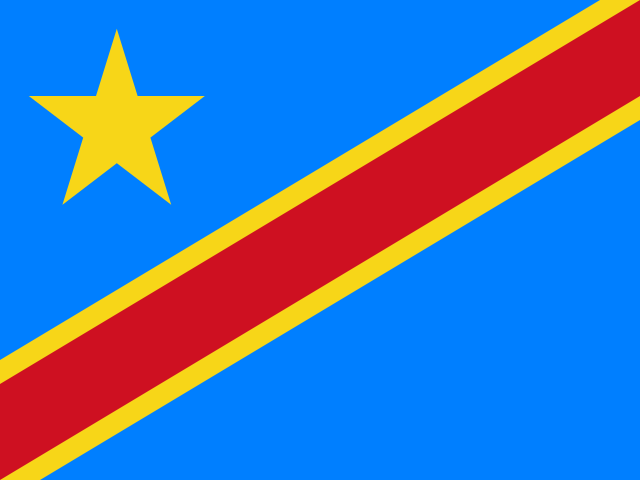
A sky-blue field crossed by a red diagonal stripe (edged in yellow) running from the lower hoist to the upper fly, with a yellow five-pointed star in the upper hoist corner. Article 1 of the constitution of 18 February 2006 sets out that design and assigns the colours no meaning at all. The readings in circulation come from the Presidency of the Republic, whose sheet on the national symbols gives blue for peace, the red band for the blood of the martyrs, yellow for the country's wealth, and the star for a country united and promised a radiant future.
Source: presidence.cd
Democratic Republic of the Congo FACTS ◢
| Capital | Kinshasa |
|---|---|
| Continent | Africa |
| Population | 112,832,473 (2025) |
| Area | 2,344,858 km² |
| Population density | 48/km² |
| Currency | Congolese franc (CDF) |
| Official language | French |
| Calling code | +243 |
| Internet TLD | .cd |
| Time zones | UTC+01:00, UTC+02:00 |
| Drives on the | Right |
| ISO codes | CD / COD |
DID YOU KNOW? ◢
- It's the second-largest country in Africa by area.
- The Congo River is the deepest river in the world and the second longest in Africa.
- It holds much of the Congo Basin, the world's second-largest tropical rainforest after the Amazon.
- It's the only place in the wild where the bonobo, one of humanity's closest relatives, lives.
- The okapi, a forest relative of the giraffe, is found only here.
Democratic Republic of the Congo QUICK ANSWERS ◢
What is the capital of the Democratic Republic of the Congo?
The capital of the Democratic Republic of the Congo is Kinshasa.
What is the population of the Democratic Republic of the Congo?
The Democratic Republic of the Congo had a population of 112,832,473 in 2025.
What currency does the Democratic Republic of the Congo use?
The Democratic Republic of the Congo uses the Congolese franc (CDF).
What languages are spoken in the Democratic Republic of the Congo?
The official language of the Democratic Republic of the Congo is French.
Think you know your flags? Play Flag Daily → · Browse all countries →
MORE ON THE FLAG ◢
The DR Congo flag is a sky-blue field, a yellow star in the top left corner, and a red band running corner to corner with a thin yellow edge. Almost every page that explains it hands you the same four readings: peace, the blood of martyrs, the country's wealth, a radiant future.
Those readings are official. They are simply not where people assume they are: the constitution describes the flag in a single sentence and gives no colour a meaning.
The meanings come from a one-page sheet on the national symbols published by the Presidency of the Republic. It also carries a word that most retellings drop.
Key Takeaways
- Article 1 of the constitution of 18 February 2006 describes the flag and assigns its colours nothing whatsoever.
- The presidency's symbols sheet does assign them, and it adds a word to the star: a country united and promised a radiant future.
- "United" is the half that usually goes missing from the retellings.
- The describing sentence is not new. It appears word for word in the constitutions of 1 August 1964 and 24 June 1967.
What do the colours on the DR Congo flag mean?
According to the presidency's own sheet on the national symbols, sky blue stands for peace, the red band represents the blood of the martyrs, and yellow is the sign of the country's wealth. The yellow star, it says, points to a country that is united and promised a radiant future.
Shortened summaries keep the radiant future and lose the unity, the half carrying a political claim rather than a hope. Article 2 lists 25 provinces alongside the city of Kinshasa, so unity is the harder half.
What article 1 actually says
Nothing about meaning. Article 1 reads, in the presidency's published text, that the emblem is the sky-blue flag decorated with a yellow star in the upper left corner and crossed on the bias by a red band finely edged in yellow. Then it moves on.
This is no accident of vagueness. The same article fixes the motto as "Justice, Paix, Travail", the anthem as "Debout Congolais", the currency as the Congolese franc, French as the official language, and Kikongo, Lingala, Swahili and Tshiluba as national languages.
The silence runs further than the colours. Article 1 gives no Pantone reference, no ratio, and no point count for the star, though every starred flag in the presidency's gallery is drawn with five points. That gap shows: the same gallery draws the pre-Zaire flags in a noticeably deeper blue than the one in force since 2006, while the constitutional wording across both eras is identical.
Why does the DR Congo flag look like a flag from the 1960s?
Because the sentence defining it was first written then, and 2006 put it back unchanged.
The Luluabourg constitution of 1 August 1964, approved at a referendum held from 25 June to 10 July 1964, opens with the same words: sky-blue flag, yellow star in the upper left corner, red band crossed on the bias and finely edged in yellow. The constitution of 24 June 1967 repeats it. The only difference between the 1964 and 2006 sentences is the opening clause naming whose emblem it is.
| Period | The flag then in force | Where it is written |
|---|---|---|
| 1963 to 1971 (the design from 1963; the wording from 1964) | Blue, yellow star upper hoist, red diagonal edged in yellow | Constitutions of 1 August 1964 and 24 June 1967, article 1 |
| 1971 to 1997 | Green, with an arm holding a lit torch on a yellow disc | Presidency's gallery of Congolese flags, Zaire era |
| 1997 to 2006 | Sky blue, a large yellow star at the centre, six small ones along the hoist | Transitional constitution of 2003, article 4 (from 2003) |
| 2006 onwards | Sky blue, yellow star upper left, red diagonal edged in yellow | Constitution of 18 February 2006, article 1 |
The transitional constitution is unusually precise about the flag the 2006 text replaced: six small yellow stars of identical size, arranged longitudinally on the hoist side. It says nothing about what any of them meant either.
The 2006 text dates itself twice, and not consistently. Its enacting formula records approval at a referendum held from 18 to 19 December 2005, while the editorial note the presidency prints above the same document says it was adopted on 18 February 2006 by popular referendum, which is the day it was promulgated and published in the Journal Officiel. The operative text is the one to follow.
Is it the same flag as the other Congo's?
Not remotely. DR Congo's neighbours run from Angola in the south-west to South Sudan in the north-east, and the one it gets confused with sits directly across the river.
- DR Congo, capital Kinshasa: sky blue, one yellow star, a red diagonal edged in yellow.
- Republic of the Congo, capital Brazzaville: a green triangle at the hoist and a red triangle at the fly, separated by a yellow diagonal band.
Brazzaville's article 3 leaves green, yellow and red unexplained, exactly as Kinshasa's article 1 leaves blue, red and yellow. Brazzaville does go further on specification: it hands the dimensions and the tones of the colours to ordinary law, where the Kinshasa text has no equivalent line.
The diagonal itself is not a Congolese trademark either. Tanzania, which DR Congo meets across Lake Tanganyika, splits its flag with a black diagonal edged in yellow on the same principle. The two differ in their colours rather than their construction, which is what makes them easy to mix up in a flag quiz.
Where did the blue and the yellow star come from?
From the colonial state, and the presidency says so plainly.
Its symbols sheet records that the first flag of the Congo was created for King Leopold II's Association internationale africaine and carried a five-pointed star at the centre of a dark blue field. The sheet attributes the design, with a note of doubt, to Henry Morton Stanley, and glosses the star as the light of civilisation illuminating black Africa. That flag served the Congo Free State and then the Belgian Congo.
Independence in 1960 kept the pairing and multiplied it: one large star with six smaller ones. The presidency's flag gallery dates the red band to 1963. So a yellow star on blue has flown over the territory, in one arrangement or another, for most of its recorded existence, with the Zaire years the single clean break.
Frequently asked questions
What does the star on the DR Congo flag stand for?
The presidency's sheet on the national symbols says it refers to a country that is united and promised a radiant future. That is an official gloss but not a constitutional one: article 1 mentions the star only to place it in the upper left corner.
Does the constitution explain the colours of the DR Congo flag?
No. The constitution of 18 February 2006 describes the design in one sentence and assigns no meaning to sky blue, red or yellow, though it fixes the motto, anthem and currency in the same article.
When did DR Congo adopt its current flag?
With the constitution its people approved at a referendum held from 18 to 19 December 2005, promulgated and published in the Journal Officiel special issue of 18 February 2006. The flag it replaced, in use from 1997, carried a large central star and six small ones.
What was the flag of Zaire?
Green, flown from 1971 to 1997 under the country's Zaire name. The presidency's gallery draws a lit torch held by an arm inside a yellow disc. It is the only design in the sequence without blue and yellow.
Why is there a thin yellow line along the red band?
Because the constitutional wording requires it: the band is finely edged in yellow. None of the constitutional texts, nor the presidency's symbols sheet, gives a reason, and the visible effect is that red never meets blue.
Sources
- Présidence de la République Démocratique du Congo, Symboles de la République: drapeau et signification de chaque couleur (includes "Galerie des drapeaux de la RD Congo", p. 2) - retrieved 12 August 2026.
- Présidence de la République Démocratique du Congo, Constitution de la République Démocratique du Congo du 18 février 2006 - retrieved 12 August 2026.
- Présidence de la République Démocratique du Congo, Constitution du 1er août 1964, dite constitution de Luluabourg - retrieved 12 August 2026.
- Présidence de la République Démocratique du Congo, Constitution de la République Démocratique du Congo du 24 juin 1967 - retrieved 12 August 2026.
- Présidence de la République Démocratique du Congo, Constitution de la Transition, 2003 - retrieved 12 August 2026.
- Constitute Project, Democratic Republic of the Congo's Constitution of 2005 with Amendments through 2011 - retrieved 12 August 2026.
- Constitute Project, Republic of the Congo's Constitution of 2015 - retrieved 12 August 2026.
PLAY ANOTHER →
One thing that happened today in history. Every day, a new one.
TODAY IN HISTORYDAILYDaily CryptogramOne quote, one scrambled alphabet. Crack it before tomorrow.
CRACK THE QUOTEDAILYDaily TriviaFive questions a day. Everyone gets the same five.
FIVE QUESTIONSDAILYDaily CodeA short message, hidden in a different cipher every day.
ONE CIPHER A DAY