
Tonga
A Polynesian kingdom of some 170 islands in the South Pacific, Tonga is the only nation in the region never brought under foreign rule and still ruled by its own monarch.
WHAT THE FLAG MEANS ◢
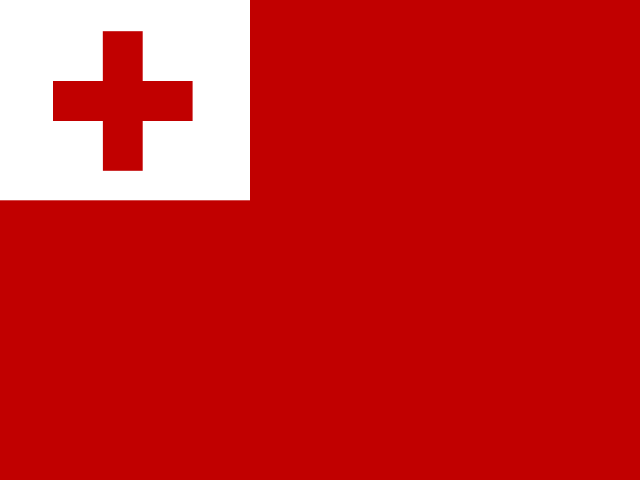
A red field with a white canton in the upper hoist bearing a red couped cross. Clause 47 of the 1875 constitution forbids the flag ever being altered but never describes it: it names no colours, no cross and no proportions, and identifies the flag only by reference, as the one King George was already flying. So no Tongan instrument assigns the design a meaning, and the readings in circulation, the cross for the kingdom's Christian foundation and the red for the blood of Christ, are conventional rather than official.
Tonga FACTS ◢
| Capital | Nukuʻalofa |
|---|---|
| Continent | Oceania |
| Population | 103,742 (2025) |
| Area | 749 km² |
| Population density | 139/km² |
| Currency | Tongan paʻanga (TOP) |
| Main languages | English, Tongan |
| Calling code | +676 |
| Internet TLD | .to |
| Time zone | UTC+13:00 |
| Drives on the | Left |
| ISO codes | TO / TON |
DID YOU KNOW? ◢
- It is the last remaining Polynesian kingdom, ruled by its own monarchy.
- It was never formally colonised by a foreign power.
- Sitting just west of the International Date Line, it is one of the first places on Earth to see each new day.
- The 2022 eruption of its Hunga Tonga volcano was one of the most powerful ever recorded.
Tonga QUICK ANSWERS ◢
What is the capital of Tonga?
The capital of Tonga is Nukuʻalofa.
What is the population of Tonga?
Tonga had a population of 103,742 in 2025.
What currency does Tonga use?
Tonga uses the Tongan paʻanga (TOP).
What languages are spoken in Tonga?
Tonga designates no official language. The languages of government and education are English and Tongan.
Think you know your flags? Play Flag Daily → · Browse all countries →
MORE ON THE FLAG ◢
Most countries can change their flag by passing a law. Tonga wrote a prohibition into its constitution in 1875 and has left it there ever since, which is why the Tonga flag is one of very few in the world that its own government has no lawful way to redesign. The clause is one sentence long, and the striking thing about it is what it leaves out: it forbids altering the flag without ever saying what the flag is.
The wording has survived a hundred and fifty years and at least one renumbering, unchanged word for word.
Key Takeaways
- Clause 47 reads: "The Flag of Tonga (the flag of King George) shall never be altered but shall always be the flag of this Kingdom and the present Royal Ensign shall always be the ensign of the Royal Family of Tonga."
- The Constitution was granted on 4 November 1875 and amended repeatedly in its first decade. The flag clause came through all of it untouched.
- It was clause 51 in the 1907 printing and is clause 47 now, with identical wording.
- The Constitution never describes the flag. It identifies it by reference, as the flag King George was already flying.
- Clause 79 lists three subjects amendments may not affect: the law of liberty, the succession to the Throne, and the titles and hereditary estates of the nobles. The flag is not among them.
Why has the Tonga flag never changed?
Because the Constitution says it may not, in terms that leave no room for a redesign.
Clause 47 of the Act of Constitution of Tonga reads in full:
The Flag of Tonga (the flag of King George) shall never be altered but shall always be the flag of this Kingdom and the present Royal Ensign shall always be the ensign of the Royal Family of Tonga.
That is the whole provision. It does two things: it forbids alteration, and it separately fixes the Royal Ensign as the ensign of the royal family, so the monarch's flag and the country's flag are settled in the same breath.
The instrument itself dates to 4 November 1875, when it was granted by the King. A 1907 printing of Tongan law reproduces the Constitution with the flag provision at clause 51, marginal note "National flag", in wording identical to the clause 47 that stands today. The renumbering happened; the sentence did not move.
The Constitution was amended a great deal, and this clause survived all of it
A prohibition is only interesting if it was tested, and Tonga's early constitutional history is not a quiet one.
The same 1907 printing carries the Constitution's own amendment record on its opening page.
| Date | Event |
|---|---|
| 4 November 1875 | Granted by the King |
| 31 July 1880 | Amended by the Legislative Assembly |
| 15 September 1882 | Ratified by the Legislative Assembly |
| 16 September 1882 | Sanctioned by the King |
| 19 October 1882 | Amended again |
| 23 October 1882 | Sanctioned by the King |
| 19 November 1885 | Amended again |
| 20 November 1885 | Sanctioned by the King |
| 1888 | Amended again |
Five rounds of amendment inside thirteen years, and the flag clause came through every one of them with its wording intact. Whatever else the Assembly was arguing about, it was not the flag.
Does the Constitution describe the Tonga flag?
No, and this is the part almost every account of it misses.
Clause 47 contains no colours. It does not mention a cross, a canton, a field, or any proportion. What it says is "the Flag of Tonga (the flag of King George)", and that parenthesis is doing all the work: it identifies the protected design by pointing at a flag that already existed and was already being flown by the reigning monarch.
That is an unusual drafting choice with a practical consequence. A constitution that describes its flag can be checked against the cloth. A constitution that names it by reference protects whatever that reference was understood to mean, and puts the burden of knowing on everyone who comes afterwards.
It also means the traditional readings of the Tongan flag are not constitutional ones. The design clause 47 protects is a red field with a white canton in the upper hoist bearing a red couped cross. The readings usually given for it (the cross for Christianity, the red for the blood of Christ, the white for purity) are not in clause 47. Nothing about the flag's appearance is. Those readings and the Constitution are not in conflict; they simply come from different places, and only one of them is law.
Tongan law of the period was perfectly capable of specifying a flag when it wanted to. The same 1907 volume sets out a customs officer's flag in exact terms: not less than four feet by two, the upper horizontal half blue and containing what it calls the Tongan Jack, the lower half white with the letters "H.M.C." on it. Flying one without being a customs officer carried a fine of up to two hundred and fifty dollars or two months' imprisonment.
Dimensions, colours, placement and a penalty, for a customs officer's flag. The national flag gets none of that in the Constitution, and none of it anywhere else in that volume either: outside clause 51, the only flags the book describes are working ones, the customs flag and the yellow quarantine flag.
Could the Tonga flag be changed if the country wanted to?
A second clause bears on this, and the two do not obviously sit together.
The Constitution sets out its own amendment procedure and, separately, a short list of subjects that amendments may not touch. In the 1907 printing that is clause 82, now clause 79, and the protected subjects are three: amendments "shall not affect the law of liberty the succession to the Throne and the titles and hereditary estates of the Nobles".
The flag is not on that list.
The same clause sets out how the Constitution's text is amended, in four steps:
- The amendment passes the Legislative Assembly three times.
- It is submitted to the King.
- The Privy Council and the Cabinet must be unanimously in favour.
- The King assents and signs, and it becomes law.
Whether a clause saying a thing shall never be altered can itself be altered is a question of Tongan constitutional law, not one for a flag page. What can be said without straying is that both things are true at once: clause 47 says the flag shall never be altered, and clause 79's list of protected subjects does not include it.
How unusual is a constitutional flag ban?
Unusual enough to be worth the whole article, and the contrast next door makes the point.
New Zealand put its national flag to two public referendums in 2015 and 2016, chose a challenger design, ran it against the incumbent, and kept the incumbent by 1,208,702 votes to 921,876. That is the ordinary modern position: a flag is a thing a country may reconsider, and occasionally does.
Tonga's Constitution closed that route on its face in the same sentence that fixed the flag, in the reign of the king it names, and no Tongan government since has had to hold the debate because the document held it for them.
If you want to see how many of these you can actually place, Flag Daily runs one a day, with factsheets for every country behind it.
Frequently asked questions
Can Tonga change its national flag?
Not under the Constitution as written. Clause 47 says the flag "shall never be altered", and that prohibition is constitutional and unambiguous. Clause 79 separately lists three subjects that amendments may not affect (the law of liberty, the succession to the Throne, and the titles and hereditary estates of the nobles) and the flag is not among them. Whether a clause saying a thing shall never be altered can itself be altered is a question of Tongan constitutional law rather than one a flag page can settle.
What does Tonga's Constitution say about the flag?
One sentence: "The Flag of Tonga (the flag of King George) shall never be altered but shall always be the flag of this Kingdom and the present Royal Ensign shall always be the ensign of the Royal Family of Tonga." That is the entire constitutional treatment of the national flag.
When was the Tonga flag adopted?
The Constitution containing the flag clause was granted on 4 November 1875. The clause protects a flag that was already flying rather than creating a new one, so the Constitution fixes the design in place rather than establishing it, and gives no adoption date of its own.
Does the Constitution say what the colours on the Tonga flag mean?
No. Clause 47 names no colours, no cross and no proportions, and assigns no meaning to anything. The readings usually given (the cross for Christianity, the red for the blood of Christ, the white for purity) are traditional rather than constitutional, because the Constitution does not describe the flag's elements at all.
Has the flag clause ever been renumbered?
Yes. A 1907 printing of Tongan law reproduces it as clause 51, under the marginal note "National flag". It is clause 47 in the Constitution as it stands today, and the wording is identical in both.
Sources
- Government of Tonga, The Law of the Government of Tonga (1907), full text - the Constitution of Tonga as printed, with the flag provision at clause 51, the amendment provision at clause 82, the grant and amendment dates on its opening page, and the customs officer's flag at section 758. Retrieved 10 August 2026.
- Comparative Constitutions Project, Constitution of Tonga, 1875 (rev. 2013) - the current text of clause 47 and the amendment restrictions in clause 79. Retrieved 10 August 2026.
- WIPO Lex, Act of Constitution of Tonga - the official listing for the instrument, giving its adoption date of 4 November 1875. The record's own PDF endpoint returned an HTML page rather than the document, so the text was read from the two sources above. Retrieved 10 August 2026.
- New Zealand Electoral Commission, Official result of the second referendum on the New Zealand flag - the 2016 result, for the comparison. Retrieved 10 August 2026.
PLAY ANOTHER →
One thing that happened today in history. Every day, a new one.
TODAY IN HISTORYDAILYDaily CryptogramOne quote, one scrambled alphabet. Crack it before tomorrow.
CRACK THE QUOTEDAILYGuess the CountryThree clues, three guesses. Work out where in the world it is.
THREE CLUESDAILYDaily CodeA short message, hidden in a different cipher every day.
ONE CIPHER A DAY