
Uganda
An equator-straddling slice of East Africa where snow-capped mountains meet the source of the Nile, and half the world's remaining mountain gorillas call the forests home.
WHAT THE FLAG MEANS ◢
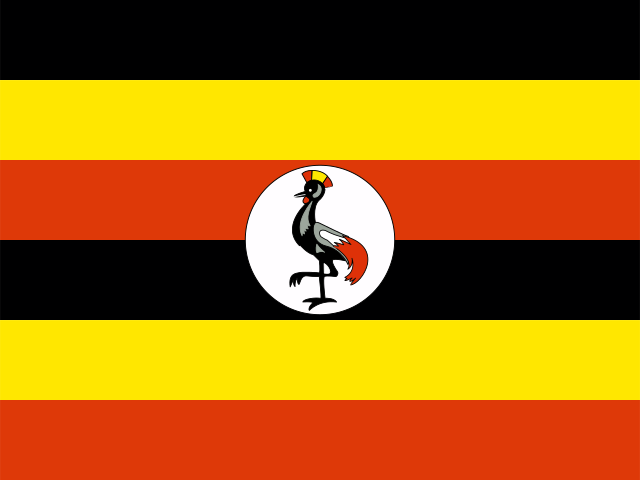
Six horizontal bands of black, yellow and red repeated twice, with the crested crane, Uganda's national bird, on a white circle in the centre. The National Flag and Armorial Ensigns Act of 1962 sets the design out in a single sentence of its Schedule and gives no element a meaning, and the constitution does not describe the flag at all. The black, yellow and red were the colours of the Uganda People's Congress, the party that won the election of April 1962. Ugandan state publications differ on the readings: the black as the African people or as African heritage and the country's soil, the yellow as Africa's sunshine or as Uganda's sunny days, and the red as African brotherhood or as the blood that links Ugandans to everyone else.
Uganda FACTS ◢
| Capital | Kampala |
|---|---|
| Continent | Africa |
| Population | 51,384,894 (2025) |
| Area | 241,038 km² |
| Population density | 213/km² |
| Currency | Ugandan shilling (UGX) |
| Official languages | English, Kiswahili |
| Calling code | +256 |
| Internet TLD | .ug |
| Time zone | UTC+03:00 |
| Drives on the | Left |
| ISO codes | UG / UGA |
DID YOU KNOW? ◢
- The White Nile begins its journey to the Mediterranean here, flowing out of Lake Victoria near Jinja.
- It shares Lake Victoria, Africa's largest lake, with neighbouring Kenya and Tanzania.
- Its Bwindi Impenetrable Forest shelters roughly half of all the mountain gorillas left on Earth.
- The Rwenzori Mountains carry permanent glaciers despite sitting almost exactly on the equator.
Uganda QUICK ANSWERS ◢
What is the capital of Uganda?
The capital of Uganda is Kampala.
What is the population of Uganda?
Uganda had a population of 51,384,894 in 2025.
What currency does Uganda use?
Uganda uses the Ugandan shilling (UGX).
What languages are spoken in Uganda?
The official languages of Uganda are English and Kiswahili.
Think you know your flags? Play Flag Daily → · Browse all countries →
MORE ON THE FLAG ◢
Black for the African people, yellow for sunshine, red for brotherhood. Ask what Uganda's flag means and that is the answer you get, from reference works and from Ugandan government websites alike.
The law that declares the flag does not say so. That instrument is the National Flag and Armorial Ensigns Act, Chapter 254 of the Laws of Uganda, which took effect on 9 October 1962, the day Uganda became independent. Its description of the flag is one sentence long. It assigns nothing a meaning.
There is a second thing the law leaves out, and it is the more interesting one. The black, yellow and red were not chosen for the country. They were the colours of the political party that won the election that April, replacing a flag that had been flying since March and that did come with published meanings.
Key Takeaways
- Part I of the Schedule to the 1962 Act describes the flag in one sentence and does not say what any of it means.
- The law's word for the bird is crested crane. It fixes no colour for it, no posture, and no direction for it to face.
- The word flag appears twice in the operative text of the 1995 Constitution, and neither place describes the design.
- The black, yellow and red came from the Uganda People's Congress, which won the April 1962 election and scrapped the provisional flag that had been flying since March.
- Two Ugandan state websites publish colour meanings that do not match each other, and neither matches the wording in Britannica.
| Element | What Part I of the Schedule says | What it does not say |
|---|---|---|
| The stripes | Six horizontal stripes of equal width, black, yellow, red, black, yellow and red from top to bottom | No shade, tint or colour standard for any of the three |
| The centre | A white circle | No diameter, and no proportion to the rest of the flag |
| The bird | A crested crane | No colour for it, no posture, and no direction for it to face |
| The flag overall | Nothing about its shape | No width to length ratio |
| Meaning | Nothing at all | No symbolism for a colour, for the circle or for the bird |
The one sentence that declares Uganda's flag
The whole of the design is in Part I of the Schedule, under the heading "Design of the national flag". Here it is, complete:
"Six horizontal stripes of equal width coloured from top to bottom black, yellow, red, black, yellow and red, with a crested crane on a white circle in the centre."
That is twenty-nine words. Section 2(1) of the Act does the declaring: "The flag of which the design is set out in Part I of the Schedule to this Act is declared to be the National Flag of Uganda." The long title says the Act exists to make provision for "the declaration of the national flag and armorial ensigns of Uganda and the protection thereof against disrespect and misuse". Declaration and protection, and nothing about interpretation.
What that sentence leaves open matters as much as what it fixes. The Act gives the crane no colour, so a description that calls the bird a grey crowned crane is describing the species rather than the instrument. It gives the flag no proportions either, so the familiar 2 to 3 ratio comes from elsewhere: Britannica states it, and no Ugandan text consulted for this article does.
The Act does the same job for the coat of arms in Part II of the same Schedule, and there the drafting is completely different. Part II is a full heraldic blazon, roughly four times as long, ending with the motto FOR GOD AND MY COUNTRY. It names the same bird in the same words, "a crested crane likewise proper", as the supporter on the sinister side. The drafter who could write a blazon that precise chose one plain sentence for the flag.
Where the black, yellow and red came from
They came from a party flag. Uganda's first post-independence government was formed by the Uganda People's Congress, and Britannica is blunt about the mechanism. The UPC's horizontal tricolour of black, yellow and red "was repeated to produce six equal horizontal stripes, and the crested crane was placed on a white disk in the centre".
The Ugandan daily New Vision reached the same conclusion from the Ugandan side in its 2012 independence jubilee series. Its report says the "predominant colours of the flag that was eventually adopted at Uganda’s independence are red and black, which are UPC’s", and that the new government's first order of business was to change the colours of the flag it had inherited.
So the doubling of the stripes is not decoration. It is what turns a three-band party flag into a six-band national one. A recollection published by New Vision, from a former information officer in the Ministry of Information and Broadcasting, adds that the stripes were repeated so that the flag would not look like the German flag, which is black, red and gold in three bands. That is one man's memory rather than a record, and it is worth holding lightly, but it fits what the same paper reports about the designer.
The flag Uganda nearly flew, and the meanings it did carry
There was already a flag. The Democratic Party government under Prime Minister Kiwanuka had appointed a committee to design the national symbols, chaired by Professor Senteza Kajubi, and that committee produced a provisional flag in the DP's own colours.
The published descriptions of it do not agree. Britannica describes vertical stripes of green, blue and green separated by narrower yellow stripes, with the silhouette of a yellow crane in the centre. New Vision, in its own voice, describes "green, two strips of yellow and blue with the Crested Crane standing on one leg in the middle". Those two agree on the colours and on the crane. A third account, the New Vision recollection by Kavuma-Kaggwa, calls it simply "The white and green flag which had been designed by the late Ben Kiwanuka". New Vision dates its use to between March and October 1962.
Here is the part that matters for a page about meanings. The rejected flag had them, and they were stated. Kajubi told New Vision: "The original flag presented to the Cabinet had the colour blue to represent the water bodies of Uganda, yellow for the tropics and green to represent the natural vegetation of the country."
Then the DP lost the election of 25 April 1962 to the UPC and its Kabaka Yekka allies, and the flag went with the government. Kajubi's own summary of the committee's position is short: "We had been appointed by the DP government, but we were now reporting to the UPC government".
The stated reason for dropping it was not politics. Kajubi said the flag was rejected on the grounds that the colour green fades. Grace Ibingira gave the same technical account and attributed it to the flag's manufacturers, Messrs Porter Bros. They reportedly said the green was pale and would fade fast in Uganda's hot sun, and that the blue did not match anything Ugandan.
New Vision records that some people believe the real reason was political intrigue, and prints both readings without settling between them.
Who designed the flag of Uganda?
Grace Ibingira, the Minister of Justice, is the name attached to it. Britannica describes the adopted design as recommended by him. New Vision calls him "a cabinet minister with artistic capabilities". It reports that the UPC and Kabaka Yekka cabinet met at Entebbe on 8 May 1962 and appointed a sub-committee under him, with the health minister E.B.S. Lumu, the information minister Adoko Nekyon and Cuthbert Obwangor. The committee reportedly asked him to make the selections and submit samples, and two were shortlisted. The full cabinet chose the present flag at Entebbe on 16 May 1962.
The same account puts a second name in the room. Ibingira liked the flag of West Germany and took that idea to Professor Cecil Todd at Makerere University, who, in Kajubi's telling, "came up with the present day flag". Todd, the committee's artistic advisor, then endorsed the choice at cabinet. New Vision also records that a Paul Mukasa is credited by some as one of the designers.
And there is a claimant. In 2007 Semei Nyai Matia, a retired teacher from Maracha, said he had answered radio announcements calling for flag designs and that the committee took his idea. He was asking for compensation of 1.5 billion shillings, a commercial building and a truck. His account of his own submission is worth reading beside the official gloss, because it is a set of meanings of his own, different again: "Black stood for the African people and land, yellow for sunshine on the tropical equator zone, red for bloodshed in the struggle for Uganda’s peace and self-determination." He says a later call asked entrants to improve their designs, and that he then doubled each colour band and inserted a crested crane in the middle. The date he gives for that second call is May 1961, a year before the cabinet meetings that settled the design. Kajubi's answer, in the same article, was that the announcements never promised any reward.
The credit has never been formally settled. The record supports this much: the design was decided at cabinet level rather than by the committee, in the eight days between 8 and 16 May 1962, and Ibingira chaired the group that put it there.
Who says black means the African people?
Not the Act. Four documents that describe the flag as adopted carry a reading, they do not agree, and two of them are more closely related than they look.
The Embassy of the Republic of Uganda in Washington publishes one version, repeated word for word by the High Commission in Pretoria: "The three colours are representative of African peoples (black), Africa’s sunshine (yellow), and African brotherhood (red being the colour of blood, through which all Africans are connected)."
Uganda's own site for its chairmanship of the Non-Aligned Movement, run from the foreign ministry's address in Kampala, gives something different: "Black symbolizes our African heritage and the fertile soils of Uganda; Yellow represents the glorious sunny days, so characteristic of Uganda; and Red is symbolic of the blood that runs through our veins and that links us to the rest of humankind."
Read them side by side and the differences are not cosmetic. The embassy black is a people, while the NAM black is a heritage plus the country's soil. The yellow belongs to Africa on one page and to Uganda on the other. The embassy red connects Africans to each other, while the NAM red connects Ugandans to everybody. Neither is wrong, because neither is law, and neither has anything to override it.
Britannica's Uganda flag article, credited to Whitney Smith of the Flag Research Center, gives a third and shorter form and ties it to the designer. In the design "recommended by Minister of Justice Grace Ibingira", it says, "black stood for the Ugandan people, yellow for sunshine, and red for brotherhood". That reading is about Ugandans rather than Africans, where both Ugandan pages say Africans.
The fourth is no longer online. The CIA World Factbook, until it was sunset in February 2026, told readers that "black symbolizes the African people, yellow sunshine and vitality, red African brotherhood". The phrase "and vitality" appears in no Ugandan source consulted for this article.
Two of those four are not independent of each other. The embassy's description of the flag's design and the Factbook's are the same sentence: from "six equal horizontal bands of black (top)" to "facing the hoist side" they differ in four things and nothing else: an added "(bottom)", disk against disc, center against centre, and the parenthetical "the national symbol" unbracketed and moved in front of the bird.
Their colour readings are not the same sentence. The embassy's is longer and adds a clause the Factbook has no equivalent of, though the three assignments underneath are the same: the African people for the black, sunshine for the yellow, African brotherhood for the red. What the two texts demonstrably share is the description of the design. Which took the design sentence from which cannot be settled from the sources consulted for this article.
The white circle is where the readings run out. No Ugandan government website and no reference work consulted for this article says what it stands for. One account does: the New Vision recollection that supplies the doubled-stripes story says Kiwanuka "protested very strongly and insisted that one of the two Democratic Party colours must be on the National Flag, then the white colour which symbolises peace, was put in the middle of the Uganda Flag". That is a single memory, from the account that also describes the rejected flag as white and green where every other description of it says otherwise.
Why is there a crane on the Uganda flag?
Because it was already on the flag before it, and on the one before that.
Britannica's explanation is that Buganda, one of the kingdoms of Uganda, was one of the few precolonial African states with a flag of its own, and that "to avoid utilizing any flag, symbol, or totem associated with a particular area, the British selected a crested crane as the badge for use on the British Blue Ensign and in other official banners for Uganda". A bird picked because it belonged to no one region.
Ibingira's own stated reason, as reported by New Vision, follows from that: he included the crane for its gentle qualities and because it was already a national symbol, in use on the colonial flag and present on the provisional flag as well.
The Factbook told it differently again, saying "the crane was the military badge of Ugandan soldiers under the UK". That is a narrower colonial origin than a territorial badge on a Blue Ensign, and no other source consulted for this article carries it.
The naming is worth a note, because the law and the state's own websites use different words for the same bird. The Act says crested crane, in both the flag design and the blazon of the arms, and so do the NAM page and New Vision.
The Washington embassy uses both words on one page, and the split follows the sentences. Its description of the flag says grey crowned crane, and that is the sentence it shares with the Factbook. Its description of the coat of arms is not part of that shared sentence and appears nowhere in the Factbook entry, and it says "a Crested Crane, a subspecies of the Grey-crowned Crane and the national bird of Uganda". Crested crane is the word the statute uses.
The Act fixes no posture for the bird and no direction for it to face. The phrase that does fix the direction, "facing the hoist side", sits inside the sentence the embassy shares with the Factbook, so it is not an independently attested Ugandan account of the flag any more than it is a statutory requirement. As for what the bird means, the NAM site is the only Ugandan government website consulted for this article that gives the crane itself a reading, and it reads the bird as a whole rather than any part of it: the crested crane is Uganda's national emblem, "which symbolizes Uganda's forward movement".
The constitution mentions the flag twice and describes it neither time
In the operative text of the 1995 Constitution the word flag appears twice, and neither appearance is a description.
Article 8, headed "National symbols and seals", is a continuation clause. It provides that the National Flag, the National Coat of Arms, the Public Seal, the National Anthem and the seals of the Courts of Judicature "in use immediately before the coming into force of this Constitution" shall "continue to be in use". It describes none of them. It does not name the Act. It simply keeps whatever was flying.
The second mention is a duty rather than a description. Article 17(1)(a) makes it a duty of every citizen "to respect the national anthem, flag, coat of arms and currency".
So the design has never been written into the constitution. It rests on an ordinary Act of 1962, and the constitution's contribution is to keep whatever was flying when it came into force flying afterwards.
What Ugandan law makes an offence
There are two prohibitions, both short, and one of them carries a prison term and no fine at all.
Section 3(1) covers contempt. Anyone who does an act, utters words or publishes writing "with intent to bring into contempt or ridicule the national flag or armorial ensigns or any representation thereof" commits an offence. The penalty is "imprisonment for a period not exceeding two years", and there is no fine. Section 3(2) adds that a non-citizen convicted under it may be ordered deported.
Section 4 covers commerce. Using the flag or the arms in connection with any business, trade, calling or profession, without the Minister's authority and in a manner calculated to suggest you are authorised, is an offence. Until 2023 the penalty was a fine not exceeding one thousand shillings, or six months in prison, or both. The Law Revision (Miscellaneous Amendments) Act 2023 converted that fine, listing Cap. 254 section 4(2) in its Schedule 4 with an equivalent of two hundred and forty thousand shillings and a substituted figure of twelve currency points. The design sentence was not touched.
Section 5 lets the Minister make regulations "prescribing the occasions upon which, the persons by whom and the manner in which the national flag or the armorial ensigns may be flown or displayed", and also to prohibit or restrict its use. Uganda's legal information institute serves its statute pages behind a block that refused every method tried for this article, so whether any regulations have been made under section 5 could not be established. No such detail is in the Act itself.
None of that helps you recognise the thing at speed, which is a separate skill. Flag Daily shows you a flag and gives you three guesses at the country, and six stripes plus a bird on a disc turns out to be a lot to hold in your head at once.
Frequently asked questions
What do the colours of the Uganda flag mean?
The Act that declares the flag assigns them no meaning, and the constitution does not describe the flag at all. Whether any regulations made under section 5 of the Act say more could not be established, because Uganda's legal information institute blocks its own statute pages. The familiar reading of black for the African people, yellow for sunshine and red for brotherhood is published by Ugandan embassies and by reference works, and different state pages word it differently.
Why does the Uganda flag have a crane on it?
The crested crane was chosen by the British, according to Britannica, as the badge for use on the British Blue Ensign and in Uganda's other official banners, because it belonged to no one region in a territory where Buganda already had a flag of its own. It carried over to the 1962 provisional flag and then to the independence flag. Grace Ibingira said he kept it because it was already a national symbol and for the bird's gentle qualities.
When was the Uganda flag adopted?
The National Flag and Armorial Ensigns Act took effect on 9 October 1962, the day of independence. The design itself was settled earlier: New Vision reports that the full cabinet chose it at Entebbe on 16 May 1962, and Britannica dates the flag's establishment to May 1962 in anticipation of independence in October.
Who designed the Uganda flag?
Grace Ibingira, then Minister of Justice, is credited with recommending the adopted design, and he chaired the cabinet sub-committee that selected it. Professor Cecil Todd of Makerere University is credited by the committee's chairman with coming up with the design itself. New Vision also records a claim by Paul Mukasa and a public claim by Semei Nyai Matia, and the credit has never been formally settled.
Is it illegal to misuse the Uganda flag?
Yes, on two counts. Section 3 of the Act makes it an offence to act, speak or publish with intent to bring the flag into contempt or ridicule, punishable by up to two years in prison. Section 4 makes unauthorised commercial use an offence, with a fine converted in 2023 to twelve currency points, or up to six months in prison, or both.
Sources
- Uganda Legal Information Institute and Laws.Africa, National Flag and Armorial Ensigns Act, Chapter 254 (PDF), consolidated text as at 31 December 2000, cited as
/akn/ug/act/ord/1962/64/eng@2000-12-31- retrieved 27 August 2026. The linked PDF is the copy that was read, character for character. The HTML pages of ulii.org returned 403 to every method tried, so no second copy of the Act was obtainable and every claim about its wording rests on this one consolidation. Its own note records it as the text as it stood at 31 December 2000, with Act 17 of 2023 listed as an outstanding amendment not yet applied; the 2023 change described here is taken from the text of Act 17 itself. A further note in the same document refers to a later Law Reform Commission consolidation as at 31 December 2023, which was not obtainable. - The Law Revision (Miscellaneous Amendments) Act, 2023, Acts Supplement No. 10 to the Uganda Gazette No. 51, Volume CXVI, 28 July 2023, Schedule 4 item 39 - copy retrieved from uapa.or.ug on 27 August 2026, because parliament.go.ug returned 404 for its own document pages.
- Constitution of the Republic of Uganda, 1995, as amended to 2017, articles 8 and 17 - retrieved 27 August 2026. Cross-checked against a second copy of the same text. The two differ only in capitalisation and one comma.
- Embassy of the Republic of Uganda, Washington DC, National Symbols - retrieved 27 August 2026. The identical text is published by the Uganda High Commission in Pretoria.
- Republic of Uganda, Non-Aligned Movement Chairmanship 2024-2027, National Symbols - retrieved 27 August 2026.
- Whitney Smith, Flag of Uganda, Encyclopaedia Britannica - read from the Internet Archive capture of 21 July 2026, because britannica.com was not reachable for this article.
- Michael Kanaabi and Richard Drasimaku, Intrigue and manoeuvres in designing the Uganda flag, New Vision, independence jubilee series, 2012 - retrieved 27 August 2026.
- Kavuma-Kaggwa, The origin of the anthem, flag and emblem, New Vision, undated - retrieved 27 August 2026. A first-person recollection by a former information officer in the Ministry of Information and Broadcasting, and the only account consulted for this article that reads the white circle.
- CIA World Factbook, Uganda, country entry - read from the Internet Archive capture of 30 May 2018. The publication was sunset on 4 February 2026 and its pages now redirect to a notice; it is cited here only as the source of a wording that circulates.
PLAY ANOTHER →
Three clues, three guesses. Work out where in the world it is.
THREE CLUESDAILYDaily CryptogramOne quote, one scrambled alphabet. Crack it before tomorrow.
CRACK THE QUOTEDAILYDaily TriviaFive questions a day. Everyone gets the same five.
FIVE QUESTIONSDAILYDaily CodeA short message, hidden in a different cipher every day.
ONE CIPHER A DAY