
Vanuatu
An archipelago of some 80 islands in the South Pacific, Vanuatu is a place where villagers dive from wooden towers with vines around their ankles, inspiring modern bungee jumping.
WHAT THE FLAG MEANS ◢
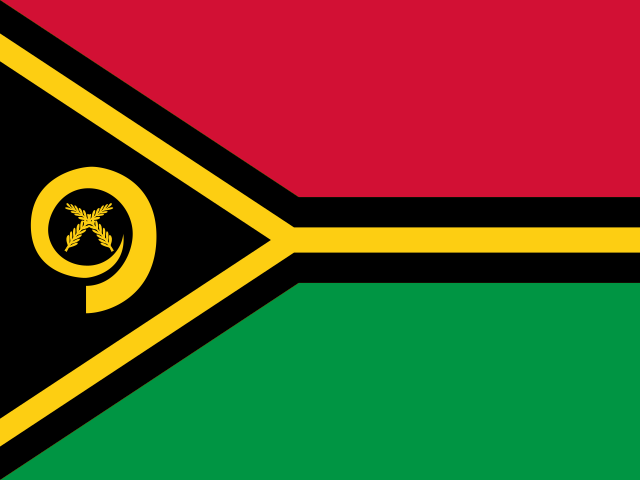
Red and green bands split by a black horizontal Y edged in yellow, with a boar's tusk enclosing two crossed namele fern fronds in the black triangle at the hoist. The constitution has no flag provision. The red is conventionally read for blood and human unity, the green for the richness of the land, the black for the ni-Vanuatu people, and the yellow Y for the layout of the islands and the light of the gospel, with the tusk for prosperity and the fern fronds for peace.
Vanuatu FACTS ◢
| Capital | Port Vila |
|---|---|
| Continent | Insular Oceania |
| Population | 335,169 (2025) |
| Area | 12,190 km² |
| Population density | 27/km² |
| Currency | Vanuatu vatus (VUV) |
| Official languages | Bislama, English, French |
| Calling code | +678 |
| Internet TLD | .vu |
| Time zone | UTC+11:00 |
| Drives on the | Right |
| ISO codes | VU / VUT |
DID YOU KNOW? ◢
- The land-diving ritual of Pentecost Island is widely credited as the inspiration for bungee jumping.
- It sits on the Pacific Ring of Fire and hosts several active volcanoes, including Mount Yasur.
- It regularly ranks among the world's happiest nations despite modest incomes.
- More than 100 distinct local languages are spoken across its islands, one of the highest densities on Earth.
Vanuatu QUICK ANSWERS ◢
What is the capital of Vanuatu?
The capital of Vanuatu is Port Vila.
What is the population of Vanuatu?
Vanuatu had a population of 335,169 in 2025.
What currency does Vanuatu use?
Vanuatu uses the Vanuatu vatus (VUV).
What languages are spoken in Vanuatu?
The official languages of Vanuatu are Bislama, English and French.
Think you know your flags? Play Flag Daily → · Browse all countries →
MORE ON THE FLAG ◢
The two objects inside the black triangle on Vanuatu's flag are a boar's tusk and two crossed fronds of the namele fern. Both are conventionally identified as custom objects, and the constitution names neither.
Hold that beside what Vanuatu's constitution does with custom. It makes the rules of custom the basis of who owns the country's land. It gives chiefs a council with constitutional standing and a right to be consulted on any bill. It declares Bislama the national language and undertakes to protect the different local languages as part of the national heritage. It makes it a duty of every parent to teach their children the culture and customs of the people of Vanuatu.
And it never mentions the tusk, the fern or the flag they sit on. Search the whole document: flag, tusk, namele, emblem, coat of arms and national anthem all return nothing.
Key Takeaways
- The Constitution of the Republic of Vanuatu contains no occurrence of the word flag, and none of tusk, namele, emblem, coat of arms or national anthem.
- Article 73 makes all land in Vanuatu the property of the indigenous custom owners and their descendants, and article 74 makes the rules of custom the basis of ownership and use.
- The Malvatumauri Council of Chiefs is a constitutional body with general competence to discuss all matters relating to land, custom and tradition, and must be consulted on any question in connection with any bill before Parliament.
- Article 3 gives an entire constitutional article to language, and undertakes to protect the different local languages as part of the national heritage.
- Article 7 makes it a fundamental duty of a parent to teach their children the culture and customs of the people of Vanuatu.
The constitution's first chapter is four articles, and one of them is language
Chapter 1 of the Constitution of the Republic of Vanuatu is headed THE STATE AND SOVEREIGNTY. It is short. Article 1 says the Republic of Vanuatu is a sovereign democratic state. Article 2 says the Constitution is the supreme law. Article 4 covers national sovereignty, the franchise and political parties.
Article 3 is the odd one out, and it arrives early:
"The national language of the Republic of Vanuatu is Bislama. The official languages are Bislama, English and French. The principal languages of education are English and French."
Three tiers, in three sentences: one national language, three official ones, two for schools. Then a second paragraph that is doing something else entirely:
"The Republic of Vanuatu shall protect the different local languages which are part of the national heritage, and may declare one of them as a national language."
That is a constitution naming a category of national heritage and putting the state under a duty to protect it. It is precisely the move a symbols article makes. Vanuatu makes it about languages, in its first chapter, and never makes it about the flag.
Article 64, much later, carries the arrangement into daily life. A citizen of Vanuatu may obtain, "in the official language that he uses, the services which he may rightfully expect from the administration of the Republic of Vanuatu".
In Vanuatu's constitution custom is not a decoration, it is the basis of land
Chapter 12 of the constitution opens with two articles of one sentence each, and between them they decide who owns the country.
"All land in the Republic of Vanuatu belongs to the indigenous custom owners and their descendants."
That is article 73, entire. Article 74 follows:
"The rules of custom shall form the basis of ownership and use of land in the Republic of Vanuatu."
Article 75 restricts perpetual ownership to indigenous citizens who acquired their land under a recognised system of land tenure. Article 76 requires Parliament to legislate for all of it, and to consult the Malvatumauri Council of Chiefs before doing so.
A constitution that puts custom at the foundation of property, and that requires chiefs to be consulted before Parliament may implement it, is not a document that treats custom as ornament. Which makes the treatment of the two custom objects on the national flag more striking rather than less. They are not mentioned.
The chiefs have a constitutional council for custom, and the flag never reaches it
Chapter 5 establishes the Malvatumauri Council of Chiefs, and article 30 gives it its remit:
"The Malvatumauri Council of Chiefs has a general competence to discuss all matters relating to land, custom and tradition and may make recommendations for the preservation and promotion of ni-Vanuatu culture and languages."
The second paragraph is stronger than the first:
"The Council must be consulted on any question, particularly any question relating to land, tradition and custom, in connection with any bill before Parliament."
Must, not may. The article imposes the duty and attaches no consequence to breaching it, which is worth noting rather than glossing over, but the duty is stated in terms.
So Vanuatu has a standing constitutional body whose subject is custom, which must be consulted on any question in connection with any bill before Parliament, and a flag whose central charge is a pair of custom objects. Nothing in the constitution connects the two, because nothing in the constitution mentions the flag.
Solomon Islands reached independence two years earlier, and the Solomon Islands flag is the companion piece to this one.
The duty to hand on custom is in the constitution too
Vanuatu's constitution does something in its second chapter that is worth stopping on: after listing fundamental rights, it lists fundamental duties. Article 7 has nine of them, owed by every person "to himself and his descendants and to others".
One is the duty "to protect the Republic of Vanuatu and to safeguard the national wealth, resources and environment in the interests of the present generation and of future generations". Another, the eighth, is directed at parents:
"in the case of a parent, to support, assist and educate all his children, legitimate and illegitimate, and in particular to give them a true understanding of their fundamental rights and duties and of the national objectives and of the culture and customs of the people of Vanuatu"
A constitutional duty to teach your children the culture and customs of the people of Vanuatu. Article 8 then makes the duties non-justiciable except as provided by law, so it is not a duty a court will ordinarily enforce, but it is written down and it is in the same instrument.
That instrument names Bislama, names custom, names the chiefs, names the custom owners of land, and requires a parent to pass the culture on. It never names the thing you would fly.
Five Acts, three decades, and the word flag never appears
The consolidated edition published by the Parliament of Vanuatu prints five Acts beneath the title, with no label of any kind:
| Act | Year |
|---|---|
| Act 10 | 1980 |
| Act 15 | 1981 |
| Act 20 | 1983 |
| Act 24 | 2006 |
| Act 27 | 2013 |
The edition does not say which of them is the principal Act and which are amending, and the commencement note sits separately, attached to the Constitution rather than to any one Act.
So the safe reading is the plain one. The text was reopened by Act across three decades, from 1980 to 2013, and the word flag is absent from the consolidated text those Acts produced.
That matters because a flag clause is about the smallest amendment a legislature could be asked to make, though article 85 sets a real bar for any of them: two thirds of all the members at a special sitting, with three quarters present, or the same majority a week later if that quorum fails. Whichever of those five is the founding Act, the others were opportunities, and none of them was used for this.
The document it kept reopening has a great deal to say about who the people of Vanuatu are.
Article 5 guarantees its rights without discrimination on grounds that include "religious or traditional beliefs", putting traditional belief alongside religion as a protected characteristic. Chapter 3 builds citizenship around the Day of Independence, a phrase that recurs through articles 9, 10 and 11 and twelve times more later in the document. Article 7 sets out duties that article 8 makes non-justiciable except as provided by law, and sets them out anyway.
The word symbol does not appear in the constitution at all. The verb does, exactly once, and it is about a person rather than an object: article 33 says the head of the Republic "shall symbolise the unity of the nation". That is the whole of the document's symbolism, and it is vested in the President.
The flag, the emblem, the coat of arms and the anthem are the pieces of national furniture the consolidated text does not contain, after the three decades those five Acts span.
What Parliament says the Constitution was for
What Parliament does publish is an account of what the constitution was for, and it is worth reading beside the flag. Its legislation page walks Chapter 1 through six topics: democracy and the election of members, the government's administration of the country, the Mama Law as the highest law, then the national and official languages across three sentences, then the franchise and the secret ballot, then political parties. Language gets more of that summary than anything else in it. The page gives the Council of Chiefs as the body with "the important job of advising the Government about preserving Vanuatu customs and traditions". The word flag does not occur anywhere on it, and neither does any other national symbol.
The same page carries the founding account in the first President's words, reproduced from an interview he gave the news service TIV. Ati George Sokomanu, whom the page describes as elected the first President of Vanuatu, is quoted on what a new country needs:
"When a country achieves self-reliance, it needs to have a statue, something to bind everyone and start us off as we go through our journey"
The page prints statue, and prints it in its navigation and footer too; from the sentence around it the word plainly wanted is statute, and the thing Sokomanu is describing is the Constitution, which the page calls the Mama Law, Mama being the Bislama for mother. Something to bind everyone. The document they wrote to do that binding is the one with no flag in it.
Parliament's page also gives the name: on independence the New Hebrides became Vanuatu, which it glosses as "our land forever", and says the Mama Law was formed "to safeguard those achievements, and to cherish our ethnic, linguistic and cultural diversity". The achievement the page has just described is the freedom the leaders struggled for, which it says they were proud of.
No Vanuatu flag law could be found
Every colour on the flag has a conventional reading attached to it, and so do the two objects, and not one of those readings is in the constitution. The constitution does not discuss the flag at all.
No Vanuatu statute or government description of the flag could be found. The consolidated legislation the Parliament publishes is not a text but a set of links out to PACLII, the regional legal information institute, and no page read on the government portal, the Vanuatu Cultural Centre or the Parliament describes the flag. If Vanuatu has a flag Act, this piece has not read it, and nothing here assumes one either way.
Which leaves a country that wrote custom into its supreme law at every level except the one you can see from a distance.
If you would rather see how many of these you can pick out before anybody explains them, Flag Daily shows you one a day and gives you three guesses at the country.
Frequently asked questions
What do the colours of the Vanuatu flag mean?
There is a conventional reading: red for blood and human unity, green for the richness of the land, black for the ni-Vanuatu people, and yellow for the light of the gospel and the layout of the islands. It appears in no instrument opened for this article, and the constitution, which is the instrument a reader would expect to carry it, does not mention the flag at all.
The word flag appears nowhere in the Constitution of the Republic of Vanuatu, and no Vanuatu statute on the flag could be found.
What is the symbol on the Vanuatu flag?
A boar's tusk with two crossed fronds of the namele fern inside it, set in the black triangle at the hoist.
Neither object is named in the constitution. The whole document returns nothing for tusk and nothing for namele, even though the same document makes the rules of custom the basis of land ownership and gives chiefs a council with general competence to discuss custom and tradition.
Does the constitution of Vanuatu describe the flag?
No. It contains no occurrence of the word flag, and none of tusk, namele, emblem, coat of arms or national anthem either.
What it does contain is an article giving Bislama, English and French their statuses and undertaking to protect the local languages as national heritage, a chapter vesting all land in the indigenous custom owners, a chapter establishing the Malvatumauri Council of Chiefs, and a fundamental duty on parents to teach their children the culture and customs of the people of Vanuatu.
What is the Malvatumauri Council of Chiefs?
A constitutional body, established by Chapter 5 of Vanuatu's constitution, with general competence to discuss all matters relating to land, custom and tradition, and to recommend measures for the preservation and promotion of ni-Vanuatu culture and languages.
Article 30 also provides that the Council must be consulted on any question in connection with any bill before Parliament, particularly a question relating to land, tradition or custom. The constitution gives it no role concerning the flag, because the constitution does not mention the flag.
Is there a Vanuatu law that defines the flag?
None could be found. The constitution does not describe the flag, and no statute or government description of it was located through the Parliament of Vanuatu, the government portal or the Vanuatu Cultural Centre.
The consolidated legislation the Parliament publishes is a set of links out to PACLII, the regional legal information institute, rather than a text of its own. Parliament's page links the Constitution itself in English, French and Bislama, and all three of those links return 404. The consolidated English edition is reachable at a different address on the same site, and that is the text read for this article. It does not mention the flag.
Sources
- Constitution of the Republic of Vanuatu, Consolidated Edition 2020 - Parliament of the Republic of Vanuatu, Laws of the Republic of Vanuatu. The edition prints Acts 10 of 1980, 15 of 1981, 20 of 1983, 24 of 2006 and 27 of 2013 beneath its title, with no label saying what they are. Articles 1 to 5, 7 to 11, 30, 33, 64, 85 and 73 to 76 are quoted or cited here. The edition records that the Constitution commenced on 30 July 1980, except articles 87 and 93, which commenced on 23 October 1979. Retrieved 30 August 2026.
- Legislation, and the Constitution of Vanuatu - Parliament of the Republic of Vanuatu. The page summarises the Constitution, links the English, French and Bislama editions, describes the Council of Chiefs, and carries the founding account quoted here, including Ati George Sokomanu on what binds a new country. Retrieved 30 August 2026.
- Vanuatu consolidated legislation - Parliament of the Republic of Vanuatu. The page states that every Act in the 2006 consolidation is a redirect to a regional legal database. Retrieved 30 August 2026.
- What could not be found: any Vanuatu statute or government description of the flag. The Parliament's own consolidation is a set of links out to PACLII, the regional legal information institute, rather than a text of its own, and no page read on the government portal, the Vanuatu Cultural Centre or the Parliament describes the flag. Checked 30 August 2026.
PLAY ANOTHER →
A short message, hidden in a different cipher every day.
ONE CIPHER A DAYDAILYDaily CryptogramOne quote, one scrambled alphabet. Crack it before tomorrow.
CRACK THE QUOTEDAILYDaily TriviaFive questions a day. Everyone gets the same five.
FIVE QUESTIONSDAILYOn This DayOne thing that happened today in history. Every day, a new one.
TODAY IN HISTORY