
Vatican City
The smallest country in the world by both area and population, Vatican City is a walled enclave inside Rome that serves as the headquarters of the Roman Catholic Church.
WHAT THE FLAG MEANS ◢
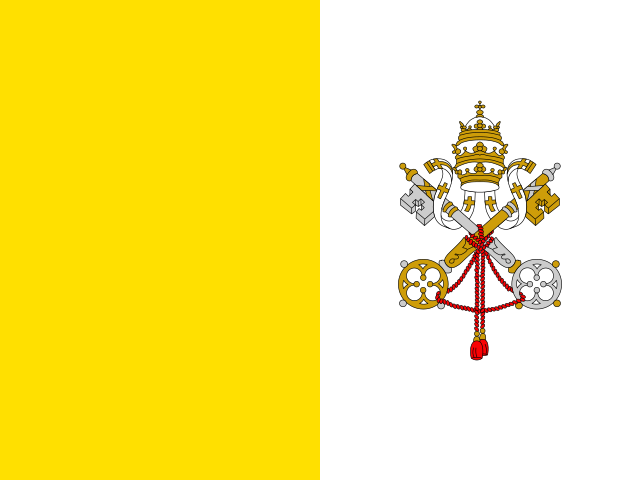
Two vertical bands of yellow and white, the white bearing the crossed keys of Saint Peter surmounted by the papal tiara. The Fundamental Law of the State fixes the flag by reference to a model annexed to the law and assigns it no meaning. The Holy See's own account of the emblem gives the gold key the power in the kingdom of heaven and the silver key the spiritual authority of the papacy on earth, and reads the tasselled cord joining them as the bond between the two powers.
Source: vaticanstate.va · vatican.va · press.vatican.va · checked 2026-08-26
Vatican City FACTS ◢
| Capital | Vatican City |
|---|---|
| Continent | Europe |
| Population | 882 (2024) |
| Area | <1 km² |
| Currency | Euro (EUR) |
| Main language | Italian |
| Calling code | +379 |
| Internet TLD | .va |
| Time zone | UTC+01:00 |
| Drives on the | Right |
| ISO codes | VA / VAT |
DID YOU KNOW? ◢
- It's the smallest sovereign state on Earth, covering only about 44 hectares.
- It sits entirely within the city of Rome, surrounded by Italy on all sides.
- St Peter's Basilica and the Sistine Chapel, with Michelangelo's ceiling, are within its walls.
- Its Swiss Guard, in Renaissance-style uniforms, has protected the pope since 1506.
Vatican City QUICK ANSWERS ◢
What is the capital of the Vatican City?
The capital of the Vatican City is Vatican City.
What is the population of the Vatican City?
The Vatican City had a population of 882 in 2024.
What currency does the Vatican City use?
The Vatican City uses the Euro (EUR).
What languages are spoken in the Vatican City?
The Vatican City designates no official language. The language of government and education is Italian.
Think you know your flags? Play Flag Daily → · Browse all countries →
MORE ON THE FLAG ◢
Vatican City's flag is prescribed by one sentence of the state's Fundamental Law, and that sentence interprets nothing. It sets two vertical fields, yellow next to the staff and white beside it, puts the tiara and the keys on the white one, and then hands the rest of the job to a drawing annexed to the law.
No colour is given a meaning there, neither key is given one, and the word gold does not appear at all.
The readings that travel with this flag are real, and the Vatican does publish them. They simply live somewhere else: on a Holy See page about the emblem of the Holy See, in wording narrower than the spiritual-and-temporal version, which the Vatican itself presents as somebody's interpretation. And the law it sits in is dated 31 July 2026, when Vatican City replaced its Fundamental Law for the third time since 2000.
Key Takeaways
- The Fundamental Law in force is dated 31 July 2026 and replaced the law of 13 May 2023 in its entirety. Its Article 24 describes the flag and assigns it no meaning.
- The law's colour word is giallo, yellow. Neither the article nor the blazon annexed to the previous law says gold.
- The gold-and-silver reading of the keys is published by the Holy See's Secretariat of State, and it is a reading of the emblem rather than of the flag.
- The Secretariat of State gives the silver key the spiritual authority of the papacy on earth. The "spiritual and temporal" pairing is one the Vatican attributes to interpreters rather than asserting itself.
- Yellow and white date from 1808, when Pius VII gave his loyal troops a new cockade in those colours to tell them apart from papal soldiers absorbed into the French army.
| Fundamental Law | Dated | Where the flag sits | Replaced by |
|---|---|---|---|
| The first, promulgated by Pius XI per the 2000 law's preamble | 7 June 1929 | not read for this article | the law of 26 November 2000, "integralmente" |
| Signed IOANNES PAULUS II, PP | 26 November 2000 | Article 20 | the law of 13 May 2023 |
| Signed FRANCESCO | 13 May 2023 | Article 23 | the law of 31 July 2026 |
| Signed LEONE XIV | 31 July 2026 | Article 24 | in force |
What Vatican City's flag law actually says
Article 24 of the Fundamental Law of 31 July 2026 gives the flag one paragraph:
"La bandiera dello Stato della Città del Vaticano è costituita da due campi divisi verticalmente, uno giallo aderente all’asta e l’altro bianco, e porta in quest'ultimo la tiara con le chiavi, il tutto secondo il modello che forma l’allegato A della presente Legge."
Rendered into English, that is: the flag of the State of Vatican City consists of two fields divided vertically, one yellow next to the staff and the other white, and bears on the latter the tiara with the keys, the whole according to the model forming Annex A of this Law.
That is the entire legal description. It fixes an arrangement, names two colours, names one device, and refers everything else to a picture. It does not say what the yellow is for, what the white is for, what the keys are for or what the tiara is for. Article 24 then does the same job for the coat of arms and for the state seal, and interprets neither.
The sentence is also older than the law it now sits in. Article 23 of Francis's Fundamental Law of 13 May 2023 says exactly the same thing, character for character, and the same sentence at Article 20 of John Paul II's Fundamental Law of 26 November 2000 differs from both by one comma. The state has replaced its constitutional instrument three times in twenty-six years, and across those three laws the flag clause has moved from article 20 to article 23 to article 24 without a word of it changing.
One oddity is worth recording. Article 24 of the 2026 law defines the flag by reference to "l’allegato A della presente Legge", and the file the Governatorato publishes on its own legislation page runs to seven pages, ends at the signature, and contains no annexes at all. The 2023 law's file runs to eleven pages and carries all three. The law commands that the sealed original be deposited in the State's Law Archive, so the annex plainly exists. A reader who wants to see the model the current law points at has to open the superseded law to find it.
The law says yellow, not gold
The colour word in Article 24 of the law now in force is giallo. Not oro, not dorato.
That is not an accident of drafting. The blazon annexed to the 2023 law uses the same plain word: Annex A captions the drawing "Drappo partito di giallo e bianco, col bianco caricato al centro delle Chiavi incrociate (decussate) sormontate del Triregno", a cloth party of yellow and white, the white charged at the centre with the crossed keys surmounted by the triple crown. Heraldry has a word for gold, and the same Vatican page that describes this flag uses it further down: the two keys of the arms are "una d'oro e l'altra d'argento". One of gold and the other of silver for the keys. For the field, giallo.
The Holy See's English is the same. Its Secretariat of State describes the flag as a "Banner divided in yellow (towards the flagpole) and white", with the keys and the tiara at the centre of the white part.
Gold does appear in Vatican descriptions of the flag, but attached to the keys and to the staff assembly rather than to the field. The Governatorato's own account of the flag describes a cloth "bipartito di giallo (verso l’asta) e di bianco", with the staff "cimata di lancia ornata di coccarda degli stessi colori della bandiera e frangiata d’oro": topped with a lance, dressed with a cockade in the flag's own colours, and fringed with gold. The gold is on the staff. The field is yellow.
The Holy See's reading of the gold and silver keys
For the meanings, you have to leave the flag law entirely and go to the Holy See's page on its own insignia, published by the Secretariat of State.
It is unambiguous about the source of the symbolism: "The symbolism is drawn from the Gospel and is represented by the keys given to the Apostle Peter by Christ." Then it splits the pair:
"Since the XIV Century, the two crossed keys have been the official insignia of the Holy See. The gold one, on the right, alludes to the power in the kingdom of the heavens, the silver one, on the left, indicates the spiritual authority of the papacy on earth."
The Italian of the same page reads "Quella d'oro, a destra, allude al potere sul regno dei cieli, quella d'argento, a sinistra, indica l'autorità spirituale del papato in terra."
Right and left there are the page's own terms, and heraldry does not use them the way a viewer does. This article quotes them and stops: it does not try to work out from them which of the two keys lies on which side of the cloth.
The page keeps going, and the rest of it is where the detail sits. The tasselled cord that ties the two handles together is not decoration: "The cord with the bows that unites the grips alludes to the bond between the two powers." The orientation is deliberate too, the wards turned up towards heaven and the handles turned down "into the hands of the Vicar of Christ". Even the shape cut into the wards is symbolic rather than mechanical, "usually in the form of a cross, not for the mechanisms of a lock, but as a religious symbol".
Note what that passage is describing. The keys gloss sits under the page's coat-of-arms headings, and the page's description of the flag itself assigns it no meaning. The page also still cites the Fundamental Law of 26 November 2000 as its authority. That citation is now two Fundamental Laws out of date, and the page is stamped with its own last update, 6 September 2013.
Where "spiritual and temporal power" comes from
The other reading of the keys gives one of them spiritual power and the other temporal power. The Vatican does carry that reading. It carries it as somebody else's.
The Holy See's page on Benedict XVI's coat of arms, credited to Mons. Andrea Cordero Lanza di Montezemolo, and dated by the Secretariat of State's copy of the same text to L'Osservatore Romano of 28 April 2005, puts it like this: "It has been a venerable tradition for the Supreme Pontiff to surround his armorial shield with crossed keys, one gold and the other silver, in the form of a St Andrew's cross: these have been variously interpreted as symbols of spiritual and temporal power."
Variously interpreted. The Italian of the same text is more explicit still, because it names the interpreters: the two keys are "da vari autori interpretate come i simboli del potere spirituale e del potere temporale", read by various authors as the symbols of spiritual and of temporal power. The Vatican is describing what other people have made of the keys.
The Vatican's own gloss, on the insignia page, gives the silver key the spiritual authority of the papacy on earth, which is not the same claim as temporal authority and is close to its opposite.
The scriptural anchor is quoted on the Benedict XVI page too, and it does not divide the keys either. Matthew's Gospel has Christ tell Peter: "I will entrust to you the keys of the kingdom of heaven. Whatever you declare bound on earth shall be bound in heaven; whatever you declare loosed on earth shall be loosed in heaven" (Mt 16: 19). The binding happens on earth and takes effect in heaven, in that direction. A reading that gives one key the power to bind in heaven and the other the same power on earth inverts the verse the Vatican is quoting, and the verse divides no keys at all.
The current pope's arms follow the same convention. The Holy See Press Office's blazon of Leo XIV's coat of arms, published on 14 May 2025, places "the crossed Petrine keys, gold (bend) and silver (bend sinister), linked by a red cord" behind the mitre, and does not interpret either key.
Why yellow and white at all, and why 1808
The colours have a documented origin and it is military rather than theological.
The Governatorato's own history says the flag of the Papal State was formerly yellow and red, from the colours of the Holy See's arms, "i due colori tradizionali del Senato e del Popolo romano" - the two traditional colours of the Senate and People of Rome. The change came under Napoleonic occupation, and it came in 1808. Pius VII ordered his Noble Guard and the other papal armed corps that had stayed loyal "di adottare una nuova coccarda con i suddetti colori per distinguerli dalle restanti truppe incorporate nell’esercito francese", to adopt a new cockade in those colours to distinguish them from the remaining troops incorporated into the French army, whom General Miollis had allowed to keep the old one.
So white and yellow began as a piece of uniform, invented to answer a practical question about who was still taking orders from the pope.
The rest of the sequence is equally unromantic. The oldest white-and-yellow papal flag dates from 1824, first flown by the merchant marine, and it had the colours set diagonally; Pius IX had them arranged as two vertical bands and added the papal arms, replacing tricolour cravats of white, red and green that had been put on the flag in 1848. The present form followed the Lateran Treaty with Italy of 11 February 1929, and the same account records that the flag then became protected as the flag of a foreign state under article 299 of the Italian penal code. The modern flag "è stata innalzata per la prima volta l'8 giugno 1929": first raised on 8 June 1929.
The Governatorato dates that account on its own site to 2018. The Holy See Press Office publishes a near-identical text and names its source, Mondo Vaticano - Passato e Presente, edited by Niccolò Del Re and published by the Libreria Editrice Vaticana in 1995.
The Vatican's two copies of that history are not quite identical, which is worth knowing before quoting either one. The Press Office copy has lost its apostrophes in transcription, so it prints lasta for l'asta, and it describes the old flag as "amaranto e rossa", amaranth and red, where the Governatorato's copy reads "amaranto e giallo", amaranth and yellow. Only the second is consistent with the word giallorossa in the sentence it explains.
One Vatican page dates the flag very differently, and it is worth meeting before the 1808 story is taken for the whole of it. The Italian edition of the Secretariat of State's insignia page carries a clause its English edition does not, beginning "Attestata dal XIII secolo, riconosciuta in occasione dei Patti Lateranensi": attested from the thirteenth century and recognised on the occasion of the Lateran Pacts. It does not say what it takes to have been attested then, and the same page dates the crossed keys as the Holy See's official insignia only from the fourteenth century. Whether the two pages are dating the same object is not something either of them settles.
Is the Vatican City flag square?
Nothing in the law makes it square. Article 24 of the law in force fixes no ratio and states no measurement, and neither does the annexed blazon, which describes the arrangement of the fields and the charge and then stops.
What is square is the drawing. The model at Annex A of the 2023 law shows a drape whose height and width, measured off the drawing, match to within a fraction of a percent, and the illustration on the Holy See's own insignia page is the same composition. Both draw the flag on its staff, with a lance finial and a cockade the drawings show fringed, which is closer to a processional banner than to the rectangle a flag chart usually prints.
That distinction is not pedantry. A proportion fixed by statute is a rule a manufacturer can breach, while a proportion that exists only in an annexed drawing is a model, and the law's own words for it are "il tutto secondo il modello", the whole according to the model. If you want to know how tall the Vatican flag is relative to its width, the answer is not in any article of any of its Fundamental Laws. It is in a picture.
Whether any of that survives contact with memory is a separate question, and one flag a day and three guesses is the cheap way to find out how much of a flag you actually hold on to.
The Holy See's emblem, the state's arms, and an older banner
The emblem, the arms and the flag are three different objects, and they get run together constantly.
The emblem of the Holy See is the crossed keys surmounted by the tiara, with no field at all. The Secretariat of State records that it was filed in 1996 with the World Intellectual Property Organization.
The coat of arms of the State of Vatican City is the same device on red. Annex B of the 2023 law blazons it in one line, "Chiavi decussate sormontate del Triregno in campo rosso", and the Holy See's English page supplies a fuller heraldic reading its Italian page does not carry: "gules, two keys in saltire or and argent, interlaced in the rings or, beneath a tiara argent, crowned or". So the same charge sits on a red field in the arms and on a white field in the flag.
The flag is the one place where the Vatican's own account does not draw that distinction. The Governatorato's account opens "La bandiera pontificia o della Città del Vaticano", the pontifical flag or that of Vatican City, treating the two names as one object. What it does warn against confusing it with is the Vessillo di Santa Romana Chiesa, the banner of the Holy Roman Church and "simbolo della sua sovranità spirituale su tutto il mondo": a different object again, vermilion, with the keys under a canopy rather than a tiara.
Working a country out from three written clues is the version of the same puzzle with no flag to lean on at all.
Three crowns, and three Vatican explanations of them
The tiara on the flag has three crowns, and the Vatican's own pages give three different accounts of what they stand for.
The Holy See Press Office's note on the triregno opens by calling it the papal tiara "formata da tre corone simboleggianti il triplice potere del Papa: padre dei re, rettore del mondo, Vicario di Cristo", three crowns symbolising the threefold power of the pope as father of kings, ruler of the world and Vicar of Christ. The same page then offers a second: "Tra le varie interpretazioni citeremo quella che dice le tre corone rappresentare la Chiese militante, la sofferente, la trionfante", among the various interpretations, the one that has the three crowns represent the Church militant, suffering and triumphant.
The page on Benedict XVI's arms gives a third. Having traced the crowns historically, one added in 1130, a second by Boniface VIII in 1301, it concludes that "the silver tiara with three gold crowns came to represent the three powers of the Supreme Pontiff: Sacred Orders, Jurisdiction and Magisterium".
The dates do not agree either. The Benedict XVI page credits the third crown to Benedict XII in 1342; the triregno note says three crowns "dal 1314 in poi", from 1314 onwards.
None of this is hidden, and none of it is contradiction in the damaging sense. It is what happens when a device has been the Holy See's official insignia since the fourteenth century and none of the Fundamental Laws that prescribe it has ever assigned it a meaning. Which is the same answer the flag law gives, at greater length: here is the design, here is the drawing, make of it what the tradition makes of it.
Frequently asked questions
What does the Vatican City flag mean?
Officially, nothing. Article 24 of the Fundamental Law of 31 July 2026 describes the flag as two vertical fields, yellow at the staff and white beside it, with the tiara and keys on the white, and refers the rest to a model annexed to the law. It assigns no meaning to any colour or device, and neither did the same clause in the Fundamental Laws of 2023 and 2000.
The meanings quoted alongside the flag are readings of the keys, and they are published by the Holy See on a page about its emblem rather than in any flag law.
Why is one key gold and one silver on the Vatican flag?
Because the two keys are read as two different powers. The Holy See's Secretariat of State says that the gold key, on the right, "alludes to the power in the kingdom of the heavens", and the silver one, on the left, "indicates the spiritual authority of the papacy on earth", with the tasselled cord that joins their handles standing for the bond between the two powers.
The reading that gives one key spiritual power and the other temporal power is one the Vatican reports rather than asserts: its page on Benedict XVI's arms says the keys "have been variously interpreted as symbols of spiritual and temporal power".
Is the Vatican City flag yellow or gold?
Yellow, in the Vatican texts that describe it. The law's word is giallo, the blazon annexed to the 2023 Fundamental Law says "Drappo partito di giallo e bianco", and the Holy See's English page calls it a banner "divided in yellow (towards the flagpole) and white".
Gold does turn up in official descriptions of the flag, but attached to the staff assembly and to one of the two keys rather than to the field itself.
Is the Vatican City flag square?
The drawing is square, but the law does not say so. No article of the Fundamental Law in force fixes a ratio or any measurement, so the only authority for the proportion is the model annexed to the law, which shows a drape as tall as it is wide, hung from a staff with a lance finial and a cockade the drawing shows fringed.
That makes squareness a feature of the official model rather than a rule stated in words, which is a real distinction if you are drawing the flag rather than describing it.
When was the Vatican City flag adopted?
The Governatorato's account dates the present form to the Lateran Treaty of 11 February 1929 and records that the modern flag was raised for the first time on 8 June 1929. Vatican City's first Fundamental Law is dated the day before that, 7 June 1929. The Secretariat of State's Italian page instead calls the flag attested from the thirteenth century, without saying on what basis.
The colours are much older than the state. White and yellow replaced the Papal State's yellow and red in 1808, the earliest white-and-yellow papal flag dates from 1824 with its colours set diagonally, and Pius IX later had them arranged as the two vertical bands still in use.
Sources
- Governatorato dello Stato della Città del Vaticano, Legge Fondamentale dello Stato della Città del Vaticano del 31 Luglio 2026 - PDF downloaded from the Normativa Generale listing, retrieved 26 August 2026.
- Governatorato dello Stato della Città del Vaticano, Legge fondamentale dello S.C.V. del 13 maggio 2023 - PDF from the same listing, including Allegati A, B and C, retrieved 26 August 2026.
- Stato della Città del Vaticano, La nuova Legge fondamentale dello Stato della Città del Vaticano, 26 novembre 2000, published at
vaticanstate.va/content/dam/vaticanstate/documenti/leggi-e-decreti/LanuovaLeggefondamentale.pdf, which no longer resolves. Read from the Internet Archive capture of 17 April 2014 - retrieved 26 August 2026. - Governatorato dello Stato della Città del Vaticano, Bandiera - retrieved 26 August 2026.
- Segreteria di Stato / Sala Stampa della Santa Sede, Bandiera, Stemma e Sigillo and its English edition - retrieved 26 August 2026.
- Sala Stampa della Santa Sede, Storia della Bandiera dello Stato della Città del Vaticano, sourced on the page to Mondo Vaticano - Passato e Presente, ed. Niccolò Del Re, Libreria Editrice Vaticana, 1995 - retrieved 26 August 2026.
- Sala Stampa della Santa Sede, Triregno - retrieved 26 August 2026.
- Mons. Andrea Cordero Lanza di Montezemolo, The Coat of Arms of His Holiness Benedict XVI, published by the Holy See. The Secretariat of State's copy of the same text credits it to L'Osservatore Romano of 28 April 2005 - retrieved 26 August 2026.
- Holy See Press Office, The coat of arms of Pope Leo XIV: Explanation, bulletin of 14 May 2025 - retrieved 26 August 2026.
PLAY ANOTHER →
Five questions a day. Everyone gets the same five.
FIVE QUESTIONSDAILYOn This DayOne thing that happened today in history. Every day, a new one.
TODAY IN HISTORYDAILYDaily CryptogramOne quote, one scrambled alphabet. Crack it before tomorrow.
CRACK THE QUOTEDAILYDaily CodeA short message, hidden in a different cipher every day.
ONE CIPHER A DAY