
Zambia
A landlocked chunk of southern Africa shaped by great rivers, Zambia shares the thundering Victoria Falls with Zimbabwe and packs its parks with elephants and hippos.
WHAT THE FLAG MEANS ◢
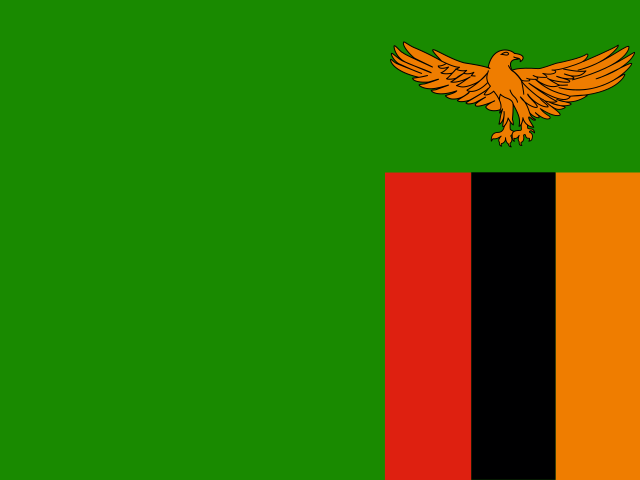
A green field with an orange eagle in flight over a block of three vertical stripes of red, black and orange at the fly. Part I of the Schedule to the National Flag and Armorial Ensigns Act declares that design, fixes the proportions at three to two and pins each colour to a British Colour Council shade - Spectrum Green 100, Union Jack Red 210, Jet Black 220 and Spectrum Orange 57 - and assigns none of them a meaning. It calls the bird simply an eagle. Zambian government pages supply readings the Act does not: green for the country's vegetation and agriculture, red for the struggle for freedom, black for the Zambian people, orange for copper and mineral wealth, and the eagle for freedom and the ability to rise above the nation's problems.
Source: parliament.gov.zm · zambialii.org · sh.gov.zm · szi.gov.zm · britannica.com · mcti.gov.zm · checked 2026-08-27
Zambia FACTS ◢
| Capital | Lusaka |
|---|---|
| Continent | Africa |
| Population | 21,913,874 (2025) |
| Area | 752,618 km² |
| Population density | 29/km² |
| Currency | Zambian Kwacha (ZMW) |
| Official language | English |
| Calling code | +260 |
| Internet TLD | .zm |
| Time zone | UTC+02:00 |
| Drives on the | Left |
| ISO codes | ZM / ZMB |
DID YOU KNOW? ◢
- It shares Victoria Falls, one of the largest waterfalls on Earth, with Zimbabwe.
- The local name for the falls is 'Mosi-oa-Tunya', meaning 'the smoke that thunders'.
- The mighty Zambezi River, which the country is named after, forms much of its southern border.
- It's one of the world's major copper producers, a metal central to its economy.
Zambia QUICK ANSWERS ◢
What is the capital of Zambia?
The capital of Zambia is Lusaka.
What is the population of Zambia?
Zambia had a population of 21,913,874 in 2025.
What currency does Zambia use?
Zambia uses the Zambian Kwacha (ZMW).
What languages are spoken in Zambia?
The official language of Zambia is English.
Think you know your flags? Play Flag Daily → · Browse all countries →
MORE ON THE FLAG ◢
Ask what Zambia's flag colours stand for and the answer comes back fast and consistent: green for the land, red for the freedom struggle, black for the people, orange for copper. The eagle, everyone adds, is about rising above the nation's problems.
The silence of the flag law on all of that is the easy half of the story. The harder and more interesting half is that the meanings are not nothing, and they are not the state's either. They have identifiable authors and identifiable dates, and the version now printed on Zambia's State House website, where it looks official, can be followed back to where it was written.
This piece follows that route, and then looks at the other thing everybody repeats about this flag: that its green changed in 1996.
Key Takeaways
- The National Flag and Armorial Ensigns Act names the four colours, ties each to a British Colour Council shade reference, and assigns none of them a meaning.
- The Act calls the bird only an eagle, in the flag's description and in the coat of arms blazon alike. The fish eagle comes from the arms as depicted and from state publications.
- The colour readings on the State House national-symbols page follow the English Wikipedia article sentence for sentence, and Wikipedia carried them first.
- Green's "agriculture and lush flora" gloss was attached to a Britannica article by a 2023 Wikipedia edit, and that article gives Zambia's green no meaning at all.
- The 1996 change to the green is repeated everywhere, and no Zambian instrument recording it has been produced. The ministry that polices flag reproduction was still printing the 1965 shade references in 2023.
| Colour | What the Act says | What Zambian government pages say it means |
|---|---|---|
| Green | "Spectrum Green", British Colour Council Shade reference 100 | vegetation, agriculture, "lush flora" |
| Red | "Union Jack Red", British Colour Council Shade reference 210 | the struggle for freedom |
| Black | "Jet Black", British Colour Council Shade reference 220 | the Zambian people; the original people of the land |
| Orange | "Spectrum Orange", British Colour Council Shade reference 57 | copper and mineral wealth |
Zambia's flag law points at a British swatch book
Zambia's flag is declared by section 2(1) of the National Flag and Armorial Ensigns Act, Chapter 6 of the Laws of Zambia, which came into force on 4 June 1965. The section does not describe anything itself. It says that the flag "of which the design and description are set out in Part I of the Schedule is hereby declared to be the National Flag of Zambia".
Part I of that Schedule is one sentence and a list. The sentence reads: "Green with an orange coloured eagle in flight over a rectangular block of three vertical stripes coloured from left to right in red, black and orange; of overall dimensions 3:2; and to the following colour specifications". The list is four lines, one per colour: "Spectrum Green", British Colour Council Shade reference 100; "Union Jack Red", reference 210; "Jet Black", reference 220; and "Spectrum Orange", reference 57.
That is the whole legal description of the flag of Zambia. Geometry, proportion, four shade references, and no symbolism.
The shade references point outside Zambia entirely, and the Act does not say into what. It gives a numbered shade and the Council's name, with no volume, edition or year. The numbered-shade standard the Science Museum Group holds under that name is the Council's Dictionary of Colour Standards, catalogued as London, 1934, with the Council itself dated 1930 to 1950.
The museum catalogues two copies of it together. One record gives the volume's formal designation as "British Standards Institution Schedule 543". The other, the copy dyed into wool, is blunt about what the book physically is: "Each of these wool strands is dyed a separate colour. They are bound in a book to form a definitive guide to colour standards."
So the statutory colour specification is not a formula. On the museum's description it is a strand of dyed wool in a reference volume issued by a body that no longer exists, so complying with the letter of the Act means, in effect, holding a copy. The values that circulate instead are Pantone approximations, and they disagree with each other: Flags of the World collates published sets from the Album des Pavillons, from Olympic flag manuals and from several flag references, and they do not match.
On the proportions there is a wording trap worth knowing. The Act says "of overall dimensions 3:2". Vexillological references usually give Zambia's flag as 2:3, and Britannica's article puts it as "The flag's width-to-length ratio is 2 to 3." Both describe the same rectangle, written from opposite ends.
Where the Zambian flag's colour meanings actually came from
The readings are real, they are just not Zambian law. They can be traced, and the trace is unusually clean.
The oldest identifiable version belongs to Whitney Smith, founder of the Flag Research Center, in his Britannica article on the flag of Zambia. His readings were already being quoted under his name on the Flags of the World list in March 1996. Smith writes that Zambia's flag was based on the flag of the United National Independence Party, whose green field he glosses as "The green field of its flag, symbolizing agriculture". Of the national flag itself he says only that "The green background remains", and then gives three readings and no fourth: "red for the freedom struggle, black for the African people, and orange for copper". The eagle he does treat as official: "Officially it symbolizes freedom and the ability of the Zambian people to rise above national problems."
Read carefully, Smith assigns Zambia's green nothing. The agriculture reading in his article belongs to the party flag that preceded it.
The English Wikipedia article is where that distinction was lost, and the edits are timestamped. Until November 2011 the article carried a passage lifted from the Flags of the World website, which it cited in a footnote. On 14 November 2011, at 16:37 UTC, an editor rewrote the paragraph and coined a new sentence: green now stood for "the nation's lush flora". The Flags of the World footnote at the end of the paragraph survived the rewrite. That page contains neither the word "lush" nor the word "flora".
On 3 May 2023, in an edit summarised as "Adding citation", another editor attached Smith's Britannica article as the reference for that sentence and simultaneously changed it to read "agriculture and lush flora", importing the word Smith had used about the party flag. The Britannica article contains neither "lush" nor "flora", and assigns Zambia's green no meaning.
That sentence is now on a Zambian government website. The State House page on national symbols reproduces the Wikipedia paragraph, including its distinctly vexillological aside that the eagle and stripes sitting at the fly is "notable" because most emblems are placed at the centre or the hoist. That aside reached its present wording on Wikipedia on 23 November 2012, and the Zambia Information Services portal was carrying it by June 2019. The colour sentence State House also reproduces, "agriculture and lush flora", did not exist on Wikipedia until 3 May 2023, and the earliest capture of the State House page in the Internet Archive is 17 April 2025.
The Zambia Information Services e-Pamodzi portal, archived in June 2019, carries the same Wikipedia sentence about the fly and then supplies its own colour list, written in its own voice: green for "rich vegetation and agricultural wealth", black for "the original people of the land", orange for copper as the country's leading earner. So the state has published the meanings, twice, in two different forms. What it has never done is enact them.
None of this makes the readings wrong. Flags accumulate meaning whether or not a statute says so. It does mean that anyone quoting the State House version is quoting an encyclopaedia rather than a law, and that this page is not independent confirmation of the encyclopaedia, because it is reproducing it. The e-Pamodzi colour list is a harder case and worth meeting head on: it is written in its own words, so nothing here establishes where its readings came from. What can be said is that it too carries a Wikipedia sentence, and that neither page is a statute.
Did the green really change in 1996?
Almost every account of this flag says the green was brightened in 1996 and the eagle redrawn to match the coat of arms. State House says it: "The Zambian flag was slightly modified in 1996." Wikipedia has said it since its very first revision on 7 February 2004, in a two-sentence stub with no citation at all.
Look for the instrument and there is nothing to find.
The Act has been amended once since 1965, by Act No. 13 of 1994, which restated the penalties in penalty units. Two independent copies of the Ministry of Legal Affairs text still specify Spectrum Green, shade reference 100: the printing published by the National Assembly of Zambia, and the ZambiaLII consolidation dated as at 31 December 1996. ZambiaLII's full-text search finds the phrase Spectrum Green in that Act and in no other Zambian instrument. The only subsidiary legislation printed under the Act in the Laws of Zambia is Statutory Instrument 270 of 1965, and it governs flying, display and use rather than specifying the design.
The strongest evidence that nothing legal happened comes from the state itself, twenty-seven years later. On 18 September 2023 the Ministry of Commerce, Trade and Industry, the ministry the flag regulations name as the office that receives permission applications, issued a public compliance notice signed by its Permanent Secretary. It states that "The National Flag must be produced in its true colours as prescribed in the Act", and then prints the same four British Colour Council references, unchanged. A ministry restating the flag's prescribed colours to the public in 2023 would be the first to know if the green had been respecified.
The earliest circulating account of the change that can be dated is not Zambian and not official. It is a posting on the Flags of the World mailing list dated 6 September 1998, attributing the information to a named individual and saying that "The dark green was substituted for a more clear green". That posting, or text derived from it, was still sitting in the Wikipedia article thirteen years later. Flags of the World's own current page on Zambia notes that no legislation for the change has been found, which matches what this piece found independently.
The honest position is this. The accounts agree that flags of the earlier period were a darker green than the ones flown today, which suggests something changed in practice. What did not change is the law, and no Zambian document has yet been produced that records the change, dates it, or authorises it. If you are told the Zambian flag was legally altered in 1996, ask which instrument.
If you want to find out how much of a flag you actually carry in your head, Flag Daily shows one flag a day and gives you three guesses at the country.
The Act calls it an eagle and names no species
The Zambian government's own pages call the bird an African fish eagle. The flag Act does not. Its words are "an orange coloured eagle in flight", with no species, no posture beyond flight, and no meaning.
The species comes from the arms as they are drawn, not as they are written. The same Act declares the coat of arms in Part III of the same Schedule, and that blazon names no species either: the badge above the shield is "An eagle head to the sinister or rising from a hoe and a pick in saltire proper". Britannica traces the bird back to the shield approved for Northern Rhodesia in 1930, whose upper portion carried a gold fish eagle holding a silver fish, and which was first used as a colonial badge on the British Blue Ensign.
The shield itself is blazoned in the Act as "Sable six pallets wavy argent", six wavy white stripes on black, and State House reads it as Victoria Falls, white water over black rock. That is the waterfall Zambia shares with Zimbabwe, on the river the country is named after. Here too the meaning is published by the state and absent from the statute, which gives the blazon and stops.
The flag inherited the bird from the arms, and neither the Schedule's description of the flag nor its blazon of the arms ever caught up with what everyone calls it.
A statutory description that says "eagle" cannot be cited for a claim about a fish eagle, and the popular reading of the eagle as freedom and resilience rests on Smith's "Officially" rather than on anything the Act contains. The reading is well established and widely published by the Zambian state. It is still absent from the instrument that declares the flag.
Who designed the flag, and when the law caught up
The flag was first flown at independence on 24 October 1964. The Act that declares it did not come into force until 4 June 1965, so for more than seven months Zambia flew a national flag that no Zambian statute had yet described.
The design is credited to Gabriel Ellison, born Gabriel Ryan in Lusaka in 1930. The Zambian magazine Nkwazi, marking the country's sixtieth independence anniversary, records that "As head of the Graphic Arts section, she was entrusted with designing the national flag." She also designed the coat of arms, the parliamentary mace and more than 480 Zambian postage stamps, was appointed MBE and made a Grand Officer of Distinguished Service by Zambia, and died in Johannesburg on 18 July 2017 at the age of 87.
Zambia's constitutional handling of its symbols has stayed deliberately hands-off throughout. The Constitution as it now stands lists the National Flag first among five national symbols and then says only that "The form, words, description and use of the national symbols shall be as prescribed." The 1996 constitution listed the flag among four symbols, the Anthem first, and left it to be settled by an Act of Parliament. In both cases the constitution points at the statute, and the statute points at a swatch book.
What Zambian law does say about the flag
The Act is thin on meaning and surprisingly detailed on conduct, and this is the part most readers have never seen.
Insulting the flag is a criminal offence carrying up to two years' imprisonment. Applying the flag, or any part of its design, to goods or to a business without the Minister's written permission is a separate offence. Statutory Instrument 270 of 1965 adds the operating rules: the flag may not be flown without written permission except at government and local authority premises, statutory bodies, state-aided schools and on a vehicle carrying a Minister.
For everybody else, the Regulations name the occasions: the flag may be flown by any person on "Africa Freedom Day, Heroes Day, Unity Day, and Independence Day", plus any other day the Minister declares. It must be kept clean and in reasonable repair, given "a more prominent position than other flags" when flown alongside them, and flown "only between the hours of sunrise and sunset". Reproducing the design without permission is an offence in its own right, and that is what the 2023 ministry notice was addressed to businesses about.
There is one more place the flag turns up in Zambian law, and it is a good one for a landlocked country. The Merchant Shipping (Temporary Provisions) Act of 1969 provides that references in the shipping code to the British flag and red ensign "shall be read and construed exclusively as references to the National Flag of Zambia or to any other flag authorised by the Minister, by statutory order, for use on any ship". Zambia has no coast, and it still legislated its ensign.
The flag also reached the High Court early. In Kachasu v Attorney General, decided on 10 November 1967, a schoolgirl who was a Jehovah's Witness challenged the school regulations requiring pupils to salute it. Those regulations described the anthem and the flag as "the secular symbols of national consciousness", which is as close as anything opened for this piece has come to saying what the flag is for. Even there, nothing is said about what its colours mean.
For a version of the same question with no picture at all, Guess the Country gives you one written clue and three guesses, and each miss buys another clue.
Frequently asked questions
What do the colours on the Zambian flag mean?
The readings published by the Zambian government are green for the country's vegetation and agriculture, red for the struggle for freedom, black for the Zambian people, and orange for copper and mineral wealth, with the eagle standing for freedom and the ability to rise above national problems. None of these meanings appears in the National Flag and Armorial Ensigns Act, which names the four colours and assigns them nothing.
Does Zambian law say what the flag's colours mean?
No. Part I of the Schedule to the National Flag and Armorial Ensigns Act describes the design, fixes the proportions at 3:2, and ties each colour to a British Colour Council shade reference, without interpreting any of them. The Constitution lists the flag among the national symbols and leaves the form and description to be prescribed by statute.
Did the Zambian flag change in 1996?
Sources agree that the green was brightened and the eagle redrawn around 1996, but no Zambian legal instrument recording it has been produced. The Act's colour specification has never been amended, and the Ministry of Commerce, Trade and Industry was still printing the original 1965 shade references in a compliance notice in September 2023. The earliest datable account of the change is a Flags of the World posting from 6 September 1998.
What kind of eagle is on the Zambian flag?
Zambian government descriptions call it an African fish eagle, the same bird that appears on the coat of arms. The flag Act itself says only "an orange coloured eagle in flight", and its blazon of the arms names no species either, so the identification comes from the arms as depicted and from state publications rather than from anything in the Act.
Who designed the Zambian flag?
Gabriel Ellison, a Lusaka-born artist who headed the Graphic Arts section of Zambia's Ministry of Information at independence. She also designed the coat of arms, the parliamentary mace and hundreds of Zambian stamps, and died in 2017.
Sources
- Ministry of Legal Affairs, Government of the Republic of Zambia, National Flag and Armorial Ensigns Act, Chapter 6 of the Laws of Zambia (published by the National Assembly of Zambia), sections 2 to 6, the Schedule Parts I and III, and Statutory Instrument 270 of 1965 - retrieved 27 August 2026.
- ZambiaLII, National Flag and Armorial Ensigns, 1965, Chapter 6, consolidated text as at 31 December 1996 - retrieved 27 August 2026.
- Ministry of Commerce, Trade and Industry, Republic of Zambia, Immediate Release: Compliance to the provisions of the National Flag and Armorial Ensigns Act No. 23 of 1965, 18 September 2023 - retrieved 27 August 2026. The PDF is a scan with no text layer; a transcription is held with the research files.
- ZambiaLII, Constitution of Zambia Act, 1991, Chapter 1, Article 6, consolidated as at 18 December 2025 - retrieved 27 August 2026.
- ZambiaLII, Merchant Shipping (Temporary Provisions) Act, 1969, section 9 - retrieved 27 August 2026.
- ZambiaLII, Kachasu v Attorney General (HC 145 of 1967) [1967] ZMHC 18, 10 November 1967 - retrieved 27 August 2026.
- State House, Republic of Zambia, National Symbols - retrieved 27 August 2026.
- Zambia Information Services, The Zambian Flag, e-Pamodzi government portal - read from the Internet Archive capture of 6 June 2019, the live page being unavailable.
- Whitney Smith, flag of Zambia, Encyclopaedia Britannica - read from the Internet Archive capture of 23 July 2026, the live site refusing automated access.
- Science Museum Group, British Colour Council Dictionary of Colour Standards, object 1996-277/136 - retrieved 27 August 2026.
- Science Museum Group, Colour dictionary, London, England, 1934, object 1996-277/137, the dyed-wool copy - retrieved 27 August 2026.
- Flags of the World, Zambia, postings dated 6 September 1998 and 30 December 2024 - retrieved 27 August 2026. Cited as the artefact in which the 1996 claim circulates, not as an authority for it.
- Wikipedia, Flag of Zambia, article revision history, revisions of 7 February 2004, 14 November 2011 and 3 May 2023 - retrieved 27 August 2026. Cited as the artefact whose wording is being traced, not as an authority.
- Nkwazi Magazine, Gabriel Ellison: Zambia's Flag Artist, 23 October 2024 - read from the Internet Archive capture of 14 April 2026, the live site refusing automated access.
PLAY ANOTHER →
One thing that happened today in history. Every day, a new one.
TODAY IN HISTORYDAILYDaily CodeA short message, hidden in a different cipher every day.
ONE CIPHER A DAYDAILYDaily TriviaFive questions a day. Everyone gets the same five.
FIVE QUESTIONSDAILYGuess the CountryThree clues, three guesses. Work out where in the world it is.
THREE CLUES