
Zimbabwe
A southern African country named after the stone-walled ruins of Great Zimbabwe, home to spectacular Victoria Falls and some of the continent's richest wildlife reserves.
WHAT THE FLAG MEANS ◢
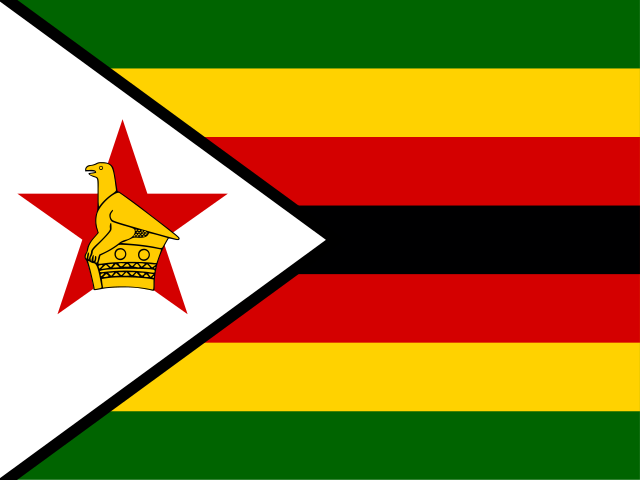
Seven horizontal stripes of green, yellow, red and black, mirrored about the centre, with a black-edged white triangle at the hoist bearing a red five-pointed star and the golden Zimbabwe Bird. The constitution prescribes the flag by depicting it rather than describing it, while the flag statute does describe it, in one sentence of heraldic blazon that fixes the design and assigns nothing a meaning. The colour readings are published by the government rather than enacted: green for vegetation and agriculture, yellow for mineral wealth, red for the blood shed in the liberation war, black for the black majority, and the white triangle for peace. The government's reading gives the red star the nation's aspirations, not the revolution usually attached to it. The bird is the soapstone Zimbabwe Bird from Great Zimbabwe, the national emblem.
Zimbabwe FACTS ◢
| Capital | Harare |
|---|---|
| Continent | Africa |
| Population | 16,950,795 (2025) |
| Area | 390,757 km² |
| Population density | 43/km² |
| Legal tender | Zimbabwe Gold (ZWG) and United States dollar (USD) |
| Official languages | Chewa, Chibarwe, English, Kalanga, Koisan, Nambya, Ndau, Ndebele, Shangani, Shona, Sign Language, Sotho, Tonga, Tswana, Venda, Xhosa |
| Calling code | +263 |
| Internet TLD | .zw |
| Time zone | UTC+02:00 |
| Drives on the | Left |
| ISO codes | ZW / ZWE |
DID YOU KNOW? ◢
- It takes its name from Great Zimbabwe, a medieval stone city whose ruins still stand today.
- It shares the vast Victoria Falls on the Zambezi River with neighbouring Zambia.
- Its Hwange National Park is one of Africa's great elephant strongholds.
- The soapstone Zimbabwe Bird from those ancient ruins appears on its national flag.
Zimbabwe QUICK ANSWERS ◢
What is the capital of Zimbabwe?
The capital of Zimbabwe is Harare.
What is the population of Zimbabwe?
Zimbabwe had a population of 16,950,795 in 2025.
What currency does Zimbabwe use?
Zimbabwe uses the Zimbabwe Gold (ZWG) and United States dollar (USD).
What languages are spoken in Zimbabwe?
The official languages of Zimbabwe are Chewa, Chibarwe, English, Kalanga, Koisan, Nambya, Ndau, Ndebele, Shangani, Shona, Sign Language, Sotho, Tonga, Tswana, Venda and Xhosa.
Think you know your flags? Play Flag Daily → · Browse all countries →
MORE ON THE FLAG ◢
The colour readings attached to Zimbabwe's flag are real, and the Government of Zimbabwe publishes them itself. What they are not is law.
The flag is prescribed by the Flag of Zimbabwe Act [Chapter 10:10], and the whole of the description that Act gives is one sentence of heraldry. That sentence names the colours, fixes the star at five points, and stops. It does not say what a single element is for. The constitution does less still: it provides for a national flag and then prints a picture of one.
So the question worth asking is not what the flag means but which text you are being quoted from, and by whom. On the red star, the answer is that no Zimbabwean instrument gives it a meaning.
Key Takeaways
- The Flag of Zimbabwe Act describes the flag in a single sentence of blazon and assigns no element any meaning.
- The 2013 constitution provides for a national flag and then prescribes it by printing a picture. Part 1 of its First Schedule is a heading and an image, with no description under it.
- The colour meanings in general circulation are published on the Government of Zimbabwe portal rather than in the Act that prescribes the flag.
- That portal gives the red star "the nation's aspirations" rather than the revolution often attached to it.
- The flag law leaves the Zimbabwe Bird untinctured, though the depiction printed in the Act's own Schedule is gold, as the Armorial Bearings Act's blazon of the same bird is.
| Element | The Flag of Zimbabwe Act's wording | The government portal's reading |
|---|---|---|
| Green field | "Vert" | "Green represents vegetation and agriculture." |
| Yellow bars | "fimbriated by two bars or" | "Yellow/Gold represents the country's mineral wealth." |
| Red band | "on a fess gules" | "Red represents the blood shed during the war of the liberation" |
| Black bar | "a bar sable" | "Black represents the black majority" |
| White triangle | "a pile argent fimbriated sable" | "White triangle represents peace." |
| Star | "a Molet of five points gules" | "Red Star represents the nation's aspirations." |
| Bird | "a representation of the Great Zimbabwe Bird" | "Zimbabwe Bird represents the National Emblem." |
What the Flag of Zimbabwe Act says, word by word
Section 3 of the Flag of Zimbabwe Act is a single line: "The Flag of Zimbabwe shall be as depicted and described in the Schedule."
The Schedule then does both jobs. It reproduces the flag as a picture, and under the heading "Description of Flag" it gives the wording that the picture illustrates:
Vert, on a fess gules, fimbriated by two bars or, a bar sable, issuant from the dexter a pile argent fimbriated sable charged with a Molet of five points gules debruised by a representation of the Great Zimbabwe Bird.
That sentence is blazon, the technical shorthand of heraldry, and it is worth unpacking because every word of it is doing work. Vert is the green field. A fess gules is a broad horizontal band across the middle, in red. Fimbriated by two bars or means that band is edged above and below by two yellow bars. A bar sable is the black bar lying on the red. Issuant from the dexter a pile argent is the white wedge running in from the hoist, and fimbriated sable gives that wedge its thin black border. Charged with a Molet of five points gules puts a red five-pointed star on the white. Debruised by a representation of the Great Zimbabwe Bird lays the bird over the star.
The picture printed in the same Schedule matches that reading element for element, black border on the triangle included, which is the check on whether the unpacking is right.
Read the blazon back and you have the whole flag, down to the black outline of the triangle that most short descriptions leave out. What you do not have is a reason for any of it. The Act's long title says it exists "to provide for the design of the Flag of Zimbabwe and for matters connected with or incidental to the foregoing", and design is exactly all it provides. Across its six sections it assigns no element a meaning.
The consolidated text records amendments from one later Act, number 22 of 2001, and both amended provisions, subsection 5(3) and section 6, adjust penalties rather than the Schedule. A Flag of Zimbabwe Amendment Bill appears in the Zimbabwe Legal Information Institute's gazette record for 6 December 1985 and left no trace in the consolidated text, which suggests it lapsed. The description has stood unchanged since the Act commenced on 18 April 1980.
Where the Zimbabwe flag's colour meanings are published
They are published on a web page: the National Flag entry in the National Symbols section of the Government of Zimbabwe portal, which sets out a list under the heading "Meanings of the colours on the flag are as follows". Whether the portal originated those readings or recorded ones already in circulation is not something any source reached here settles.
The portal is a state publication and it is the closest thing to an authorised reading that exists, so this is not folklore dressed as fact. It is a gloss with a different standing from a statute. The portal's list runs: green for vegetation and agriculture, yellow or gold for mineral wealth, red for the blood shed in the liberation war, black for the black majority, the white triangle for peace, and the Zimbabwe Bird for the national emblem.
The same page also supplies in ordinary English the physical detail that the blazon compresses into heraldic shorthand. The stripes are "all equal in width" and run green, gold, red, black, red, gold, green from top to bottom, and "The stripes are separated from the white triangle by a thin black line." It dates the design too: the flag "was accepted on 22 March 1980" and was "first raised at the midnight on 17/18 April to mark independence", the two moments about four weeks apart. Neither the Act nor the portal names a designer, and no Zimbabwean state source opened for this article does either. Names do circulate, but they rest on unofficial compilations rather than on anything Zimbabwe has published.
Notice what the portal does not claim. It never says the meanings are prescribed, and it never cites the Act for them. The distinction only becomes visible once you go and read the Act, so the two get merged constantly.
The red star, and the reading the state does not give it
Retellings of Zimbabwe's flag routinely give the red star to the revolution, or to socialism, or to the liberation movement. The government portal does not. Its line is that "Red Star represents the nation's aspirations."
Aspirations and revolution are not the same claim. One points forward and the other backward, and the flag law is no help, because it calls the device a Molet of five points gules and leaves it there.
There is, however, a second state text describing the same device, and it is far more forthcoming. Zimbabwe's coat of arms carries a red star with the Zimbabwe Bird on it, exactly as the flag does, and the arms have an official gloss far fuller than anything written for the flag. The portal's Coat of Arms page states: "The Star is the ancient symbol of hope for the future tinctured red to remind us of the suffering of all our people and the need to avoid any recurrence of that suffering."
That is a reading with two halves, hope and remembrance, and it sits far closer to the portal's aspirations than to any account of revolt. It is also a gloss on the arms rather than on the flag, so it cannot simply be transferred across. But when the only detailed state interpretation of a red star bearing a Zimbabwe Bird reads it as hope for the future, a confident sentence assigning the flag's star to revolution is standing on nothing Zimbabwe has published.
The constitution provides for the flag and prints a picture
Section 4 of the Constitution of Zimbabwe is one sentence: "Zimbabwe has a National Flag, a National Anthem, a Coat of Arms and a Public Seal, which are set out in the First Schedule."
Turn to that Schedule and Part 1 is headed NATIONAL FLAG, and then there is an image of the flag and nothing else. No dimensions, no colour references, no description, no meanings. Part 3 does the same for the coat of arms. The drafters plainly understood the difference between showing and telling, because Part 4 of the same Schedule reaches the Public Seal and prints the bracketed instruction "[Depict the Public Seal]" where the picture should be. Veritas Zimbabwe, whose consolidated text of the constitution is the version read here, footnotes that gap: "The Public Seal was not depicted in the Constitution as originally enacted."
So the constitutional position on Zimbabwe's flag is that it exists, that it is the one in the picture, and that citizens have a duty under section 35(4)(c) of the constitution "to respect the national flag and the national anthem". Everything about what it looks like in words is in the Flag of Zimbabwe Act, and everything about what it means is somewhere else again.
Which is one reason the flag is worth learning by sight rather than by description. Guessing the country from a flag alone is a different skill from reading a blazon, and it is the skill anyone actually uses.
The only constitutional words interpreting the flag are in the anthem
There is a strict exception, and it is easy to miss, because it sits one part further down the same Schedule.
Part 2 of the First Schedule sets out the national anthem in English, in full. Its first verse opens "O lift high, high, our flag of Zimbabwe", and the two lines that follow are "Born of the fire of the revolution" and "And of the precious blood of our heroes."
Those are constitutional words, in the constitution's own Schedule, and they do interpret the flag. They are the only ones that do: section 4 and section 35 mention the flag without saying anything about it. The anthem attributes the flag as a whole to revolution and to the blood of the dead. It does not hand either idea to a particular stripe or charge. A reader wanting a constitutional basis for the red-for-blood reading has the nearest thing available here, and it is a verse in a schedule rather than a definition in an operative section.
It is worth noticing where that leaves the revolution. The anthem gives the fire of the revolution to the flag entire, and no Zimbabwean text opened for this article gives it to the star.
The bird the flag law will not colour in
The Zimbabwe Bird on the flag is drawn in gold. The Flag of Zimbabwe Act does not say so. Its Schedule asks only for "a representation of the Great Zimbabwe Bird", with no tincture attached, in a sentence that otherwise tinctures everything it mentions.
That omission stands out because Zimbabwean law does tincture the same bird elsewhere. The Armorial Bearings, Names, Uniforms and Badges Act [Chapter 10:01] defines the country's arms in its own Schedule, and the crest reads: "On a wreath or and vert a mullet gules debruised by a representation of the Great Zimbabwe Bird or." Same bird, same red star beneath it, same debruised construction, and this time the bird is explicitly or, which is gold. The two statutes do not even spell the star the same way: the flag law writes Molet where the arms Act writes mullet.
So the gold bird on the flag is settled by the picture in the flag Act's Schedule and by practice, not by its words. The government portal describes what everybody draws, "a gold Zimbabwe bird superimposed on a five pointed red star", and the wording of the flag law simply never gets there.
As for which bird it is, the portal's Zimbabwe Bird page declines to choose between two candidates: the bateleur eagle, chapungu in Shona, "which was held to be a messenger from Mwari (God) and the ancestors", or the fish eagle, hungwe, which it says has been suggested as the original totem of the Shona.
Eight birds, and where they went
The flag's bird is not a drawing invented for it. It is a carved object.
The soapstone birds come from Great Zimbabwe, the stone city in south-central Zimbabwe that gave the modern state its name. The National Museums and Monuments of Zimbabwe, which runs the site, dates the settlement's flourishing to "between 1290 and 1450AD" and records "the famous eight zimbabwe birds which are carved on soapstone" among the artefacts excavated there. It places them: "Of the eight, six were found in the Eastern Enclosure of the Hill Complex, one on a balcony facing the Western Enclosure and the most aesthetically appealing was found in the Valley enclosures."
Their subsequent history is the part the flag does not tell you. NMMZ states that "Most of the birds were exported to South Africa and Europe in the late 19th century but today all of them except one are on display in the site museum." A national emblem that had to be brought home, with one still outstanding, is a considerable amount of history folded into a single charge. NMMZ names two destinations for the exported carvings, and one of them is Zimbabwe's neighbour South Africa.
NMMZ also sets out how far the emblem now reaches: "One of the birds is used as the national emblem", appearing on the coat of arms, on the flag, "on the obverse side of all coins and is also used as a watermark on all the notes". Which of the eight became the emblem it does not say, and no state source opened for this article names it.
What the law does with the flag once it has described it
The Flag of Zimbabwe Act runs to six short sections, and the ones that are not about the design show what the statute is really for.
Section 4 of the flag Act requires that the Minister "shall cause a copy of the Flag to be prepared and deposited in the National Archives established in terms of the National Archives of Zimbabwe Act". A copy, not the definitive flag: section 3 makes the Schedule what prescribes. That matters, because the Act fixes no proportions and cites no colour standard, so the deposited copy and the Schedule's picture are the only physical referents a dispute could reach for.
Section 5 of the same Act lets the President make regulations protecting the flag from improper use, reaching "the importation, manufacture, sale, loan, use, possession, wearing or display of the Flag or any reproduction or likeness thereof". The power was exercised. No statutory instrument under that section appears in the Zimbabwe Legal Information Institute's legislation collection, where both the Legislation and Statutory Instruments facets return nothing, but its gazette collection carries one: the Government Gazette of 19 June 1987 lists the Flag of Zimbabwe (Use and Application of Flag) Regulations, 1987. The Armorial Bearings Act points at them too, excepting from its own protection "any matter which is the subject of any regulation made in terms of section 5 of the Flag of Zimbabwe Act [Chapter 10:10]". The regulations' own text was not reached for this article, so what they require is unread here. Section 6 of the flag Act makes burning, mutilating or otherwise insulting the flag an offence, where the circumstances are calculated or likely to show disrespect for it or bring it into disrepute.
One provision sits outside the flag Act entirely and is easy to enjoy. Section 55 of the Inland Waters Shipping Act [Chapter 13:06], headed "Ensign", provides that "The Flag of Zimbabwe may be worn by such vessels, in such manner and for such purposes as may be prescribed." Zimbabwe is landlocked. Its statute book still makes provision for the national flag to be worn as a vessel's ensign on its inland waters. If working a country out from that kind of detail appeals, three written clues and three guesses is the same puzzle with the flag taken away.
Frequently asked questions
What do the colours on the Zimbabwe flag mean?
The Government of Zimbabwe portal publishes the standard reading, as a gloss rather than as law: green for vegetation and agriculture, yellow or gold for mineral wealth, red for the blood shed in the liberation war, black for the black majority, and the white triangle for peace. The Flag of Zimbabwe Act, which prescribes the design, names the colours in heraldic terms and gives none of them a meaning.
Is the meaning of Zimbabwe's flag written into law?
No. The Flag of Zimbabwe Act [Chapter 10:10] describes the flag in one sentence of blazon and interprets nothing, and Part 1 of the First Schedule to the constitution prescribes the flag by printing a picture with no accompanying words. The nearest thing to a constitutional interpretation is the national anthem, set out in Part 2 of that same Schedule, whose first verse calls the flag "Born of the fire of the revolution".
What is the bird on the Zimbabwe flag?
It is one of eight soapstone birds excavated at Great Zimbabwe, the stone city that gave the country its name. The National Museums and Monuments of Zimbabwe records six of them as found in the Eastern Enclosure of the Hill Complex, one on a balcony facing the Western Enclosure, and one in the Valley enclosures. The government portal says the carvings represent either the bateleur eagle, chapungu, or the fish eagle, hungwe, and does not settle which.
What does the red star on the Zimbabwe flag mean?
The Government of Zimbabwe portal says the red star "represents the nation's aspirations", which is not the revolution commonly attached to it. Neither the Flag of Zimbabwe Act nor the constitution assigns the star a meaning: the Act calls it a Molet of five points gules and leaves it there. The state's fullest gloss on a red star bearing a Zimbabwe Bird is written for the coat of arms, where it is called a symbol of hope for the future, tinctured red as a reminder of suffering.
When was the Zimbabwe flag adopted?
The Government of Zimbabwe portal says the flag "was accepted on 22 March 1980" and was "first raised at the midnight on 17/18 April to mark independence". The Flag of Zimbabwe Act [Chapter 10:10], which prescribes the design, commenced on 18 April 1980, the day of independence. The Schedule that describes the flag has not been amended since. The one later Act to amend the statute, in 2001, changed its penalties.
Sources
- Government of Zimbabwe, Flag of Zimbabwe Act [Chapter 10:10], consolidated by the Law Development Commission of Zimbabwe, via the Zimbabwe Legal Information Institute - read from the Internet Archive capture of 5 January 2026, the live page being behind a bot challenge. Retrieved 26 August 2026.
- Government of Zimbabwe, Armorial Bearings, Names, Uniforms and Badges Act [Chapter 10:01], Schedule, via the Zimbabwe Legal Information Institute - read from the Internet Archive capture of 15 February 2026. Retrieved 26 August 2026.
- Government of Zimbabwe, Inland Waters Shipping Act [Chapter 13:06], section 55, via the Zimbabwe Legal Information Institute - read from the Internet Archive capture of 18 April 2026. Retrieved 26 August 2026.
- Constitution of Zimbabwe Amendment (No. 20) Act, 2013, section 4, section 35 and the First Schedule, consolidated text published by Veritas Zimbabwe - read from the Internet Archive capture of 29 August 2023 and cross-checked against the Zimbabwe Legal Information Institute text. Retrieved 26 August 2026.
- Government of Zimbabwe, National Flag of Zimbabwe - retrieved 26 August 2026.
- Government of Zimbabwe, Coat of Arms - retrieved 26 August 2026.
- Government of Zimbabwe, Zimbabwe Bird - retrieved 26 August 2026.
- National Museums and Monuments of Zimbabwe, Southern Region, Masvingo - retrieved 26 August 2026
- Government of Zimbabwe, Zimbabwe Government Gazette, 19 June 1987, number 34, page 18, listing the Flag of Zimbabwe (Use and Application of Flag) Regulations, 1987, via the Zimbabwe Legal Information Institute, located through the ZimLII search API - retrieved 26 August 2026.
- Government of Zimbabwe, Zimbabwe Government Gazette, 6 December 1985, number 74, page 6, listing the Flag of Zimbabwe Amendment Bill (A.B. 25, 1985), via the Zimbabwe Legal Information Institute, located through the ZimLII search API - retrieved 26 August 2026..
PLAY ANOTHER →
Three clues, three guesses. Work out where in the world it is.
THREE CLUESDAILYDaily CodeA short message, hidden in a different cipher every day.
ONE CIPHER A DAYDAILYDaily CryptogramOne quote, one scrambled alphabet. Crack it before tomorrow.
CRACK THE QUOTEDAILYDaily TriviaFive questions a day. Everyone gets the same five.
FIVE QUESTIONS