
Antigua and Barbuda
A twin-island Caribbean nation with a beach for every day of the year, give or take. Antigua and Barbuda trades in sunshine, sailing and cricket.
WHAT THE FLAG MEANS ◢
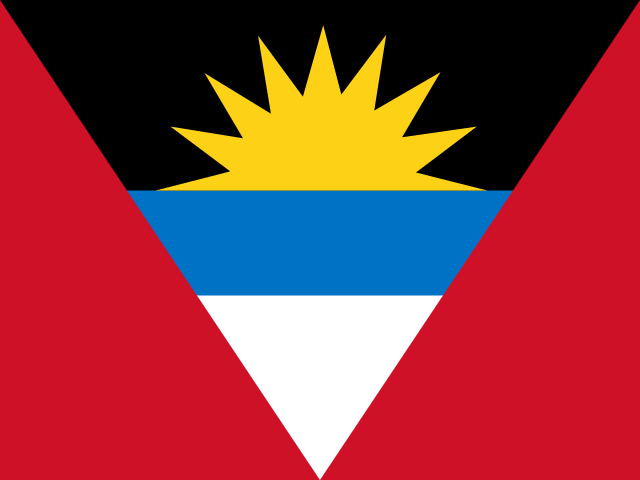
A black band across the top carries a golden half-sun of seven points, with blue and white below narrowing to a point at the bottom centre and red filling the triangles at the hoist and fly. The government's reading: the sun is the dawn of a new era, red the lifeblood of slave forefathers and the dynamism of the people, blue hope, black the soil and African heritage, and gold, blue and white together the sun, sea and sand. The V formed by the red is for 'Victory at last'.
Source: gis.gov.ag
Antigua and Barbuda FACTS ◢
| Capital | St. John's |
|---|---|
| Continent | North America |
| Population | 94,209 (2025) |
| Area | 440 km² |
| Population density | 214/km² |
| Currency | Eastern Caribbean dollar (XCD) |
| Official language | English |
| Calling code | +1268 |
| Internet TLD | .ag |
| Time zone | UTC-04:00 |
| Drives on the | Left |
| ISO codes | AG / ATG |
DID YOU KNOW? ◢
- It's often said to have 365 beaches, one for roughly every day of the year.
- Its Nelson's Dockyard is the only continuously working Georgian-era naval dockyard in the world.
- Cricket is a national passion, and the islands have produced some of the sport's greatest players.
- The frigatebird, with its bright red inflatable throat pouch, nests in large colonies on Barbuda.
Antigua and Barbuda QUICK ANSWERS ◢
What is the capital of Antigua and Barbuda?
The capital of Antigua and Barbuda is St. John's.
What is the population of Antigua and Barbuda?
Antigua and Barbuda had a population of 94,209 in 2025.
What currency does Antigua and Barbuda use?
Antigua and Barbuda uses the Eastern Caribbean dollar (XCD).
What languages are spoken in Antigua and Barbuda?
The official language of Antigua and Barbuda is English.
Think you know your flags? Play Flag Daily → · Browse all countries →
MORE ON THE FLAG ◢
The Antigua and Barbuda flag was drawn in about half an hour by a high-school art teacher who entered the national competition at the last minute and had to buy an envelope on the way to hand it in.
He won. Reginald Samuel, later Sir Reginald, beat more than 600 entries in 1966, and what he sketched has flown unchanged ever since.
The design, for anyone reading this without it in front of them: a black band across the top carrying a golden half-sun, then blue and white below narrowing to a point at the bottom centre, with red filling the two triangles that leaves at the hoist and the fly. Album des Pavillons puts the proportions at two by three.
The government publishes its own reading of that design, and it is shorter and blunter than most of the versions in circulation.
Key Takeaways
- Reginald Samuel beat over 600 entries in the 1966 competition with a design he made in about half an hour.
- The government's reading: the sun is the dawn of a new era, red the lifeblood of slave forefathers and the dynamism of the people, blue hope, black the soil and African heritage.
- Gold, blue and white together stand for sun, sea and sand. White gets no separate meaning of its own.
- The V has an official meaning of its own: "Victory at last!"
- 27 February 1967 was associated statehood, not independence. Independence came on 1 November 1981 and the flag did not change.
What do the colours on the Antigua and Barbuda flag mean?
The Government of Antigua and Barbuda's Information Service sets the answer out on its National Symbols page. Three colours get a meaning each, a fourth grouping gets a joint meaning, and each of the two shapes gets one of its own.
- Red: the "lifeblood of slave forefathers and dynamism of the people".
- Blue: "hope".
- Black: "the soil and African heritage".
- Gold, blue and white together: the country's "tourist attraction", meaning sun, sea and sand.
- The sun: "the dawn of a new era".
- The V: "Victory at last!"
Two things in that list get lost almost every time it is retold.
The first is red. Short summaries tend to give it as the energy of the people and stop there. The state's own wording puts the enslaved first and the energy second, in that order, and the order is the point.
The second is white. It never stands alone. It carries a meaning only inside the gold, blue and white trio, where it is the sand. A reading that hands the white band purity or peace by itself did not come from the government.
Who designed the Antigua and Barbuda flag?
Reginald Samuel, an art teacher at an Antiguan high school.
The Museum of Antigua and Barbuda's account, reproduced by the flag reference Flags of the World, says the competition was held in 1966 for the occasion of "attaining Independence in Association with Great Britain" on 27 February 1967. There were over 600 entries, and Samuel took a first prize the museum gives as $500, without naming the currency.
The rest of that account is the part still told on the islands. Samuel entered at the very last minute, made the design in only about half an hour, and rushed to buy an envelope so the entry would reach the Administration Building in time. "Later he heard he had won!"
The winning drawing went up on a board outside the Administration Building beside the anthem, coat of arms and slogan, so people could see the symbols they were about to be given. The museum still holds it.
The same reference carries a news agency report from 2 November 2006: Samuel was knighted the previous day, among twelve people the government honoured for their contribution to sport. The flag was not what the honour was for. Since 2024 the islands have marked a National Flag Day on 2 July, his birthday rather than the flag's, though the government's own list of national holidays does not include it. He turned 91 on that day in 2025.
Does the sun on the Antigua and Barbuda flag have seven points or nine?
Both counts are in print, and both describe the same shape. The government calls it "the seven point Golden Sun"; Wikipedia's description says the half-sun has nine rays. Neither is a slip.
The construction sheet published by Flags of the World, following the French naval reference Album des Pavillons, draws the sun as half of a sixteen-pointed star. Halve a sixteen-pointed star along a horizontal line and seven of its points stand clear above the line while two more lie flat along it, one at each end.
| Count | What it counts | Where it comes from |
|---|---|---|
| Seven | Only the points that stand clear of the horizon | The government's National Symbols page, and the 1994 decision below |
| Nine | Every wedge, including the two lying flat along the horizon | Wikipedia, describing the half-of-a-sixteen-pointed-star construction as drawn |
Seven is the number the country settled on, and it settled late. The museum's account records that "In 1994, it was decided that seven full points of the sun should be displayed", because renderings had sometimes carried as many as twenty. For the first twenty-seven years of the flag's life, how many rays its sun had was not fixed.
Nor is much else. Flags of the World states plainly that "No official specification of the color shades and design is known for the Antigua and Barbuda flag", and the third-party recommendations disagree: Album des Pavillons gives Pantone 186c for the red where the Olympic flag manuals for Beijing 2008 and London 2012 give the lighter PMS 032. One Flags of the World contributor recorded in 2003 that the country's embassy in London had sent a delivery of flags back to the manufacturer for being made in yellow rather than gold. Gold is the word the government uses too.
What does the V mean, and do the seven points stand for the parishes?
The V is the easy half. The government's National Symbols page gives it a single line: "Victory at last!" The museum's account attributes the shape to the red borders, the two triangles that meet at the bottom centre.
The seven points are the harder half, and here a popular reading has quietly overtaken the official one.
Antigua has six parishes: Saint John, Saint George, Saint Peter, Saint Philip, Saint Paul and Saint Mary. Six parishes plus Barbuda makes seven, and the arithmetic is tidy enough that the reading has stuck.
It is not the state's reading. The government gives the seven-point sun a single meaning, the dawn of a new era, and no other. The museum's account is blunter still: it records the parishes suggestion and adds that "the designer himself did not have this in mind".
There is a third island, too. The Constitution says the territory "shall comprise the islands of Antigua, Barbuda and Redonda". A parishes-plus-Barbuda count leaves Redonda out.
What happened on 27 February 1967?
Not independence. That is the most common thing said about this flag and the thing to get right.
Antigua became an associated state of the United Kingdom on that date, in the government's own words "with full internal autonomy", while Britain kept defence and external affairs. The flag was adopted for the occasion, eleven days after the West Indies Act 1967 took royal assent on 16 February. That statute turned Antigua and several neighbours, Dominica and Grenada among them, from British colonies into states in free association with Britain.
What the flag replaced was a British Blue Ensign carrying a badge taken from the arms of the Leeward Islands, introduced around 1957 and dropped at associated statehood.
Independence came more than fourteen years later, on 1 November 1981. The Antigua and Barbuda Constitution Order 1981 marks it in the opening recital: "the status of association of Antigua with the United Kingdom is to terminate on 1st November 1981".
Read that wording again. Until that day the state was called Antigua, though Barbuda and Redonda were inside its territory throughout. What the name gained in 1981 was Barbuda, and the flag Samuel drew in 1966 carried over unaltered.
That Constitution does not mention the flag at all. Read the Order end to end and the word never appears, so the design the government lists first among the national symbols is described nowhere in the country's founding law. Whether that is why no official construction sheet exists is not something any source settles.
As national flags go this one is unmistakable and awkward to redraw from memory, and the sun is the part that repays a second look. Try the flag on Flag Daily, or work along the Leeward Islands through the country pages.
Frequently asked questions
What does each colour on the Antigua and Barbuda flag stand for?
The Government of Antigua and Barbuda gives red the lifeblood of slave forefathers and the dynamism of the people, blue hope, and black the soil and African heritage. Gold, blue and white together stand for the country's sun, sea and sand. White is given no meaning on its own, the sun means the dawn of a new era, and the V means "Victory at last!"
Who was Sir Reginald Samuel?
The designer of the Antigua and Barbuda flag: an art teacher at an Antiguan high school who won the 1966 national competition, beating more than 600 entries with a design he made in about half an hour and entered just before the deadline. A news agency report from November 2006 records his knighthood, given for his contribution to sport rather than for the flag. The islands have marked a National Flag Day on his birthday, 2 July, since 2024.
How many points does the sun on the Antigua and Barbuda flag have?
Seven on the government's own reading, though you will also see nine. Antigua and Barbuda's National Symbols page calls it the seven point Golden Sun, and in 1994 it was settled that seven full points should be shown, because renderings had sometimes carried as many as twenty. Descriptions that say nine rays are counting the two flat wedges lying along the horizon as well as the seven that rise above it.
The published construction sheet draws the sun as half of a sixteen-pointed star, which produces exactly that arrangement: seven points clear of the line, and one at each end lying along it.
What does the V on the Antigua and Barbuda flag mean?
Victory. The government's National Symbols page puts the V in a single line: "Victory at last!" The shape is the one the two red triangles make where they meet at the bottom centre of the flag.
When was the Antigua and Barbuda flag adopted?
On 27 February 1967, the day Antigua became an associated state of the United Kingdom with full internal autonomy. That was not independence, which followed on 1 November 1981, and the flag was carried over to the independent state unchanged.
Sources
- Government of Antigua and Barbuda Information Service, National Symbols, National Flag entry - retrieved 12 August 2026.
- Government of Antigua and Barbuda Information Service, Independence, "Colonial era"; Parishes; and National Holidays, whose list runs from New Year's Day to Boxing Day and contains no Flag Day - retrieved 12 August 2026.
- West Indies Act 1967 (1967 c. 4), enacted text at legislation.gov.uk, giving royal assent as 16 February 1967 - retrieved 12 August 2026.
- Flags of the World, Antigua and Barbuda - the Museum of Antigua and Barbuda on the 1966 competition and the 1994 seven-points decision, the 2 November 2006 knighthood report, the Album des Pavillons construction sheet, ratio and Pantone notes, and the "no official specification" line. Its colonial flags page covers the Blue Ensign that preceded it. Retrieved 12 August 2026.
- Wikipedia, Flag of Antigua and Barbuda - cited only as the source of the "nine rays" description discussed above, not as authority for any other claim. Retrieved 12 August 2026.
- The Antigua and Barbuda Constitution Order 1981, opening recital and Chapter I section 1, full text via Georgetown University's Political Database of the Americas - retrieved 12 August 2026.
- Antigua Observer, National Flag Day (24 June 2024) and Sir Reginald Samuel celebrates 91st birthday (3 July 2025) - retrieved 12 August 2026.
PLAY ANOTHER →
A short message, hidden in a different cipher every day.
ONE CIPHER A DAYDAILYOn This DayOne thing that happened today in history. Every day, a new one.
TODAY IN HISTORYDAILYDaily TriviaFive questions a day. Everyone gets the same five.
FIVE QUESTIONSDAILYGuess the CountryThree clues, three guesses. Work out where in the world it is.
THREE CLUES