
Dominica
A rugged Caribbean island so mountainous and rainforest-thick that Christopher Columbus supposedly described it by crumpling a piece of paper. Dominica is the wild, unpaved cousin of the beach-resort islands.
WHAT THE FLAG MEANS ◢
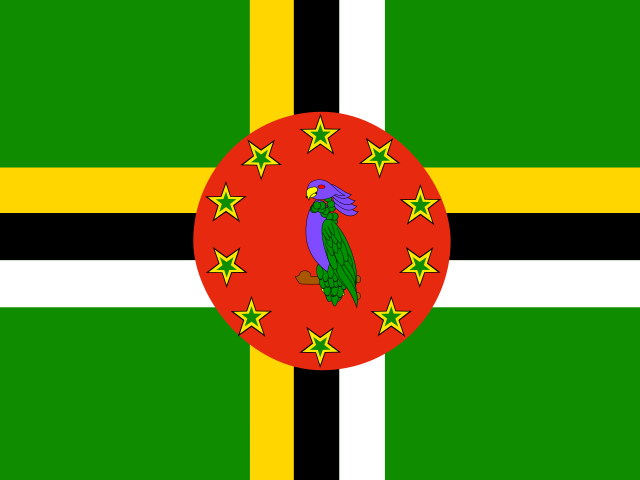
A forest-green field crossed by three vertical and three horizontal stripes of yellow, black and white, with a red disc at the centre bearing a Sisserou parrot on a twig inside a ring of ten stars. The Government of Dominica assigns a meaning to every element: green for the island's forest, the cross for the Trinity and for the principle that the country is founded on acknowledgement of the supremacy of God, yellow for sunshine, citrus and bananas and the Carib and Arawak people, white for the clarity of the rivers and purity of aspiration, black for the rich soil and African heritage, the ten stars for the ten parishes each with equal status, and the red disc for social justice. The parrot is the national bird and is taken from the coat of arms. In 1978 the government's own announcement gave the red disc a different reading: it said the emblem carried the connotation of socialism.
Source: dominica.gov.dm
Dominica FACTS ◢
| Capital | Roseau |
|---|---|
| Continent | North America |
| Population | 65,871 (2025) |
| Area | 751 km² |
| Population density | 88/km² |
| Currency | Eastern Caribbean dollar (XCD) |
| Official language | English |
| Calling code | +1767 |
| Internet TLD | .dm |
| Time zone | UTC-04:00 |
| Drives on the | Left |
| ISO codes | DM / DMA |
DID YOU KNOW? ◢
- It's home to the Boiling Lake, one of the largest actively boiling lakes on Earth.
- Its official name, the Commonwealth of Dominica, helps distinguish it from the much larger Dominican Republic.
- It has hundreds of rivers, with locals joking there's one for every day of the year.
- It's one of the few places where the endangered imperial amazon parrot, its national bird, still lives in the wild.
Dominica QUICK ANSWERS ◢
What is the capital of Dominica?
The capital of Dominica is Roseau.
What is the population of Dominica?
Dominica had a population of 65,871 in 2025.
What currency does Dominica use?
Dominica uses the Eastern Caribbean dollar (XCD).
What languages are spoken in Dominica?
The official language of Dominica is English.
Think you know your flags? Play Flag Daily → · Browse all countries →
MORE ON THE FLAG ◢
A purple Sisserou parrot sits at the centre of a red disc, ringed by ten stars, on a cross of yellow, black and white laid over forest green.
No part of the Dominica flag is left without an official meaning. Its government publishes a meaning for every stripe, colour and star, where most flags come with folk readings no government has put its name to. (It is not the Dominican Republic; its official name is the Commonwealth of Dominica.)
That gloss has moved: in 1978 the announcement at independence said the red disc "carries the connotation of socialism", where the wording the government publishes in 2026 gives the same disc social justice.
Key Takeaways
- The government assigns a meaning to every element, from green for the forest to white for the rivers and black for African heritage.
- The ten stars are the ten parishes, "each with equal status"; the red disc is social justice, where the 1978 announcement said it "carries the connotation of socialism".
- Alwin Bully entered a design competition early in 1978, and the government's announcement called the flag an amendment of his design.
- The flag has been redrawn three times since 1978, and nothing found here shows the schedule that defines it in law being amended to match.
What do the colours on the Dominica flag mean?
The government's national symbols page sets out the scheme. Green, the background, is the island's forest and its lushness. The cross, three vertical and three horizontal stripes in three colours, represents the Trinity, and the government adds that it "demonstrates belief in God since the Commonwealth of Dominica is founded upon the principles that acknowledge the supremacy of God". That is lifted almost intact from the constitution's preamble.
Each arm does its own work. Yellow is the sunshine, the citrus and banana crops, and a symbol of the Carib and Arawak people, whom the government names as the first inhabitants. White is the clarity of the rivers and waterfalls, and purity of aspiration. Black is the rich black soil and African heritage.
The ten stars are the traditional symbol of hope and stand for the ten parishes, "each with equal status, thus the equality of our people". The parrot is the national bird, taken from the coat of arms. The red disc is Dominica's "commitment to social justice". The words "social justice" appear in the constitution's preamble too, where the people of Dominica "respect the principles of social justice", though the government's flag page does not cite it.
Who designed the Dominica flag?
Alwin Bully. The government's national symbols page credits him by name, and a Ministry of Education profile carried by Dominica News Online in 2018 describes the playwright and artist who founded and first led the island's Department of Culture.
His route to the flag was a competition. The government's announcement of 3 November 1978, reproduced by Flags of the World, describes it as "an amendment of a design submitted by Alwin Bully for a flag competition held early this year". The announcement does not say he won it; the Dominica magazine eMAGE DM, profiling him in October 2021, calls the entry "Bully's winning submission".
He named what mattered most to him in that profile: "Of greatest importance to me is the circle with ten stars of the same size, signifying the equality of our ten parishes and every Dominican citizen in these parishes." That is the government's own reading of the stars, in his words. Dominica gave him the Sisserou Award of Honor for the design in 1985.
Why does the Dominica flag have a purple parrot?
Because the bird's tail and underparts are, and because it was already an emblem of the state. The government says the Sisserou, Amazona imperialis, "figures prominently on the Coat of Arms, the National Flag, The Public Seal, The Mace of the House of Assembly ...", and that it is found only in Dominica.
Its description of the bird explains the colour: the upper parts and back are mostly green, the head greenish blue, and "the tail and under parts are of a purplish violet hue". Which purple is a different question, and no official answer to it turned up. Flags of the World records PMS 254 from the London 2012 Olympic protocol manual, PMS 258 from the Beijing 2008 manual, Pantone 2070c from the Album des Pavillons of 2023 and PMS 265C from Vexilla Mundi, among others. Of the London 2012 figure the archive notes that each National Olympic Committee approved its own flag's shades, so it need not be the government's, and the Album is a third-party reference work, not a specification issued by Dominica's government. Set the flag beside Saint Lucia, Grenada or Antigua and Barbuda and the purple is what marks it out.
Has the flag changed since 1978?
Yes, three times, by margins most people never notice.
| Element | Flag announced 3 November 1978 | Flag as flown in 2026 |
|---|---|---|
| Order of the cross stripes | Yellow, white, black | Yellow, black, white |
| Stars | Lime green, no border | Dark green, no border |
| Parrot | Facing sinister, colouring further from the living bird | Looking towards the hoist, colouring modified towards the living bird |
Stripe order is the clearest change. The 1978 announcement describes stripes of "yellow, white and black"; the government's page describes "yellow, black and white". A Flags of the World contributor, Mark Sensen, records in a note of January 1996 that the bands were interchanged on 3 November 1981, and another, Martin Grieve, cites The Flag Bulletin of late 1983 reporting a revised flag introduced exactly three years after independence.
The stars have their own history. A 1991 Flag Bulletin article quoted by Flags of the World says they "originally were 'lime green' instead of the dark green of the flag background", that later versions added a yellow border, and that those borders, "not mentioned in the official blazon, have now been omitted". Christopher Southworth places the shift to dark green between 1981 and 1988, and Zoltan Horvath dates the removal of the borders to 3 November 1990. Dominica's published wording keeps the 1978 phrasing, "ten lime green stars".
The same article covers the bird: "The parrot had its colouring modified to correspond more closely to the appearance of the national bird ..." Its posture moved too, dated to 1988 by Sensen in that same note; the archive's own summary line dates a modification to 1988 without saying which element changed. The Album des Pavillons of 2000 already has the parrot "looking towards hoist". Horvath's 2024 entry gives 3 November 1990 as the last change of any kind, though that summary line still reads "Flag adopted: 3 November 1978 (Modified 1988)". Try Flag Daily to see whether you can pick the flag out unprompted.
Where is the flag actually defined in law?
Not in the constitution. In the 1978 text with amendments through 2014 published by the Constitute Project, it runs to 121 sections across ten chapters, and the words flag, emblem, coat of arms and anthem appear in none of them.
It comes from a statute instead. Flags of the World carries a transcription posted by the contributor Christopher Southworth in May 2005, from a copy of the official description he says he held. Its source is Act No. 18 of 1978, the National Emblems of Dominica Act, signed on 31 October 1978, gazetted the next day and effective on independence day, 3 November 1978. Part II of its schedule is a heraldic blazon: "Vert three pallets conjoined in pale and as many bars similarly conjoined in fess or argent and sable overall a roundel gules charged with a Sisserou Parrot ... facing sinister perched on a wooden twig proper within a orle of ten mullets. Also vert." Pallets and bars are vertical and horizontal stripes, a roundel gules is a red disc, an orle of ten mullets a ring of ten stars, and facing sinister means turned towards the fly.
Read as heraldry and set against the flag that flies, that schedule describes the 1978 design. The Act's stripe tinctures are or, argent and sable, which is gold, silver and black. That is the yellow, white and black of the 1978 announcement, not the yellow, black and white the government describes on its national symbols page in 2026. Its parrot is blazoned facing sinister, and the bird's posture is the element dated to 1988. The stars it tinctures vert without fixing a shade, so the shift from lime green to dark green departs from the government's published wording rather than from the schedule.
The blazon also assigns no meanings at all: green, not forest; ten stars, not ten parishes. Every reading here comes from what the government publishes alongside the law, not from the law itself, which is why the red disc could move from socialism to social justice without a word of the statute changing. Nothing reached in this search shows the schedule amended as the flag was redrawn in 1981, 1988 and 1990.
An honest gap: both documents this section rests on, the schedule and the 1978 announcement, arrive through the same flag archive reproducing copies rather than a government text this account could open. Searching the government's online index of the laws by title for "emblem" returns nothing, where "constitution" returns four instruments, so the search itself works. But that index describes itself as covering the Revised Laws of Dominica 1990 and Acts and Statutory Rules and Orders from 1991 to 2009, though the results it returns include instruments from 2014 and 2015. Either way, a 1978 Act would appear in it only if it had been carried into the 1990 revision.
Frequently asked questions
What do the ten stars on Dominica's flag mean?
They represent the ten parishes, described by the government as "each with equal status, thus the equality of our people". Bully told eMAGE DM in October 2021 that the equal-sized ring mattered most to him.
Why is the parrot on Dominica's flag purple?
Because the tail and underparts of the living bird are, though the Sisserou is mostly green above. No official specification of the shade turned up: the references Flags of the World records give PMS 254 (London 2012), PMS 258 (Beijing 2008), Pantone 2070c (Album des Pavillons 2023) and PMS 265C (Vexilla Mundi), among others.
When did Dominica's flag last change?
On 3 November 1990, when the yellow border around the ten stars was dropped, on the dating of the Flags of the World contributor Zoltan Horvath in a 2024 entry. That was the last of three changes since independence, after the stripe swap of 1981 and the turn of the parrot in 1988, though the same archive's summary line for Dominica still reads "Modified 1988".
Is Dominica's flag described in its constitution?
No. In the 1978 constitution as amended through 2014, none of the 121 sections mentions a flag, an emblem or a coat of arms. It comes instead from the National Emblems of Dominica Act, Act No. 18 of 1978, whose schedule survives as a transcription held by Flags of the World rather than a government text.
Who designed Dominica's flag and when?
Alwin Bully, through a competition held early in 1978. The government's announcement of 3 November 1978 called the flag an amendment of his design, so what flies is not quite what he entered.
Sources
- Government of the Commonwealth of Dominica, National Flag - retrieved 13 August 2026.
- Government of the Commonwealth of Dominica, National Bird - retrieved 13 August 2026.
- Government of the Commonwealth of Dominica, Laws of Dominica - retrieved 13 August 2026.
- Constitute Project, Dominica's Constitution of 1978 with Amendments through 2014 - retrieved 13 August 2026.
- Flags of the World, Dominica - retrieved 13 August 2026.
- eMAGE DM, Dionne Durand-Smith, Profile: Alwin Bully, Cultural Icon, 11 October 2021 - retrieved 13 August 2026.
- Dominica News Online, Ministry of Education, Alwyn Bully, designer of Dominica's National Flag, 15 October 2018 - retrieved 13 August 2026.
PLAY ANOTHER →
A short message, hidden in a different cipher every day.
ONE CIPHER A DAYDAILYOn This DayOne thing that happened today in history. Every day, a new one.
TODAY IN HISTORYDAILYGuess the CountryThree clues, three guesses. Work out where in the world it is.
THREE CLUESDAILYDaily CryptogramOne quote, one scrambled alphabet. Crack it before tomorrow.
CRACK THE QUOTE