
Dominican Republic
Sharing the island of Hispaniola with Haiti, the Dominican Republic is where the Americas' oldest European city sits a short drive from towering peaks. Baseball, merengue and Santo Domingo's old stone streets set the tempo.
WHAT THE FLAG MEANS ◢
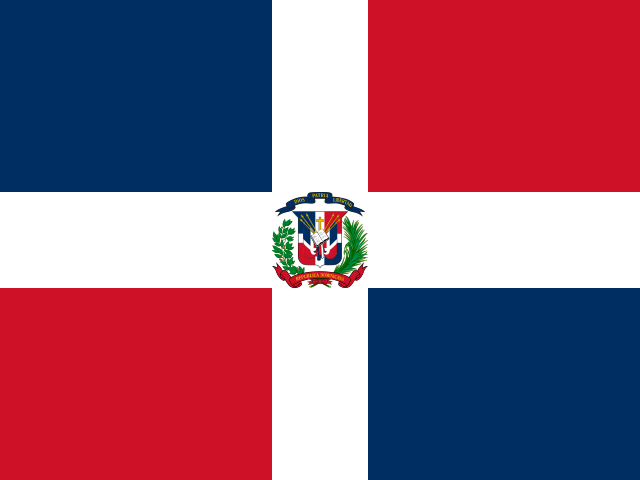
A white cross dividing the flag into alternating quarters of ultramarine blue and vermilion red, blue at the top of the hoist, with the coat of arms at the centre showing a Bible open at John 8:32. Article 31 describes the design and gives the colours no meaning; the familiar readings come from government pages, which disagree. Without the arms it is the merchant flag.
Source: constituteproject.org
Dominican Republic FACTS ◢
| Capital | Santo Domingo |
|---|---|
| Continent | North America |
| Population | 11,520,487 (2025) |
| Area | 48,671 km² |
| Population density | 237/km² |
| Currency | Dominican peso (DOP) |
| Official language | Spanish |
| Calling code | +1849 |
| Internet TLD | .do |
| Time zone | UTC-04:00 |
| Drives on the | Right |
| ISO codes | DO / DOM |
DID YOU KNOW? ◢
- Santo Domingo was the first permanent European settlement in the Americas, founded in 1496.
- Pico Duarte is the highest mountain in the entire Caribbean.
- It has produced a remarkable number of Major League Baseball stars for its size, with the sport treated almost as a national religion.
- It shares the island of Hispaniola with Haiti, the only Caribbean island split between two independent countries.
Dominican Republic QUICK ANSWERS ◢
What is the capital of the Dominican Republic?
The capital of the Dominican Republic is Santo Domingo.
What is the population of the Dominican Republic?
The Dominican Republic had a population of 11,520,487 in 2025.
What currency does the Dominican Republic use?
The Dominican Republic uses the Dominican peso (DOP).
What languages are spoken in the Dominican Republic?
The official language of the Dominican Republic is Spanish.
Think you know your flags? Play Flag Daily → · Browse all countries →
MORE ON THE FLAG ◢
The Dominican Republic flag is described in unusual detail and explained hardly at all. The constitution names both shades, puts the blue quarter at the upper hoist, fixes the white cross's width at half a quarter's height, and even names the chapter and verse the Bible at its centre lies open at.
On what any of it stands for, the text is silent.
Blue for liberty and white for faith are attributions rather than law. The state publishes blue for liberty inconsistently, and white for faith not at all.
Key Takeaways
- Article 31 describes the flag down to the width of the cross, and gives the colours no meaning.
- The Senate presents the familiar readings as personal appreciations by Dominican writers, then prints two that contradict one another.
- The Presidency gives blue as the sky, God's protection and progress. Liberty is not in its list, and no official page read for this article gives white as faith.
- The arms carry a Bible open at John 8:32, a chapter and verse the 2010 reform wrote in.
- The same flag without the arms is the merchant flag, named in the same article. Both are official.
Three government bodies publish four readings between them, because the Senate publishes two. All four are translated here from the Spanish.
| Element | Article 31 | The Senate, in two versions | The Presidency | The Presidential Guard |
|---|---|---|---|---|
| Ultramarine blue | Two quarters, blue at the upper hoist | God protects the nation; then progress and liberty | Sky, God's protection, ideals of progress | Liberty, progress, divine protection, sky and sea |
| Vermilion red | The other two quarters, diagonally opposite | Blood of our liberators; then of the heroes of the Patria | Blood shed by patriots in the battles for independence | Blood of the heroes who forged the nation's liberty |
| White cross | Width equal to half a quarter's height | The liberators' struggle; then peace and union | Peace and union among all Dominicans | Peace, unity, purity of ideals |
What do the colours on the Dominican Republic flag mean?
Officially, nothing. Article 31 sets the flag out in two sentences: the colours "azul ultramar y rojo bermellón", quarters alternating with the blue quarter at the upper hoist, a white cross whose width equals half the height of a quarter, the arms at the centre, and then the merchant flag. Neither sentence pauses to say why. Law 210-19 of 2019 governs the flag's use across fifty-two articles and is silent on symbolism too.
So every meaning you have read is somebody's attribution, and the state says as much. The Presidency introduces its list by saying the concepts are attributed to the colours. The Senate is blunter, calling its readings "apreciaciones personales de insignes hombres de letras dominicanos", personal appreciations by distinguished Dominican men of letters, and then printing two that do not match.
The four readings agree on red: blood, shed by liberators, patriots or heroes. They mostly agree on white. Blue is where they part. The Presidential Guard leads with liberty and the Senate's second version names it too, while the Presidency gives the sky, divine protection and progress and never arrives at it. So blue for liberty is not folklore, and it is not law either. It is what two state bodies publish and a third does not.
Why is there a Bible on the Dominican Republic flag?
Because the arms sit at the centre of the flag, and Article 32 puts a book at the centre of the arms. It is unusually specific: the Bible open at the Gospel of Saint John, chapter 8, verse 32, a cross above it, both rising from a trophy of two lances and four national flags without the arms. The verse reads, in the King James Version, "and ye shall know the truth, and the truth shall make you free".
The precision dates from 2010. The Instituto Duartiano traces the wording through every constitutional text: in 1844 the arms were a cross with the Book of the Gospels open at its foot, and that book survived reforms in 1874, 1924, 1942 and 1947 and revisions as late as 2002. Only the 2010 reform named the Bible, the Gospel and the verse.
It has not stopped the state's publishers diverging. The Foreign Ministry and the Instituto Duartiano both reproduce Article 32 with its two lances; the Presidency's reproduction has three. The uniqueness claim needs care too: Saudi Arabia's flag carries scripture as text on the flag itself. The Dominican claim is the narrower one, about the shield, and the Presidency is the body making it: the only national coat of arms carrying a Bible.
Who designed the Dominican Republic flag?
Juan Pablo Duarte. The Trinitaria oath of 16 July 1838, quoted in full by both the Presidency and the Foreign Ministry, bound its members to a definitive separation from the government of Haiti and described what the new republic would fly: a tricolour of red and blue squares crossed with a white cross.
Duarte's arrangement was not the present one. The Presidency records a blue band along the top and a red band below with the cross laid over them, and says the constituent congress alternated the quarters on 6 November 1844. The first flag, sewn by a group of women including María Trinidad Sánchez and Concepción Bona, had flown on 27 February 1844, the day of independence.
Two later changes are small and telling. Writing for the Academia Dominicana de la Historia, the historian Américo Moreta Castillo notes that the 1844 flag article, number 194, said rosado, pink, where the oath had said encarnado. And the Instituto Duartiano, in a page tracing the coat of arms that quotes the flag articles as it goes, records that the 1908 reform rewrote how the white cross is measured, dropping an 1874 formula that had sized it against the width of one of the other colours in favour of a fraction of the quarter itself. Article 31 in the text of 2015 states it as a width equal to half the height of a quarter.
Why do some Dominican flags have no coat of arms?
Because the plain version is also official. Article 31 ends on the merchant flag: it is the same as the national one, without the arms. A quartered flag with a bare white cross is the civil ensign rather than a simplified version of anything. The split is as old as the republic, and the Instituto Duartiano quotes the 1844 constitution requiring the war flag to carry the arms at its centre, which is exactly why the merchant flag did not.
The shield has also been redrawn often. The Foreign Ministry counts twenty-one versions including the current one, and records that heraldic uniformity arrived only with the decree of 6 February 1913, which carried a drawing by Casimiro Nemesio de Moya and fixed the present colours in its second article.
None of this touches Dominica, a separate country whose flag looks nothing like it.
What does Dominican law say about the flag?
Law 210-19, promulgated on 12 July 2019, replaced a scattered body of older rules. Among them is Ley 360 of 1943, which the Presidency and the Foreign Ministry both still name as the law regulating the flag. Article 4 of the new law sets three official sizes, the largest 2.5 metres by 1.666 metres, and permits any size that keeps those proportions; Article 3 confirms 27 February as Flag Day. The Consultoría Jurídica del Poder Ejecutivo records that the date used to be 24 October, dropped in 1961, with 27 February instituted by a law of 22 October 1962.
Most of the rest is about what may not be done, and it reaches the colours again from the other side. Article 24, items 1 and 2, make it an act of irreverence to use shades other than the ones the constitution names, or to put a version of the arms other than the official one on the flag. Even the folding is prescribed, down to the last triangle. Flag Daily works at about that level of detail.
Frequently asked questions
Does the Dominican constitution say what the flag's colours mean?
No. Article 31 describes the flag precisely and assigns its colours no meaning, and Law 210-19 of 2019 is silent on symbolism too. The readings in circulation come from government pages that present them as attributions.
How many lances are in the Dominican coat of arms?
Two. Article 32 describes a trophy of two lances and four national flags without the arms, and the Foreign Ministry and the Instituto Duartiano both reproduce it that way. The Presidency's own page prints three, one of several points where the state's publications differ from each other.
What are the Dominican flag's proportions?
The constitution gives none. It fixes the cross's width at half the height of a quarter and leaves the flag's overall ratio unstated. Article 4 of Law 210-19 lists three official sizes, which all work out at almost exactly 3:2, length to height; the Presidency publishes the same ratio the other way round, as 2:3, height to length.
Is a Dominican flag without the coat of arms a real flag?
Yes. Article 31 provides that the merchant flag is the same as the national flag without the arms, so both versions are official and a plain quartered flag is not a defective one.
Which law governs the Dominican flag?
Law 210-19 of 12 July 2019, which repealed Ley 360 of 1943 and later measures amending it. It punishes irreverence towards the flag with fifteen to thirty days in prison and a fine of one to five public-sector minimum wages, and the graver class it calls outrage with one to three months.
Sources
- Constitute Project, Dominican Republic 2015 Constitution - retrieved 13 August 2026.
- Presidencia de la República Dominicana, Símbolos patrios - retrieved 13 August 2026.
- Senado de la República Dominicana, Símbolos Patrios - retrieved 13 August 2026.
- Ministerio de Relaciones Exteriores, Símbolos Patrios - retrieved 13 August 2026.
- Consultoría Jurídica del Poder Ejecutivo, Bandera de la República Dominicana - retrieved 13 August 2026.
- Instituto Duartiano, Escudo Nacional Dominicano - retrieved 13 August 2026.
- Congreso Nacional, Ley No. 210-19 sobre los símbolos patrios - retrieved 13 August 2026.
- 1er Regimiento Guardia Presidencial, Bandera Nacional - retrieved 13 August 2026.
- Academia Dominicana de la Historia, Américo Moreta Castillo, La Constitución de San Cristóbal del 6 de noviembre de 1844 - retrieved 13 August 2026.
PLAY ANOTHER →
A short message, hidden in a different cipher every day.
ONE CIPHER A DAYDAILYGuess the CountryThree clues, three guesses. Work out where in the world it is.
THREE CLUESDAILYDaily CryptogramOne quote, one scrambled alphabet. Crack it before tomorrow.
CRACK THE QUOTEDAILYOn This DayOne thing that happened today in history. Every day, a new one.
TODAY IN HISTORY