
Saudi Arabia
Occupying most of the Arabian Peninsula, Saudi Arabia is home to Islam's two holiest cities and a desert, the Rub' al Khali, so vast it's called the Empty Quarter.
WHAT THE FLAG MEANS ◢
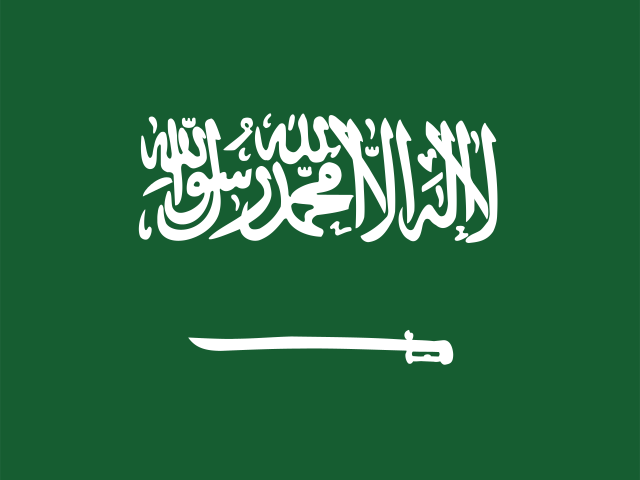
A green field two thirds as wide as it is long, bearing the Islamic declaration of faith in white Thuluth script with a drawn sword beneath it. Article 3 of the Basic Law fixes the colour, the proportions, the wording and the sword, and adds that the flag is never lowered. The flag law that sets out the rest assigns no element a meaning; the reading the state has since put on record takes the declaration of faith for a message of peace and Islam, and the sword for strength, pride, and high wisdom and standing.
Saudi Arabia FACTS ◢
| Capital | Riyadh |
|---|---|
| Continent | Asia |
| Population | 36,973,555 (2025) |
| Area | 2,250,000 km² |
| Population density | 16/km² |
| Currency | Saudi riyal (SAR) |
| Official language | Arabic |
| Calling code | +966 |
| Internet TLD | .sa |
| Time zone | UTC+03:00 |
| Drives on the | Right |
| ISO codes | SA / SAU |
DID YOU KNOW? ◢
- It contains Islam's two holiest cities, Mecca and Medina, drawing millions of pilgrims for the annual Hajj.
- The Rub' al Khali, or Empty Quarter, is the largest continuous sand desert in the world.
- It has no permanent rivers, one of the largest countries on Earth without a single one.
- The ancient rock-cut tombs of Hegra (Mada'in Salih) were the country's first UNESCO World Heritage Site.
Saudi Arabia QUICK ANSWERS ◢
What is the capital of Saudi Arabia?
The capital of Saudi Arabia is Riyadh.
What is the population of Saudi Arabia?
Saudi Arabia had a population of 36,973,555 in 2025.
What currency does Saudi Arabia use?
Saudi Arabia uses the Saudi riyal (SAR).
What languages are spoken in Saudi Arabia?
The official language of Saudi Arabia is Arabic.
Think you know your flags? Play Flag Daily → · Browse all countries →
MORE ON THE FLAG ◢
Saudi Arabia's flag law is unusually exact. It sets the proportions, names the calligraphic style of the inscription, and fixes the sword at three quarters the length of the writing above it. It says which way the hilt faces. It requires the inscription and the sword to be drawn clearly from both sides of the cloth.
It runs to twenty-two articles. Not one of them says what any of it means.
The meaning is on the record. It is just not in the flag law. It is in a royal order issued in March 2023 whose operative part is one sentence long and creates a public holiday. The preamble above that sentence is where the Saudi state set out, in its own voice, what the inscription and the sword stand for.
The country's national archive, on the page it built for that same holiday, then gives the sword a second reading that is not the royal order's, and gives the green a reading that no instrument carries.
Key Takeaways
- The Law of the Flag of the Kingdom of Saudi Arabia, issued by Royal Decree M/3 of 10/2/1393H, describes the flag in detail across twenty-two articles and assigns no element a meaning.
- Royal Order A/303 of 9/8/1444H, which made 11 March Flag Day, says in its preamble that the declaration of faith at the flag's centre stands for a message of peace and Islam, and the sword for strength, pride, and loftiness of wisdom and standing.
- Article 3 of the Basic Law of Governance gives the flag three lettered lines, and ends the third with a prohibition: the flag is never lowered.
- No Saudi instrument opened for this article fixes a shade of green, or gives the green any meaning. The national archive's prose reads it for greenery, growth and the bounty of the land. The same archive's symbols chart leaves the colour out.
- The flag law forbids flying the flag at half mast, using it as a trademark or in advertising, and flying it faded, and requires a worn flag to be burned by whoever was using it.
| Instrument | Date | What it fixes | What it says the flag means |
|---|---|---|---|
| Basic Law of Governance, article 3 (Royal Order A/90) | 27/8/1412H | Green, width two thirds of length, the declaration of faith with a drawn sword beneath it, never lowered | Nothing |
| Law of the Flag (Royal Decree M/3) | 10/2/1393H | Twenty-two articles: geometry, script, protocol, prohibitions, a penalty | Nothing |
| Royal Decree M/34 | 24/12/1418H | Replaces article 3(a) of the flag law | Nothing, and it leaves the position undisturbed |
| Royal Order A/303 | 9/8/1444H | Makes 11 March each year Flag Day | The declaration of faith stands for a message of peace and Islam; the sword for strength, pride, and loftiness of wisdom and standing |
The meaning is set out in a royal order about a public holiday
Royal Order A/303, issued by King Salman on 9/8/1444H and carried by the official gazette on 10 March 2023, does one thing: it makes 11 March each year a day for the flag, under the name Flag Day. Two clauses, one of which is the instruction to notify the relevant authorities.
Everything of interest is in the recitals above them. The order recites the Basic Law, recites the 1973 flag law, and then departs from the usual form of a Saudi royal order to explain itself. It sets the flag against the founding of the Saudi state in 1139H, which it gives as 1727, and then assigns two elements a meaning.
The declaration of faith at the centre, it says, symbolises رسالة السلام والإسلام, the message of peace and Islam on which the state was founded. The sword symbolises القوة والأنفة, strength and pride, together with علو الحكمة والمكانة, loftiness of wisdom and of standing.
The same passage says citizens have taken the flag as a banner of glory, شامخة لا تنكس, lofty and never lowered. And it fixes the date the holiday commemorates: 27 Dhu al-Hijjah 1355H, which it gives as 11 March 1937, the day King Abdulaziz approved the flag in the form flown today, with what the order calls its great significations pointing to monotheism, justice, strength, growth and prosperity. That last list is the widest statement of meaning in any instrument opened for this article, and it is attached to the flag as a whole rather than to any part of it.
The twenty-two articles of Saudi Arabia's flag law interpret nothing
The Law of the Flag of the Kingdom of Saudi Arabia was approved by Council of Ministers Resolution 101 of 2/2/1393H and issued by Royal Decree M/3 of 10/2/1393H under King Faisal. The Bureau of Experts at the Council of Ministers, which publishes the Saudi statute book, still records it as in force.
Article 1 holds the detail. The flag is rectangular, its width two thirds of its length, green from the staff to the end of the flag, with the declaration of faith across the centre and a drawn sword beneath it and parallel to it. Both are drawn in white and, in the article's words, clearly from both sides. Paragraph (b) sets the block of writing and sword against the flag's four margins. Paragraph (c) is the one to read twice: the declaration is drawn in خط الثلث, the Thuluth script, with its baseline halfway up the block, and the sword is drawn at a length equal to three quarters of the length of the writing, equidistant from the sides.
Article 1(a) even fixes the sword's orientation, with its قبضته إلى القسم الأدنى, its hilt turned toward the lower section of the flag. The statute's own vocabulary is better evidence than a dictionary for what أدنى is doing there. Paragraph (b) measures the design against الأعلى والأدنى, the upper and the lower, and separately against الأيمن والأيسر, the right and left ones, so the horizontal axis has a pair of words of its own. Article 2 then places the royal emblem in الزاوية الدنيا, the lower corner, المجاورة لعود العلم, the one adjacent to the staff, treating lower and next-to-the-staff as two facts rather than one. All of it points at lower. And Model (1), the illustration this same article attaches, prints the hilt at the staff end. Nothing in the law reconciles the two.
Article 2 of the flag law gives the King a personal flag: the national flag with the state emblem, two crossed swords beneath a palm tree, embroidered in gilded silk thread in the lower corner beside the staff. Articles 3 to 12 are the raising protocol. Articles 13 to 16 are prohibitions, 17 the military salute, 18 precedence between flags, and 19 unit banners. Article 20 is a penalty. Articles 21 and 22 hand interpretation to the Council of Ministers and the executive regulations to the Interior Minister.
Across all of it, no sentence says what the green, the writing or the sword stands for.
Nothing has replaced that law since. In early 2022 the Shura Council voted through a draft amendment to it, proposed by one of its own members, whose stated purpose was reported as filling the gap left by the absence of any law defining the state anthem, which article 4 of the Basic Law says the Law shall determine. The draft's own text could not be reached for this article. What can be checked is that the Bureau still records the 1973 law as in force, and that Royal Order A/303, issued more than a year after that vote, recites it as the operative flag law.
The sword has two state readings, and the same institution publishes both
The King Abdulaziz Foundation for Research and Archives is the Saudi state's historical archive. Its Flag Day page carries an infographic titled رموز العلم, the symbols of the flag, which gives the declaration of faith the royal order's reading and gives the sword the royal order's reading too: strength, pride, and loftiness of wisdom and standing.
The prose on the same page says something else. There, the sword يشير إلى العدل, points to justice, and to the defence of religion and homeland. Strength does not appear in that sentence and justice does not appear in the chart's entry for the sword.
Both readings are the archive's, on one page, live together on the day the holiday was first kept. Neither is in the flag law, because the flag law has no such sentence to be in. Unreconciled rather than contradictory is the ordinary condition of a symbol that acquired its meanings after its design.
The chart reproduces the royal order's five significations for the flag as a whole under the heading دلالات العلم, and then gives three Arabic words the flag goes by, راية, بيرق and لواء, which is a reminder that the object had names long before it had a statute.
The instruments that make Saudi Arabia's flag give the green no meaning and no shade
Ask what the green means and the answer you will usually get, that green is the colour of Islam, is not what the Saudi state says.
The archive's prose says the choice of green came رمزاً للخضرة والنماء, as a symbol of greenery and growth, and as an expression of the bounty the land of the Kingdom yields. That is a reading about the country, not about the religion.
The archive's own symbols chart does not include the colour at all. It has an entry for the declaration of faith and an entry for the sword, and stops. Royal Order A/303 assigns meanings to the same two elements and says nothing about the field they sit on. The Basic Law and the flag law both name the colour and neither interprets it.
Nor does any of them fix a shade. The Basic Law says لونه أخضر, its colour is green, and that is the whole of the colour specification in it. The flag law adds only that the green runs from the staff to the end of the flag. The only colour artefact anywhere in the instrument is the printed illustration attached as Model (1), which is a plate reproduced in 1393H rather than a specified value.
If you want to see how differently a state can behave here, Iraq's flag law puts the meaning of its colours in one statutory sentence and has rewritten that sentence at least once.
The prohibitions, and the one that is in the Basic Law
Article 3 of the Basic Law of Governance, issued by Royal Order A/90 of 27/8/1412H, describes the flag in three lettered lines, and the third of them ends with four words that are not description at all: ولا ينكس العلم أبدا, and the flag is never lowered.
A constitutional-level instrument that declines to interpret any element of the flag still commits the state, in the same breath as the design, to a rule about how it is flown. Article 3 then hands the rest to ordinary legislation.
The flag law picks the never-lowered rule up and widens it, and article 13 is the one that turns on the inscription rather than the cloth. Its bar on تنكيس, on lowering to half mast, reaches the national flag, the King's flag, and any other Saudi flag carrying the declaration of faith or a Quranic verse. That is a rule about a text rather than about a banner.
Articles 14 to 16 are about the object. Article 14 says neither the national flag nor the King's flag may touch the ground or the water. Article 15 prohibits using the national flag as a trademark, for commercial advertising, or for any purpose other than those provided for in the law, which sets a default of prohibition with exceptions rather than the reverse. Article 16 prohibits flying it faded in colour or in poor condition, and requires a flag too old to use to be burned by the body that was using it rather than by any central authority.
Article 20 attaches a penalty. Anyone who publicly drops, destroys or in any way insults the national flag, the royal flag, or any other emblem of the Kingdom or of a friendly foreign state, out of hatred or contempt for the authority of the government or of those states, faces up to a year's imprisonment and a fine of up to three thousand riyals, or one of the two.
The Bureau's online text of the flag law's article 3 stops one paragraph in
The Bureau of Experts publishes the flag law twice: as a web text, and as a scan of the printed original from the Government Press at Mecca, attached to the same entry. In the web text, article 3 has one lettered paragraph, (a), covering the flag inside the Kingdom between sunrise and sunset on the weekly holiday and the eids, on all government buildings and public institutions.
The scan prints three. Paragraph (b) covers the flag outside the Kingdom, flown daily between sunrise and sunset at Saudi missions abroad, including on Fridays and the eids, subject to courtesy and international custom. Paragraph (c) covers government posts on the borders, such as police stations, customs and the border guard, along with airports and ports, where the flag flies continuously, night and day.
Both documents are the Bureau's. Why the web text stops where it does is not something either document says.
Only paragraph (a) was ever amended, by Royal Decree M/34 of 24/12/1418H, which King Fahd issued on the strength of a Shura Council resolution of 2/7/1418H and a Council of Ministers resolution of 23/12/1418H. That amendment replaced Fridays with the weekly holiday, which is the sort of change a country makes when its weekend moves rather than when its flag does.
The sword changed sides of the inscription, and the white band went
The archive traces the flag to the first Saudi state, founded in 1139H, given as 1727. Its banner was green, worked from khazz and ibrisim, carrying the declaration of faith, and tied to a plain staff. The declaration has been on it ever since, through the second Saudi state, founded in 1240H and given as 1825, and through the campaigns that made the third.
The archive sets out four stages for the design itself. In the first, the flag is green with a white band at the staff and the declaration of faith in two lines. In the second, two crossed swords sit above the writing. In the third, the two swords are replaced by one drawn sword, still above the writing. In the fourth, the white band is gone, the writing is on one line, and the sword has moved below it, which is the flag flown today.
So the sword changed sides of the inscription and the white hoist band was dropped, all of it within King Abdulaziz's own campaigns on the archive's account, which dates none of the four.
The date the state now commemorates, 11 March 1937, is the day it says he approved the fourth of them. The proportions and the white-on-green rule were written into law thirty-six years after that, in a statute that says nothing at all about where the design came from.
The national archive's own corrections
The archive's Flag Day page includes a short set of cards under the heading أخطاء شائعة, common errors.
The first shows a green flag bearing a white crescent, struck through, with the line that this shape has no connection to the flag of the Saudi state in any historical period. The design circulates widely as a supposed early Saudi or Nejdi flag. The archive's position is that it never was one.
The second addresses authorship. The archive says the common attribution of the design to Hafiz Wahba is incorrect. Its account is that the design developed from the days of the first Saudi state, that the Shura Council prepared it in its present form, and that King Abdulaziz approved it. The flag has no one designer, and the body credited with settling the modern shape is a committee.
That is worth holding on to when reading confident claims about this flag, including confident claims about what it means. A design that accreted acquires its meanings the same way, and the next country this site reads that way is Afghanistan.
Recognising a flag and knowing what its law says about it are different skills, and the first is more fun: Flag Daily shows one flag a day and gives you three guesses at the country.
Frequently asked questions
What does the Saudi Arabian flag mean?
According to Royal Order A/303 of 9/8/1444H, which created Flag Day, the Islamic declaration of faith at the flag's centre stands for the message of peace and Islam on which the Saudi state was founded, and the sword stands for strength, pride, and loftiness of wisdom and standing. Neither the Basic Law nor the 1973 flag law assigns any element of the flag a meaning.
The same order attributes to the flag as a whole what it calls great significations pointing to monotheism, justice, strength, growth and prosperity.
Why is the Saudi flag never flown at half mast?
Because two instruments forbid it. Article 3 of the Basic Law of Governance says of the flag that it is never lowered, and article 13 of the 1973 flag law extends the prohibition to the King's flag and to any other Saudi flag bearing the declaration of faith or a Quranic verse.
The bar is tied to the inscription rather than to the flag as an object, so the article names Quranic verses alongside the declaration of faith.
Can the Saudi flag be used on merchandise?
Article 15 of the flag law prohibits using the national flag as a trademark, for commercial advertising, or for any purpose other than those the law provides for. Article 16 separately prohibits flying it faded or in poor condition, and requires a flag too worn to use to be burned by whoever was using it.
Who designed the Saudi flag?
The King Abdulaziz Foundation for Research and Archives says the common attribution to Hafiz Wahba is not correct, and that the design developed from the days of the first Saudi state before the Shura Council prepared it in its present form and King Abdulaziz approved it. The date the state commemorates for that approval is 27 Dhu al-Hijjah 1355H, given as 11 March 1937.
What does the green on the Saudi flag mean?
Neither the Basic Law, nor the 1973 flag law, nor the 2023 royal order that reads the inscription and the sword gives the green a meaning. The first two name the colour and stop, and the third does not mention the field at all. The national archive's prose reads the choice of green as a symbol of greenery and growth and of the bounty of the land, which is not the same as the widely repeated claim that it stands for Islam.
Sources
- النظام الأساسي للحكم / Basic Law of Governance, articles 3 and 4, Bureau of Experts at the Council of Ministers. Issued by Royal Order A/90 of 27/8/1412H, and read from the Wayback Machine capture of 14 January 2026 because the host does not answer from this machine. Retrieved 21 August 2026.
- نظام العلم للمملكة العربية السعودية / Law of the Flag of the Kingdom of Saudi Arabia, Bureau of Experts at the Council of Ministers. Issued by Royal Decree M/3 of 10/2/1393H on Council of Ministers Resolution 101 of 2/2/1393H, and recorded by the Bureau as in force in the Wayback Machine capture of 15 February 2026 that this was read from. Retrieved 21 August 2026.
- The printed original of the flag law, sixteen page scan, attached by the Bureau of Experts to the same entry, from the Government Press at Mecca, 1393H edition. It carries article 3 in three paragraphs, the two attached flag models, and Royal Decree M/34 of 24/12/1418H. Read from the Wayback Machine and transcribed beside this draft. Retrieved 21 August 2026.
- يكون يوم (11 مارس) من كل عام يوماً خاصاً بالعَلَم, Umm al-Qura, the official gazette of Saudi Arabia, published 10 March 2023. The full text of Royal Order A/303 of 9/8/1444H, which makes 11 March each year Flag Day. Retrieved 21 August 2026.
- يوم العلم / Flag Day, King Abdulaziz Foundation for Research and Archives, together with the infographics that page embeds. The host answers a security block to every client tried here, so it was read from the Wayback Machine capture of 11 March 2023, with the images transcribed beside this draft. Retrieved 21 August 2026.
- السعودية توافق على تعديل نظام العلم والشعار والنشيد الوطني, Anadolu Agency, 1 February 2022, quoting a Shura Council statement, the Saudi Press Agency and two Saudi newspapers on the 2022 draft amendment. Reported here as press rather than as an instrument, and saved beside this draft. Retrieved 21 August 2026.
PLAY ANOTHER →
One thing that happened today in history. Every day, a new one.
TODAY IN HISTORYDAILYDaily TriviaFive questions a day. Everyone gets the same five.
FIVE QUESTIONSDAILYDaily CodeA short message, hidden in a different cipher every day.
ONE CIPHER A DAYDAILYGuess the CountryThree clues, three guesses. Work out where in the world it is.
THREE CLUES