
Afghanistan
A rugged, landlocked crossroads where the Hindu Kush mountains have funnelled traders, empires and caravans between Central and South Asia for thousands of years.
WHAT THE FLAG MEANS ◢
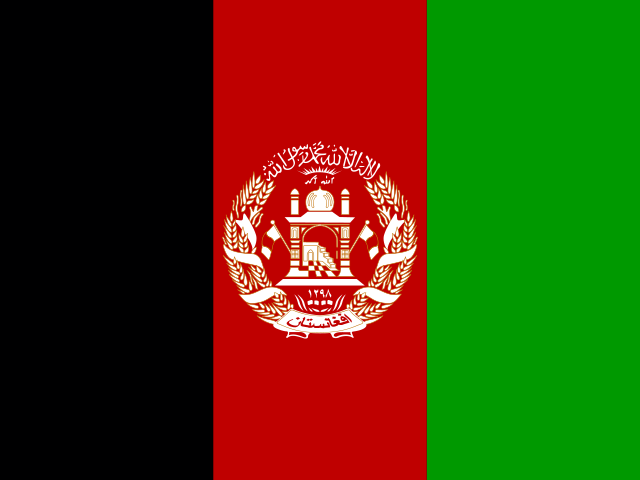
Three vertical bands of black, red and green with the national emblem in white at the centre - a mihrab and pulpit beneath the Shahada and the takbir, a rising sun behind the inscription, and the word 'Afghanistan' with the year 1298 (1919, when Afghanistan declared its independence from Britain) encircled by two sheaves of wheat. Article 19 of the 2004 constitution describes the flag in detail but assigns the three colours no meaning. The Islamic Emirate has required a plain white flag bearing the Shahada since a decree of 20 March 2022, and the tricolour is barred from official use; it is still flown by many Afghans and by the mission holding Afghanistan's seat at the United Nations.
Source: constituteproject.org
Afghanistan FACTS ◢
| Capital | Kabul |
|---|---|
| Continent | Asia |
| Population | 43,844,111 (2025) |
| Area | 652,230 km² |
| Population density | 67/km² |
| Currency | Afghani (AFN) |
| Official languages | Dari, Pashto |
| Calling code | +93 |
| Internet TLD | .af |
| Time zone | UTC+04:30 |
| Drives on the | Right |
| ISO codes | AF / AFG |
DID YOU KNOW? ◢
- The mighty Hindu Kush mountain range runs through it, with peaks soaring above 7,000 metres.
- It sits on the ancient Silk Road, once a key link for trade between China, India and the Mediterranean.
- The Bamiyan Valley once held two of the tallest standing Buddha statues ever carved into a cliff.
- Its national sport is buzkashi, a wild horseback game played with a goat carcass instead of a ball.
Afghanistan QUICK ANSWERS ◢
What is the capital of Afghanistan?
The capital of Afghanistan is Kabul.
What is the population of Afghanistan?
Afghanistan had a population of 43,844,111 in 2025.
What currency does Afghanistan use?
Afghanistan uses the Afghani (AFN).
What languages are spoken in Afghanistan?
The official languages of Afghanistan are Dari and Pashto.
Think you know your flags? Play Flag Daily → · Browse all countries →
MORE ON THE FLAG ◢
Afghanistan flies two national flags at the same time, and they could hardly look less alike.
One is a vertical tricolour of black, red and green with a white emblem in the middle. The other is plain white with a line of black Arabic script across it.
Which one is the Afghan flag is not really a question about design. It is a question about who is asking, and where they are standing.
Key Takeaways
- The black, red and green tricolour is the flag set out in Article 19 of Afghanistan's 2004 constitution, and it is still the flag of the mission holding Afghanistan's seat at the United Nations.
- The plain white banner carrying the Shahada is the flag of the Islamic Emirate. A decree of 20 March 2022 made it compulsory for every Afghan government office at home and abroad.
- Article 19 describes the tricolour in close detail and gives none of its three colours a meaning. The familiar colour readings come from somewhere else entirely.
- The widely repeated adoption date of 19 August 2013 has no traceable basis. No Afghan law records a change to the flag that year.
- The date on the emblem, 1298 in the solar calendar, is 1919, the year Afghanistan declared its independence from Britain.
- Russia recognised the Islamic Emirate on 3 July 2025 and the Moscow embassy changed flags. As of August 2026 no other state has followed.
| Feature | The tricolour | The white banner |
|---|---|---|
| Design | Black, red and green vertical bands, white emblem centred | Plain white, the Shahada in black Thuluth script |
| Defined by | Article 19, Constitution of Afghanistan, 2004 | No flag law that vexillologists have been able to locate |
| In use since | Signed into force January 2004, first hoisted that December | Plain white from 1996, the Shahada added October 1997, restored 2021 |
| Proportions | 2:3, derived from the constitution's own wording | Usually given as 1:2, often made 2:3 |
| Flown by | The mission holding Afghanistan's seat at the United Nations | Every Afghan government office, by decree of 20 March 2022 |
What do the colours on the Afghan flag mean?
Officially, nothing at all.
That is worth saying plainly, because almost every page you will find says otherwise. The legal text that defines the flag is Article 19 of the 2004 constitution, and it is purely descriptive:
"The flag of Afghanistan shall be made up of three equal parts, with black, red and green colors juxtaposed from left to right vertically. The width of every color shall be half of its length, and at the center of which the national insignia shall be located."
Read what that sentence does not do. It does not say what black stands for, or red, or green. It moves straight on to the emblem, and it ends by handing everything else to ordinary legislation: "The law shall regulate the use of the flag and insignia."
It is also a construction drawing in disguise. Three bands, each one twice as tall as it is wide, gives a flag two units high by three across.
Afghanistan's own diplomats took the same line. The Islamic Republic's consulate general in Vancouver explained the flag to the public by reproducing Article 19 word for word and adding nothing about what the colours stood for.
One honest caveat on all of this. Article 19 delegates the detail to an implementing flag law, and that law is not published in English anywhere this article could reach. So the accurate claim is narrower than "nobody has ever said": the constitution assigns no meanings, and neither does the description Afghanistan's own mission gave the public.
The colour readings you usually meet trace back to one attributable statement rather than to a legal text. Flags of the World records an Afghan border affairs official, Abdul Wakil Omari, quoted in an AFP report of 29 January 2002: black for the nineteenth century, when the country was occupied and not independent, red for the fight for independence, and green for independence achieved.
Look at that third one. Green for independence achieved, not green for hope, and not green for Islam.
Vexillologists tracing the same three colours back to the tricolour of 1928 hedge harder still: black as the survival of the old plain field of the sovereign, red possibly borrowed from the Soviet flag as a badge of modernity, green for Islam. That reading comes from Jaume Olle's history of Afghan flags, drawing on The Flag Bulletin and Flagmaster, and it is the historian's own word "possibly" doing the work, not this article's.
What is the emblem in the middle of the Afghan flag?
A mosque seen head-on, carrying nearly everything the state wanted to say about itself.
Article 19 lists the parts. A mihrab, the niche in a mosque wall that marks the direction of prayer, and a pulpit, both in white. A flag at each of its two corners. Inscribed above them, the Shahada together with the takbir, which the constitution's own text renders as "There is no God but Allah and Mohammad is his Prophet, and Allah is Great." A rising sun behind the writing. At the foot, the word "Afghanistan" and a year, with two sheaves of wheat wrapped around the whole thing.
The year is the part worth stopping on. It reads 1298 in the solar calendar, as Article 19 specifies, and 1298 plus 621 gives 1919. That is the year the 26-year-old king Amanullah Khan, having fought the British Raj to a settlement at Rawalpindi, declared Afghanistan's first independence day.
It has not always said that. The flag of the Transitional Authority, flown from 2002, carried 1348 instead, for 1929, the year Mohammed Nadir Shah was crowned.
Run the same sum on that one and it fails: 1348 plus 621 is 1969. The two numbers are not on the same calendar. Afghanistan's solar Hijri year and the lunar Hijri year of the wider Islamic calendar both count from the same starting point, but a lunar year is about eleven days shorter, so after thirteen centuries they have drifted four decades apart. 1348 is the lunar year, and it began in the middle of 1929.
Whichever calendar you read it in, the 2004 redesign swapped a coronation for an independence. The same change inserted the rising sun, nine long rays and eight short ones, between the two inscriptions, and stretched the proportions from 1:2 to 2:3.
Was the Afghan flag really changed in 2013?
Probably not, though you would never guess it from how often that date is repeated.
Reference pages routinely give 19 August 2013 as the adoption date of the current tricolour. Look at the day: 19 August is Afghan Independence Day, the anniversary of the very declaration the emblem's 1298 commemorates. It is exactly the date you would reach for if you needed a plausible one.
Flags of the World, the long-running online vexillological archive, carries a signed contributor note of 5 April 2023 saying the date cannot be traced: "there are no sources implying any change was ever made in 2013", and "nothing in any Afghan laws mentions a change to the flag in 2013".
The explanation offered there is a good one. Article 19 never specifies how large the emblem should be, so flagmakers drew it at different sizes. One small-emblem drawing was then catalogued as a separate flag covering the years 2004 to 2013, and the catalogue entry travelled faster than anybody could check it.
This is an argument from absence, and it should be read as one. Nobody has produced an Afghan legal instrument dated 2013, and nobody has produced one ruling the possibility out either.
What is documented is the constitution itself, signed into force on 26 January 2004, and the flag's first hoisting that December at Hamid Karzai's inauguration. Treat 2013 as unconfirmed rather than as fact.
What does the white Taliban flag say?
It carries the Shahada, the Islamic declaration of faith, in black on plain white, written in the calligraphic Thuluth style. No emblem, no date, no wheat.
It is the same declaration the constitution puts on the tricolour's emblem, rendered here in different English: "there is no god but God, and Muhammad is the messenger of God" and the constitution's "There is no God but Allah and Mohammad is his Prophet" are two translations of one Arabic sentence, not two texts.
The contrast is in what surrounds it. The republic's flag crowds the creed with the apparatus of a state, a date, a country name, a wheat harvest; the Emirate's flag carries the creed alone. Saudi Arabia's flag uses the same declaration, which is part of why the design reads as a claim about religious authority rather than about a nation.
It arrived in stages. When the Taliban took Kabul in September 1996 the banner was plain white, with nothing written on it at all. The Shahada was added in late October 1997, at the same moment the country's name was changed from the Islamic State of Afghanistan to the Islamic Emirate of Afghanistan. A 1997 report in The Flag Bulletin described the lettering as green; Flags of the World files that version under "probably mistaken", and black is what the flag has carried since.
Proportions are usually given as 1:2, though 2:3 turns up constantly in practice, and variants carry the Emirate's name in Pashto beneath the creed. Note the hedge in "usually given": the same reference notes that an amendment to a flag law was supposedly issued and that no copy of it could be found, so the specification circulating is an observation of flags in use rather than a published standard.
Which Afghan flag is official right now?
Both are, in different rooms.
Inside Afghanistan, the white banner. A decree issued on 20 March 2022 required every government agency, at home and in Afghan missions abroad, to use it, and barred officials from appearing in public with the tricolour. Flags of the World's contributors record that the tricolour "does not appear to be fully outlawed", that it is "still widely used by most civilians in opposition to the Taliban government", and that flying it can bring retribution from Taliban-aligned troops.
At the United Nations, the tricolour, because Afghanistan's seat is still held by a mission accredited under the former republic. The mechanism is procedural and stubborn. Rival sets of credentials arrive, one from the Permanent Mission in New York and one from the Ministry of Foreign Affairs in Kabul, and the Credentials Committee declines to choose. Its report of 1 December 2021 records the first deferral. The report of 20 November 2024 records the same two letters arriving and the committee postponing again, agreeing "to revert to consideration of these credentials at a future time".
Those are the two reports read for this article, almost three years apart, and neither records the seat changing hands.
Formal recognition finally arrived on 3 July 2025, when Russia recognised the Islamic Emirate. Staff at the Afghan embassy in Moscow lowered the tricolour and raised the white flag. As of August 2026 Russia is still the only state to have taken that step. Accepting a Taliban-appointed ambassador is not the same thing, and the distinction is one the states involved insist on: when China received a Taliban ambassador in January 2024, its foreign ministry said in as many words that accepting the credentials did not signal recognition of Afghanistan's rulers.
The same argument was fought over an embassy flagpole in 1997
Wind back and the pattern repeats almost exactly.
On 28 May 1997 two Afghan diplomats in Washington clashed over which flag should fly above their embassy, one backing the Taliban government then holding Kabul, the other the government it had driven out. The flag being hauled down was not the tricolour discussed here: the Islamic State of Afghanistan flew green, white and black.
The dispute ran all summer, and the United States settled it by closing the building. On 14 August 1997 the State Department spokesman James Rubin announced that the embassy's operations would be suspended a week later, on 21 August, "because of continuing contention among Afghan factions within the embassy over who represents Afghanistan". By then the embassy was reported to be occupied by the Taliban's representative alone.
That first emirate was recognised by three states: Pakistan, Saudi Arabia and the United Arab Emirates. The government it had displaced kept the United Nations seat for the whole of that period. And recognition proved reversible: the UAE broke relations in the week after the 11 September 2001 attacks and Saudi Arabia followed on 25 September, leaving Pakistan alone.
Two flags, an embassy flagpole, and a credentials committee that will not decide. Afghanistan has been here before, and the flags are the part of it you can see from the street. Most national flags are arguments about something, which is what makes telling them apart more interesting than memorising them.
Frequently asked questions
Why does Afghanistan have two flags?
Because two authorities each claim to govern Afghanistan and each has its own flag. The Islamic Emirate flies a plain white banner bearing the Shahada, and required every government office at home and abroad to use it by a decree of 20 March 2022. The black, red and green tricolour defined in the 2004 constitution is still used by the mission holding Afghanistan's seat at the United Nations, where the Credentials Committee has deferred the question of who represents the country rather than deciding it.
Russia recognised the Islamic Emirate on 3 July 2025 and its Moscow embassy switched flags. As of August 2026 no other state has done the same.
Is there an official meaning for the Afghan flag's colours?
Nothing, in the text that defines the flag. Article 19 of Afghanistan's 2004 constitution sets out the three colours and their arrangement without assigning any of them a meaning, and the Islamic Republic's own consulate general in Vancouver described the flag to the public by reproducing that article and adding no symbolism. The familiar reading is not from a legal text at all: Flags of the World records a border affairs official, Abdul Wakil Omari, quoted in an AFP report of 29 January 2002 giving black for the nineteenth-century occupation, red for the fight for independence, and green for independence achieved.
Two qualifications. Article 19 delegates the rest to an implementing flag law that is not published in English, so this is a claim about the published texts rather than about every Afghan statute ever written. And the version usually repeated online gives green as hope, or as Islam, which is not what the Afghan official said.
What is written on the white Taliban flag?
The Shahada, the Islamic declaration of faith, in black Arabic script on a white field: there is no god but God, and Muhammad is the messenger of God. It is written in the calligraphic Thuluth style, and the flag carries no emblem, date or country name in its standard form.
The banner was plain white when the Taliban took Kabul in September 1996. The inscription was added in late October 1997, alongside the change of the country's name to the Islamic Emirate of Afghanistan.
Is it illegal to fly the old Afghan flag in Afghanistan?
Not outright, but flying it is risky. A decree of 20 March 2022 bars the black, red and green tricolour from every Afghan government agency at home and abroad and bars officials from appearing in public with it. For private citizens the position is less formal: Flags of the World records that the tricolour "does not appear to be fully outlawed", while noting that its use alone "can result in some retribution from Taliban-aligned troops".
The same archive records that the tricolour is "still widely used by most civilians in opposition to the Taliban government". Before that decree, the Taliban had already ordered residents of Khost province to take the flag off their roofs and vehicles.
Which Afghan flag is used at the United Nations?
The black, red and green tricolour, because Afghanistan's seat is held by a mission accredited under the former republic rather than by the Islamic Emirate. Rival credentials have been submitted since 2021, and the Credentials Committee has deferred a decision rather than choosing between them: its reports of 1 December 2021 and 20 November 2024 both record a postponement, and the seat has not changed hands.
Sources
A note on what was reachable. Afghanistan publishes no Official Gazette in English that this article could open, so the implementing flag law Article 19 delegates to has not been read, and three of the eleven sources below are pages of the volunteer-maintained Flags of the World archive rather than government documents. Where that archive is the only support for a claim, the text above says so.
- Constitute Project, Constitution of the Islamic Republic of Afghanistan (2004), Chapter One, Article 19 - retrieved 12 August 2026.
- Consulate General of the Islamic Republic of Afghanistan, Vancouver, Afghanistan Flag - an Afghan mission's own description of the flag, which is Article 19 verbatim and no colour symbolism - retrieved 12 August 2026.
- Flags of the World, Afghanistan January 2004 to August 2021 - the 2004 adoption, the emblem's contents, the change from 1348 to 1298, the 2002 colour statement, and the 2013 question - retrieved 12 August 2026.
- Flags of the World, Afghanistan since August 2021 - the white flag's proportions and script, and the decree of 20 March 2022 - retrieved 12 August 2026.
- Flags of the World, Afghanistan 1996-2001 - the addition of the Shahada in October 1997, the doubted green-lettering report, the 1997 Washington embassy dispute, and the three states that recognised the first emirate - retrieved 12 August 2026.
- United Nations General Assembly, Report of the Credentials Committee, A/76/550 (1 December 2021), paragraphs 8-9, and A/79/613 (20 November 2024), paragraphs 9-10 - retrieved 12 August 2026.
- Faiz Ahmed, Learning from Afghanistan's Independence, Perspectives on History, American Historical Association, 13 November 2019 - Amanullah Khan declaring 19 August 1919 Afghanistan's first independence day after the Treaty of Rawalpindi - retrieved 12 August 2026.
- Sonia Winter, RFE/RL, Afghanistan: U.S. Temporarily Closes Embassy, 15 August 1997, via ReliefWeb - retrieved 12 August 2026.
- Al Jazeera, Is China's recognition of Afghanistan envoy a diplomatic win for the Taliban?, 14 February 2024 - China's foreign ministry saying that accepting the credentials of the Taliban ambassador received on 30 January 2024 did not signal recognition - retrieved 12 August 2026.
- PBS NewsHour, Saudi Arabia Ends Ties with Taliban, 25 September 2001 - the Saudi and UAE withdrawals of recognition and Pakistan being left alone - retrieved 12 August 2026.
- Emily Hoge, Lawfare, The Awkward History of Russia's Recent Recognition of the Taliban, 15 July 2025 - retrieved 12 August 2026.
PLAY ANOTHER →
A short message, hidden in a different cipher every day.
ONE CIPHER A DAYDAILYDaily CryptogramOne quote, one scrambled alphabet. Crack it before tomorrow.
CRACK THE QUOTEDAILYGuess the CountryThree clues, three guesses. Work out where in the world it is.
THREE CLUESDAILYDaily TriviaFive questions a day. Everyone gets the same five.
FIVE QUESTIONS