
Belize
A tiny Central American nation where English is the official language and the reef never quits. Belize trades crowds for jungle, Maya ruins and some of the clearest water in the Caribbean.
WHAT THE FLAG MEANS ◢
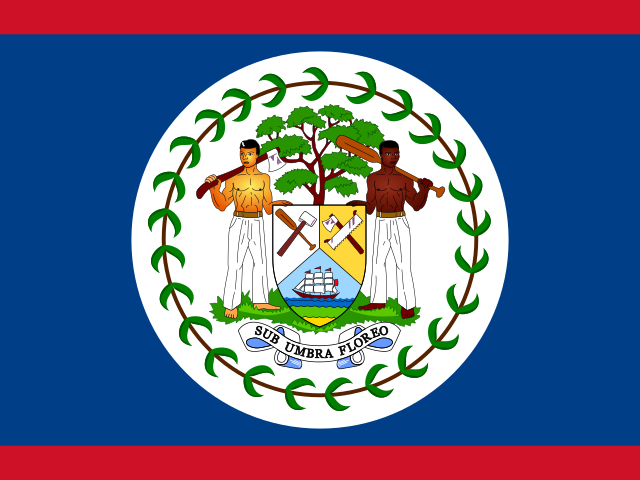
A royal blue field with a red border along the top and bottom edges and a white circle at the centre bearing the coat of arms - two Belizeans, one Mestizo and one Afro-Belizean, supporting a shield of timber-industry tools above a ship in full sail, with a mahogany tree rising behind and the motto 'Sub Umbra Floreo' ('Under the shade I flourish') on a scroll below. The National Symbols Act, 2025 prescribes the flag in statute: proportions of 3:5, royal blue PMS 2738 C, red PMS 485 C, and the two red borders taking one-fifth of the width between them. It assigns the colours no meaning. The one symbol it explains is the wreath of fifty leaves, for 1950, when Belizeans began the struggle for independence. The reading that blue stands for the People's United Party and red for the United Democratic Party is conventional rather than official; the blue flag was the PUP's before independence, and the red borders came out of a bi-partisan committee's public design competition.
Source: agm.gov.bz
Belize FACTS ◢
| Capital | Belmopan |
|---|---|
| Continent | North America |
| Population | 422,924 (2025) |
| Area | 22,966 km² |
| Population density | 18/km² |
| Currency | Belize dollar (BZD) |
| Official language | English |
| Calling code | +501 |
| Internet TLD | .bz |
| Time zone | UTC-06:00 |
| Drives on the | Right |
| ISO codes | BZ / BLZ |
DID YOU KNOW? ◢
- It's home to the Belize Barrier Reef, the second-largest reef system in the world after Australia's.
- The Great Blue Hole, a giant underwater sinkhole, is one of the planet's most famous dive sites.
- It's the only country in Central America where English is the official language.
- Ancient Maya cities like Caracol once held more people than any city in modern Belize.
Belize QUICK ANSWERS ◢
What is the capital of Belize?
The capital of Belize is Belmopan.
What is the population of Belize?
Belize had a population of 422,924 in 2025.
What currency does Belize use?
Belize uses the Belize dollar (BZD).
What languages are spoken in Belize?
The official language of Belize is English.
Think you know your flags? Play Flag Daily → · Browse all countries →
MORE ON THE FLAG ◢
Belize wrote its national flag into an Act of Parliament in February 2025, forty-three years after independence in 1981.
Schedule I of the National Symbols Act gives the proportions, prints a drawing of the flag, and names two Pantone colours. Then it stops.
Read the Act end to end and the thing everyone wants is missing: it never says what the blue or the red stand for.
Key Takeaways
- The National Symbols Act, 2025 was assented to and gazetted on 11 February 2025. Its Schedule I sets the flag out in Belizean statute.
- Schedule I sets royal blue at PMS 2738 C, red at PMS 485 C and the proportions at 3:5, and gives the colours no meaning.
- The one element the Act gives a symbolic meaning is the wreath: fifty leaves for 1950, the year it dates the independence struggle from.
- The popular reading, blue for the PUP and red for the UDP, is the wording of the CIA World Factbook's Belize entry, a publication that disappeared in February 2026. Neither the Act nor Belize's National Library Service carries it.
- The 1907 Royal Warrant for the British Honduras arms described both figures as Black men. The 2025 Act describes one as Mestizo-Belizean and one as Afro-Belizean.
What does Belize's flag law actually specify?
A drawing, a sentence, and four lines beneath it.
Schedule I of the Act, the schedule that section 3 points to, reproduces a drawing of the flag and then says:
"The flag of Belize is made up of blue with a white circle and a red border, these two horizontal red borders are one-fifth of the total width of the flag, with the Coat of Arms centred on the white circle."
Beneath that it records the motto, the royal blue as PMS 2738 C, the red as PMS 485 C, and the proportion 3:5.
The fraction is often quoted as though each red border took a fifth of the flag's width. The statute gives the two of them a fifth between them, which puts each at a tenth, and that is what the drawing printed above the wording shows.
A gap is what prompted all this. Introducing the bill in the House of Representatives on 7 February 2025, Culture Minister Francis Fonseca said that apart from a provision of the trade marks legislation there was "no restriction or prohibition on the use of the Belizean flag or other national symbols".
So most of the Act is about control rather than design. Section 11 vests copyright in the flag, the arms and the anthem in the Crown in perpetuity. Section 12 requires a licence to sell goods bearing the flag or to use it in a business, exempting educational institutions, religious institutions and official ceremonies. Section 14 makes defacing the flag an offence carrying a fine of one thousand dollars or a year's imprisonment.
Do the blue and the red stand for the political parties?
The law that had the clearest chance to say so does not.
The familiar reading is blue for the People's United Party and red for the United Democratic Party. Its best-known wording is not Belizean at all. The CIA World Factbook's country entry said "the colors are those of the two main political parties: blue for the PUP and red for the UDP", and that sentence is the one that gets repeated. The Factbook vanished from the internet on 4 February 2026, so the sentence survives only in archived snapshots, and neither the 2025 Act nor Belize's National Library Service repeats it.
What Belize's own National Library Service records is narrower and more interesting. The PUP proposed a blue flag with the coat of arms in a white circle. Because of "the close association of the flag with the PUP, public opinion was divided as to its suitability to act as a unifying symbol". The UDP put forward no design of its own and instead called for a flag that could rally citizens "regardless of their political affiliation".
What followed was a public competition. The library records that a bi-partisan National Symbols Committee invited citizens to submit designs, and that the winner was "a royal blue flag with one horizontal red stripe at the top, one at the bottom, and a white circle with the Coat of Arms in the center". Channel 5 Belize reports that the committee settled its list of symbols in August 1981 and that the flag was unveiled on 21 September 1981, the day of independence.
So the red arrived as the answer to a complaint about the blue. Reading it as the opposition party's colour is a reasonable inference, but it is an inference, and neither the library's account nor the 2025 statute makes it.
The Act does assign one symbol a meaning. Schedule IV says a wreath of fifty leaves encircles the arms, and that the wreath "symbolises the year 1950 when Belizeans began the struggle for Independence". Fifty leaves, one year, and no other element given a symbolism.
Who are the two people on the Belize flag?
They started as a colonial device, and the law has changed its mind about who they are.
Their oldest description in a formal grant of arms is the Royal Warrant of 28 January 1907 assigning arms to British Honduras, recorded by Arthur Charles Fox-Davies in The Book of Public Arms. That blazon is a shield of timber tools above a ship in full sail, with "a canton of the Union device", a mahogany tree for the crest, and the motto "Sub umbra floreo".
The supporters in that warrant are two Black woodcutters, one holding a beating axe and the other a paddle. Fox-Davies gives the wording of the day: "a negro proper, breeches argent", and on the other side "a like negro".
Set that against Schedule IV of the 2025 Act. Belize now describes the same two figures as "two Belizeans", the one on the left a Mestizo-Belizean holding the beating axe and the one on the right an Afro-Belizean holding the paddle.
The tools, the ship, the tree and the Latin all survived independence. The Union canton did not, and neither did the 1907 reading of the men. The arms of the timber colony became, in the statute, a picture of two of the country's peoples.
The mahogany explains the rest of it. Belize's motto translates as "Under the shade I flourish", and the national tree is the mahogany. The National Library records British settlers exploiting the forest for mahogany from about the middle of the seventeenth century, exported as squared logs to the United Kingdom. The flag is a logging camp, and it says so in Latin.
Is Belize really the only flag with people on it?
Nearly, and the sweeping version of the claim came from the same Factbook entry as the party colours.
The Factbook's note read that Belize's is "the only national flag that depicts human beings", adding that two British overseas territories, Montserrat and the British Virgin Islands, also depict humans. Territories are not sovereign states, so that caveat left the claim standing.
It misses Malta. The Maltese flag carries the George Cross in the upper hoist, and that decoration, as The Gazette describes it, is "a plain silver cross, with a central medallion showing St George and the dragon". There is a person on the Maltese flag. He is a few millimetres tall and inside a medal.
Belize's own institutions put it more carefully. Rolando Cocom, director of the Institute for Social and Cultural Research, said in 2023 that the flag carries "two persons, two males", and that "we are one of the only countries that features predominantly human characteristics on it".
Prominence, not presence, is the version that survives checking. On Belize's flag the people are the subject, not a few millimetres inside a medal. Easy to spot in Flag Daily.
Frequently asked questions
What do the colours on the Belize flag mean?
Officially, nothing. The National Symbols Act, 2025 describes the flag in Belizean statute, and its Schedule I records the royal blue and the red only as Pantone numbers with proportions attached. Blue for the People's United Party and red for the United Democratic Party is a popular reading traceable to the CIA World Factbook rather than to the Act or to Belize's National Library Service.
What does the wreath on the Belize flag stand for?
The year 1950. Schedule IV of the National Symbols Act, 2025 says the fifty leaves encircling the coat of arms symbolise "the year 1950 when Belizeans began the struggle for Independence". Beyond translating the motto and naming what the shield depicts, it is the only symbolism the Act supplies.
Who are the two men on the Belize flag?
The Act calls them "two Belizeans", describing the figure on the left as a Mestizo-Belizean carrying a beating axe and the one on the right as an Afro-Belizean carrying a paddle. They are inherited from the 1907 arms of British Honduras, where the Royal Warrant described both of them as Black woodcutters.
What does "Sub Umbra Floreo" mean?
"Under the shade I flourish", the translation given both in Schedule IV of the National Symbols Act, 2025 and by Belize's National Library Service. The shade is mahogany, Belize's national tree and, on the National Library's account, the basis of the colonial economy in the 18th and 19th centuries. The motto appears in the 1907 Royal Warrant for the arms of British Honduras.
What are the official colours of the Belize flag?
Royal blue PMS 2738 C and red PMS 485 C, with the coat of arms on a white circle, set out in Schedule I of the National Symbols Act, 2025. The same schedule fixes the flag's proportions at 3:5 and puts the two red borders together at a fifth of its width.
Sources
- Government of Belize, National Symbols Act, 2025 (No. 9 of 2025), sections 3 and 11 to 14, Schedule I and Schedule IV, assented 11 February 2025 - retrieved 12 August 2026.
- Belize National Library Service and Information System, National Symbols of Belize, sourced to the National Heritage Library vertical files - retrieved 12 August 2026.
- A. C. Fox-Davies, The Book of Public Arms, 1915, alphabetical entry for British Honduras, arms illustrated at p. 118, recording the Royal Warrant of 28 January 1907 - retrieved 12 August 2026.
- Love FM Belize, National Symbols Bill introduced to protect and standardize Belizean icons, reporting the House sitting of 7 February 2025 - retrieved 12 August 2026.
- Channel 5 Belize, Rolando Cocom of the Institute for Social and Cultural Research on the origins of the national flag, 22 September 2023 - retrieved 12 August 2026.
- The Gazette, The history of the George Cross, on the decoration's design - retrieved 12 August 2026.
- CIA World Factbook, Belize country page, archived snapshot of 12 June 2024. Quoted here as the provenance of two widely repeated claims, not relied on as an authority - retrieved 12 August 2026.
- CNN, CIA terminates its World Factbook, 5 February 2026, reporting that the publication "disappeared from the internet on February 4 with no advance notice" - retrieved 12 August 2026.
PLAY ANOTHER →
A short message, hidden in a different cipher every day.
ONE CIPHER A DAYDAILYOn This DayOne thing that happened today in history. Every day, a new one.
TODAY IN HISTORYDAILYDaily CryptogramOne quote, one scrambled alphabet. Crack it before tomorrow.
CRACK THE QUOTEDAILYGuess the CountryThree clues, three guesses. Work out where in the world it is.
THREE CLUES