
Bosnia and Herzegovina
A mountainous Balkan country where Ottoman bazaars and Austro-Hungarian facades sit side by side in Sarajevo. Bosnia and Herzegovina packs a lot of history into steep river valleys.
WHAT THE FLAG MEANS ◢
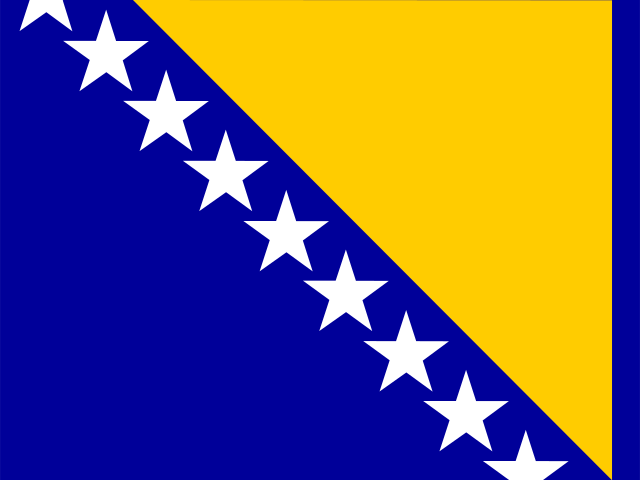
A blue field with a yellow triangle right of centre and a line of white five-pointed stars running parallel to the triangle's left side from the top edge of the flag to the bottom, so the stars at each end are cut by the edge. The design was imposed by the High Representative in February 1998 after the Parliamentary Assembly failed to agree one, and the Law on the Flag assigns no meaning to any element. The readings in circulation come from that office on the day: the triangle for the three constituent peoples, the yellow for the sun, and the blue and the stars together for Europe. The blue and yellow are those of the Council of Europe flag.
Source: ohr.int
Bosnia and Herzegovina FACTS ◢
| Capital | Sarajevo |
|---|---|
| Continent | Europe |
| Population | 3,140,095 (2025) |
| Area | 51,197 km² |
| Population density | 61/km² |
| Currency | Convertible mark (BAM) |
| Main languages | Bosnian, Croatian, Serbian |
| Calling code | +387 |
| Internet TLD | .ba |
| Time zone | UTC+01:00 |
| Drives on the | Right |
| ISO codes | BA / BIH |
DID YOU KNOW? ◢
- Sarajevo was where the assassination that sparked World War I took place in 1914.
- It hosted the 1984 Winter Olympics, the first Winter Games held in a socialist country.
- The rebuilt Stari Most bridge in Mostar is a UNESCO World Heritage Site and a famous diving spot.
- Sarajevo was one of the first European cities to have a synagogue, mosque, Catholic and Orthodox church within the same neighbourhood.
Bosnia and Herzegovina QUICK ANSWERS ◢
What is the capital of Bosnia and Herzegovina?
The capital of Bosnia and Herzegovina is Sarajevo.
What is the population of Bosnia and Herzegovina?
Bosnia and Herzegovina had a population of 3,140,095 in 2025.
What currency does Bosnia and Herzegovina use?
Bosnia and Herzegovina uses the Convertible mark (BAM).
What languages are spoken in Bosnia and Herzegovina?
Bosnia and Herzegovina designates no official language. The languages of government and education are Bosnian, Croatian and Serbian.
Think you know your flags? Play Flag Daily → · Browse all countries →
MORE ON THE FLAG ◢
Bosnia and Herzegovina did not choose its own flag. On 4 February 1998 the High Representative in Sarajevo, the Spanish diplomat Carlos Westendorp, signed Decision No. 01/98 and put the present design into force himself, a day after the Parliamentary Assembly had again failed to settle on one.
The law he enacted is still the law, and it never says what any part of the flag means. It gives a colour, a shape, a row of stars and a ratio, then stops. The readings everyone repeats come from a press briefing his spokesman gave that afternoon.
Key Takeaways
- Parliament adopted none of three designs on 3 February 1998. In the House of Representatives, Alternative 1 took 16 votes, 16 abstentions and one against.
- Westendorp imposed it next day under the Bonn powers, on an interim basis.
- He altered it as he enacted it: the blue and yellow were to be the Council of Europe's.
- The Law on the Flag assigns no meaning to the colours, the triangle or the stars.
- Bosnia's own institutions adopted the flag only in 2001, three years after they began flying it.
| The claim | Who actually said it, and where we read it |
|---|---|
| The triangle stands for the three constituent peoples | OHR spokesman Duncan Bullivant, briefing of 4 February 1998, logged by Flags of the World |
| The yellow is the sun, a symbol of hope | The same briefing, same carrier |
| The blue and the stars represent Europe | The same briefing, same carrier |
| The triangle echoes the shape of the country | No law, decision or briefing we could find |
Who chose the flag of Bosnia and Herzegovina?
Dayton left the question open. Article I.6 of the Constitution, Annex 4 to the 1995 peace agreement, disposes of national symbols in one sentence: "Bosnia and Herzegovina shall have such symbols as are decided by its Parliamentary Assembly and approved by the Presidency." In the Bosnian text the Constitutional Court quotes, "Bosna i Hercegovina će imati one simbole koje svojom odlukom odredi Parlamentarna skupština i potvrdi Predsjedništvo."
Two institutions, both required, and for two years neither delivered. So the Peace Implementation Council, meeting in Bonn on 10 December 1997, set a deadline under Sintra Issues in part II of its conclusions: it "invites the High Representative to establish a process leading to a decision on a new flag and symbols if the parties cannot agree on their own by 31 December 1997". Part XI of the same conclusions gave him power to impose binding decisions, the Bonn powers. The decision invokes exactly that: "my authority under Annex 10 of the Peace Agreement and Article XI of the Bonn Document".
They did not agree. On 31 December the OHR announced an independent commission "composed of persons of reputable standing and guaranteeing a fair representation of the peoples of Bosnia and Herzegovina". It was declared on 12 January 1998 with seven members, whom the OHR's release names without diacritics: Mladen Kolobaric, Nedo Milicevic, Sado Musabegovic, Marco Orsolic, Ranko Risojevic, Vehid Sehic and Gajo Sekulic.
Given until 31 March, they delivered three designs on 26 January, because the same conclusions, under Other Issues, expected Bosnian athletes at Nagano that February to compete "under one flag as one country". Parliament was to choose on 3 February and did not. The decision records the arithmetic: "In the House of Representatives Alternative 1 for the flag secured 16 votes, 16 abstentions and only one vote against."
What the Law on the Flag of Bosnia and Herzegovina says
Article 3 is the whole of the design, and it is pure geometry:
Zastava Bosne i Hercegovine je plave boje. Desno od centra nalazi se trougao žute boje. Paralelno lijevoj strani trougla, od gonjeg [sic] ruba zastave do donjeg ruba, proteže se red bijelih petokrakih zvijezda. Zastava je pravougaonog oblika. Odnos između dužine i širine zastave je 1:2.
In English: blue field, yellow triangle right of centre, a row of white five-pointed stars parallel to the triangle's left side running edge to edge, ratio 1:2. The misspelling of gornjeg is in the text the Parliamentary Assembly publishes today and in the Constitutional Court's quotation of it; the OHR's 1998 original spells it correctly.
Article 4 hands the rest to a specification sheet: the measurements and technical specifications "koje se nalaze u prilogu ovog zakona" sit in the annex and form part of the law. The rest is display, offences and publication.
Nowhere is there a meaning. Not for blue, not for yellow, not for the triangle, not for the stars. A Bosnian embassy's page on the state symbols reproduces Article 3 and the display rules and adds nothing either. Both Croatia and Serbia put a coat of arms on their flags. Bosnia's carries no charge at all.
Where the three peoples and the stars for Europe come from
They come from Duncan Bullivant, the OHR's spokesman, briefing journalists on 4 February 1998. The OHR's site carries no transcript of it today; what follows is the text as Flags of the World logged it the next day.
This flag is a flag of the future. It represents unity not division, it is the flag that belongs in Europe. The triangle represents the three constituent peoples of Bosnia and Herzegovina, the yellow the sun representing the symbol of hope. The blue and the stars represent Europe, a Europe that Bosnia and Herzegovina is a constituent part of.
Two details rarely survive the retelling: the yellow gets a meaning of its own, the sun and hope, and Europe is assigned to the blue and the stars together, not the stars alone.
That European reference is the one part of the design the High Representative fixed in writing himself. The decision amends the winning proposal: "the blue and yellow colours used in the flag have been amended and shall be the blue and yellow of the flag of the Council of Europe". Note where that sits. It is in the decision, not in Article 3, which says only blue and yellow; any shade values would sit in the specification sheet annexed to the law, which we could not obtain. The Council of Europe adopted that flag in December 1955, and the European Communities took it as their own in June 1985.
What is absent is the country's outline. Nothing in the law, the decision or the briefings says the triangle traces Bosnia's shape. That reading is everywhere and we could not source it anywhere.
Why are the stars at the ends cut off?
Because a journalist asked. Bullivant returned to it at the next briefing, on 5 February 1998, again as Flags of the World logged it:
There was a question yesterday about the stars and why we have a half star and a three quarter star. The reason for that, I'm informed by the technical experts who designed it, is that the stars are infinite and what is represented on the flag is a continuation rather than a finite number.
He added: "If you understand that, you're a better man or woman than I am."
Note what he did not say. Not the top and bottom stars, but "a half star and a three quarter star". The two cuts are unequal, and by how much is a question for the annexed specification sheet rather than for the statute, which fixes no number of stars at all. Nine is the count Flags of the World gives, working from the model the OHR supplied with the decision; Jan Oskar Engene, redrawing the flag from that model in the same week, recorded that it left the stars' positions relative to the triangle undefined. Anyone placing this flag at a glance, which is what Flag Daily asks of one flag a day in three guesses, is working from the drawing, not the law.
When did Bosnia and Herzegovina adopt the flag itself?
Not for three more years. The decision is explicit that it is a stopgap: the law takes effect "na privremenim osnovama, dok Parlamentarna skupština ne usvoji ovaj zakon u odgovarajućoj formi", on a provisional basis until the Parliamentary Assembly adopts it in due form. Article I.6 still needed both halves of the machinery.
They finally did. The House of Peoples adopted the Law on the Flag on 23 May 2001 and the House of Representatives on 6 June; it appeared in the Official Gazette of Bosnia and Herzegovina 19/01 of 3 August 2001. The Presidency confirmed the flag's appearance and form on 12 October 2001, in gazette 28/01 of 13 November 2001.
Amendments in 2004 extended display to Armed Forces buildings and set fines; in 2021 the Constitutional Court upheld them in case U 11/19. The dissenting vice-president, Miodrag Simović, put the history bluntly: agreement had been impossible for years, so the High Representative "simbole jednostavno nametnuo", simply imposed the symbols.
Frequently asked questions
Who designed the flag of Bosnia and Herzegovina?
An independent commission of seven members, appointed by High Representative Carlos Westendorp on 12 January 1998, proposed three designs. Parliament adopted none, so on 4 February 1998 Westendorp enacted Alternative 1, which his decision records as taking 16 votes, 16 abstentions and one against in the House of Representatives, and changed its blue and yellow to the Council of Europe's.
What do the stars on the Bosnian flag mean?
The Law on the Flag of Bosnia and Herzegovina assigns them no meaning. The reading in circulation comes from the OHR's spokesman on the day it was imposed, who assigned Europe to the "blue and the stars" together, not to the stars on their own.
Why are two of the stars on the Bosnian flag cut off?
The OHR's spokesman answered on 5 February 1998, in a briefing logged by Flags of the World. He described "a half star and a three quarter star" and said the design's technical experts had told him "the stars are infinite and what is represented on the flag is a continuation rather than a finite number". The law itself fixes no number.
Does the yellow triangle represent the shape of Bosnia and Herzegovina?
No source we could find supports it. Neither the Law on the Flag nor Westendorp's decision nor the OHR's February 1998 briefings mention the country's outline. No instrument we could reach assigns the triangle a meaning at all; the only reading the imposing office offered came from its spokesman on 4 February 1998, that the triangle represents the three constituent peoples, which in Bosnian constitutional usage are the Bosniaks, Croats and Serbs.
When did the flag of Bosnia and Herzegovina become law?
It took effect on 4 February 1998 as an interim measure imposed by the High Representative. The Parliamentary Assembly adopted the Law on the Flag in 2001 and the Presidency confirmed the design on 12 October 2001, satisfying Article I.6.
Sources
- OHR, Decision imposing the Law on the Flag of BiH, 4 February 1998, and the Bosnian text of the decision and the law.
- OHR, press statement announcing the commission, 31 December 1997; commission declared, 12 January 1998; three models, 26 January 1998.
- Peace Implementation Council, Bonn Conclusions, 10 December 1997.
- OHR, 9th Report to the UN Secretary-General, 9 April 1998.
- Parliamentary Assembly of BiH, Zakon o zastavi Bosne i Hercegovine, consolidated text.
- Constitutional Court of BiH, U 11/19, 15 July 2021, Official Gazette 49/21, which reproduces Article I.6, the Law on the Flag, the Presidency's confirming decision and the 2004 amendments.
- OHR, Constitution of Bosnia and Herzegovina.
- Flags of the World, Bosnia and Herzegovina, logging the OHR briefings of 4 and 5 February 1998 and Jan Oskar Engene's note on the OHR construction sheet.
- Embassy of BiH in North Macedonia, Grb, Zastava i Himna.
- European Union, The European flag, for the 1955 and 1985 adoption dates.
All sources retrieved 12 August 2026.
PLAY ANOTHER →
One thing that happened today in history. Every day, a new one.
TODAY IN HISTORYDAILYDaily CodeA short message, hidden in a different cipher every day.
ONE CIPHER A DAYDAILYDaily TriviaFive questions a day. Everyone gets the same five.
FIVE QUESTIONSDAILYGuess the CountryThree clues, three guesses. Work out where in the world it is.
THREE CLUES