
Botswana
A largely dry, sparsely populated country that turned diamonds into stability and left huge tracts of land to the wildlife. Botswana is where the Kalahari meets one of Africa's great wetlands.
WHAT THE FLAG MEANS ◢
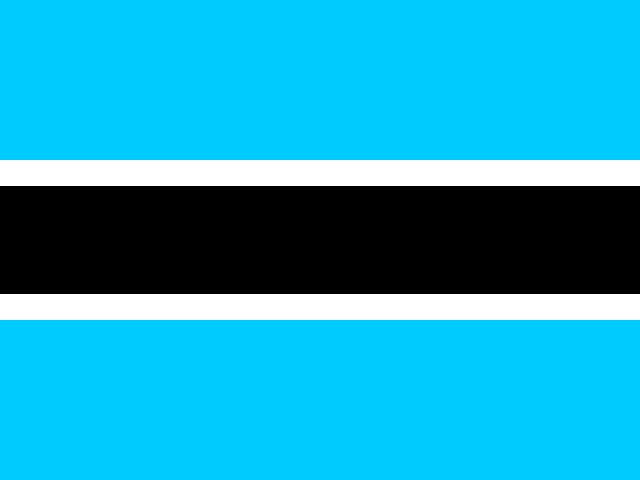
Five horizontal stripes - Botswana blue, white, black, white, Botswana blue - with the black band four times the width of each white one. The emblems law that defines the flag fixes only the colours and the widths and assigns no meaning at all, and the constitution does not mention the flag. Government accounts read the blue as sky and water and the white-black-white bands as racial harmony and the country's plural make-up, which is what the designer said of his own drawing. The zebra reading is popular but unassigned: the state's own account has the zebra chosen to match the flag, not the flag drawn from the zebra.
Source: botswanalaws.com · parliament.gov.bw · botswanamission.ch · bankofbotswana.bw · crwflags.com
Botswana FACTS ◢
| Capital | Gaborone |
|---|---|
| Continent | Africa |
| Population | 2,562,122 (2025) |
| Area | 581,737 km² |
| Population density | 4/km² |
| Currency | Botswana pula (BWP) |
| Main language | English |
| Calling code | +267 |
| Internet TLD | .bw |
| Time zone | UTC+02:00 |
| Drives on the | Left |
| ISO codes | BW / BWA |
DID YOU KNOW? ◢
- The Okavango Delta is one of the world's largest inland deltas, flooding the desert every year.
- It has one of the largest elephant populations of any country on Earth.
- Much of the country is covered by the Kalahari Desert.
- The Makgadikgadi is one of the largest salt-pan complexes in the world.
Botswana QUICK ANSWERS ◢
What is the capital of Botswana?
The capital of Botswana is Gaborone.
What is the population of Botswana?
Botswana had a population of 2,562,122 in 2025.
What currency does Botswana use?
Botswana uses the Botswana pula (BWP).
What languages are spoken in Botswana?
Botswana designates no official language. The language of government and education is English.
Think you know your flags? Play Flag Daily → · Browse all countries →
MORE ON THE FLAG ◢
Botswana's flag is five horizontal stripes: blue, white, black, white, blue. Ask what the colours mean and you will get the same three answers almost everywhere. Water. Racial harmony. A zebra.
Two of those come from the man who drew it and from Botswana's own government pages. The third comes from nobody in Botswana at all.
The instrument that creates the flag is the Botswana Emblems Law, 1966. It has six sections and a three-part schedule, and it does not contain a single word about what anything means. It gives the stripes colours and widths, and it stops.
Key Takeaways
- The Botswana Emblems Law, 1966 fixes the five stripes' colours and relative widths and assigns them no meaning whatever.
- The Constitution of Botswana never mentions the flag. It provides for the Public Seal and goes no further.
- Since 31 December 2004 the flag's legal colour word has been "Botswana blue". The 1966 text said "azure blue".
- The man who drew it said he used straight lines to make the flag easy to draw, and gave the blue water and the black band racial harmony.
- Botswana's own account runs the zebra the other way round: the zebra was adopted as national animal partly because it matched the flag.
| The reading | Who actually says it | What it rests on |
|---|---|---|
| Blue is sky and water | Botswana's permanent mission at Geneva | A government page, not a legal text |
| The white-black-white bands are racial harmony | The same page, and the designer | Agreed by both, assigned by neither statute |
| Blue is rain | Nobody, of the flag | Rain is the motto's word, and the currency's since 1976. No text gives it to the stripes |
| The bands echo the zebra | A Flags of the World contributor, 1 November 1996 | No Botswana instrument or state page carries it |
What do the colours on Botswana's flag mean?
The closest thing to an official answer comes from Botswana's permanent mission to the United Nations at Geneva, whose national symbols page says of the flag that "The blue represents the sky and water" and that "The white-black-white colours depict the racial harmony of the people as well as the pluralistic racial composition of the nation."
Notice what the sentence does not say. It does not say rain. The same page gives the national motto separately as "Pula!", glossing it as "let there be rain", and notes that the currency carries the same word. So in the state's own telling rain belongs to the motto and the money, and water belongs to the flag. The two get merged constantly.
The rain reading is not silly. The Bank of Botswana records that when the country left the Rand Monetary Area and had to name a currency, "the choice of Pula (meaning 'rain' or 'blessings') as the basic unit made up of 100 thebe ('shield') was overwhelmingly supported by a poll of public opinion". That was 1976, a decade after the flag, and the word was already on the coat of arms.
The law that defines the flag says nothing about meaning
The Botswana Emblems Law, 1966 was passed by the Legislative Assembly on 23 August 1966 and assented to on 7 September by H.S. Norman-Walker, Her Majesty's Commissioner. It came into operation on 30 September 1966, the day of independence.
Its enacting words are still colonial. "ENACTED by the Legislature of Bechuanaland."
Section 4 is one sentence. "The flag of which the design is set out in Part II of the Schedule shall be the National Flag of Botswana."
Part II of the Schedule is a list. It opens: "Five horizontal stripes having colour and width as follows, that is to say taken from the top".
Then it counts them off. The first is "azure blue having a width equal to 9/24ths of the total depth of the flag". The second is white at 1/24th. The third is "black having a width equal to 4/24ths of such depth". The fourth is white again at 1/24th, and the fifth blue at 9/24ths.
That is the whole specification. Nine, one, four, one, nine. The Law does not fix the flag's overall proportions at all, only how the depth divides, and it does not say what any stripe stands for.
The silence is not an oversight of the drafter's, either. The Constitution of Botswana does not mention the flag anywhere in its text. Section 2 does reach for another emblem, and stops: "The Public Seal of the Republic shall be such device as may be prescribed by or under an Act of Parliament." The subsidiary legislation is the same. The Botswana Emblems Regulations, 1972 govern who may display the coat of arms and fly the vehicle pennants, set a maximum fine of R50, in rand, four years before the pula existed, and never once explain a colour.
Does the black and white stripe represent a zebra?
Not according to Botswana. The zebra is genuinely a national symbol, and it is in the 1966 statute: the blazon of the arms ends "for the supporters on either side a zebra the dexter supporting an elephant's tusk the sinister a stalk of sorghum proper. Motto Pula." Two zebras hold up the shield.
But the state's account of the zebra runs in the opposite direction to the popular one. The Geneva mission's page explains the choice of national animal this way: "The Zebra became the symbol of Botswana because it is considered to be neutral in so far as tribal symbols go, and secondly because its black and white colours are in consonance with the colours of the flag". The zebra was picked to match the flag. The flag was not drawn from the zebra.
The reading does have an identifiable author. The vexillological archive Flags of the World carries the line "They are inspired by the coat of the zebra, the national animal", signed by contributor Nick Artimovich and dated 1 November 1996. Thirty years later it is recited nearly everywhere, usually in the voice of the state.
Neutrality is the part usually lost in the retelling, and it is the interesting part. The zebra was chosen because it belongs to no particular group in a country with several, which is the same argument the bands are making.
Who designed Botswana's flag?
By his own account, a civil servant did, after the competition failed.
George Winstanley reached the Bechuanaland Protectorate in 1954 and was Clerk to the Cabinet by the independence period. In his memoir, Under Two Flags in Africa (Colchester: Blackwater Books, 2000), he writes that competitions were held for the anthem, the arms and the flag "to try and involve the population at large".
Then this. "The entries received in the flag competition were hopeless so I designed the flag myself."
His reason for the shape is the useful part if you ever have to place a flag from memory in Flag Daily, where you see the flag and get three guesses at the country. He "wanted to make it easy to draw", so he used nothing but straight horizontal lines.
On meaning he is brief and he matches the government page: "The blue background of the flag represents water", and "the black central strip bordered with two white strips represents racial harmony". No zebra. Where he does invoke the animal, it is for the arms, where the two zebras "symbolise the abundant wildlife in the country as well as alluding to black/white co-operation".
One caution on this source. The passage above is quoted on Flags of the World with page references to the book, and that transcription is what was available here; the memoir itself could not be obtained, and the same passage carries at least one visible copying slip elsewhere in it.
The design's timing invites a further claim that Botswana's own texts never make. The flag was raised in 1966 next door to South Africa, where apartheid law was in force, and the contrast is often presented as the point of the black band. Neither the statute, nor the mission's page, nor the designer names a neighbouring country. The bands are given as a statement about Botswana. What is plain on sight is how little the flag shares with its region: none of the red, green or gold that Zimbabwe's flag carries appears anywhere on Botswana's.
Why the flag's legal colour changed its name in 2004
For thirty-eight years the statutory colour was "azure blue", which is not a manufacturing instruction. Flags came back in whatever blue a supplier had. Writing on Flags of the World in May 2001, Bruce Berry reported that the shade was before Cabinet, because "There has been a problem with standardisation and so flags with various shades of blue (from different manufacturers) are seen and the government wants to change this."
Parliament acted in 2004. The Botswana Emblems (Amendment) Act, 2004 was passed by the National Assembly on 8 December, assented to on 20 December and commenced on 31 December 2004. Its second limb amends the Schedule "by substituting, for the words 'azure blue', wherever they appear in the Schedule, the words 'Botswana blue'". The same Act rewrote the blazon of the arms in plain colour terms, down to the scroll: "Motto 'Pula' in black on a Botswana blue half tone scroll. The reverse side of the scroll is red."
Two things follow. The flag's correct legal colour word is now Botswana blue, not azure blue, sky blue or light blue. And the amendment still assigns no meaning, so a change made in 2004 to settle what the colour looks like left untouched the question of what it stands for.
The reference literature has not caught up. Flags of the World's transcription of the Schedule still reads "azure blue", and its most recent note on the subject, from April 2024, says of the colours: "I haven't found any document which defines the colors."
Frequently asked questions
What do the colours on the Botswana flag mean?
Botswana's permanent mission at Geneva says the blue represents the sky and water, and that the white-black-white bands depict the racial harmony of the people and the country's plural racial make-up. That is a government explanation rather than a legal one: the Botswana Emblems Law, 1966, which defines the flag, gives the stripes only colours and widths and assigns them no meaning.
Does the Botswana flag represent a zebra?
No Botswana instrument or government page says so. The zebra appears on the coat of arms, where the 1966 statute makes two of them the supporters, and it is the national animal. Botswana's own explanation reverses the popular one: the zebra was adopted partly because its black and white colours are in consonance with the colours of the flag. The flag came first.
Who designed the flag of Botswana?
George Winstanley, a British administrator who served in the Bechuanaland Protectorate from 1954 and was Clerk to the Cabinet at independence. In his memoir he writes that the entries to the public flag competition were hopeless, so he designed it himself, and that he used straight horizontal lines to make the flag easy to draw.
What are the exact proportions of the Botswana flag?
Taken from the top, the five stripes are 9/24ths, 1/24th, 4/24ths, 1/24th and 9/24ths of the flag's total depth, so the black band is four times the width of each white one. Those fractions are set out in Part II of the Schedule to the Botswana Emblems Law, 1966. The Law does not fix the flag's overall length-to-depth ratio.
Is the blue on the Botswana flag officially light blue?
The legal term is Botswana blue. The Botswana Emblems (Amendment) Act, 2004 substituted those words for "azure blue" wherever they appeared in the Schedule, with effect from 31 December 2004. No Botswana instrument attaches a printing specification such as a Pantone number to the term, and vexillological references still quote the superseded 1966 wording.
Sources
- Botswana Emblems Law, 1966 (No. 25 of 1966), sections 3 to 6 and the Schedule, Parts I to III, scanned text via Botswana Laws - retrieved 12 August 2026.
- Botswana Emblems (Amendment) Act, 2004 (No. 36 of 2004), section 2, scanned text via Botswana Laws - retrieved 12 August 2026.
- Botswana Emblems Regulations, 1972 (S.I. No. 65 of 1972), regulations 2 to 8, scanned text via Botswana Laws - retrieved 12 August 2026.
- Parliament of Botswana, Constitution of Botswana, section 2 - retrieved 12 August 2026.
- Permanent Mission of the Republic of Botswana to the United Nations Office, Geneva, National Symbols - retrieved 12 August 2026.
- Bank of Botswana, History of Botswana Currency - retrieved 12 August 2026.
- Flags of the World, Botswana, including Bruce Berry's transcription of George Winstanley, Under Two Flags in Africa (Colchester: Blackwater Books, 2000), pp. 235 to 236 - retrieved 12 August 2026.
PLAY ANOTHER →
A short message, hidden in a different cipher every day.
ONE CIPHER A DAYDAILYDaily TriviaFive questions a day. Everyone gets the same five.
FIVE QUESTIONSDAILYOn This DayOne thing that happened today in history. Every day, a new one.
TODAY IN HISTORYDAILYGuess the CountryThree clues, three guesses. Work out where in the world it is.
THREE CLUES