
Brazil
South America's giant, home to most of the Amazon and a football obsession to match its size. Brazil is the only country the equator and a tropic both cross, and it speaks Portuguese while its neighbours speak Spanish.
WHAT THE FLAG MEANS ◢
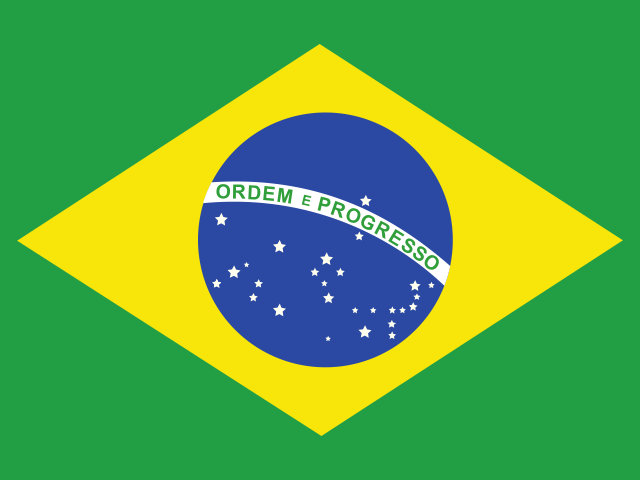
A green field with a large yellow diamond enclosing a blue celestial globe crossed by a white band reading 'Ordem e Progresso' ('Order and Progress'). The 27 white stars represent the states and federal district, set out as the sky over Rio de Janeiro at 8.30 on the morning of 15 November 1889, seen from outside the celestial sphere.
Brazil FACTS ◢
| Capital | Brasília |
|---|---|
| Continent | South America |
| Population | 212,812,405 (2025) |
| Area | 8,515,767 km² |
| Population density | 25/km² |
| Currency | Brazilian real (BRL) |
| Official language | Portuguese |
| Calling code | +55 |
| Internet TLD | .br |
| Time zones | UTC-05:00, UTC-04:00, UTC-03:00, UTC-02:00 |
| Drives on the | Right |
| ISO codes | BR / BRA |
DID YOU KNOW? ◢
- It holds the record for the most FIFA World Cup wins, with five titles.
- The Amazon rainforest, mostly within Brazil, is the largest tropical rainforest on Earth.
- It's the largest country in both South America and the entire Southern Hemisphere.
- The Amazon River carries more water than the next several largest rivers combined.
- Its capital, Brasília, was purpose-built from scratch in the late 1950s in the shape of an aeroplane.
Brazil QUICK ANSWERS ◢
What is the capital of Brazil?
The capital of Brazil is Brasília.
What is the population of Brazil?
Brazil had a population of 212,812,405 in 2025.
What currency does Brazil use?
Brazil uses the Brazilian real (BRL).
What languages are spoken in Brazil?
The official language of Brazil is Portuguese.
Think you know your flags? Play Flag Daily → · Browse all countries →
MORE ON THE FLAG ◢
Brazil's flag carries 27 white stars, and Brazilian law names every one of them. An appendix to the flag statute sets out 27 rows pairing each state and the Federal District with a named star: Pará with Spica, Amazonas with Procyon, São Paulo with Alpha Crucis, the Federal District with Sigma Octantis.
The same statute makes a dated astronomical claim. It says the constellations correspond to the sky over Rio de Janeiro at 8.30 am on 15 November 1889, the morning the republic was proclaimed, and that they must be read as seen by an observer standing outside the celestial sphere.
That claim is worth following back. The man who conceived the design wrote that the match with 15 November was spotted after the flag had been made, and the sentence fixing it in law has been added, repealed and added again.
Key Takeaways
- The flag's sky is fixed by statute at 8.30 am on 15 November 1889, in brackets "twelve sidereal hours", read from outside the celestial sphere.
- That sentence first entered the law in 1968, was dropped by the 1971 flag act, and was restored in 1992.
- The founding decree of 19 November 1889 gave the flag 21 stars, for 20 states and the Neutral Municipality, the federal capital district of the day.
- The star-to-state table is statutory, not customary. All 27 pairings are listed by name in an appendix.
- Raimundo Teixeira Mendes wrote that an astronomer noticed the 15 November sky only after the flag was executed, at about nine in the morning.
- The white band is the ecliptic, not the equator. The Positivist Church corrected that error in print in the 1890s.
| The claim | Where it is written | What it establishes |
|---|---|---|
| 21 stars, arranged by their astronomical positions | Decreto nº 4, art. 1, 1889 | A sky from the start, with no place or time named |
| 8.30 am on 15 November 1889, twelve sidereal hours | Lei nº 5.443, art. 3 § 1, 1968 | The moment enters the statute book, 79 years late |
| Sky of Rio, Southern Cross on the meridian, no clock | Lei nº 5.700, art. 3, sole paragraph, 1971 | The 1968 sentence is repealed with the law that held it |
| The 1968 wording restored, and 27 stars | Lei nº 5.700, art. 3 § 1, inserted by Lei nº 8.421/1992 | The current text, and the one everyone quotes |
| That sky was noticed after the flag was made | Teixeira Mendes, A Bandeira Nacional, p. 15 | The designers claimed coincidence, not reconstruction |
What do the 27 stars on Brazil's flag mean?
One star for each state, and one for the Federal District. What is unusual is that the pairings are written into the law rather than left to habit.
They live in Appendix I to Annex nº 2 of Lei nº 5.700, as replaced by Lei nº 8.421 of 11 May 1992. Its heading is "Correspondência das estrelas da Bandeira Nacional com o Distrito Federal e os Estados brasileiros". That is the correspondence of the flag's stars with the Federal District and the Brazilian states. What follows it is a plain two-column list:
| State or district | Star named in the appendix |
|---|---|
| Acre | Gamma Hydrae |
| Alagoas | Theta Scorpii |
| Amapá | Beta Canis Majoris |
| Amazonas | Procyon (Alpha Canis Minoris) |
| Bahia | Gamma Crucis |
| Ceará | Epsilon Scorpii |
| Espírito Santo | Epsilon Crucis |
| Federal District (Brasília) | Sigma Octantis |
| Goiás | Canopus (Alpha Carinae) |
| Maranhão | Beta Scorpii |
| Mato Grosso | Sirius (Alpha Canis Majoris) |
| Mato Grosso do Sul | Alphard (Alpha Hydrae) |
| Minas Gerais | Delta Crucis |
| Paraíba | Kappa Scorpii |
| Paraná | Gamma Trianguli Australis |
| Pará | Spica (Alpha Virginis) |
| Pernambuco | Mu Scorpii |
| Piauí | Antares (Alpha Scorpii) |
| Rio de Janeiro | Beta Crucis |
| Rio Grande do Norte | Lambda Scorpii |
| Rio Grande do Sul | Alpha Trianguli Australis |
| Rondônia | Gamma Canis Majoris |
| Roraima | Delta Canis Majoris |
| Santa Catarina | Beta Trianguli Australis |
| Sergipe | Iota Scorpii |
| São Paulo | Alpha Crucis |
| Tocantins | Epsilon Canis Majoris |
Nine constellations supply those stars: eight from Scorpius, five from the Southern Cross, five from Canis Major, three from Triangulum Australe, two from Hydra, and one each from Canis Minor, Virgo, Octans and Argus. Argus is the old Argo Navis, long since broken up, and the star the appendix takes from it is Canopus, now Alpha Carinae.
The number is not fixed for good. Article 3 requires the flag to be updated "sempre que ocorrer a criação ou a extinção de Estados", whenever a state is created or abolished, which is how 21 stars in 1889 became 27.
The Federal District has the smallest star on the flag. Article 5, item IX, of Lei nº 5.700 sorts the stars into five size classes, and Annex nº 2 puts Sigma Octantis alone in the fifth. It is drawn inside a circle a tenth of a module across, against three tenths for a first-class star. Item IX of the 1968 act, Lei nº 5.443, had only four classes, so that fifth and smallest class was created in 1971.
Does the flag really show the sky over Rio de Janeiro?
The law says so, and the sentence saying it has an unsettled history.
The current wording is article 3, paragraph 1, of Lei nº 5.700, inserted by Lei nº 8.421 in 1992. It reads: "As constelações que figuram na Bandeira Nacional correspondem ao aspecto do céu, na cidade do Rio de Janeiro, às 8 horas e 30 minutos do dia 15 de novembro de 1889 (doze horas siderais)." In English: the constellations correspond to the aspect of the sky, in the city of Rio de Janeiro, at 8 hours and 30 minutes on 15 November 1889, twelve sidereal hours.
None of that is in the founding text. Decreto nº 4 of 19 November 1889 asks only for 21 stars "dispostas da sua situação astronomica, quanto á distancia e o tamanho relativos", arranged by their astronomical position as to relative distance and size. It names no city, no date and no hour.
The clock arrived in 1968. Article 3, paragraph 1, of Lei nº 5.443 of 28 May 1968 carries the 8.30 am sentence in almost exactly the words used today, brackets and all.
Then it disappeared. Lei nº 5.700 repealed the 1968 act in 1971, and its own article 3 speaks only of "um aspecto do céu do Rio de Janeiro, com a constelação Cruzeiro do Sul no meridiano". That is an aspect of the sky of Rio de Janeiro with the Southern Cross on the meridian, with no date and no time at all. For more than twenty years the flag's most quoted fact was not in the statute book. It came back in 1992.
Why do the constellations look mirrored?
Because the law tells you to stand in the wrong place. In its 1968 wording and again since 1992, the same paragraph says the constellations "devem ser consideradas como vistas por um observador situado fora da esfera celeste". They must be considered as seen by an observer situated outside the celestial sphere.
Teixeira Mendes had explained the same thing in the 1890s, answering critics who said the flag showed the constellations reversed. Each star, he wrote on page 14, is plotted as if the flag were "um espelho plano", a plane mirror. The constellations were then pulled apart while keeping their own shape and their arrangement relative to each other.
He also conceded in print that the flag is not a faithful copy of any moment. Objectively, he wrote, the Southern Cross is not the most beautiful constellation of the southern sky, and it was given prominence for symbolic reasons. His footnote credits the astronomer Manuel Pereira Reis with the argument that fidelity to the real sky was beside the point for a symbol.
Then comes the sentence that undoes the popular version. Of Pereira Reis, once the flag had been executed, the pamphlet says on page 15 that he "fês depois notar que éla refletia o espetáculo sideral na manhan de 15 de Novembro, no Rio de Janeiro às 9 lióras aprossimadamente". He noticed afterwards that it reflected the sidereal spectacle of the morning of 15 November at Rio, at roughly nine o'clock. The pamphlet calls that a happy coincidence.
Is the white band on Brazil's flag the equator?
No, and getting this wrong has a long pedigree. The band is the ecliptic, the plane of the earth's orbit, which is why the motto sits at a slant instead of running level.
In the 1890s a critic named Antão de Vasconcelos argued in the Rio press that the flag was upside down, since the south pole is the one overhead in the southern hemisphere. He then got the Société astronomique de France to agree with him in its journal L'Astronomie. The pamphlet reprints the reply on page 39: "le drapeau du Brésil, portant la croix du Sud, au-dessous de sa bande equatoriale, est à l'envers pour les habitants du Brésil." Carrying the Southern Cross below its equatorial band, the flag is the wrong way round for Brazilians.
Miguel Lemos answered in a footnote on the same page. The band bearing the motto, he wrote, "não é tal o equador, mas a eclitica", is not the equator at all but the ecliptic, and the error had been repeated by the French society's own journal. Louis Cruls, director of the astronomical observatory in Rio, added the practical point on page 42: at Rio's latitude the Southern Cross is not circumpolar, so it is never seen below the pole at its meridian passage, always above it.
The distinction decides the flag's oddest detail. Spica is the single star drawn above the band, and the Chamber of Deputies describes it as representing "o estado do Pará, o estado mais ao norte do País no início da República". That is the state of Pará, the northernmost state in the country at the start of the republic.
Read that description against a map of the time rather than a modern one. Decreto-Lei nº 5.812 of 13 September 1943 carved five federal territories "com partes desmembradas dos Estados do Pará, do Amazonas, de Mato Grosso, do Paraná e de Santa Catarina", from parts detached from Pará, Amazonas, Mato Grosso, Paraná and Santa Catarina. Two of them were Amapá, north of the mouth of the Amazon, and Rio Branco, now Roraima, whose limits in that decree run up to the Venezuelan and British Guianese borders.
Teixeira Mendes gives a different reason for its position, on pages 9 to 11. Procyon was the star chosen to signify a state north of the equator. Spica was lifted above the line "para quebrar a monotonia do emisfério boreal", to break the monotony of the northern half, on the reasoning that a small change in the ecliptic's tilt would carry it there anyway. Today's appendix gives Procyon to Amazonas.
In June 2009 the Chamber's constitution committee approved a Senate amendment swapping the Pará and Federal District stars, on the argument that the star above the band had first been meant for the capital. The annexes have not been altered since 1992, so Spica still carries Pará.
Where does "Ordem e Progresso" come from?
From Auguste Comte, by way of a small religious body in Rio de Janeiro, and the people who put it there said so plainly.
The motto is a compression of the positivist formula printed at the head of the Positivist Church's own pamphlets: "O Amor por principio, e a Ordem por baze; O Progrésso por fim." Love as the principle, Order as the basis, Progress as the goal. Writing on page 30 about the flag's three elements, Teixeira Mendes says the motto "foi formulada, explicada e proposta aos povos e governos ocidentais por Augusto Comte". It was formulated, explained and proposed to Western peoples and governments by Comte.
The design's route into law was short. Miguel Lemos proposed keeping the imperial flag of José Bonifácio wherever it could be kept, and simply inscribing the political motto on it. The project went to Benjamin Constant, who adopted it, and Decreto nº 4 enacted it four days after the proclamation.
Most of the shape was inherited, and the pamphlet prints the 1822 decree it came from on pages 6 and 7. Pedro I's arms for the kingdom of Brazil were "em campo verde uma esféra armilar de ouro", a golden armillary sphere on a green field, ringed by "19 estrelas de prata em uma órla azul", nineteen silver stars in a blue orle, one for each province. The flag was to be a green parallelogram carrying a gold rhomboid. Green field, yellow lozenge, a sphere and one star per province: all four predate the republic. The sphere is older still. The pamphlet notes that the imperial arms "manteve a esféra armiiar de ouro e apenas mudou o campo de azul para verde", kept the golden armillary sphere and only changed the field from blue to green. The device came over from Brazil's years under Portugal.
Teixeira Mendes was blunt about the mockery this attracted. The Argentine flag, he noted, puts a human face on its sun, and nobody thought to ridicule the neighbours for it.
What the law does not say about Brazil's colours
This is the part where a flag article usually reaches for forests and gold. No Brazilian statute supports it.
Decreto nº 4 explains its colours in its preamble, and the explanation is about continuity rather than landscape. Green and yellow were kept because they "recordam as luctas e as victorias gloriosas do exercito e da armada na defesa da patria", recall the struggles and glorious victories of the army and the navy in the defence of the fatherland. They were kept also because, independently of the form of government, they "symbolizam a perpetuidade e integridade da patria", symbolise the perpetuity and integrity of the fatherland.
That is the whole of it. The decree assigns no meaning to the blue of the sphere and none to the white band. The later laws add only geometry: the radius of the circle, the arcs of the band, the five star sizes, and the instruction that the letters of the motto are green. Anything more specific about the colours is somebody's reading rather than the state's.
Whether you could pick Brazil out of a line-up of green and yellow fields is a separate question, and a daily flag round will tell you in three guesses. Every other country has a page of its own.
Frequently asked questions
How many stars are on the Brazilian flag and what does each one stand for?
There are 27, one for each of the 26 states and one for the Federal District, and each pairing is named in a statutory appendix rather than settled by custom. Appendix I to Annex nº 2 of Lei nº 5.700, as replaced in 1992, gives Sirius to Mato Grosso, Antares to Piauí, Spica to Pará and Sigma Octantis to the Federal District.
What time of day is the sky on the Brazilian flag?
Half past eight in the morning. Article 3, paragraph 1, of Lei nº 5.700, inserted by Lei nº 8.421 of 1992, gives the moment as 8.30 am on 15 November 1889 in Rio de Janeiro, with "twelve sidereal hours" in brackets as the equivalent in star time.
Which star is above the "Ordem e Progresso" band on the Brazilian flag?
Spica, the brightest star of Virgo, is the only one drawn above the band, and the statutory appendix assigns it to Pará. The designers' own account gives an aesthetic reason for putting it there rather than a geographical one, and the star they picked to mark a state north of the equator was Procyon, which the law now gives to Amazonas.
Are the constellations on the Brazilian flag reversed?
Yes, deliberately. Article 3, paragraph 1, of Lei nº 5.700 requires them to be read as seen by an observer outside the celestial sphere, so a visitor to Rio comparing the flag with the sky is looking at the same constellations from the other side.
Who designed the Brazilian flag?
The concept came from Raimundo Teixeira Mendes and Miguel Lemos of the Positivist Church of Brazil, with the astronomer Manuel Pereira Reis consulted on the sky. The model was painted by Décio Villares and the design was enacted by Decreto nº 4 of 19 November 1889.
Sources
- Presidência da República, Decreto nº 4, de 19 de novembro de 1889 - retrieved 12 August 2026.
- Presidência da República, Lei nº 5.443, de 28 de maio de 1968, art. 3 § 1 and art. 5 item IX, repealed by Lei nº 5.700 - retrieved 12 August 2026.
- Presidência da República, Decreto-Lei nº 5.812, de 13 de setembro de 1943, art. 1 and its territorial limits - retrieved 12 August 2026.
- Presidência da República, Lei nº 5.700, de 1º de setembro de 1971, texto compilado - retrieved 12 August 2026.
- Presidência da República, Lei nº 8.421, de 11 de maio de 1992 and its annexes, including Annex nº 2 and its Appendix I - retrieved 12 August 2026.
- R. Teixeira Mendes and Miguel Lemos, A Bandeira Nacional, Igreja e Apostolado Pozitivista do Brazil, pamphlet no. 110, Internet Archive; the L'Astronomie reply is quoted from page 39 of this pamphlet rather than from the journal - retrieved 12 August 2026.
- Agência Câmara, Câmara dos Deputados, CCJ aprova troca de estrelas do Pará e DF na Bandeira Nacional, 25 June 2009 - retrieved 12 August 2026.
PLAY ANOTHER →
Five questions a day. Everyone gets the same five.
FIVE QUESTIONSDAILYDaily CodeA short message, hidden in a different cipher every day.
ONE CIPHER A DAYDAILYOn This DayOne thing that happened today in history. Every day, a new one.
TODAY IN HISTORYDAILYGuess the CountryThree clues, three guesses. Work out where in the world it is.
THREE CLUES