
Cameroon
Nicknamed 'Africa in miniature', Cameroon packs beaches, desert, rainforest and mountains into one country, and plays football like the fate of nations depends on it.
WHAT THE FLAG MEANS ◢
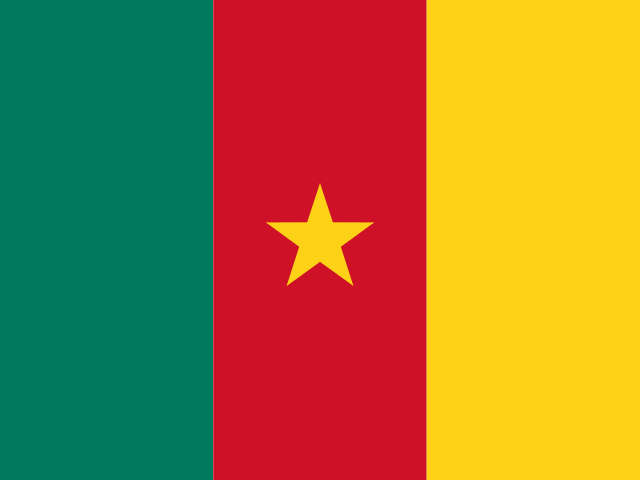
Three vertical Pan-African bands of green, red and yellow with a single gold star at the centre of the red band. That is all the constitution says: it fixes no point count and gives the colours no meaning, so the southern forest, northern sun and unity readings come from Cameroon's diplomatic missions.
Cameroon FACTS ◢
| Capital | Yaoundé |
|---|---|
| Continent | Africa |
| Population | 29,879,337 (2025) |
| Area | 475,442 km² |
| Population density | 63/km² |
| Currency | Central African CFA franc (XAF) |
| Official languages | English, French |
| Calling code | +237 |
| Internet TLD | .cm |
| Time zone | UTC+01:00 |
| Drives on the | Right |
| ISO codes | CM / CMR |
DID YOU KNOW? ◢
- Its national football team, the Indomitable Lions, was the first African side to reach a World Cup quarter-final, in 1990.
- Mount Cameroon, an active volcano, is one of the highest peaks in West Africa at over 4,000 metres.
- It has two official languages, English and French, a legacy of its colonial past.
- Debundscha, on its coast, is one of the wettest places on Earth, drenched by around 10 metres of rain a year.
Cameroon QUICK ANSWERS ◢
What is the capital of Cameroon?
The capital of Cameroon is Yaoundé.
What is the population of Cameroon?
Cameroon had a population of 29,879,337 in 2025.
What currency does Cameroon use?
Cameroon uses the Central African CFA franc (XAF).
What languages are spoken in Cameroon?
The official languages of Cameroon are English and French.
Think you know your flags? Play Flag Daily → · Browse all countries →
MORE ON THE FLAG ◢
Cameroon's flag is written into its constitution, in one sentence, and that sentence contains no meanings.
Article 1 of the Constitution of the Republic of Cameroon sets the flag out in its fifth paragraph: "Son drapeau est Vert, Rouge, Jaune, à trois bandes verticales d'égales dimensions. Il est frappé d'une étoile d'or au centre de la bande rouge." Cameroon is officially bilingual, and the English text of the same paragraph is just as short: "Its flag shall be three equal vertical stripes of green, red and yellow charged with one gold star in the centre of the red stripe."
That is all of it. Green is not the forest. Yellow is not the sun. The star is gold rather than yellow, is given no number of points, and is not called the star of unity. Every reading of the colours you have ever seen comes from somewhere other than the text that makes them official.
Key Takeaways
- Article 1(5) names three colours and one gold star at the centre of the red band, and assigns no meaning to any of them.
- The same article spends roughly 180 words in French on the state seal and the coat of arms, against 24 on the flag, so the flag clause is short by choice rather than by oversight.
- Reference works have given the red band four different formulations since 1961, moving from sovereignty to unity while the cloth stayed the same.
- The star count follows the form of the state: none in 1957, two in the green band from 1961, one on the red from 1975.
- No Cameroonian law or decree has ever fixed the size of that star, and flags in use show it both enormous and barely visible.
| Instrument | Date | What it says about the flag | What that establishes |
|---|---|---|---|
| Law 57/46 | 29 October 1957 | Green, red and yellow in three equal vertical bands | The tricolour predates independence, and carried no star |
| Federal Constitution, Article 1 | 1 September 1961 | "deux étoiles d'or dans la bande verte" | Two gold stars, in the green band, with no meaning given |
| Constitutional revision, Law 75/1 | 9 May 1975 | Rewrites Article 1 | The single star reaches the text three years after the unitary state |
| Decree 76/424 | 16 September 1976 | Ratio of 2:3, three equal stripes | The proportions are settled; the star's size is not |
| Constitution, Article 1(5) | In force today | "une étoile d'or au centre de la bande rouge" | One gold star, centred on red, still with no meaning |
What does Cameroon's constitution actually say about the flag?
Twenty-four words in French, and not one of them symbolic.
The flag clause is the fifth of eight paragraphs in Article 1, sitting between the national motto in the fourth ("Paix-Travail-Patrie") and the national anthem in the sixth. It names the three colours, orders them, makes the bands equal and vertical, and puts one gold star at the centre of the red. Then it stops.
That brevity is worth noticing, because the drafters were plainly capable of the opposite. Two paragraphs later the same article gives the state seal and the coat of arms 184 words of French, counting the running text of paragraph 7 and ignoring the page numbers the printed edition drops into it, against the flag's 24. The seal is fixed as "a circular medallion in bas-relief, 46 millimetres in diameter", carrying a girl's head in profile turned to the dexter, meaning to its own right, a coffee branch with two leaves, five cocoa pods to the sinister or left, and inscriptions in French on one face and English on the other. The arms then get full heraldic treatment, down to the sword and scales of justice in sable, meaning black.
A document that measures a medallion to the millimetre and counts the cocoa pods beside a two-leafed coffee branch says of the flag only that it is green, red, yellow and starred. Pascal Vagnat and Jos Poels, in a survey of what constitutions say about national symbols quoted on Flags of the World, put it exactly: Article 1(5) describes the current flag but does not detail it.
What do the colours of the Cameroon flag mean?
In law, nothing. The reading you will meet everywhere else, green for the forested south, yellow for the sun and the northern savannahs, red for the unity of the nation, is real, widely taught and worth knowing. It is also commentary rather than text, and it matters whose commentary it is.
The version most often repeated in English is published by Cameroon's own diplomatic missions. The Embassy of Cameroon in the Netherlands lists green for "Hope and the Southern Forests", red for "Unity" and yellow for "Sunshine and Prosperity", and calls the central star the "Star of Unity" signifying the unitary status of Cameroon. That is a Cameroonian state source, about as close to official as the glosses get, and it is still not the constitution.
Follow the same colour back through the reference works, as they are collected and quoted on Flags of the World, and it will not hold still. National Geographic, writing in September 1961 about the flags of the then 99 members of the United Nations, gave "green for the luxuriant vegetation of the south, red for sovereignty, and yellow for the sunshine of this African nation's northern region". Arnold Rabbow's 1970 lexicon of political symbols has "the red stands for national sovereignty". Ludvik Mucha, in 1985, has "red is the symbol of independence and unity".
Sovereignty, then national sovereignty, then independence and unity, then unity. Four formulations of the same band, which never changed colour. Only the explanation moved, and an explanation that moves is a reading rather than a rule.
Where the green, red and yellow came from
The tricolour is older than the country in its present form, and older than its independence.
French-administered Cameroun became an autonomous state in May 1957, and acquired the full set of state emblems with it: a government, an anthem, a motto and a flag. The flag was fixed later that year by Law 57/46 of 29 October 1957 as plain green, red and yellow vertical bands, with nothing on them.
Two influences sit in that design and neither is disputed. The arrangement, three equal vertical bands, follows the French tricolore of the administering power. The palette is the Pan-African one, based on the green, yellow and red of Ethiopia's flag, a horizontal tricolour dated to 1897 that shaped the colours of many post-colonial African flags. Ethiopia aside, Cameroon was the second African state to take those colours up, after Ghana.
None of the legal texts connect those facts. The colours are Pan-African in origin, and the constitution mentions neither Ethiopia nor Pan-Africanism, nor for that matter France. If you want to know how much of a flag you actually retain, three guesses a day against a real flag is unkind about exactly this sort of detail.
Why the star count changed twice
Because the flag is a running record of what kind of state Cameroon was, and the state changed twice.
The federal constitution of 1 September 1961 brought together the former French Cameroun, renamed Cameroun oriental or East Cameroon, and the former British Southern Cameroons, renamed Cameroun occidental or West Cameroon. Northern Cameroons had voted in the same plebiscite to join Nigeria instead. Article 1 of that constitution gave the flag "deux étoiles d'or dans la bande verte", two gold stars in the green band. That article names both territories in its opening sentence and never once says the stars are them, so even the least controversial star reading in Cameroonian history is an inference.
The federation ended by referendum on 20 May 1972, and 20 May is now Cameroon's national day. The flag took almost three more years to catch up. The constitutional revision of 9 May 1975 rewrote Article 1, and the single gold star at the centre of the red band is what stands in the text afterwards. The redesigned flag was officially hoisted on 20 May 1975, on the anniversary of the referendum rather than of the law.
What Article 1 said about the flag between June 1972 and May 1975 is harder to establish than it looks, and worth being honest about. The transcription anyone can read, the Digithèque MJP text kept by the Université de Perpignan, states in its own header note that it takes account of the 1975 revision, and Article 1 is one of the seven articles that revision rewrote.
Accounts still disagree about which constitutional moment took the second star. Laura-Stella Enonchong's study of Cameroon's constitution places the loss at the renaming of February 1984, when the United Republic of Cameroon became the Republic of Cameroon, and reads the lost star as West Cameroon's. The flag literature is near unanimous on 1975.
Nobody ever fixed the size of Cameroon's star
The most conspicuous thing on the flag is the least specified thing in the law, and you can see the result in photographs.
Decree 76/424 of 16 September 1976 settles the flag's proportions at 2:3 with three equal stripes. It centres the star on the red band and says nothing about how big it should be. Gervais Mbarga went through the legislation and the government orders for a 2014 study of the flag and found no prescribed ratio for the star anywhere, a conclusion reported on Flags of the World along with the decree. Christopher Southworth, contributing to the same archive, reports that the latest flag-bearing statute he could obtain, Law 84-1 of 4 February 1984, likewise gives no size.
An unspecified star is a star that drifts, and the same archive collects the sightings. One contributor described a Reuters photograph of the flags outside the Commonwealth summit in Malta in 2005, on which the Cameroonian star looked wide enough to take up seven eighths of the central band. Another reported the two large Cameroonian flags hung in the stadium at the 2008 Africa Cup of Nations as having "a very small star, hardly visible from a distance". Ivan Sache, who visited Yaoundé in 2004, found flags over official buildings and on street stalls "with no uniformity in the size of the star".
The shade is loose in the same way. The constitution says "or", gold, which is not the yellow of the fly band, and the earliest reference drawings show the federal stars darker than the stripe. Mass-produced flags print star and band in a single yellow. The flag flown for the president keeps the darker gold.
Frequently asked questions
What do the colours of Cameroon's flag mean?
The constitution assigns them no meaning. The readings usually quoted, green for hope and the southern forests, red for unity and yellow for sunshine and prosperity, are published by Cameroon's diplomatic missions rather than written into Article 1, and reference works have disagreed about the red band for more than sixty years.
Treating those readings as the official meaning is the common error. Treating them as worthless is the other one: they are a Cameroonian state gloss on a Cameroonian flag, which is a strong provenance for a gloss.
Why does Cameroon's flag have one star?
Because Cameroon is a unitary state. The flag carried two gold stars in the green band from 1961, when a federation of two territories was formed, and a single gold star centred on the red band after the federation was abolished. Neither the federal text nor the current one explains the stars, so the link between star count and state form is drawn from the history rather than quoted from the law.
Is the star on Cameroon's flag yellow or gold?
The constitutional word is "or", gold, in both the French and English texts. Gold and the yellow of the third band are not the same colour, and older reference drawings render the star noticeably darker than the stripe. Ordinary flags print both in a single yellow, while the version flown for the president keeps the star darker.
How many points does the star on Cameroon's flag have?
Five, in every version you will encounter, including the ones sold and flown in Cameroon. No Cameroonian legal text says so. The constitution gives the star a colour and a position and leaves its geometry alone, which is why the point count, the size and the exact shade all rest on custom.
When was the current Cameroon flag adopted?
The single-star design entered Article 1 through the constitutional revision of 9 May 1975 and was officially hoisted on 20 May 1975, Cameroon's national day. The green, red and yellow tricolour beneath it is much older, dating from a law of October 1957, more than two years before independence.
Sources
- National Assembly of Cameroon, La Constitution de la République du Cameroun (Law No. 96/06 of 18 January 1996 revising the Constitution of 2 June 1972, amended by Law No. 2008/001 of 14 April 2008), Article premier - retrieved 12 August 2026.
- International Labour Organization NATLEX, Constitution of the Republic of Cameroon, English text, Article 1 - retrieved 12 August 2026.
- Digithèque MJP, Université de Perpignan, Constitution de la République fédérale du Cameroun, 1er septembre 1961 and Constitution de la République unie du Cameroun, 2 juin 1972 - retrieved 12 August 2026.
- Embassy of Cameroon in the Netherlands, National Symbols - retrieved 12 August 2026.
- Flags of the World, Cameroon and Historical flags of Cameroon, quoting National Geographic (September 1961), Rabbow (1970), Mucha (1985), Vagnat and Poels (2000) and Mbarga (2014) - retrieved 12 August 2026.
- Laura-Stella E. Enonchong, The Constitution and Governance in Cameroon (Routledge Studies on Law in Africa, 2021), p. 24 on the February 1984 amendment and the second star; open access, full text read at the Internet Archive - retrieved 12 August 2026.
PLAY ANOTHER →
One thing that happened today in history. Every day, a new one.
TODAY IN HISTORYDAILYDaily TriviaFive questions a day. Everyone gets the same five.
FIVE QUESTIONSDAILYDaily CodeA short message, hidden in a different cipher every day.
ONE CIPHER A DAYDAILYDaily CryptogramOne quote, one scrambled alphabet. Crack it before tomorrow.
CRACK THE QUOTE