
Central African Republic
A landlocked country near the geographic heart of the continent, the Central African Republic is thick with rainforest and savanna, and shelters forest elephants and lowland gorillas.
WHAT THE FLAG MEANS ◢
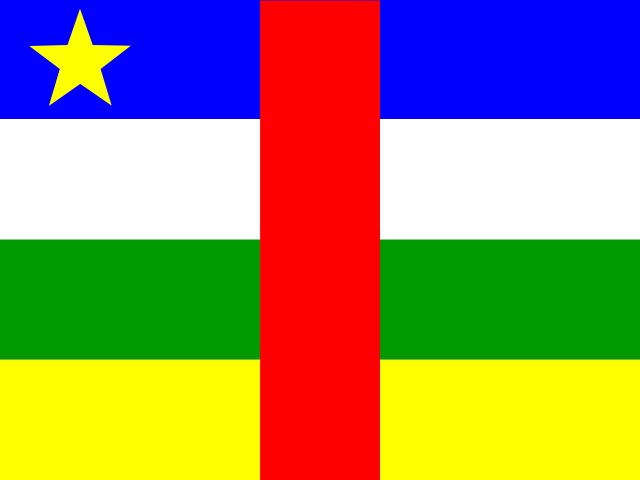
Four horizontal bands of blue, white, green and yellow crossed at their middle by a vertical red stripe, with a yellow five-pointed star in the upper hoist. It combines the French tricolour with the Pan-African colours, but the 1958 law that instituted it and every constitution since give the colours no official meaning.
Central African Republic FACTS ◢
| Capital | Bangui |
|---|---|
| Continent | Africa |
| Population | 5,513,282 (2025) |
| Area | 622,984 km² |
| Population density | 9/km² |
| Currency | Central African CFA franc (XAF) |
| Official languages | French, Sango |
| Calling code | +236 |
| Internet TLD | .cf |
| Time zone | UTC+01:00 |
| Drives on the | Right |
| ISO codes | CF / CAF |
DID YOU KNOW? ◢
- It sits almost exactly in the geographic centre of the African continent.
- It's completely landlocked, bordered by six other countries.
- The Sangha Trinational rainforest reserve, shared with its neighbours, is a UNESCO World Heritage Site rich in forest elephants and gorillas.
- Sango is one of its official languages, spoken as a common tongue across the country.
Central African Republic QUICK ANSWERS ◢
What is the capital of the Central African Republic?
The capital of the Central African Republic is Bangui.
What is the population of the Central African Republic?
The Central African Republic had a population of 5,513,282 in 2025.
What currency does the Central African Republic use?
The Central African Republic uses the Central African CFA franc (XAF).
What languages are spoken in the Central African Republic?
The official languages of the Central African Republic are French and Sango.
Think you know your flags? Play Flag Daily → · Browse all countries →
MORE ON THE FLAG ◢
The Central African Republic has one of the few flags whose designer, date and stated intent all get repeated with confidence. Barthélemy Boganda presented it to the assembly in Bangui on 1 December 1958, the day Oubangui-Chari stopped being a French territory and became a republic. The reading that travels with it is that its four Pan-African bands, crossed by a vertical red stripe, stand for the blood common to Europeans and Africans alike.
The law that instituted the flag was passed in that same session, on that same day. It says nothing of the kind. It describes the cloth, orders itself published, and stops.
Eight further constitutional texts have prescribed the flag since, from Boganda's own constitution of 1959 through Bokassa's imperial constitution, four later republican constitutions, a transitional charter and the document in force today. Every one of them is precise about geometry. Not one explains a colour.
Key Takeaways
- The founding text is Loi constitutionnelle n° 58.1 of 1 December 1958. It runs to two articles and gives the colours no symbolism.
- Nine constitutional texts between 1958 and 2023 describe the flag. None of them assigns a meaning to the colours or to the star.
- The flag is prescribed today by article 1 of the constitution promulgated on 30 August 2023, having sat at article 24 of the 2016 text.
- The "Europeans and Africans" reading of the red stripe is a vexillologist's interpretation published in 1982, not a Central African claim.
- The one quotation attributed to Boganda about the red stripe calls it the symbol of "our blood", which is a different claim again.
| Text | Date | Flag clause | How it describes the design | Meaning assigned |
|---|---|---|---|---|
| Loi constitutionnelle n° 58.1 | 1 December 1958 | article 1 | "quatre bandes horizontales (bleu-blanc-vert-jaune)", star in the "angle supérieur interne" | None |
| Constitution | 16 February 1959 | article 1 | Four bands, star in the "angle supérieur interne" | None |
| Constitution of the Central African Empire | 4 December 1976 | article 3 | The 1958 wording reproduced, parenthesis and all | None |
| Constitution | 28 November 1986 | article 1 | Four bands, star in the "angle supérieur interne gauche" | None |
| Constitution | 14 January 1995 | article 17 | Four bands, star in the "angle supérieur gauche" | None |
| Constitution | 27 December 2004 | article 18 | Four bands, star in the "angle supérieur gauche" | None |
| Charte constitutionnelle de transition | 18 July 2013 | article 19 | "cinq couleurs dont quatre bandes horizontales", star in the "angle supérieur gauche" | None |
| Constitution | 30 March 2016 | article 24 | "cinq (5) couleurs dont quatre (4) en bandes horizontales", star in the "angle supérieur gauche" | None |
| Constitution | 30 August 2023 | article 1 | "cinq couleurs dont quatre en bandes horizontales", star in the "angle supérieur gauche" | None |
What does the law actually say about the Central African Republic's flag?
The constitution promulgated on 30 August 2023 puts the flag in its opening article, beside the name of the state and its borders of 13 August 1960:
"Son emblème est le drapeau à cinq couleurs dont quatre en bandes horizontales d'égale largeur, de couleurs bleue, blanche, verte et jaune, barrées perpendiculairement, en leur milieu, par une bande d'égale largeur de couleur rouge et frappé dans l'angle supérieur gauche par une étoile à cinq branches de couleur jaune."
Its emblem, in English, is the flag of five colours, four of them in horizontal bands of equal width, blue, white, green and yellow, crossed perpendicularly at their middle by a band of equal width in red, and struck in the upper left corner by a five-pointed yellow star.
That is all of it. The article goes on to fix the motto as "Unité - Dignité - Travail", the anthem as "La Renaissance" and the national holiday as 1 December, then hands the seals and the coat of arms to ordinary legislation. Nowhere does it say what blue is for, or white, or the star.
Two texts in the sequence are worth singling out. Bokassa's imperial constitution of 4 December 1976 gave the emperor a personal emblem with a plain identity, "l'Aigle dans le Soleil", the Eagle in the Sun. It then reproduced the 1958 flag clause word for word, bracketed colour string included, without explaining any of it.
Kolingba's constitution of 28 November 1986 is the hinge in the wording. It is the only text that places the star in the "angle supérieur interne gauche", carrying both the old adjective and the new one at once.
Did Boganda explain the colours himself?
This is where the trail thins, and it is worth being exact about how thin.
The founding statute takes a minute to read. Loi constitutionnelle n° 58.1, "instituant l'emblème national de la République centrafricaine", was adopted by the constituent legislative assembly sitting on 1 December 1958 and published in the Journal officiel de l'Afrique équatoriale française. Article 1 describes the flag. Article 2 says the law will be promulgated, published and executed as a law of the state. There is no article 3.
So if Boganda gave the colours meanings, he did it in the speech rather than in the text. A speech was reportedly made. Flags of the World, the long-running vexillological archive, carries an English rendering of what he is said to have told the deputies before the vote, including the line "The red stripe which crosses the four colours is the symbol of our blood." Its contributor credits that to a volume titled République Centrafricaine - Na-Ndouzou, published for the Presidency of the Central African Republic around 1969 by Éditions Delroisse.
That is a citation at two removes: a translation, on a mailing-list archive, of a presidency-sponsored book produced about a decade after the words were spoken. Neither the Bibliothèque nationale de France catalogue nor the French union catalogue Sudoc returns a record for Na-Ndouzou, although both hold other Delroisse titles.
A printed collection of Boganda's speeches from the right years does exist. The BnF holds Enfin, on décolonise... Discours 1957-1958, printed in Bangui by the Imprimerie centrale d'Afrique, and Jean-Dominique Pénel's edition of Boganda's Écrits et discours. Neither is digitised. Anyone who wants the words of 1 December 1958 in Boganda's own French will have to open a book.
Where does the "shared blood" reading come from?
Not from any Central African statute, and on the available evidence not from Boganda either. It comes from a vexillologist.
Flags of the World attributes the interpretation to a 1982 reference work by Whitney Smith, which it cites as smi82. The reading itself runs like this: the colours were chosen to represent France and the Pan-African palette, and what the two have in common, red as blood, is superimposed to symbolise that Europeans and Africans have to respect each other.
That is a careful reading of a deliberate design. It is also an outsider's gloss written twenty-four years after the flag was first hoisted.
The difference matters, because the two readings point opposite ways. Smith's red is a bridge between coloniser and colonised. The quotation attributed to Boganda is about sacrifice by Central Africans: the symbol of "our blood", to be shed for Africa and for the new republic.
The country's own diplomatic pages give a third answer. Its embassy in Paris, under "Ses symboles", says the red "correspond au sang versé par tous les martyrs", the blood shed by all the martyrs, and that the star "guide les pas du peuple noir vers la liberté et l'émancipation". Martyrs' blood, Boganda's "our blood" and Smith's shared blood are three separate claims wearing the same colour.
Why do the four bands get read as four countries?
Because the federation Boganda wanted is a matter of record, even though it never came into being.
French Equatorial Africa was a federation of four colonies: Gabon, Moyen-Congo, Oubangui-Chari and Chad. The proclamation the assembly adopted on 1 December 1958, immediately before the flag law, put the ambition in writing. Its article 3 states that the republic "manifeste la volonté de s'unir avec les autres États membres de la Communauté et notamment avec ceux appartenant à l'actuelle fédération de l'AEF", declaring the will to unite with the other member states of the Community and especially those in the AEF federation then in existence.
Four territories, four bands. The mapping in circulation assigns one colour to each: blue for the Congo and the ocean that cradles it, white for Chad and its cotton, green for Gabon and its forests, yellow for the Central African Republic and its mineral wealth.
That mapping sits on the embassy's page, which makes it look official. Read the page closely and it hedges in an encyclopedia's voice: "Notons que pour tous les drapeaux, plusieurs significations sont à retenir. La plus répandue pour ce drapeau est la suivante", meaning several readings are available and this is the most widespread. The same sentences, in the same order, have been on the French Wikipedia article about the flag since December 2011 and July 2012, and the earliest archived copy of the embassy page dates from September 2023.
So the most-cited official-looking statement of what the colours mean reads like a decade-old encyclopedia entry, and even that entry declines to call the meaning official. If you want to know whether you can pick this flag out of a set of five-colour African designs, a daily flag round settles it faster than the paperwork does.
How has the Central African Republic's flag description changed since 1958?
Two things have shifted, both visible only by reading the texts side by side.
The star moved without moving. From 1958 to 1976 the law places it in the "angle supérieur interne", the inner upper corner, which is how a flag gets described by someone thinking about the hoist. The 1986 constitution says "angle supérieur interne gauche", both at once. From 1995 onward the word "interne" is gone and only "gauche" remains, the upper left corner, which is how a flag gets described by someone looking at a picture of one. The star has not shifted. The vocabulary has.
The count changed too. Every text from 1958 to the 2004 constitution describes four horizontal bands crossed by a fifth in red. The transitional charter of 18 July 2013 reframes the same cloth as a flag of five colours, four of them in bands, and the constitutions of 2016 and 2023 keep that framing. The red stripe is promoted from an interruption of the design to a full member of it, fifty-five years after it was first drawn.
Two gaps are worth naming rather than papering over. The Digithèque MJP collection used here carries no separate text for 1964, and its account of the period says the 1959 constitution, revised several times, formally survived until the Empire was proclaimed. The short-lived constitution of February 1981 is likewise absent from the collection, so its flag clause, if it had one, has not been checked here. If you would rather place a country without a flag to look at, three clues and no flag is the harder game.
Frequently asked questions
What do the colours of the Central African Republic's flag mean?
No Central African legal text assigns them a meaning. The 1958 law that instituted the flag, and the eight later constitutional texts that describe it, all set out the colours and their arrangement without interpreting them. The readings in circulation come from vexillological reference works and from the country's diplomatic web pages, and they disagree with one another about the red stripe in particular.
Who designed the Central African Republic's flag?
Barthélemy Boganda, who presented it to the assembly in Bangui on 1 December 1958, the day the republic was proclaimed. He led the provisional government that followed and died in an aircraft crash on 29 March 1959, under four months later. His early death is part of why so little of his own account of the design is reachable today.
Does the red stripe stand for blood shared by Europeans and Africans?
That is one published interpretation, credited to the vexillologist Whitney Smith in 1982, and it is not a Central African claim. The quotation attributed to Boganda calls the stripe the symbol of "our blood", to be shed for Africa and for the republic. The Central African Republic's embassy in Paris describes it instead as the blood shed by all the martyrs.
Did the Central African Republic's flag change under Bokassa's empire?
No. The imperial constitution of 4 December 1976 reproduced the 1958 description of the flag in its article 3, down to the bracketed colour string, and left it unexplained. What Bokassa added was a personal emblem for himself, named in article 1 as the Eagle in the Sun. The national flag outlasted the empire unchanged.
What does the yellow star on the Central African Republic's flag represent?
In law, nothing: the constitution says only that a five-pointed yellow star strikes the upper left corner. The country's embassy in Paris says the star guides the steps of black people towards liberty and emancipation, and adds that the design originally carried a hand with its index finger pointing at the star of Boganda's MESAN party.
Sources
- Digithèque MJP, Université de Perpignan, Proclamation de la République centrafricaine and Loi constitutionnelle n° 58.1 instituant l'emblème national, transcribed from the Journal officiel de l'Afrique équatoriale française of 1 January 1959 - retrieved 12 August 2026.
- Digithèque MJP, Université de Perpignan, the later Central African constitutional texts read for this article: 16 février 1959, 4 décembre 1976 (Empire), 28 novembre 1986, 14 janvier 1995, 27 décembre 2004, charte de transition du 18 juillet 2013 and 30 mars 2016, plus the collection's Centrafrique overview - retrieved 12 August 2026.
- Journal officiel de la République Centrafricaine, Édition spéciale, March 2016, Constitution de la République centrafricaine du 30 mars 2016 (gazette scan, article 24, corroborating the MJP transcription) - retrieved 12 August 2026.
- International Labour Organization NATLEX, Constitution de la VIIe République centrafricaine, promulguée le 30 août 2023 (article 1) - retrieved 12 August 2026.
- Ambassade de la République Centrafricaine en France, Ses symboles - retrieved 12 August 2026.
- Internet Archive Wayback Machine, capture of the embassy's "Ses symboles" page, 24 September 2023 - retrieved 12 August 2026.
- Flags of the World, Central African Republic, including Ivan Sache's note of 24 December 2002, its citation of République Centrafricaine - Na-Ndouzou, and the
smi82attribution to Whitney Smith - retrieved 12 August 2026. - Bibliothèque nationale de France, catalogue record for Enfin, on décolonise... Discours 1957-1958 - retrieved 12 August 2026.
- Bibliothèque nationale de France, catalogue record for Jean-Dominique Pénel, Barthélemy Boganda: écrits et discours - retrieved 12 August 2026.
- Sudoc (Agence bibliographique de l'enseignement supérieur), union-catalogue search for "Na-Ndouzou", returning no records - retrieved 12 August 2026.
- Wikipedia, "Drapeau de la République centrafricaine", revisions of 13 December 2011 and 12 July 2012 - retrieved 12 August 2026.
PLAY ANOTHER →
Five questions a day. Everyone gets the same five.
FIVE QUESTIONSDAILYGuess the CountryThree clues, three guesses. Work out where in the world it is.
THREE CLUESDAILYOn This DayOne thing that happened today in history. Every day, a new one.
TODAY IN HISTORYDAILYDaily CodeA short message, hidden in a different cipher every day.
ONE CIPHER A DAY