
Eritrea
A Red Sea nation whose capital is an open-air museum of Art Deco and Modernist architecture built during Italian rule. Eritrea is where 1930s Italy went to daydream about the future.
WHAT THE FLAG MEANS ◢
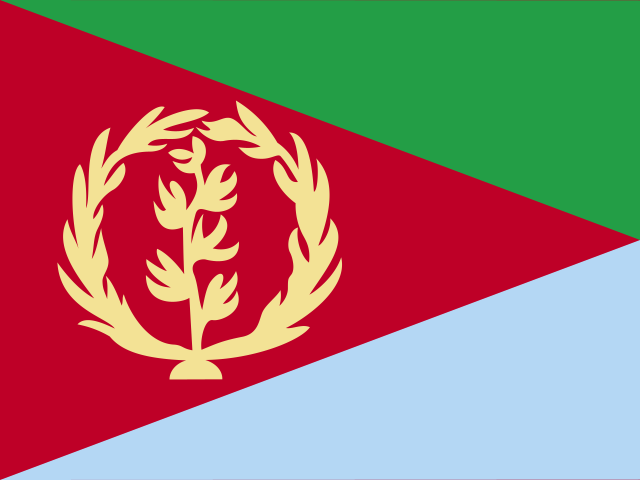
A red triangle spanning from the hoist to the fly, dividing a green upper triangle from a blue lower one, with a gold olive wreath and upright branch on the red. Article 4 of the 1997 Constitution assigns the colours no meaning at all, saying only that the flag shall have green, red and blue with golden olive leaves and that the detail shall be set by law. The readings in circulation come from the Ministry of Information: green for agriculture and livestock, blue for the bounty of the Red Sea, red for bloodshed in the struggle, and the olive branches, taken from the 1952 Eritrean flag, for peace. Its 30 leaves stand for the 30 years of armed struggle.
Source: shabait.com · constituteproject.org
Eritrea FACTS ◢
| Capital | Asmara |
|---|---|
| Continent | Africa |
| Population | 3,607,003 (2025) |
| Area | 117,600 km² |
| Population density | 31/km² |
| Currency | Nakfa (ERN) |
| Main languages | Arabic, English, Tigrinya |
| Calling code | +291 |
| Internet TLD | .er |
| Time zone | UTC+03:00 |
| Drives on the | Right |
| ISO codes | ER / ERI |
DID YOU KNOW? ◢
- Its capital, Asmara, is a UNESCO World Heritage Site celebrated for its early-20th-century Modernist architecture.
- It has a long coastline on the Red Sea, including the many islands of the Dahlak Archipelago.
- Asmara sits high on a plateau, giving it a mild climate despite the country's hot lowlands.
- It gained independence from Ethiopia in 1993, making it one of Africa's youngest nations.
Eritrea QUICK ANSWERS ◢
What is the capital of Eritrea?
The capital of Eritrea is Asmara.
What is the population of Eritrea?
Eritrea had a population of 3,607,003 in 2025.
What currency does Eritrea use?
Eritrea uses the Nakfa (ERN).
What languages are spoken in Eritrea?
Eritrea designates no official language. The languages of government and education are Arabic, English and Tigrinya.
Think you know your flags? Play Flag Daily → · Browse all countries →
MORE ON THE FLAG ◢
Most flag explanations open with what the colours stand for. Eritrea's is worth checking against the country's own constitution first, because the constitution declines to answer.
Article 4(1) of the 1997 Constitution gives the Eritrean flag two sentences: "The Eritrean Flag shall have green, red and blue colors with golden olive leaves. The detailed description of the Flag shall be determined by law."
That is the whole constitutional description, and no colour is assigned a meaning. The readings in circulation match an official source, but that source is the country's information ministry rather than its law. They are also not fixed: three articles published by the Ministry of Information since 2012 give three accounts of the flag's colours. They disagree about how many colours the flag has, about whether yellow carries a meaning of its own, and about which flag the meanings belong to.
Key Takeaways
- Article 4(1) of the 1997 Constitution describes the flag in two sentences and assigns none of its colours a meaning.
- Articles published by the Ministry of Information supply them instead. The 2021 one gives green for agriculture and livestock, blue for the bounty of the Red Sea, red for bloodshed, and the olive branches for peace.
- The 2020 article treats the flag as having four colours and gives yellow the mineral resources of Eritrea. The 2012 article glosses the colours as the liberation front's, and returns to them for the national flag only as a reading of the geometry.
- The 2012 article counts 30 leaves for the 30 years of armed struggle, arranged as 12 a side plus six on the upright branch.
- The wreath is the only device on the flag, and the liberation front did not design it. It quotes the 1952 flag and replaced the front's gold star.
- The 1997 Constitution "has never been implemented", the UN commission of inquiry on human rights in Eritrea reported in June 2015.
Four published accounts, set side by side:
| Account | Green | Blue | Red | Yellow |
|---|---|---|---|---|
| Ministry of Information, 1 June 2012, describing the liberation front's flag | Fertility of the country | The sea | Blood lost in the fight for freedom | Mineral resources, in the star, whose five points stand for equality, unity, liberty, justice and prosperity |
| Ministry of Information, 17 October 2020 | Agricultural exuberance of Eritrea | The Red Sea and its marine resources | Blood shed in the struggle for independence | Mineral resources of Eritrea |
| Ministry of Information, 19 May 2021 | Agriculture and livestock of the country | The bounty of the Red Sea | Bloodshed in the struggle | Not listed as a colour; the golden olive branches represent peace |
| Eve Devereux, Identifying Flags (1998), quoted by Flags of the World | Agricultural and livestock economy | Marine wealth | Bloodshed in the struggle for independence | Mineral wealth of Eritrea |
What do the colours on the Eritrean flag mean?
The answer depends on which ministry article you read.
The most recent of the three is by Mikal Tesfay, dated 19 May 2021. It gives green for "the agriculture and livestock of the country", blue for "the bounty of the Red Sea", and red for "the bloodshed in the struggle". The golden olive branches "were adapted from the 1952 Eritrean flag", it says, and "represent peace".
Simon Weldemichael, writing for the same ministry on 17 October 2020, counts differently. His article says: "Eritrea's national flag has four colors: red, blue, green and yellow." Yellow is not the wreath's material there, it is a colour with a meaning of its own, "the mineral resources of Eritrea". Blue becomes "the Red Sea and its marine resources", and green "agricultural exuberance".
The oldest of the three, published on 1 June 2012, is the odd one out in a different way. Its colour glosses sit in the paragraph describing the Eritrean People's Liberation Front's flag rather than the national one: green for "the fertility of the country", blue for "the sea", red for "the blood lost in the fight for freedom", and the gold star carrying mineral resources in its colour and equality, unity, liberty, justice and prosperity in its five points. The national flag took its layout and its colours from that flag, so the gloss reaches the current flag by inheritance rather than by statement, and the article restates the colours for the current flag only in its reading of the triangles, never as a plain list.
Two of the three are signed, by Simon Weldemichael and Mikal Tesfay; the 2012 article carries no byline, though it is written in the first person. None is issued as a statement of the ministry about what the flag means.
A reference work reached the same reading before the ministry printed it. Flags of the World quotes Eve Devereux's Identifying Flags of 1998: "Green symbolizes the agricultural and livestock economy of the country, red the bloodshed in the struggle for independence, blue the marine wealth, and yellow the mineral wealth of Eritrea". That is the 2020 article's reading, in a book published two decades earlier, and it includes the yellow the 2021 article leaves out.
One contributor doubts the colours borrow from the neighbours at all. Jaume Ollé, writing on Flags of the World in August 2001, gave it as his opinion that Eritrea's palette has no relation to those around it: Djibouti uses blue for the Issas and green, white and blue for the Afars, Sudan flies the Pan-Arab colours, and Ethiopia the Pan-African ones. Željko Heimer, writing on the same page and the same day, allows that "certainly the light blue - green combination is popular in this part of the world".
On Ollé's reading the borrowing from 1952 goes further than the wreath: Eritrea's blue and green come from that flag too, "with the red added for socialism". The 2012 article traces the current flag's colours only as far back as the front's 1977 design, and does not say where the front's own blue and green came from.
So the meanings in circulation come from an official publisher without coming from law, and they come in more than one version. A reading can be published by the state without being law, and it can be published more than once in incompatible forms.
What do the shapes on the Eritrean flag mean?
The 2012 ministry article is the only source found for this article that reads the geometry rather than the palette, and that reading is the most interesting thing in it.
The red triangle has its base at the hoist and tapers towards the fly, so the green and blue triangles widen as it narrows. The 2012 article is loose about which way that runs, saying in one place that the triangle "extends towards the left" and in another that the front's ran "from the hoist to the fly (right)"; the 2021 article settles it, describing "a red triangle pointing away from the hoist side". What matters is that the 2012 article attaches meanings to the direction and not only to the colours: the red stands for "the declining amount of blood spilt for the independence and sovereignty of the country", and the green and blue for "the growing amount of fertility as well as land bounty on one hand and the vast marine resources and clear (unpolluted) skies respectively".
It is a reading of the flag as a diagram of a trend rather than a list of virtues, and no other source opened for this article offers it. Neither of the two later ministry articles repeats it, and neither does Devereux.
The construction detail comes from elsewhere. Flags of the World records the Album des Pavillons of 2000 as putting the midpoint of the wreath half a hoist-length from the hoist.
The wreath's 30 leaves, and how they are arranged
The 2012 article gives the wreath 30 leaves, one for each year of the armed struggle for independence, which Flags of the World dates from September 1961 to May 1991. The 2020 article dates independence "Thirty-two years after the beginning of its armed struggle", counting on to the declaration of May 1993 rather than stopping at the military victory two years earlier.
The total gets repeated constantly and the breakdown almost never does, which matters because the total on its own tells you nothing about the arrangement. A wreath that looks like two matched branches invites the assumption of an even split, 15 a side.
The 1 June 2012 article published the real arithmetic: 12 leaves on each side, "with six more on the upright branch in the middle, totaling altogether to 30". The two side branches match each other exactly. The odd element is the upright branch, and a reader who counts only the pair gets 24.
That is the only count from an Eritrean government source this article could find. The 2020 and 2021 ministry articles both give the total and neither gives the split.
The emblem deserves the same caution. Jaume Ollé, writing on Flags of the World in August 2001, accepts the two outer branches as olive but queries the central forked-leaved one, and adds a caution about the device as a whole: "Since adoption the emblem was slightly changed, something which is not very well documented, so it may not still be considered an olive branch." No Eritrean source opened here documents such a change.
Where the wreath came from, and what it replaced
The wreath is a deliberate quotation, and the star is what it replaced.
The layout came from the Eritrean People's Liberation Front, at its First Organizational Congress in 1977: a red triangle from hoist to fly, green above, blue below, with a gold five-pointed star in the red. The wreath is older. It comes from the flag Eritrea flew under the federation with Ethiopia, a blue field carrying, in the words of the 2012 article, "an upright olive wreath and a single branch within".
By the 2012 article's account that 1952 flag was in use "until the end of the 1950s, when the territory was absorbed and then forcibly annexed into Ethiopia", and then survived as the "flag of liberation" into the 1970s. That article gives no year for the annexation. The NYU GlobaLex survey of Eritrean law dates the federal period 1952 to 1962 and says the Government of Ethiopia "abolished the federal arrangement in 1962". A third account differs again: Flags of the World cites The Flag Bulletin of May/June 1996 for absorption in 1959, and carries the liberation flag through to 1993 rather than the 1970s.
At the declaration of independence on 24 May 1993 the front's design went up with the star removed and the 1952 wreath in its place.
So the emblem's provenance is not the independence movement. It is the older civilian symbol the movement deferred to, and the movement's own emblem is the piece that was dropped. What the wreath carries is a different matter: the 2012 and 2021 articles both tie its 30 leaves to the 30 years of the armed struggle, so the leaf count commemorates the movement even though the device does not come from it.
Who decided Eritrea should have a flag at all?
The Eritrean Assembly, in 1952, after an argument the United Nations recorded in detail.
The UN General Assembly resolved on 2 December 1950 that Eritrea "shall constitute an autonomous unit federated with Ethiopia under the sovereignty of the Ethiopian Crown", and provided for a United Nations Commissioner in Eritrea to prepare a constitution. The Assembly elected Eduardo Anze Matienzo of Bolivia to the post twelve days later, on 14 December 1950. Resolution 390 (V) does not mention a flag. The word does not appear in it once.
Matienzo's final report records what happened when he asked Eritreans what the constitution should contain. The views submitted to him "concerned the Assembly, the Executive, the electorate, the representative of the Emperor, the official languages and the flag, the last three questions being the most controversial".
The split ran along the same line as every other question. The Moslem League of the Western Province, the Independent Moslem League and other parties, in the report's account, "recognized that the Federal flag should be that of Ethiopia, but claimed that Eritrea should have a flag of her own". Against them, the Unionist Party, the acting head of the Coptic Church and a number of their supporters "opposed the creation of a separate Eritrean flag, which they considered contrary to the spirit of Federation. In their view, Eritrea should be placed under the Ethiopian flag." On the plateau the majority "wished the Eritrean flag to be that of Ethiopia"; in the Western Province and the Red Sea Division three Moslem Leagues asked for a separate one.
He left the choice to the Eritrean Assembly, telling the Administering Authority that "personally he felt it would be wiser to leave it to be decided by the Eritrean Assembly, if agreement could not be reached beforehand". The Assembly settled it on 2 July 1952 by adopting an article on symbols in two clauses: "The Federal flag shall be respected in Eritrea" and "There shall be a flag, seal and arms of Eritrea, details of which shall be decided upon by law". The Commissioner's final report numbers that article 22 in his account of the debate, 21 in the footnote listing the laws the Constitution calls for, and prints it as Article 15 in the constitution itself.
The design followed. In the 2012 article's account the political leader Mohammed Omer Hakito proposed a light blue flag with seven stars, the proposal was debated, and the members of the Eritrean Parliament "finally voted unanimously" for the blue field with a green olive wreath instead. The same article rejects the story that the UN donated the flag: those assumptions "hardly hold water".
A related story attaches the UN to the wreath rather than to the flag's donation, and it predates the ministry's rejection rather than surviving it. Nathan Lamm, writing on Flags of the World in August 2002, records having read that the wreath stands for the UN and its part in Eritrean independence. Flags of the World, citing The Flag Bulletin, calls the 1952 field "United Nations blue", which is the likeliest reason the association exists at all. No Eritrean source opened for this article says the wreath stands for the UN.
Is there a law that describes the flag?
Two constitutions forty-five years apart both hand the detail of the flag to a law, and no text of either law could be found for this article.
The 1952 text delegated the details of the flag, seal and arms outright, and the Commissioner's report names the measure that was meant to follow: a "Law on the Flag, Seal and Arms of Eritrea", listed in a footnote enumerating the articles of the Constitution that call for a law. It is not among the seven organic laws the report goes on to list as drafted, which run from the Administration of Justice Proclamation to the Civil Service Act.
Article 4(1) of the 1997 Constitution delegates in the same way: "The detailed description of the Flag shall be determined by law."
Reaching that law is the problem. Eritrean proclamations appear in the Eritrean Gazette, the official law reporter under Proclamation 9/91. The 2023 GlobaLex survey counts around 200 of them, notes that the Gazette is "limited to domestic circulation", and records that since 2017 the government has not published laws in it at all. The online database that survey points to did not resolve in August 2026, and no flag measure turned up anywhere else reachable for this article.
With no Eritrean text of the flag law reachable, the published detail comes from flag reference works, and they do not agree either. Flags of the World's Eritrea page carries "Flag adopted 05 December 1995" in its header, unattributed to any of the contributors whose signed notes make up the rest of the page.
Its own sources also disagree about the specification. Željko Heimer set out in 2001 that the ratio had been given as 2:3 by Flags of the World's own earlier pages, the World Flag Database and the Album des Pavillons of 1995, and as 1:2 by that album's 2000 edition, the corrections to the 1995 edition and the Shipmate Flag Chart. He judged the later figure the sounder one: "Presumably the latter data would be more correct."
The colour specifications divide too, though less evenly. The page carries seven sources for the colours, five of which give the same four Pantone numbers. Two break with the rest: the Beijing 2008 manual gives red 032 and blue 292 where the others give 185 and 279, and a Wikipedia value puts green at 2422 C where every other source on the page gives 361. No Eritrean specification was reachable for this article to measure any of them against.
One Eritrean law does reach the flag, without describing it. The 2020 ministry article cites Article 123 of the 2015 Penal Code, which it describes as making it an offence to insult the national flag of Eritrea or of any other country intentionally, punishable by imprisonment or a fine. The code's own text could not be opened for this article, so that is the 2020 article's account of the provision rather than the provision itself.
The constitution carrying the flag clause has itself never taken effect. The UN commission of inquiry on human rights in Eritrea put it flatly in June 2015: "What was meant to be the supreme law of the country, the Constitution of 1997, has never been implemented." The GlobaLex survey says the same in its own words. The flag is nonetheless treated with ceremony: Mikal Tesfay describes hearing a whistle at dusk near a police station, standing to attention, and drivers who "also stopped and got off their cars".
Frequently asked questions
Why is there an olive wreath on the Eritrean flag?
The wreath comes from the Eritrean flag of 1952, which the ministry's 2012 article describes as a blue field carrying "an upright olive wreath and a single branch within". The ministry's article of 19 May 2021 says the olive branches represent peace. When the current flag was first raised at independence in 1993, the wreath took the place of the gold star on the liberation front's flag.
A separate story, recorded by a Flags of the World contributor in August 2002, holds that the wreath stands for the United Nations. No Eritrean government source opened for this article supports that.
How many leaves does the Eritrean flag's wreath have?
Thirty, which the 2012 ministry article ties to the 30 years of armed struggle before independence. That article's own breakdown is 12 leaves on each side plus six more on the upright branch in the middle. The two side branches match; the upright branch is the part that makes the total come out wrong if you count only the pair.
Sources that print only the total leave the arrangement open, and the ministry's later articles of 2020 and 2021 are among them.
Does Eritrea's constitution say what the flag's colours mean?
No. Article 4(1) says only that the flag "shall have green, red and blue colors with golden olive leaves" and that the detailed description shall be determined by law. It assigns no meaning to any colour. The meanings in circulation are carried by articles published on the Ministry of Information's site, which give three different accounts of them between 2012 and 2021.
What is the difference between the Eritrean flag and the liberation front's flag?
The emblem. Flags of the World describes the front's flag as similar to the current one, with a gold star in the hoist where the current flag carries the wreath. The front's flag was proposed at its congress in 1977, and the national flag put the gold olive wreath in the star's place in 1993.
The 2012 article reads that star two ways at once: its colour for Eritrea's mineral resources, and its five points for equality, unity, liberty, justice and prosperity.
When was the current Eritrean flag adopted?
It was first raised at the declaration of independence on 24 May 1993. Flags of the World's page header gives 5 December 1995 as the date the flag was adopted, without saying what instrument did it. No published text of any Eritrean flag measure was reachable for this article, so that date rests on a secondary record alone.
Sources
- Constitute Project, Eritrea 1997 Constitution - retrieved 12 August 2026.
- United Nations General Assembly, Resolution 390 (V), Eritrea: Report of the United Nations Commission for Eritrea, 2 December 1950 - retrieved 12 August 2026.
- United Nations, Final Report of the United Nations Commissioner in Eritrea, General Assembly Official Records, Seventh Session, Supplement No. 15 (A/2188), 1952 - retrieved 12 August 2026.
- United Nations Human Rights Council, Report of the commission of inquiry on human rights in Eritrea (A/HRC/29/42), 4 June 2015 - retrieved 12 August 2026.
- Eritrea Ministry of Information, Mikal Tesfay, Respecting Eritrean National Symbols, 19 May 2021 - retrieved 14 August 2026.
- Eritrea Ministry of Information, Simon Weldemichael, National Flag: Precious National Symbol, 17 October 2020 - retrieved 14 August 2026.
- Eritrea Ministry of Information, The High Hoisted Banner Of Pride And Glory, 1 June 2012 - read from the Internet Archive capture of 21 October 2020, retrieved 14 August 2026.
- Flags of the World, Eritrea and Historical flag of Eritrea (1952) - retrieved 14 August 2026.
- GlobaLex (NYU School of Law), Luwam Dirar and Kibrom Tesfagabir Teweldebirhan, Introduction to Eritrean Legal System and Research, July/August 2023 - retrieved 14 August 2026.
PLAY ANOTHER →
One thing that happened today in history. Every day, a new one.
TODAY IN HISTORYDAILYDaily CryptogramOne quote, one scrambled alphabet. Crack it before tomorrow.
CRACK THE QUOTEDAILYDaily TriviaFive questions a day. Everyone gets the same five.
FIVE QUESTIONSDAILYGuess the CountryThree clues, three guesses. Work out where in the world it is.
THREE CLUES