
Djibouti
A small, blisteringly hot country wedged at the mouth of the Red Sea, where the land drops below sea level and salt lakes shimmer like something off another planet. Djibouti trades on its geography and does very well out of it.
WHAT THE FLAG MEANS ◢
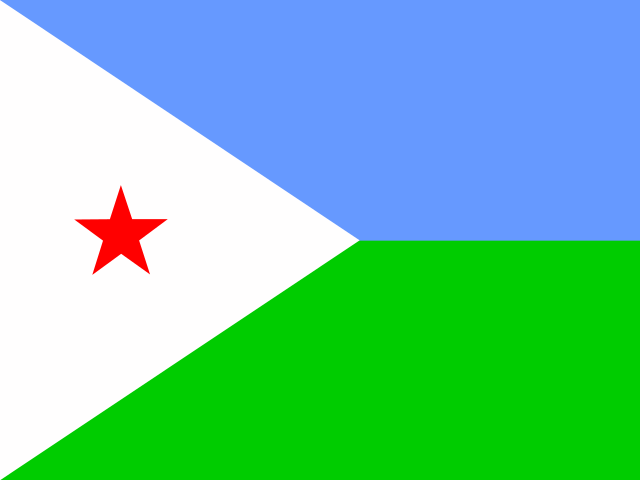
Two horizontal bands, light blue over green, with a white triangle at the hoist bearing a red five-pointed star. Article 2 of the constitution of 15 September 1992 names the flag only as 'le drapeau bleu, vert, blanc frappé d'une étoile rouge à cinq branches' and assigns the colours no meaning; the same article sends the anthem and the seal to legislation but not the flag, and no Djiboutian flag law is published anywhere reachable as of August 2026. Two unofficial readings circulate: blue for the Issa and green for the Afar, and blue for the sea and sky with green for the earth.
Source: presidence.dj
Djibouti FACTS ◢
| Capital | Djibouti |
|---|---|
| Continent | Africa |
| Population | 1,184,076 (2025) |
| Area | 23,200 km² |
| Population density | 51/km² |
| Currency | Djiboutian franc (DJF) |
| Official languages | Arabic, French |
| Calling code | +253 |
| Internet TLD | .dj |
| Time zone | UTC+03:00 |
| Drives on the | Right |
| ISO codes | DJ / DJI |
DID YOU KNOW? ◢
- Lake Assal sits about 155 metres below sea level, the lowest point in Africa and one of the saltiest bodies of water on Earth.
- Its position at the entrance to the Red Sea makes it one of the world's busiest shipping chokepoints.
- The surreal chimneys and steam vents of Lake Abbe look so alien they are often likened to the surface of another planet.
- It regularly ranks among the hottest inhabited countries on the planet.
Djibouti QUICK ANSWERS ◢
What is the capital of Djibouti?
The capital of Djibouti is Djibouti.
What is the population of Djibouti?
Djibouti had a population of 1,184,076 in 2025.
What currency does Djibouti use?
Djibouti uses the Djiboutian franc (DJF).
What languages are spoken in Djibouti?
The official languages of Djibouti are Arabic and French.
Think you know your flags? Play Flag Daily → · Browse all countries →
MORE ON THE FLAG ◢
Officially, nothing.
The country's constitution names the colours of the Djibouti flag without saying what any of them stands for. Article 2 of the constitution of 15 September 1992, as published by the Presidency of Djibouti, gives the flag one sentence of its three: "L'emblème de la République est le drapeau bleu, vert, blanc frappé d'une étoile rouge à cinq branches." The emblem of the Republic is the blue, green and white flag bearing a red five-pointed star.
That is the whole of it. No sea, no sky, no earth, no peace, no blood.
Key Takeaways
- Article 2 of the 1992 constitution names the flag in one sentence and assigns the colours no meaning.
- The same article sends the anthem and the seal to legislation, and the flag nowhere.
- Djibouti legislates symbolism when it wants to: the 2000 law on the seal spends a whole article on what each part of the seal stands for.
- Both readings, the Issa and the Afar and the sea and the earth, are recorded in one Flags of the World note of December 1995.
- No Djiboutian specification is published anywhere reachable as of August 2026, and the reference books run from 1:2 through 2:3 to 21:38.
What do the colours on the Djibouti flag mean?
Look at the flag first. Two horizontal bands, light blue above green, with a white triangle at the hoist carrying a red five-pointed star. Sudan carries a triangle at the hoist too, though its triangle is green and bears no star.
None of that layout is in the constitution. Article 2 does not say which colour goes where, how large the star is, or which shade of blue it means. Djibouti flies one design because that design has flown as the national flag since 1977, not because the 1992 text prescribes it.
Some of the terseness looks French. France administered the territory until 1977, and Article 2 of the French constitution is just as terse about the emblem: the tricolour, blue, white and red, and nothing about what the colours mean.
Why does the seal get an official explanation and the Djibouti flag does not?
The constitution routes one to the legislature and not the other. The last line of Djibouti's Article 2 reads "La loi détermine l'hymne et le sceau de la République", the law determines the anthem and the seal of the Republic. France's Article 2 has no such clause; it names "La Marseillaise" and the motto in the constitutional text itself. Djibouti wrote a delegation the French model lacks, sent two symbols to it, and left the flag out. No text says why.
Law number 91/AN/00/4th L of 10 July 2000 duly defines the seal, and its own Article 2 is nothing but meaning: the laurel wreath for the peace won at independence on 27 June 1977, the shield, the spear and the star for the defence of national sovereignty and the integrity of the territory.
So the state legislates symbolism when it decides to, and never did for the flag. A page on the Presidency's site headed "Les Symboles" carries that seal law and nothing else. Djibouti's embassies in Kuwait and in Switzerland both give the constitutional sentence for the flag, then the seal law with its meanings.
Where did blue for the Issa and green for the Afar come from?
From a period before the country existed, and from the same page as the rival reading.
Flags of the World holds a note by Željko Heimer, dated December 1995, that carries both. It reports that a liberation movement, which the note names only tentatively, had flown the design since 1972, and that under that use green was read as the Afar and blue as the Issa. The same note reports a different reading for the national flag, again without naming who supplied it: white for peace, blue for the sea and sky, green for the earth, the red star for unity.
No Djiboutian text opened for this article anchors either reading. Neither the constitution nor any Djiboutian government page reached for it mentions the Issa, the Afar, the sea or the earth in connection with the flag.
France had renamed the territory the French Territory of the Afars and the Issas in 1967, so a two-community reading of a two-band flag was already in the air.
What shape is the Djibouti flag supposed to be?
Nobody can say with authority, and that follows from Article 2. A sentence that names colours and a star cannot fix a ratio.
Zoltan Horvath's 2024 survey for Flags of the World checked the Presidency's symbols page, found only the seal law, and reported locating no legislation on the flag's specification or colours. What survives is a set of books and manuals that disagree, all recorded on the same Flags of the World page:
| Published source | Proportions | Red, as recorded there |
|---|---|---|
| Whitney Smith, Flags Through the Ages and Across the World (1975) | about 21:38 | not given |
| Nicole Smith's 1995 book Flags of the World (not the website) and the Shipmate Flagchart | 1:2 | not given |
| Album des Pavillons (2000) | 2:3, with 21:38 noted | Pantone 179c |
| Flag manual, Beijing 2008 | not stated | PMS 179 |
| Flags and Anthems Manual, London 2012 | not stated | PMS 032 |
| Album des Pavillons (2023) | 2:3, with 21:38 noted | Pantone 186c |
The red is not stable either. Flags of the World carries Ian Sumner's account of the London 2012 manual: the organisers sent each national Olympic committee its shades for approval, so the manual records what a committee believed rather than a government specification.
Where did the Album's 2:3 come from? Armand du Payrat, who worked on the Album des Pavillons, explained on the same page that he relied on a sketch drawn in an official letter dated 22 July 1977 from the French naval authority then at Djibouti. A drawing in a letter, 25 days after independence, doing the work a specification would normally do.
When was the Djibouti flag first raised?
As the national flag, on 27 June 1977. That day the French Territory of the Afars and the Issas became the Republic of Djibouti, a country that now sits between Eritrea, Ethiopia and Somalia. Heimer's 1995 note records the flag as officially hoisted at independence, and France's national audiovisual institute holds the TF1 evening bulletin from that date, a 45-second report of what it calls a sober ceremony on the French side, with the lowering of the colours.
Nobody has settled who designed it. Flags of the World recorded in 2002 that a Djiboutian portal named Mahamoud Harbi as the flag's designer and the artist Hassan Robleh as the designer of the emblem. That web address redirected to an unrelated site when checked in August 2026, leaving no way to check the attribution where it was made, and no Djiboutian government page names a designer.
One gap is worth stating. The flag flew for fifteen years before the 1992 constitution existed, and the texts of the transitional period are not published anywhere this article could reach. What is left, as of August 2026, is the design itself, which is the part flag quizzes test.
Frequently asked questions
Does Djibouti's constitution say what the flag's colours mean?
No. The relevant article runs to three sentences and spends one of them on the flag: Article 2 of the constitution of 15 September 1992 names blue, green and white and a red five-pointed star, and assigns no colour a meaning.
Is there a Djiboutian law that specifies the flag?
None published anywhere reachable as of August 2026. Zoltan Horvath's 2024 survey for Flags of the World found no legislation on the flag's specification or colours, while the same state's Law 91/AN/00/4th L of 10 July 2000 explains the seal element by element.
Does blue stand for the Issa and green for the Afar?
No Djiboutian official text opened for this article supports it: not the constitution, not the Presidency's symbols page, not the embassy pages in Kuwait and Switzerland. Flags of the World records the reading against the design's use by a liberation movement from 1972, in a note by Željko Heimer of December 1995; the same note gives the national flag an elemental reading instead, blue for the sea and sky, green for the earth.
What does the red star on the Djibouti flag mean?
Officially nothing: the constitution assigns it nothing. The nearest official Djiboutian statement about a star is in the 2000 seal law, where the shield, the spear and the star symbolise the defence of national sovereignty and the territory's integrity. That is the seal's star, not the flag's.
What are the correct proportions of the Djibouti flag?
There is no official answer: no Djiboutian text setting one is published anywhere reachable as of August 2026. Djibouti's embassy in Kuwait illustrates the flag at 2:3, and Zoltan Horvath's 2024 survey for Flags of the World reports that the longer version is seen more often around high officials.
Sources
- Présidence de la République de Djibouti, La Constitution de la République de Djibouti - retrieved 12 August 2026.
- Présidence de la République de Djibouti, Les Symboles - retrieved 12 August 2026.
- Constitute Project, Djibouti's Constitution of 1992 with Amendments through 2010 - retrieved 12 August 2026.
- Embassy of the Republic of Djibouti to the State of Kuwait, Seals of the Republic - retrieved 12 August 2026.
- Ambassade de la République de Djibouti en Suisse, Emblèmes et Drapeaux - retrieved 12 August 2026.
- Conseil constitutionnel, Texte intégral de la Constitution du 4 octobre 1958 en vigueur - retrieved 12 August 2026.
- Flags of the World, Djibouti - retrieved 12 August 2026.
- Institut national de l'audiovisuel, Djibouti : cérémonie indépendance, TF1 Actualités 20H, 27 June 1977 - retrieved 12 August 2026.
PLAY ANOTHER →
Three clues, three guesses. Work out where in the world it is.
THREE CLUESDAILYDaily TriviaFive questions a day. Everyone gets the same five.
FIVE QUESTIONSDAILYOn This DayOne thing that happened today in history. Every day, a new one.
TODAY IN HISTORYDAILYDaily CodeA short message, hidden in a different cipher every day.
ONE CIPHER A DAY