
Somalia
Perched on the Horn of Africa, Somalia has the longest mainland coastline on the continent and a deep tradition of poetry that earned it the nickname 'nation of bards'.
WHAT THE FLAG MEANS ◢
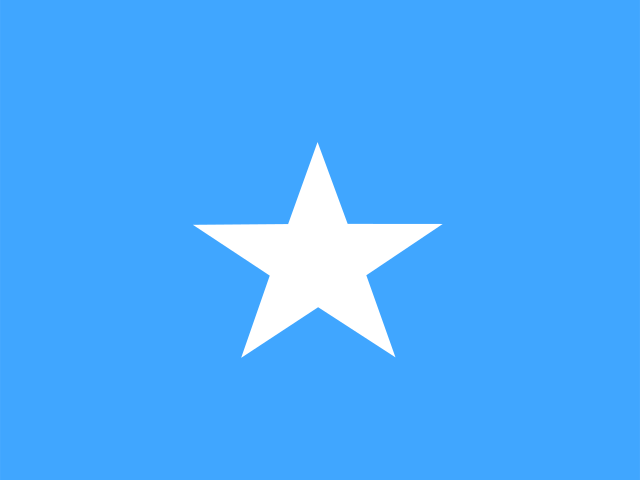
A light blue field with a single white five-pointed star at the centre. Article 6(1) of the 2012 Provisional Constitution describes the flag without interpreting it, giving the blue no meaning, shade reference or origin; the government's own description takes the star's five points as the regions where Somali people live. The widely repeated account that the blue was taken from the United Nations flag is not stated by any Somali official source.
Somalia FACTS ◢
| Capital | Mogadishu |
|---|---|
| Continent | Africa |
| Population | 19,654,739 (2025) |
| Area | 637,657 km² |
| Population density | 31/km² |
| Currency | Somali shilling (SOS) |
| Official languages | Arabic, Somali |
| Calling code | +252 |
| Internet TLD | .so |
| Time zone | UTC+03:00 |
| Drives on the | Right |
| ISO codes | SO / SOM |
DID YOU KNOW? ◢
- It has the longest coastline of any country on mainland Africa, stretching over 3,000 kilometres.
- Somalia sits on the Horn of Africa, the continent's easternmost point.
- Poetry is so central to its culture that Somalis have been called a 'nation of poets'.
- The vast majority of its people speak Somali, and camels are prized enough to feature in traditional wealth and dowries.
Somalia QUICK ANSWERS ◢
What is the capital of Somalia?
The capital of Somalia is Mogadishu.
What is the population of Somalia?
Somalia had a population of 19,654,739 in 2025.
What currency does Somalia use?
Somalia uses the Somali shilling (SOS).
What languages are spoken in Somalia?
The official languages of Somalia are Arabic and Somali.
Think you know your flags? Play Flag Daily → · Browse all countries →
MORE ON THE FLAG ◢
The five points on the Somali flag stand for five regions where Somali people live. Two of those regions are inside other countries today, a third is a separate sovereign state, and the flag was drawn six years before Somalia existed.
The five regions are what Somalia's own government says the star is for. That those regions extend well beyond the country's borders is the Library of Congress's reading of it, in a country study that calls them "those areas claimed as part of the Somali nation".
Key Takeaways
- The Federal Government of Somalia states the flag "was adopted on October 12, 1954, and was designed by Mohammed Awale Liban", and that the star "represents the five regions in which Somalis reside".
- The Library of Congress names the five as the former Italian and British territories, the Ogaden, Djibouti, and what was then Kenya's Northern Frontier District.
- The flag predates the state. The Somali Republic was formed on 1 July 1960, when British Somaliland joined the trust territory.
- The Provisional Constitution of 2012 describes the flag in one line and assigns no meaning at all to the colour or the star.
- Somalia's national anthem is Qolobaa Calankeed, which the government translates as "Every Nation Has Its Own Flag".
What do the five points on the Somali flag mean?
Five regions inhabited by Somalis, and the list is specific rather than poetic.
The Federal Government of Somalia's own description is brief: "the flag's five-pointed star represents the five regions in which Somalis reside." It does not enumerate them.
The Library of Congress's country study of Somalia does, and its wording is franker. The national flag, it says, "featured a five-pointed star whose points represented those areas claimed as part of the Somali nation - the former Italian and British territories, the Ogaden, Djibouti, and the NFD."
| Point | Then | Now |
|---|---|---|
| 1 | Italian Somaliland, the UN trust territory | southern Somalia |
| 2 | British Somaliland, a protectorate | northern Somalia, where the self-declared Republic of Somaliland was proclaimed in 1991 |
| 3 | The Ogaden | a region of Ethiopia |
| 4 | French Somaliland | the Republic of Djibouti, a UN member since 20 September 1977 |
| 5 | The Northern Frontier District | north-eastern Kenya |
Only the first two ended up inside the country, and even that has been contested since 1991. The star was a programme rather than a description, and the same country study records the Siad Barre government still reading the last three points as "unredeemed territories" decades after independence.
Who designed the Somali flag?
Mohammed Awale Liban, and the attribution comes from the government itself rather than from an enthusiast site.
Somalia's official page states flatly that the flag "was adopted on October 12, 1954, and was designed by Mohammed Awale Liban". A named designer and a date to the day, published by the state, is a firmer footing than most flag pages can offer.
What the government page does not do is tell the story around it. The circulating version, that Liban was chosen by a Somali labour organisation to produce a design ahead of independence, does not appear in any Somali official source consulted for this page. Take the name and the date as sourced and the rest as an account.
Why was the flag adopted in 1954 and not at independence?
Because in 1954 there was a territory preparing for independence, with institutions of its own, and it needed colours before it needed a country.
Southern Somalia was then the Trust Territory of Somaliland, administered by Italy under a United Nations mandate rather than as a colony. The name is a trap: this is the southern, Italian-administered territory, not the northern British protectorate that later revived the name Somaliland for itself in 1991.
The Library of Congress country study sets out the arrangement. The UN agreement established an Italian Trusteeship Administration "to prepare southern Somalia for independence over a ten-year period", with "a UN Advisory Council based in Mogadishu" observing it and reporting to the UN Trusteeship Council. The agreement also required the administration to develop political institutions, expand education, improve infrastructure, and "give the indigenous people freedom of the press and the right to dissent".
The state itself arrived six years later, and in two pieces. British Somaliland "received its independence on June 26, 1960, and united with the trust territory to establish the Somali Republic on July 1, 1960". The flag drawn in 1954 for one territory became the flag of a country made of two.
That sequence explains why two of the five points describe the same country. Points one and two are the two halves that merged.
What does the Somali flag's blue mean?
Officially, unstated, and this is where an extremely popular explanation runs out of documentation.
The Provisional Constitution of the Federal Republic of Somalia, adopted in 2012, disposes of the whole flag in one sentence. Article 6(1) reads: "The flag of the Federal Republic of Somalia, as shown in section A of Schedule One, is a light blue rectangle in the centre of which is a white star with five equal points."
That is the entire constitutional treatment. No shade reference for the light blue, no proportions, no meaning for the colour, and no meaning for the five points either. The emblem gets a longer description in the next sub-clause, down to the two leopards and the interlaced palm leaves, and it too is described rather than interpreted.
The account you will meet almost everywhere is that the light blue was taken from the United Nations flag, in acknowledgement of the UN's role in the trusteeship. It is plausible and the timing fits. It is also not in the Constitution, not in the government's own description of the flag, and not traceable to any Somali official source consulted here. The government says the star means the five regions; on the blue it says only that the rectangle is light blue.
Where an official source declines to assign a meaning, that silence is worth reporting as it stands rather than filling in.
What the Constitution says about other flags, including Somaliland's
Article 6 has a fourth sub-clause that is rarely quoted alongside the flag description, and it is the most revealing line in the provision.
The Federal Member States of the Federal Republic of Somalia, it says, "shall have their own flags and national symbols in accordance with the federal system".
A constitution that describes the national flag in a single sentence spends another one guaranteeing that its constituent states will have flags of their own. For a flag whose central symbol is a claim to unify Somalis across five territories, that is a considerable shift in emphasis.
The sharpest version of the same tension sits at point two of the star. The Library of Congress country study records that in May 1991 the Somali National Movement proclaimed the Republic of Somaliland in the north, across the territory of the former British protectorate. As of that study's completion in early 1993, it says, the Republic of Somaliland "had not been recognized by any foreign government". It does not appear on the United Nations list of member states today either; Somalia does, admitted on 20 September 1960.
Somalia's own Constitution takes the territory to be part of the federal republic. Article 7(2) states that "the territory of the Federal Republic of Somalia is inviolable and indivisible", and article 7(4) fixes the country's boundaries as "those described in the 1960 Constitution of Somalia", which is to say the boundaries of the union the north later repudiated. One point of the star describes exactly that union.
The national anthem sits in the same article of the Constitution, and its title is almost too neat. Qolobaa Calankeed, which the government renders in English as "Every Nation Has Its Own Flag".
If you want to see how many flags you can actually place, Flag Daily runs one a day, with factsheets for every country behind it.
Frequently asked questions
What do the five points on the Somali flag represent?
Five regions where Somali people live. The Federal Government of Somalia states that the star "represents the five regions in which Somalis reside", and the Library of Congress country study names them as the former Italian and British territories, the Ogaden, Djibouti, and what was then Kenya's Northern Frontier District.
Who designed the flag of Somalia?
Mohammed Awale Liban. The Federal Government of Somalia's description of the national flag states that it "was adopted on October 12, 1954, and was designed by Mohammed Awale Liban", and gives no further detail: no commissioning body, no competition, and no account of how the design was chosen.
Why does the Somali flag have a blue background?
The Constitution says only that the flag is "a light blue rectangle" and gives the colour no meaning, no shade reference and no origin. The widely repeated explanation, that the blue echoes the United Nations flag because Somalia's south was a UN trust territory when the design was adopted, is not stated by any Somali official source traced for this page.
When did Somalia adopt its flag?
On 12 October 1954, according to the Federal Government of Somalia, six years before the country existed. British Somaliland became independent on 26 June 1960 and united with the trust territory on 1 July 1960 to form the Somali Republic, which took the 1954 design as its national flag.
Does Somalia's Constitution explain the flag?
Barely. Article 6(1) of the 2012 Provisional Constitution describes it as a light blue rectangle with a white five-pointed star in the centre and stops there, assigning no meaning to either element. Article 6(4) then provides that the Federal Member States "shall have their own flags and national symbols in accordance with the federal system".
Sources
- Federal Republic of Somalia, About Somalia - the government's own description of the flag, the 12 October 1954 adoption date, the attribution to Mohammed Awale Liban, the five regions, and the translation of the national anthem's title. Retrieved 10 August 2026.
- Federal Republic of Somalia, The Provisional Constitution, 2012 (full text, University of Minnesota Human Rights Library) - article 6 in full, including the one-line description of the flag, the longer description of the emblem, and sub-clause (4) on Federal Member State flags; and article 7(2) and 7(4) on the territory. Retrieved 10 August 2026.
- Federal Research Division, Library of Congress, Somalia: A Country Study, ed. Helen Chapin Metz, 4th edition, 1993, full text - the five points named as claimed territories, the "unredeemed territories" framing under Siad Barre, the terms of the Italian trusteeship under UN mandate, the 26 June and 1 July 1960 dates, and the Somali National Movement's May 1991 proclamation of the Republic of Somaliland and its lack of recognition as of early 1993. Retrieved 10 August 2026.
- United Nations, Member States - Djibouti's date of admission, 20 September 1977. Retrieved 10 August 2026.
- Comparative Constitutions Project, Constitution of Somalia - used to cross-check article 6 against a second rendering of the same text. Retrieved 10 August 2026.
PLAY ANOTHER →
One quote, one scrambled alphabet. Crack it before tomorrow.
CRACK THE QUOTEDAILYDaily CodeA short message, hidden in a different cipher every day.
ONE CIPHER A DAYDAILYDaily TriviaFive questions a day. Everyone gets the same five.
FIVE QUESTIONSDAILYGuess the CountryThree clues, three guesses. Work out where in the world it is.
THREE CLUES