
Georgia
Wedged between the Black Sea and the Caucasus Mountains, Georgia claims to be the birthplace of wine and has the archaeology to back it up. Its own alphabet and its own take on hospitality make it hard to mistake for anywhere else.
WHAT THE FLAG MEANS ◢
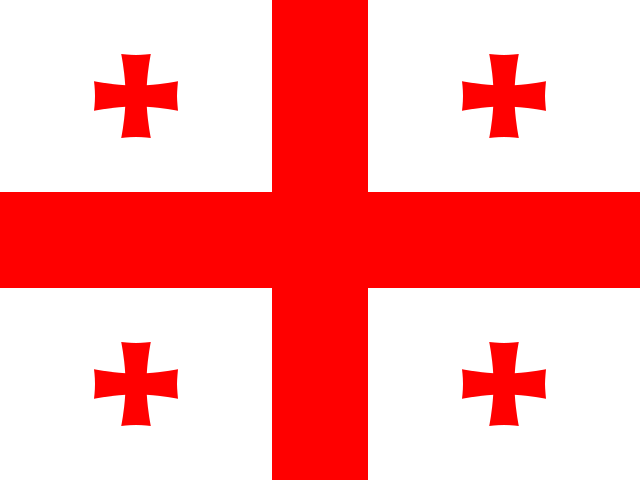
White with a large red cross reaching all four edges and a smaller red bolnur-katskhuri cross in each quarter - the 'Five Cross Flag'. Georgia adopted it on 14 January 2004, replacing the dark red flag of the 1918 republic that had flown since 1990. The organic law describes the design and assigns the crosses and the colours no meaning at all; the Christian readings attached to them are traditional rather than official.
Source: matsne.gov.ge
Georgia FACTS ◢
| Capital | Tbilisi |
|---|---|
| Continent | Europe |
| Population | 3,935,766 (2025) |
| Area | 69,700 km² |
| Population density | 56/km² |
| Currency | Georgian lari (GEL) |
| Official language | Georgian |
| Calling code | +995 |
| Internet TLD | .ge |
| Time zone | UTC+04:00 |
| Drives on the | Right |
| ISO codes | GE / GEO |
DID YOU KNOW? ◢
- Archaeologists have found the world's oldest evidence of winemaking here, dating back around 8,000 years.
- Georgians make wine in large clay vessels called qvevri, a method recognised by UNESCO.
- The Georgian language has its own unique alphabet, one of only a handful of alphabets in use worldwide.
- The Caucasus Mountains along its border include some of the highest peaks in Europe.
Georgia QUICK ANSWERS ◢
What is the capital of Georgia?
The capital of Georgia is Tbilisi.
What is the population of Georgia?
Georgia had a population of 3,935,766 in 2025.
What currency does Georgia use?
Georgia uses the Georgian lari (GEL).
What languages are spoken in Georgia?
The official language of Georgia is Georgian.
Think you know your flags? Play Flag Daily → · Browse all countries →
MORE ON THE FLAG ◢
Georgia's flag is a large red cross reaching all four edges of a white field, with a smaller red cross in each quarter. Ask what the five crosses stand for and the answers arrive fast: Christian faith, the five wounds of Christ, the banner of a medieval king.
Ask Georgian law and you get nothing. Two organic laws have defined the Georgian flag since 2004. Each describes the geometry in a single sentence, and neither assigns the crosses, the red or the white any meaning at all.
There is a second thing worth knowing before any of the traditional readings. The law that most accounts quote stopped being law on 16 December 2018.
Key Takeaways
- The Organic Law of Georgia on the National Flag, adopted on 14 January 2004, describes the design and gives its crosses and colours no symbolic meaning.
- That law expired on 16 December 2018 and was replaced by the Organic Law on State Symbols of Georgia, which repeats the description and the silence.
- The four small crosses are bolnur-katskhuri crosses, a Georgian form with flared, cut-in arms, and both statutes use that term.
- Drawings annexed to the two texts fix the flag at 2 by 3 and its red at #FF0000, and the 2018 sheet corrects a radius the 2004 sheet specified wrong.
- The manuscript usually cited for a medieval five-cross flag gives that flag to Sauasco, footnoted by its English editor as Sebastia or Siwas, and gives Georgia no flag at all.
Most adult Georgians have flown two national flags.
| Feature | Flag flown 1990 to 2004 | Flag flown since 2004 |
|---|---|---|
| Field | Dark red | White |
| Charges | A canton divided black over white | One large red cross plus four small bolnur-katskhuri crosses |
| Ratio | 3:5 | 2:3 |
| Legal basis | Organic laws of 14 November 1990 and 28 December 1990 | Organic law of 14 January 2004, then of 14 November 2018 |
| Origin | Designed by the sculptor Iakob Nikoladze for the republic of 1918 | Attested on a chart of 1367 as the flag of Tbilisi |
What do the five crosses on the Georgian flag mean?
Officially, nothing, and that is unusual enough to be worth stating plainly.
Article 2 of the 2004 organic law defines the flag as "a rectangular white fabric with a large, red, right-angled cross in the centre touching all four sides of the flag; the squares created by the vertical and horizontal arms of the cross feature four bolnur-katskhuri crosses of the same colour". That is the whole description. The rest of the law says where the flag must fly and how it must be treated, and its first article is blunt about substitutes: "The use of any other flag as the national flag of Georgia shall be prohibited." It never says what the design is for.
The constitution is no more forthcoming. In the text in force when the flag was adopted, the whole of Article 11 read: "The state symbols of Georgia shall be determined by the Organic Law." The current wording, in Article 2, adds one condition worth knowing: the flag, the coat of arms and the anthem "are established by the organic law, which shall be revised in accordance with the procedure established for revising the Constitution". Georgia protected its flag at constitutional level without ever saying what it stands for.
So the five wounds and the Christian heritage are traditional readings. No instrument opened for this article, and no Georgian state body it names, supplies an official one, and no source opened for this article traces the five-wounds reading to a named proponent at all.
Why is the flag law most accounts quote no longer in force?
Because Parliament folded the flag, the coat of arms and the anthem into one statute, and the swap took effect in the middle of a presidential inauguration.
The Organic Law on State Symbols of Georgia was adopted on 14 November 2018 and signed by President Giorgi Margvelashvili at Kutaisi. Its Article 5 sets an unusual trigger for its own commencement: "This Law shall enter into force upon the taking of an oath by the President of Georgia elected in the next presidential elections." A companion organic law of the same day, No 3725-Iს, declared the 2004 flag law invalid, and the Legislative Herald of Georgia records the 2004 law's expiry as 16 December 2018.
That is the day Salome Zurabishvili was sworn in. Civil Georgia reported on the day that she "was sworn in as Georgia's fifth president for a six-year term on December 16 in an oath-taking ceremony in the eastern Georgian town of Telavi", and that the same ceremony "marked entry into force of the new constitution". The same oath commenced a constitution, and the Herald records the flag law expiring that day.
Article 2 of the new law is the old description word for word, down to "four Bolnur-Katskhuri crosses of the same colour"; in the Georgian the only differences are a semicolon becoming a full stop and one comma dropped. Nothing about meaning was added in fourteen years.
One thing did not survive the change. The 2004 law carried a short Article 6: "The date of the adoption of this Law shall hereby be declared as the day of the national flag of Georgia." The 2018 replacement has five articles, covering the flag, the arms, the anthem and its own commencement, and no Flag Day provision among them. The observance itself was alive and well the year before the swap: David Chkheidze, who writes for the Council of Heraldry at the Parliament of Georgia, told the 2017 International Congress of Vexillology that "Georgia celebrates 14 January each year as its Flag Day". No source opened for this article reports on the observance after the repeal.
What are bolnur-katskhuri crosses, and how is the flag drawn?
A bolnur-katskhuri cross is not a plain cross. Its arms widen outward from a narrow centre and finish in a concave curve, the shape a heraldist would file near a cross patty, and the compound name appears to point at two Georgian church sites.
The Bolnisi half is documented. Chkheidze reproduces the carved stone at Bolnisi Sioni Cathedral, dated AD 494 and carrying "the oldest Georgian inscriptions within the territory of Georgia", and attributes the name to "the historical and cultural importance of the bas-relief in Georgia". No source opened for this article documents the Katskhi half, so treat that as the statute's own naming rather than as something established here.
The geometry does not live in either statute's articles, and where it was sent has itself changed twice. As adopted in 2004, Article 2(2) said the flag's standard dimensions and exact image are set by a decree of the President of Georgia, and Decree No. 31 of 25 January 2004, signed by Mikheil Saakashvili, put them in two annexes. Organic Law No 1068 of 6 September 2013 then redirected that power to a resolution of the Parliament of Georgia, required it before January 2014, and kept the presidential decree in force until it arrived; the consolidated text carried that wording through the last consolidation, of 14 November 2018. The 2018 law ended the arrangement by putting the drawings inside the statute, at annexes No 1 and No 2.
Both drawings set the flag at 2 units by 3. Both give the red as #FF0000, and the 2004 decree adds a flat prohibition, "აკრძალულია დროშის ფერების ცვლილება", which renders as a ban on changing the flag's colours. A flag law can be exact about a colour and silent about what it means, and this one is.
The drawings also carry a correction that took fourteen years. Within days of the 2004 decree the vexillologist Graham Bartram reported on Flags of the World: "The specification for the cross patty does not match the drawing." The numbers produced a straighter cross than the sheet beside them depicted. The 2004 sheet traces the arms of the small crosses on an arc of radius 0.56. On the 2018 annex that figure is 0.54, with every other dimension unchanged, which fits the crosses back into the 0.4 square the sheet marks out for them. That single digit is the only substantive difference between the two construction sheets.
Is the Georgian flag really medieval?
Partly, and the part that holds up is narrower than the usual claim.
The firm evidence is a chart of 1367 by the Venetian brothers Domenico and Francesco Pizzigano. Chkheidze reproduces the detail and writes that the flag "is shown as the flag of Tbilisi on a fourteenth-century map by Domenico and Francesco Pizzigano". That is a genuine fourteenth-century image of this design over a Georgian city.
The weaker evidence is the piece repeated most often. Popular accounts cite a fourteenth-century friar's manuscript describing a white cloth with five red crosses and present it as Georgia's flag. The manuscript does not say so. In the Hakluyt Society's 1912 English edition of the Book of the Knowledge of All the Kingdoms, the passage runs: "This city of SAUASCO was the ancient SAMARIA, though now it is SAUASCO head of the kingdom with a white flag having five red crosses." Its editor, Clements Markham, footnotes Sauasco as "Sebastia or Siwas", in what is now Turkey, and indexes it as Sivas. The narrator names Jorgania, which Markham footnotes as Georgia, twice, and attaches no flag to it either time.
Two further details from the same edition are worth having. The manuscript places Sauasco among the provinces of Turquia, which it equates with Asia Minor, and then calls it the ancient Samaria, so the traveller may be running two places together. And the same book gives the province of Jerusalem "a white flag with red crosses", which Markham annotates sharply. The real arms of Jerusalem, he notes, are "argent a cross potent or between four lesser crosses or", and of the manuscript's red version he writes that "These five crosses gules have no other authority". The manuscript's five-red-cross design is not unique to Sauasco, and where it can be checked against known arms it is wrong.
Attribution of the Georgian flag to Queen Tamar, who reigned from 1184 to 1213, is traditional and no source opened here documents it. Georgian heraldic scholarship points a century later. Flags of the World reproduces a statement by the Georgian scholar Giorgi Gabeskiria, which in turn cites D. Kldiashvili's History of the Georgian heraldry of 1997 for the reading that the four small crosses were added under Giorgi V the Brilliant, in imitation of the Jerusalem cross. That is a claim at two removes, and it is worth knowing that the same Flags of the World page carries Mikhail Revnivtsev's objection that in the friar's book "there are only three pictures for Sivas but nothing on banners of any Georgian state or city".
Why did Georgia change its flag in 2004?
Because the design had already won the street, and then it won an election.
The earlier flag was dark red with a black and white canton, created for the republic of 1918 and brought back on 14 November 1990. Parliament voted in 1999 to swap it for the five-cross design. Writing in Slate seven weeks before the change, Brendan Koerner reported what happened next: "In 1999, the Georgian parliament voted to change the flag, and all Shevardnadze had to do was issue a supportive decree. Inexplicably, he refused to do so, instead setting up a powerless heraldic commission to study the matter."
The five-cross flag became the banner of Mikheil Saakashvili's National Movement, and Flags of the World's contributors record that it outnumbered every other flag, the national flag included, in the demonstrations that ended Eduard Shevardnadze's presidency in November 2003. Parliament adopted it on 14 January 2004, and Flags of the World also records it going up over the Parliament building that evening at 21:00 local time.
Saakashvili had been elected but not yet inaugurated, which is why the organic law closes with the signature of Acting President Nino Burjanadze rather than his. He signed the construction decree eleven days later.
Calling the five-cross flag a revival needs care too. Writing in 2003, Flags of the World's contributors recorded that "The flag of the National Movement was unknown ten years ago" and was called the Georgian historical national flag by opposition leaders only after publications by the Georgian vexillologist I.L. Bichikashvili.
Why Georgia's flag is mistaken for England's, and for a US state's
Because the big cross is the same shape and the same colour, and at a distance the small ones disappear.
England flies a plain red cross on white with four empty quarters. Georgia fills all four. Busy quarters mean Georgia, empty quarters mean England, and the United Kingdom flag layers that cross with two more. A round of Flag Daily drills the difference faster than reading about it.
One more source of confusion has nothing to do with the design. Searches for the Georgia flag reach two flags, because the United States has a state of the same name flying an entirely different one. Everything here is about the country in the Caucasus.
Frequently asked questions
Do the colours on the Georgian flag have an official meaning?
No. The 2004 organic law on the national flag and the 2018 organic law on state symbols both describe the flag and assign red and white no meaning, and the constitution delegates the flag to organic law without describing it. Readings such as the five wounds of Christ appear in none of the Georgian instruments or state publications opened for this article.
The 2018 law's annexes do fix the red at #FF0000 and the white at #FFFFFF, which is a specification rather than a symbolism.
Is 14 January Georgia's Flag Day?
It was, by statute, until 16 December 2018. Article 6 of the 2004 organic law declared the date of its own adoption to be the day of the national flag, and the 2018 statute that replaced it carries no equivalent provision. The observance was reported as annual by a Georgian heraldry official in 2017, a year before the repeal, and none of the sources opened for this article covers it since.
When did Georgia adopt the five-cross flag?
Parliament adopted it on 14 January 2004, and the organic law was signed by Acting President Nino Burjanadze. Mikheil Saakashvili signed Decree No. 31, fixing the flag's exact image and standard dimensions, on 25 January. A parliamentary vote in 1999 had already tried and failed.
What flag did Georgia use before 2004?
A dark red flag in the ratio 3:5, with a canton divided into a black stripe over a white one. The Kharitton Akhvlediani Museum of Ajara records that the flag of the Democratic Republic of Georgia was the work of the sculptor Iakob Nikoladze and that a law on it was passed on 10 September 1918. Georgia readopted the design on 14 November 1990.
Slate called Nikoladze a painter in 2003 and the description has travelled, but the museum that holds the flag calls him a sculptor. Flags of the World gives a different legal history again, a design contest won in 1917 and official adoption only on 22 April 1921.
What are the standard dimensions of the Georgian flag?
The construction sheet annexed to the 2018 organic law sets the flag at 2 units high by 3 wide. Both arms of the central cross are 0.4 wide. In each quarter the small cross sits inside a square of 0.4, set 0.45 from the nearest vertical edge and 0.2 from the nearest horizontal one. The 2004 presidential decree carried the same drawing with one figure different: the arcs cutting the arms of the small crosses had a radius of 0.56, and the 2018 sheet gives 0.54.
Sources
- Legislative Herald of Georgia, Organic Law of Georgia on the National Flag (document 3233, adopted 14 January 2004, expiry recorded as 16 December 2018) - the consolidated English and Georgian texts, the original publication of 24 January 2004, and the page's own record of amendments, which names organic law No 3725-Iს of 14 November 2018 as the instrument declaring the law invalid - retrieved 14 August 2026.
- Legislative Herald of Georgia, Organic Law of Georgia on State Symbols of Georgia (document 3724-Iს, adopted 14 November 2018) - English and Georgian texts retrieved 14 August 2026.
- Legislative Herald of Georgia, Decree of the President of Georgia No. 31 of 25 January 2004 on the standard dimensions and exact image of the state flag (document 34906) - Georgian text and annexed construction sheets retrieved 14 August 2026.
- State Council of Heraldry of Georgia, Organic Law on State Symbols with annexes 1 to 5 - the construction sheet and colour values are read from this copy, retrieved 14 August 2026.
- Constitute Project, Constitution of Georgia, 1995 text as revised to 2004, Article 11 - retrieved 14 August 2026.
- Constitute Project, Constitution of Georgia, 2018 text, Article 2 - retrieved 14 August 2026.
- David Chkheidze, The flags of contemporary Georgia, 27th International Congress of Vexillology, London 2017, published by the Flag Institute - retrieved 14 August 2026.
- Clements R. Markham, translator, Book of the Knowledge of All the Kingdoms, Lands, and Lordships That Are in the World, Hakluyt Society, 1912, pages 20 to 22 and the index - retrieved 14 August 2026.
- Flags of the World, Georgia, recording Decree No. 31 in translation, Graham Bartram's note on the construction sheet, Giorgi Gabeskiria's statement citing Kldiashvili, and Mikhail Revnivtsev's objection to it - retrieved 14 August 2026.
- Flags of the World, Georgia: National flag, 1990-2004 - retrieved 14 August 2026.
- Flags of the World, Georgia: First Republic, 1918-1921 - retrieved 14 August 2026.
- Kharitton Akhvlediani Museum of Ajara, National flag of democratic Georgia - retrieved 14 August 2026.
- Civil Georgia, Zurabishvili Sworn-in as New President, 16 December 2018 - retrieved 14 August 2026.
- Brendan Koerner, Georgia's Flag of Protest, Slate, 25 November 2003 - retrieved 14 August 2026.
PLAY ANOTHER →
A short message, hidden in a different cipher every day.
ONE CIPHER A DAYDAILYDaily TriviaFive questions a day. Everyone gets the same five.
FIVE QUESTIONSDAILYOn This DayOne thing that happened today in history. Every day, a new one.
TODAY IN HISTORYDAILYDaily CryptogramOne quote, one scrambled alphabet. Crack it before tomorrow.
CRACK THE QUOTE