
Jamaica
A Caribbean island with outsized influence on world culture, Jamaica gave birth to reggae and keeps producing the fastest sprinters on Earth.
WHAT THE FLAG MEANS ◢
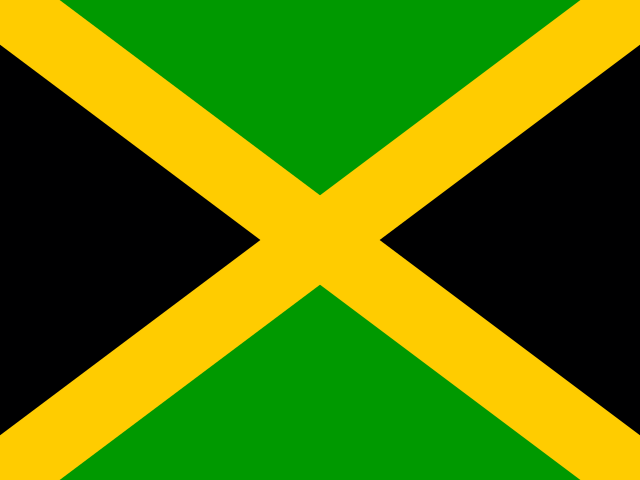
A gold saltire divides the flag into green triangles top and bottom and black triangles at the hoist and fly. The constitution has no flag provision, and the official interpretation is a sentence rather than a statute. The gold is read for the sunlight and the wealth of the country, the green for hope and agricultural resources, and the black for the strength and creativity of the people. That last reading dates from February 1996, when a committee on national symbols replaced an original one in which the black stood for hardships overcome and to be faced.
Jamaica FACTS ◢
| Capital | Kingston |
|---|---|
| Continent | North America |
| Population | 2,837,077 (2025) |
| Area | 10,992 km² |
| Population density | 258/km² |
| Currency | Jamaican dollar (JMD) |
| Official language | English |
| Calling code | +1876 |
| Internet TLD | .jm |
| Time zone | UTC-05:00 |
| Drives on the | Left |
| ISO codes | JM / JAM |
DID YOU KNOW? ◢
- Reggae music was born in Jamaica and is recognised by UNESCO as cultural heritage.
- Jamaican sprinters, led by Usain Bolt, have dominated Olympic sprinting for years.
- Blue Mountain coffee, grown on the island's peaks, is among the most prized in the world.
- It was the first Caribbean country to send a bobsled team to the Winter Olympics.
- English is the official language, though most Jamaicans also speak Patois.
Jamaica QUICK ANSWERS ◢
What is the capital of Jamaica?
The capital of Jamaica is Kingston.
What is the population of Jamaica?
Jamaica had a population of 2,837,077 in 2025.
What currency does Jamaica use?
Jamaica uses the Jamaican dollar (JMD).
What languages are spoken in Jamaica?
The official language of Jamaica is English.
Think you know your flags? Play Flag Daily → · Browse all countries →
MORE ON THE FLAG ◢
Jamaica's flag has an official interpretation and it is one sentence long: "The sun shineth, the land is green and the people are strong and creative". Black is the people, gold is the sunlight, green is the land.
It has not always said that. Until 1996 the black on the flag stood for something quite different, and the change was deliberate, dated, and made by a named committee that wrote down its reasons.
Three Jamaican government sources publish the flag's meaning today. Only one of them, the National Library, records that the reading was changed.
Key Takeaways
- The black originally stood for "hardships overcome and to be faced", a reading that looked forward as well as back.
- A committee on National Symbols and Observances chaired by Professor Rex Nettleford replaced it in February 1996 with the strength and creativity of the people.
- The committee's stated reason was that Jamaicans link themselves to the colour black and were affronted by its association with hardships.
- The Jamaican constitution does not mention the flag at all. Searched end to end, the 1962 Order in Council contains the word flag zero times, and no Jamaican statute prescribing the flag was found either.
- The flag's green has an exact specification, Emerald T8 17 in the British Admiralty bunting pattern, which is more precision than its meaning has ever had.
Jamaica's official interpretation is one sentence, and it has been rewritten once
Every Jamaican government source that publishes it gives the same words. The Office of the Prime Minister and the Jamaica Information Service both print "The sun shineth, the land is green and the people are strong and creative"; the National Library sets the same sequence with semicolons, "The sun shineth; the land is green; and the people are strong and creative". In an article that will shortly make something of one adjective moving, that is worth noticing rather than smoothing over.
Read it against the flag and the mapping is obvious. The gold saltire is the sun. The green triangles top and bottom are the land. The black triangles at the hoist and the fly are the people.
The Jamaica Information Service spells the mapping out: "Black depicts the strength and creativity of the people; Gold, the natural beauty of the sunlight and the wealth of the country; and Green signifies hope and agricultural resources."
That is the current text. The interesting question is what it replaced.
What the black on Jamaica's flag used to mean
The original reading gave the black to hardship, and it is worth getting the wording exactly right, because the short version that circulates loses half of it.
The National Library of Jamaica gives it as "hardships overcome and to be faced".
Not hardships endured, and not hardships borne. Overcome, and still to come. The original interpretation looked forward as well as back, which is a considerably bleaker thing for a brand-new country to write into its flag than a simple nod to a difficult past.
That is the reading the flag had from Independence in August 1962 until February 1996. A mnemonic sentence went with it, as one goes with the current reading, but no Jamaican government source opened for this page prints the pre-1996 version, so it is not repeated here.
The committee that changed it, and the reason it gave
The change was not a drift in usage. It was a decision, by a body appointed to make it.
The National Library of Jamaica records that the hardships association "was eschewed in February 1996 by a committee appointed to review and report on Jamaica's National Symbols and Observances", and it names the chair: "the late Professor the Hon. Rex Nettleford, OM, OCC".
The committee's reasoning is quoted from its own report, at page 13: "the Committee came to realize that many Jamaicans make a link between themselves and the colour black and are affronted by the negative association with hardships."
That sentence is doing something unusual. It is a state committee reporting that a national symbol's official meaning was giving offence to the people it described, and adjusting the meaning rather than defending it. The library's own summary of the outcome is that the committee "opted to adjust the official interpretation for what was seen as a more positive and optimistic view of the colour black in the National Flag".
So the black on Jamaica's flag means the strength and creativity of the people because a committee decided in 1996 that it should, having decided that what it meant before was giving offence.
| Element | Reading before February 1996 | Reading since |
|---|---|---|
| Black | hardships overcome and to be faced | the strength and creativity of the people |
| Gold | sunlight and the wealth of the country | unchanged |
| Green | hope and agricultural resources | unchanged |
| The mnemonic | not obtained for this page | "The sun shineth, the land is green and the people are strong and creative" |
Three official Jamaican sources, and one adjective that moves
Here is the part that will catch anyone trying to quote the official meaning exactly. The Office of the Prime Minister, the Jamaica Information Service and the National Library all publish it, and they do not agree on the gold clause.
The Office of the Prime Minister: "Gold, the natural wealth and beauty of sunlight".
The Jamaica Information Service: "Gold, the natural beauty of the sunlight and the wealth of the country".
The National Library of Jamaica: "Gold is associated with the natural beauty of the sunlight and wealth of the country".
Read those slowly. It is a two-way split rather than three separate wordings: the Jamaica Information Service and the National Library say the same thing in slightly different words, and the Office of the Prime Minister does not. In the OPM's version the word natural attaches to the wealth. In the other two it attaches to the beauty of the sunlight. One adjective, two nouns, and no way to tell which reading is the official one.
Nothing turns on it for a reader, and it is exactly the sort of thing that turns into an argument when somebody needs the official wording for a schoolbook or a monument. There is no canonical text found to appeal to, because no statute setting the sentence out was found.
Green is agricultural resources, not vegetation
One clause says the same thing in all three sources and is frequently misquoted anyway.
Green is "hope and agricultural resources" in the OPM's wording and the JIS's, and "hope and Jamaica's abundant agricultural resources" in the library's. The reading that circulates instead is green for vegetation, or for the island's greenery.
Those are not the same claim. Vegetation is what grows. Agricultural resources is what the country farms and earns from. The official reading is economic as much as it is scenic, and it sits beside a gold clause that also names the wealth of the country. Read together the two are about what the island produces, which is a different flag from the one where green is simply the colour of trees.
Jamaica's constitution does not mention the flag, and no statute was found that does
The flag rests on very little law for something this well specified.
The Jamaica (Constitution) Order in Council 1962, the statutory instrument that made Jamaica independent, runs to 164 pages. Searched end to end, it contains the word flag exactly zero times. So do emblem, anthem and coat of arms. The same extraction yields the unbroken string Governor-General two hundred and thirty-five times, and more again where the printer hyphenated it across a line, so the search is not reading an empty file.
The silence is selective rather than general. The same instrument finds room for the Broad Seal of Jamaica, requiring the Governor-General to keep and use it and invoking it in some thirty operative places. It had space for a seal and none for a flag.
No Jamaican statute prescribing the flag was found either. What exists instead is a code and an office. The National Library refers to "The National Flag Code", which "lays out guidelines for the correct display and handling of the Flag", and the Jamaica Information Service names the authority for using the flag's image: "Official sanction should be obtained from the Office of the Prime Minister prior to using the image or representation of the National Flag."
The one statute that comes near the flag comes near it sideways, and less near than it first looks. Jamaica's Trade Marks Act has a section headed "National emblems of Convention countries" and another headed "Other state emblems", and it requires the Registrar to keep a public list, open to inspection free of charge, of "state emblems and official signs or hallmarks" protected under the Paris Convention.
The operative text held here is narrower than those headings suggest. What it spells out is a bar on registering marks containing "the armorial bearings, flags or other emblems" of international inter-governmental organizations without their authorisation. That is a law about what may be registered as a trade mark. It is not a law about what Jamaica's flag is.
This is a declared search rather than a proved absence: Jamaica's statute book is not fully searchable from outside, and the finding here is that nothing prescribing the flag was found, not that nothing exists.
The colour has a specification the meaning never had
For a flag whose meaning was rewritten by committee, the physical article is pinned down with real precision.
The National Library, quoting Merrick Needham's 2011 study of the flag, gives the design in the terms a flagmaker needs: "The Flag has a diagonal cross or saltire with four triangles in juxtaposition. The cross is in GOLD and the width of each of its bends (arms) is one-sixth of the length of the fly of the flag; the top and bottom triangles are in GREEN; and the hoist and fly triangles are BLACK."
The Jamaica Information Service carries the same specification, opening "The emblem has a diagonal cross or saltire with four triangles in juxtaposition" and adding two things the library leaves out: that the flag "follows the 'Admiralty Pattern'" and that its width-to-length ratio is 1:2.
And then the shade, which is the library's alone: "The exact shade of green used in the Flag is Emerald T8 17, British Admiralty Bunting Pattern".
That is a named colour in a named naval bunting standard. It is the kind of specification Russia's flag conspicuously lacks, where the state says outright that the shades of its blue and red are not regulated at all.
The Jamaica Information Service treats the shades as a live issue rather than a technicality, warning that flags "with the incorrect shade of gold or green are imported into the island and are used during functions", and quoting the Jamaica Intellectual Property Office's acting executive director and legal counsel, Lilyclaire Bellamy, on a flag in the wrong colours: "It's a flag, but it's not really the Jamaican flag."
Which is a useful thing to know before drawing one from memory, and the reason a wrong-shade Jamaica trips people up in Flag Daily, where you get one flag a day and three guesses at the country.
The design that was nearly Tanganyika's
The flag exists in its current form because of a resemblance nobody wanted.
The National Library's account of the design is a story of a competition that failed. At the end of September 1961 the decision was made to hold competitions for a national anthem and a national flag, with an award of £100 for the accepted flag design. "Over 368 entries were received", the library says, without separating the flag's from the anthem's. Several of the original submissions are still in its Special Collections. A shortlist of twelve went to a Joint Committee of Parliament, and not one of them was found suitable.
The flag was then designed by a bipartisan committee of the House of Representatives, and their first approved design used horizontal stripes. That design was dropped when it turned out to resemble the flag of newly independent Tanganyika, now part of Tanzania. The library says only that "The design was modified to the now familiar black, green, and gold", crediting the change to the colours rather than to the geometry. What emerged was the saltire.
So the saltire, the most distinctive thing about this flag, exists because of a clash with a country on the far side of the Atlantic and most of Africa.
Two Jamaican government sources date the flag's first appearance in their own words, and they do not agree. The Jamaica Information Service has it "unfurled and hoisted for the first time at the dramatic hour of midnight on August 5, 1962 as the British flag was being lowered". The Office of the Prime Minister says "The Jamaica National Flag was first raised on Independence Day, August 6, 1962". The National Library carries "The National Flag came into use on 6 August 1962, Jamaica's Independence Day", though that sentence is inside the passage it quotes from Needham rather than a date the library gives in its own voice.
The Information Service settles it against itself two paragraphs later, having the committee design the flag "in time for Independence Day Celebrations on August 6, 1962". So the midnight in question is the one that ends the fifth and begins the sixth, and every one of them is pointing at Independence Day.
Frequently asked questions
What do the colours of the Jamaican flag mean?
The official interpretation is the sentence "The sun shineth, the land is green and the people are strong and creative". The Jamaica Information Service spells it out as black for the strength and creativity of the people, gold for the sunlight and the wealth of the country, and green for hope and agricultural resources. Green is agricultural resources rather than vegetation in every official wording.
Did the meaning of the black on the Jamaican flag change?
Yes, in February 1996. The black originally stood for "hardships overcome and to be faced". A committee appointed to review Jamaica's National Symbols and Observances, chaired by Professor Rex Nettleford, replaced that reading with the strength and creativity of the people, recording that many Jamaicans link themselves to the colour black and were affronted by the negative association with hardships.
Is Jamaica's flag described in the constitution?
No. The Jamaica (Constitution) Order in Council 1962 runs to 164 pages and does not use the word flag anywhere in it, nor emblem, anthem or coat of arms. No Jamaican statute prescribing the flag was found for this page either. The guidance that exists is the National Flag Code, and permission to use the flag's image is given by the Office of the Prime Minister.
What is the exact shade of green on the Jamaican flag?
The National Library of Jamaica gives it as Emerald T8 17 in the British Admiralty bunting pattern, citing Merrick Needham's 2011 study for the Jamaica Military Museum and Library. The Jamaica Information Service treats wrong shades as a real problem, noting that flags in incorrect gold or green are imported and used at functions, and quoting the Jamaica Intellectual Property Office to the effect that a flag in the wrong colours is not really the Jamaican flag.
Who designed the Jamaican flag?
A bipartisan committee of the Jamaica House of Representatives, in early 1962, after a public competition drew more than 368 entries and none of the twelve shortlisted designs was found suitable. The committee's first approved design used horizontal stripes and was changed because it resembled the flag of newly independent Tanganyika.
Sources
- National Library of Jamaica, The Story of the Jamaican National Flag, which is the only Jamaican government source found that records the February 1996 change and quotes the committee's report. Retrieved 25 August 2026.
- Jamaica Information Service, Jamaica National Flag, the government's canonical page on the flag, its design and the code for its use. Retrieved 25 August 2026.
- Office of the Prime Minister, National Flag. Retrieved 25 August 2026.
- Jamaica Information Service, Respect the National Flag and Anthem, for the Jamaica Intellectual Property Office on incorrect shades. Retrieved 25 August 2026.
- Government of Jamaica, Ministry of Justice, The Jamaica (Constitution) Order in Council 1962, Statutory Instruments 1962 No. 1550, read in full and searched for any flag provision. Retrieved 25 August 2026.
- Government of Jamaica, Ministry of Justice, The Trade Marks Act, sections 50 to 52, for the Paris Convention Article 6ter machinery on state emblems. Retrieved 25 August 2026.
PLAY ANOTHER →
One thing that happened today in history. Every day, a new one.
TODAY IN HISTORYDAILYDaily TriviaFive questions a day. Everyone gets the same five.
FIVE QUESTIONSDAILYGuess the CountryThree clues, three guesses. Work out where in the world it is.
THREE CLUESDAILYDaily CodeA short message, hidden in a different cipher every day.
ONE CIPHER A DAY