
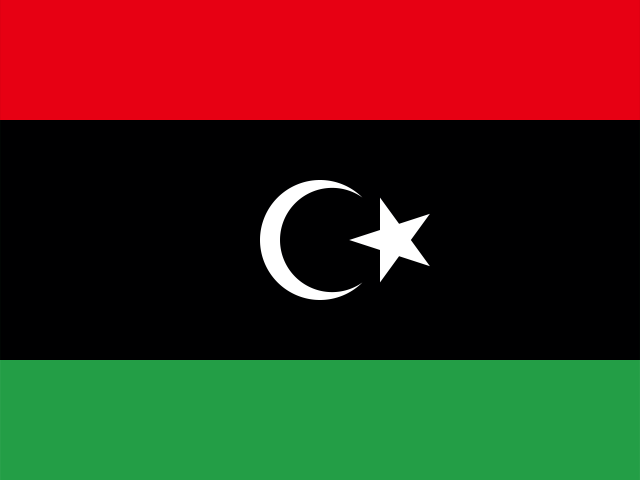
Libya
A vast North African country where the Sahara swallows more than nine-tenths of the land and the Mediterranean guards spectacular Roman ruins. Libya packs some of Earth's most extreme desert heat.
WHAT THE FLAG MEANS ◢
Three horizontal bands of red, black and green, the black one equal in area to the other two together and bearing a white crescent with a five-pointed white star between its two ends. Article 3 of the Constitutional Declaration prescribes exactly that, at a length twice the width, and assigns none of it a meaning; neither did article 7 of the 1951 constitution, which it re-enacts almost word for word. The 1951 independence flag was restored in 2011. By tradition the red is read for the blood shed for independence, the black for the Senussi banner of the resistance, the crescent and star for Islam, and the green for prosperity.
Source: security-legislation.ly · mohammedelsenussi.org · unis.unvienna.org · febp.ly · checked 2026-08-27
Libya FACTS ◢
| Capital | Tripoli |
|---|---|
| Continent | Africa |
| Population | 7,458,555 (2025) |
| Area | 1,759,541 km² |
| Population density | 4/km² |
| Currency | Libyan dinar (LYD) |
| Official language | Arabic |
| Calling code | +218 |
| Internet TLD | .ly |
| Time zone | UTC+02:00 |
| Drives on the | Right |
| ISO codes | LY / LBY |
DID YOU KNOW? ◢
- Over 90% of the country is desert, part of the great Sahara.
- Leptis Magna is one of the best-preserved Roman cities anywhere in the world.
- It once claimed the record for the highest air temperature ever measured, though that century-old reading was later disqualified as unreliable.
- The Man-Made River, a colossal network of pipes, carries ancient groundwater across the desert to its cities.
Libya QUICK ANSWERS ◢
What is the capital of Libya?
The capital of Libya is Tripoli.
What is the population of Libya?
Libya had a population of 7,458,555 in 2025.
What currency does Libya use?
Libya uses the Libyan dinar (LYD).
What languages are spoken in Libya?
The official language of Libya is Arabic.
Think you know your flags? Play Flag Daily → · Browse all countries →
MORE ON THE FLAG ◢
A conventional reading and a legal text are two different things, and Libya's flag is a good place to watch them come apart.
Libya's flag is fixed in the country's supreme law. Article 3 of the Constitutional Declaration issued by the National Transitional Council on 3 August 2011 sets out the proportion, the order of the colours, the relative area of the stripes, the charge in the middle and the exact position of the star. It is one long, careful sentence, and no part of it interprets anything.
That is not an oversight of the 2011 drafters. They were copying. The sentence they wrote is article 7 of Libya's 1951 constitution, reproduced almost word for word, and that article assigned the colours nothing either. Sixty years apart, two Libyan constitutional texts describe this flag in detail and decline to explain it.
Key Takeaways
- Article 3 of the 2011 Constitutional Declaration prescribes the flag's shape and dimensions and assigns no colour, and neither the crescent nor the star, any meaning.
- The article is a near-verbatim re-enactment of article 7 of the 1951 constitution, which was repealed in 1969 and came back in 2011.
- The gazetted 2011 text drops one word the 1951 text has, so it sets the black stripe's area against the area of the two other colours rather than against their sum.
- The 1969 Constitutional Declaration and the 1977 declaration of the authority of the people mention the flag nowhere at all.
- The office of the head of the former royal house publishes an account of the design, and it offers several readings of the colours rather than one.
| Instrument | Date | What it says about the flag |
|---|---|---|
| Constitution of the United Kingdom of Libya, art. 7 | 7 October 1951 | Full description of shape and dimensions, no meaning assigned |
| Constitutional Declaration of the Revolutionary Command Council | 11 December 1969 | No mention of the flag in any of its thirty-seven articles |
| Declaration of the establishment of the authority of the people | 2 March 1977 | No mention of the flag |
| Constitutional Declaration, art. 3 | 3 August 2011 | Full description of shape and dimensions, no meaning assigned |
| Draft constitution adopted by the Constitution Drafting Assembly, art. 5 | 29 July 2017 | Leaves the flag to a law passed by a two-thirds majority, and does not describe it |
What article 3 of Libya's constitutional text prescribes
The Libyan Official Gazette restarted its numbering after the war. Issue number one of year one, dated 9 February 2012 and published by order of the Minister of Justice, carries the Constitutional Declaration at page one. The gazette's own cover is framed in a triple rule of red, black and green.
Article 3 opens by saying the national flag shall be in accordance with the following shape and dimensions, and then does five things in one sentence.
It fixes the proportion, with the length double the width. It divides the field into three parallel colours, ألوان متوازية in the article's own words, in the order red at the top, then black, then green. It sets the area of the black against the area of the other two. It puts a white crescent at the centre of the black. And it places a five-rayed white star بين طرفيه, between the crescent's two ends.
The word used for the star is كوكب rather than the ordinary word for a star, and it is qualified as خماسي الأشعة, five-rayed. Both Libyan texts use exactly that wording, which is why the flag's point count is settled by the constitutional text rather than left to whoever draws it.
Notice what the area clause does not settle. Taken with the 1951 wording that the next section returns to, it ties the black band to the red and the green together, which makes the black half the hoist. What no version of the clause says is that the red and the green are equal to each other. The flag as flown divides the remaining half evenly, and the article does not require it.
Nowhere does the article say what any of it stands for. There is no clause of purpose, no reference to the regions, no reference to religion, no reference to sacrifice. The sentence ends at the star.
The 2011 article is the 1951 article, minus one word
Set the two Arabic texts side by side and the family resemblance is total.
Article 7 of the 1951 constitution, issued by the Libyan National Assembly on 7 October 1951, says that the national flag shall be of the following shape and dimensions, its length double its width, divided into three parallel colours, the uppermost red, then black, then green, the area of the black colour equal to مجموع, the sum, of the area of the two other colours, with a white crescent at its centre and, between the crescent's two ends, a five-rayed white star.
Article 3 of 2011 is that sentence again. The preposition after the verb for dividing changes, the crescent gains a redundant qualifier after the word for white, and the punctuation is modernised. Every measurement and every element survives.
One thing does not. The gazetted 2011 text omits مجموع. Read strictly, it sets the area of the black equal to the area of the two other colours rather than to their sum, which is either an ellipsis or a slip of the pen in the fair copy. Nobody has ever drawn the flag differently because of it, and the black band has been half the hoist throughout.
It is worth knowing because the transcription of article 3 published in the DCAF Libyan legal database silently restores the missing word. The most convenient online text of the article is not quite the text that was gazetted, and the same transcription changes the verb in article 2 back to the 1951 one as well.
The star sits between the crescent's two ends, not above it
The clause بين طرفيه is doing more work than it looks.
It does not say the star sits above the crescent, or inside its curve, or at its centre of curvature. It says between its two ends, which places the star in the mouth of the crescent, on the line joining the horns. Both the 1951 and 2011 articles say this, in the same words.
The distinction is not academic, because Libya has a second national symbol that did it the other way. The Crown of Libya, the emblem of the kingdom, also carried a large white crescent and a five-pointed star. The office of the head of the former royal house, reconstructing the crown from banknotes and postage stamps because the law prescribing it could not be obtained, notes that its star is "located well above the perimeter of the crescent" and adds that this "places the star at the extremities of the crescent" on the flag instead.
So the state's two emblems used the same two shapes and arranged them differently, and only one of the two arrangements is written into constitutional text. If you are redrawing this flag from memory, that clause is the one that decides whether you get it right, which is the sort of detail that separates a lucky guess from a real one in Flag Daily, where a flag appears and you get three attempts at the country.
Between 1969 and 2011 no Libyan constitutional text mentioned the flag
The 1951 constitution was repealed by the Constitutional Declaration the Revolutionary Command Council issued on 11 December 1969. That document runs to thirty-seven articles. It does not mention the flag, the emblem or the anthem once.
Neither does the declaration of the establishment of the authority of the people of 2 March 1977, the instrument that reorganised the state around the people's congresses. It names no flag, no emblem and no anthem either. Both counts were run over the Arabic as well as the English, and the only near-misses in the Arabic are two occurrences of the word for teacher, which happens to contain the letters of the word for flag.
The flag itself changed more than once across those decades. The Libyan newspaper Febrayer, setting out the sequence, records that the 1969 republic used a horizontal tricolour of red, white and black, and that in 1977 the state adopted a plain green field, which it flew until the uprising.
That absence matters for the question of what the colours mean. If a Libyan instrument had ever glossed the flag's colours, the four decades in which the flag was changed and changed again would have been the moment for it. Instead the constitutional record says nothing about the flag for the whole of that period, and resumes in 2011 with the 1951 sentence restored.
Who drew the design, and what the UN commissioner recorded
The account of how the design was chosen goes back to Adrian Pelt, the United Nations commissioner for Libya from 1949 to 1951. His own book on the transition is held by the Internet Archive as a lending copy and could not be opened for this article, so the passage below is quoted as the office of Prince Mohammed El Senussi publishes it.
In that account, "during deliberations of the Libyan National Constitutional Convention, a paper drawing of a proposed national flag was presented to the convention by Omar Faeq Shinneeb", a member of the delegation from Cyrenaica, who "informed the delegates that this design had met the approval of His Highness Emir of Cyrenaica, Idris El Senussi". The assembly then approved it.
The Arabic edition of the same page adds a caveat the English edition omits, which is that Pelt did not say whether any other designs were under consideration. So what is documented is one drawing on a sheet of paper, presented with the Emir's backing and accepted. There is no competition here, no shortlist, and no recorded debate about symbolism.
The Libyan newspaper Febrayer describes Omar Faiek Shennib as chief of the royal court, deputy president of the National Assembly and minister of defence under King Idris, and describes the design as the black flag of the Emirate of Cyrenaica with a red band added above it and a green band below, which is how the flag came to be red, black and green with a white crescent and star. What no source puts in his mouth is an explanation of the colours.
The three-regions reading has a Fezzan problem
One reading says the flag stands for the union of Libya's three historic regions, Tripolitania, Cyrenaica and Fezzan, and it is usually told with one colour handed to each. It is short, it is easy to remember, and both of the accounts opened for this article repeat it.
The royal house's account carries the first half of that and not the second. Both its editions do give a unity reading, and both keep it at arm's length: the English says it is believed that the colours also celebrate the unification of the three territories, and the Arabic gives the same thought as something others hold. Neither then hands a colour to a region. Both editions then derive the colours one at a time, the Arabic in these terms. It gives red as the dominant colour of the Ottoman flag and of the Tripoli fleet's ensign in the Karamanli period. It gives the black band with its white crescent and star as the flag of the Emirate of Cyrenaica, which declared independence in 1949, two years before the united kingdom did. It gives green as the colour of the palm tree on the flag of the Tripolitanian Republic, a state the English edition of the same page dates from 1918 to its annexation by Italy in 1923.
Then the Arabic edition says, in a sentence that does not appear in the English one, that the region of Fezzan had no distinctive flag of its own before Italian colonisation other than the flag of the Ottoman state.
Count that up. Two of the three colours are traced to Tripolitanian or Ottoman precedents, one to Cyrenaica, and Fezzan to nothing at all. The one-colour-per-region version is a tidy summary of an account that is not tidy, and even the unity reading it compresses is offered there as one view among several rather than as the meaning of the flag.
Libya's colour readings contradict each other
The colour glosses in circulation do not agree with each other, which is what you would expect when no instrument decides between them.
The royal house's own text puts the martyrs first. It gives red for the blood of the righteous martyrs and the sacrifices made for independence, the black centre for the Senussi banner of the resistance raised by fighters including Omar al-Mukhtar and later carried by the Senussi liberation army alongside the Allies, and green for goodness, prosperity and growth for the Libyan nation and its coming generations. Its English edition renders that last one as "hope, peace and prosperity", which is not the same list.
Febrayer, publishing under a headline that translates as Libya's flag, its colours and their meanings, offers a different set again. It gives red for the blood shed and the sacrifices made for freedom and independence, green as Libya's national colour, reflecting its Islamic character and an aspiration to make the country green again as the desert advances, and black either for the black-skinned people of Africa or for the dark days of the Italian occupation.
None of these is the state's. They are a dynastic office and a newspaper, and neither claims otherwise. The crescent and star are commonly read as an emblem of Islam, and Febrayer sets that reading out in full: the crescent recalling the start of the lunar month and the story of the Prophet's migration, the star standing for hope, light and optimism about a better tomorrow. The same pair appears on the flags of Tunisia and Turkey. But an association is not a prescription, and Libyan law has never made one.
The draft constitution would stop describing the flag at all
The Constitution Drafting Assembly adopted a draft permanent constitution on 29 July 2017. It is a draft, and the 2011 Constitutional Declaration is still recorded as the applicable constitutional text.
Article 5 of that draft covers the state's flag, its anthem, its emblems and its official holidays together, and says in full that a law issued by a two-thirds majority of the members shall determine them. That is the whole article. There is no description of the flag in it, and no meaning attached to anything.
So the drafting has moved in the opposite direction from the one people expect. The 2011 declaration inherited a detailed description from 1951 and kept it, while the draft that would replace it hands the flag to ordinary legislation and says nothing about how it looks.
If that text is ever adopted, Libya's flag would for the first time since independence be prescribed by statute rather than by constitution, and the sentence that has survived since 1951 would go with it.
Frequently asked questions
What do the colours on the Libyan flag mean?
No Libyan constitutional text has ever said. Article 3 of the 2011 Constitutional Declaration and article 7 of the 1951 constitution both describe the flag in full and assign the red, black and green no meaning at all. The readings in circulation come from elsewhere: the office of the head of the former royal house gives red for the blood of the martyrs of the independence struggle, black for the Senussi banner of the resistance, and green for goodness and prosperity, and it presents that as one account among several.
Is the Libyan flag's meaning written in law?
It is not. Libyan law prescribes the flag's appearance and nothing else. Article 3 of the Constitutional Declaration fixes the proportion, the order of the three colours, the area of the black band, the white crescent and the position of the star, and then ends. Article 2 of the same declaration leaves the state emblem and the national anthem to be determined by a law, so the flag is the one symbol the constitutional text settles itself.
Why is the black stripe on the Libyan flag wider than the others?
Because the article says so. The 1951 text requires the area of the black colour to equal the sum of the areas of the other two, which on a flag of horizontal bands makes the black band half the hoist. It does not say the red and green are equal to each other, though the flag as flown splits the remaining half evenly. The 2011 gazetted text drops the word for sum and sets the black area against the area of the two other colours, and nobody has ever drawn the flag differently because of it.
Where is the star on the Libyan flag?
Between the two ends of the crescent, in its mouth, rather than above it or inside its curve. Both the 1951 and the 2011 articles use the same phrase for this. The Crown of Libya, the emblem of the kingdom, placed its star well above the crescent instead, so the two national symbols arranged the same pair of shapes differently.
Which flag did Libya use before 2011?
A plain green field, adopted in 1977 and flown until the uprising, and before that a horizontal tricolour of red, white and black adopted in 1969. The National Transitional Council brought back the 1951 design during the war, and the United Nations Information Service in Vienna recorded the change on 5 October 2011, noting that Libya's permanent mission had formally notified the UN of the council's decision to change the national flag.
Sources
- Libya, Official Gazette, issue No. 1, year one, 9 February 2012, the Constitutional Declaration as gazetted, pages 1 to 11, published by order of the Minister of Justice. The scan has no text layer, so articles 2 and 3 were rendered at 450 dpi and transcribed - retrieved 27 August 2026.
- DCAF Libyan Legal Database, Constitutional Declaration of 2011, consolidated, Arabic and English editions - retrieved 27 August 2026.
- DCAF Libyan Legal Database, Constitution of 1951, Arabic and English editions and the original scan - retrieved 27 August 2026.
- DCAF Libyan Legal Database, Constitutional Declaration of 1969, Arabic and English editions - retrieved 27 August 2026.
- DCAF Libyan Legal Database, Resolution of 1977 on the establishment of the authority of the people and its enabling decisions, Arabic and English editions - retrieved 27 August 2026.
- DCAF Libyan Legal Database, 2017 Proposal of a Consolidated Draft Constitution, Arabic and English editions - retrieved 27 August 2026.
- Office of Prince Mohammed El Senussi, Flag and Crown, English and Arabic editions - retrieved 27 August 2026.
- Office of Prince Mohammed El Senussi, the national anthem of Libya - retrieved 27 August 2026.
- United Nations Information Service, Vienna, UNIS/VIC/184, Flag of Libya's National Transitional Council flying at the United Nations in Vienna, 5 October 2011 - retrieved 27 August 2026.
- Febrayer, Libya's flag, its colours and their meanings, 15 February 2021 - retrieved 27 August 2026.
PLAY ANOTHER →
Three clues, three guesses. Work out where in the world it is.
THREE CLUESDAILYOn This DayOne thing that happened today in history. Every day, a new one.
TODAY IN HISTORYDAILYDaily CryptogramOne quote, one scrambled alphabet. Crack it before tomorrow.
CRACK THE QUOTEDAILYDaily CodeA short message, hidden in a different cipher every day.
ONE CIPHER A DAY