
Mauritania
Where the Sahara meets the Atlantic, Mauritania runs one of the world's last great desert railways - an iron-ore train several kilometres long that people ride across the dunes.
WHAT THE FLAG MEANS ◢
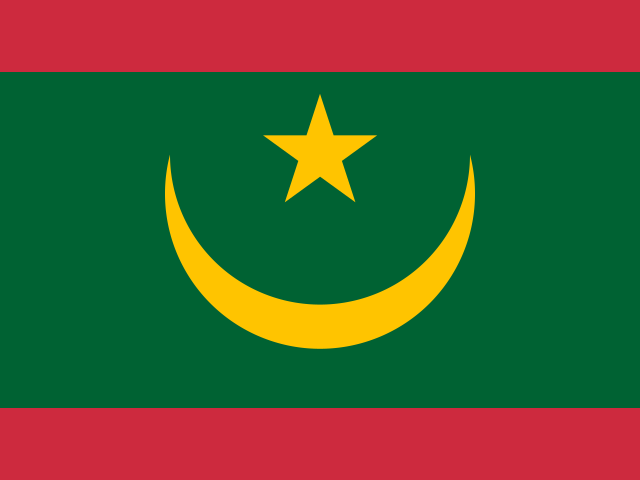
A green field with a gold crescent and star, bordered top and bottom by red stripes added in 2017. The constitutional text, as amended that year, describes a crescent and star of gold colour on a green field with a horizontal rectangular red band on each side, and assigns none of it a meaning. The flag law and decree that followed it are equally silent. The green, the gold and the crescent and star are conventionally read as symbols of Islam, and the red stripes as the blood shed by those who resisted colonial rule.
Source: msgg.gov.mr · mjp.univ-perp.fr · checked 2026-08-27
Mauritania FACTS ◢
| Capital | Nouakchott |
|---|---|
| Continent | Africa |
| Population | 5,315,065 (2025) |
| Area | 1,030,700 km² |
| Population density | 5/km² |
| Currency | Mauritanian ouguiya (MRU) |
| Official language | Arabic |
| Calling code | +222 |
| Internet TLD | .mr |
| Time zone | UTC±00:00 |
| Drives on the | Right |
| ISO codes | MR / MRT |
DID YOU KNOW? ◢
- One of the world's longest and heaviest trains hauls iron ore across the desert here, often stretching over two kilometres.
- The vast majority of the country is covered by the Sahara Desert.
- The Richat Structure, a giant bullseye formation in the desert, is so large it's used as a landmark from space.
- It has a long Atlantic coastline whose rich waters draw fishing fleets from around the world.
Mauritania QUICK ANSWERS ◢
What is the capital of Mauritania?
The capital of Mauritania is Nouakchott.
What is the population of Mauritania?
Mauritania had a population of 5,315,065 in 2025.
What currency does Mauritania use?
Mauritania uses the Mauritanian ouguiya (MRU).
What languages are spoken in Mauritania?
The official language of Mauritania is Arabic.
Think you know your flags? Play Flag Daily → · Browse all countries →
MORE ON THE FLAG ◢
The short account usually given for this flag, that the constitution describes it and assigns it no meaning, is correct and it understates the case. Mauritania has put its flag into law nine times since 1959, and every one of those texts reads as a set of instructions to a flagmaker rather than as a statement about a nation.
Nine instruments carry this flag into law, and a tenth was made to apply one of them. A decree of 1 April 1959, three constitutions, a completing decree of 2010, a referendum law of 2017, a description law and a description decree later the same year, and an amending decree signed in November 2025. Between them they fix the ratio, the number of points on the star, which way the crescent faces, how thick the red bands are, who is allowed to sew one and what happens at heights above twelve metres.
Not one of them says what any of it means.
Key Takeaways
- Decree n° 59-007 of 1 April 1959 drew the flag: green field, gold crescent and star, a two-to-three ratio, a five-pointed star and a crescent turned convex side down. All of that is still the rule, although the decree itself was repealed in 2017 and its geometry re-enacted.
- The two red bands were approved by referendum on 5 August 2017 and written into article 8 of the Mauritanian constitution on 15 August 2017.
- The amended article 8 fixes neither how thick the red bands are nor where on the flag they sit. A law and a decree, two months later, do that.
- The constitution says the specimen of the emblem is approved by law. The law passes the model to a decree, and the gazette does not print the decree's annex.
- Not one of the nine instruments that carry this flag into law assigns its colours a meaning, and neither the 1960 law on the seal of state nor the 2017 law that defines the national anthem does.
| Instrument | Date | What it fixed | Meaning assigned |
|---|---|---|---|
| Décret n° 59-007 | 1 April 1959 | Green field, gold crescent and star, 2:3, five-pointed star, crescent convex side down | None |
| Constitutions of 1959 (art. 5), 1961 (art. 5) and 1991 (art. 8) | 1959 to 1991 | One identical sentence in all three | None |
| Décret n° 114-2010 | 30 June 2010 | Which ministry makes the flag | None |
| Loi constitutionnelle référendaire n° 2017-021 | 15 August 2017 | A red band on each side; a specimen to be approved by law | None |
| Loi n° 2017-023 | 24 October 2017 | Bands at the top and bottom sides; square standards for the forces | None |
| Décret n° 467-2017 | 25 October 2017 | Each band a fifth of the flag's width; thirteen categories of flag | None |
| Décret n° 249-2025 | 5 November 2025 | Flags flown at heights above twelve metres may be lengthened | None |
Why does Mauritania's flag have two red bands?
Because a referendum on 5 August 2017 approved a constitutional law devoted to nothing else.
The instrument is Loi constitutionnelle référendaire n° 2017-021 of 15 August 2017, and its title is exact about its scope: it revises article 8 of the constitution, and only article 8. The Journal Officiel prints it in a special edition dated the day of promulgation. Article premier repeals the old article and replaces it with this:
"L’emblème national est un drapeau portant un croissant et une étoile de couleur or sur fond vert, portant, sur chaque côté une bande horizontale, rectangulaire de couleur rouge."
The national emblem is a flag bearing a crescent and star of gold colour on a green field, bearing, on each side, a horizontal rectangular band of red colour. Then one more sentence, which turns out to matter: "Le spécimen de l’emblème national est approuvé par loi." The specimen is approved by law.
The Arabic text of the same article, which is the version in the official language, is equally bare. It gives the green field as على خلفية خضراء. What 2017 added it calls a horizontal rectangular band, شريط أفقي مستطيل. Its colour it gives as أحمر اللون. There is no clause after any of those words.
The promulgation formula is worth reading too. It records that the President put the law to the people "conformément aux dispositions de l’article 38 de la constitution". Article 38 is the general power to refer any question of national importance to a referendum.
The constitution's own amendment procedure was articles 99 to 101, and its first gate was Parliament. A revision had to carry two-thirds of the deputies of the National Assembly and two-thirds of the senators of the Senate before it could be submitted to referendum. Article 101 then let the President send it instead to Parliament sitting in congress, where three fifths would carry it and the people would not vote at all. Article 38 required neither chamber and went straight to the ballot. The law's twin, Loi constitutionnelle référendaire n° 2017-022, promulgated the same day, abolished that Senate outright.
The flag had a bill to itself from the start. Décret n° 2017-052 of 9 May 2017 records that the Council of Ministers approved a draft referendary constitutional law revising article 8, and that "Ce projet de loi sera soumis au suffrage du peuple par referendum". A second decree of the same day, n° 2017-053, did the same for the omnibus bill that became 2017-022.
The vote itself was then moved. Décret n° 2017-079 of 5 June convoked the electorate for 15 July, and Décret n° 2017-082 of 12 June pushed the referendum back to 5 August. That second decree also sent the two bills to one poll on two papers: its article 18 gives the flag question a ballot with a blue verso and the omnibus question one with a yellow verso.
What the Mauritanian constitution actually says about the flag
Before 2017 it said one sentence, and it had been saying it for fifty-eight years.
"L'emblème national est un drapeau portant un croissant et une étoile d'or sur fond vert." The national emblem is a flag bearing a crescent and star of gold on a green field. That sentence is article 5 of the constitution of 22 March 1959, article 5 of the constitution of 20 May 1961 and article 8 of the constitution of 20 July 1991, read from the Digithèque MJP's transcriptions of the first two and from the government's own consolidated edition of the third. Three constitutions and independence in between, and the wording had not moved.
Nor had the silence. In every version the next sentence turns to the seal and the anthem and leaves the flag behind. No version adds a clause telling a reader what a colour is for.
One thing the 2017 wording does not do is measure. It says the band is horizontal and rectangular and that there is one on each side, and then stops. Nothing in the constitution says how thick a band is, how far from the edge it sits, what proportion of the flag it takes or what red it is. Those are the questions the description law and the decree of two months later exist to answer.
The 1959 decree that drew the flag, and what it settled
The constitution named the flag ten days before any decree drew it, which is why the decree opens by reciting it.
Décret n° 59-007 of 1 April 1959 was signed at Nouakchott by Moktar Ould Daddah as President of the Council of Government. It appears in the very first issue of the Journal Officiel de la République Islamique de Mauritanie, dated Wednesday 3 June 1959 and headed as the first year and the first number, whose subscription notice still gives the paper's address as the Presidency of the Council at Saint-Louis, in what is now Senegal.
Article premier makes the flag "conforme à la maquette jointe au présent décret" - conforming to the model attached to the decree. Article 2 then sets out the geometry that every later text inherits. The short dimension is two thirds of the long one. The crescent sits at the centre of the flag with "la convexité tournée vers le bas", its convex side turned downward, so the horns point up. And the star has five branches, placed level with the crescent's points.
Read the gazette closely and the typesetting is charmingly rough: the emblem is called "nationale" where every later text writes national, one sentence spells the same word "dimention" and then "dimension", and the signature is set as Moktar Oul Daddah, without the final letter of the name. Those are the printer's slips, not the drafter's, and they are reproduced here rather than tidied, because a transcription that corrects its source has stopped being one.
Fifty-one years passed before anyone amended it. Décret n° 114-2010 of 30 June 2010 inserted two new articles into the 1959 decree, and both are administrative: the Ministry of National Defence becomes the department responsible for making the national flag, and a ministerial order is to fix the different types of flag and their uses. The 2010 amendment adds no colour, no charge and no gloss.
That order was made two months later, as arrêté n° 0002248/MDN of 29 August 2010. It is the tenth flag instrument, and the only one whose text could not be read: the one place it is recorded is the clause that repealed it.
What the 2017 decree specifies, down to who may make a Mauritanian flag
The decree, not the law, is where the 2017 package turns unusual.
Décret n° 467-2017 of 25 October 2017 is the text that makes the specimen real. It repeats the description, then adds the measurement the constitution left out: "Les bandes rouges ont, chacune une largeur correspondant à 20% de la largeur du drapeau." Each red band is a fifth of the flag's width, so the two together take two fifths and the green field keeps three. It also states that the annexed maquette fixes the dimensions and the flag's palette of colours, "répertoriées au nuancier universel" - listed against the universal colour chart. The gazette issue that carries the decree does not reproduce that annex. Every one of its forty pages is set text and none is a reproduced plate, so the flag's official shades are named by reference to a chart the gazette itself does not print.
There is a small constitutional wrinkle in that chain, and it is worth naming. Article 8 as amended says the specimen of the national emblem is approved by law. Article 3 of Loi n° 2017-023 then says the model of the national flag, the different categories of flag and their uses are fixed by decree. The law describes no specimen of its own beyond its article 2, and the model annexed to the decree is the only thing in the chain that answers to the word. Reading them together, the constitution asks for the specimen by law and the law passes it to a decree.
The decree then divides Mauritanian flags into thirteen categories, from the 28 November flag hoisted on the Presidential Palace and the United Nations format down through embassy, avenue, building-front, car and table flags to the standards of military formations and unit pennants. The decree's article 7 gives the Ministry of National Defence the job of manufacture. The decree's article 8 goes further: the National Army is charged exclusively with making and producing the national flag and its accessories, and supplies state services, private bodies and individuals on request at their own cost. Article 9 puts the National Gendarmerie in charge of enforcing the decree's standards across the whole territory. Law and decree were signed a day apart and are not quite identical: where the law places the star level with the crescent's "points", the decree, like the 1959 original, writes "pointes".
The decree's article 10 repeals what it replaces, by name: Décret n° 59-007 of 1 April 1959, Décret n° 114-2010 of 30 June 2010 and arrêté n° 0002248/MDN of 29 August 2010. The 1959 decree stopped being law on the same day the new flag went up. Its geometry did not, because the 2017 law and this decree re-enact all of it.
The decree's article 11 sets the moment of change with a precision most flags never get. It takes effect from 28 November 2017 at ten in the morning, which is Mauritania's independence day. The constitutional text had already changed three months earlier, so the gap between the two dates is the time it took to turn a sentence into a specification.
The newest instrument in this story was signed in November 2025. Décret n° 249-2025 of 5 November 2025, published in the Journal Officiel of 15 February 2026, completes the 2017 decree's article 4 so that flags flown from heights above twelve metres may be lengthened beyond category 1 by twenty-five centimetres of fly per additional metre. A flag law that reaches that level of detail and still never mentions symbolism is making a choice.
So whose reading is the blood of the martyrs?
Somebody's, and not the state's in any text that can be produced.
The reading circulates in a stable form: green and gold and the crescent and star for Islam, the red bands for the blood shed by those who resisted French colonisation. It appeared in press coverage as soon as the flag changed. Jeune Afrique, reporting the promulgation on 17 August 2017, described the two bands as "censées symboliser le sang versé par les martyrs de la nation face aux colons français" - supposed to symbolise the blood shed by the nation's martyrs against the French colonisers. The hedge is the magazine's own, and it names no instrument, because there is none to name.
That is a negative claim, so here is the search behind it. The Journal Officiel's own legal database, run by the ministry that publishes the gazette, returns six texts for the word drapeau in a title. One of the six is a 1960 personnel decision about a teacher placed sous les drapeaux. The other five are the 1959 decree, the 2010 decree, the 2017 law, the 2017 decree and the 2025 decree. Emblème returns one text, a 1959 decision about the emblems of the Communauté. Sceau returns two and hymne four. Martyrs returns two, and both are about a fund for the children of the martyrs of members of the armed and security forces, not about the flag.
Two limits belong with it. The first is in the search itself. It looks in titles, so it cannot see an instrument whose title names no symbol, and that includes Loi constitutionnelle référendaire n° 2017-021, titled as a revision of article 8 and nothing else. That is why the instruments here were read rather than searched. One of them could not be: arrêté n° 0002248/MDN, the order the 2010 decree called for and made two months later, is the single flag instrument in this article whose text was never opened.
The second limit is that the presidency's, the National Assembly's and the Conseil constitutionnel's own sites did not resolve, and the presidency's has no archived symbols page, so a gloss published by the state somewhere other than the gazette cannot be ruled out.
What can be ruled out is a gloss in any of the instruments quoted here. Each was read in full, except the constitution's Arabic edition and the 1960 law on the seal, where the quoted article alone was read from page renders because those text layers drop letters.
The other half of the method is to check the country's remaining symbols before concluding, since a state that leaves its flag bare sometimes glosses its arms or its anthem instead. Mauritania does neither.
Loi n° 60-140 of 3 August 1960 describes the seal of state in one long clause: on one face a crescent and a star with a palm tree overprinted to the left and, to the right, "deux plants de mil dont un des épis est crossé" - two millet plants, one of whose ears is crooked - with the republic's name in French and Arabic, and on the other face a crown of palms and olive branches. Every element, no meanings, and no colour named at all.
The anthem is the closer call, because Mauritania replaced that too in the same season. Loi n° 2017-026 of 17 November 2017 defines the words of a new national anthem, and its refrain contains the only colour idea anywhere in the 2017 symbol package: a promise to clothe the country's hills "بِلَوْنِ الأَمَلْ". In the colour of hope. It is a fine line and it is about hills, not about a flag, and the anthem never mentions the flag at all.
Nine instruments have been asked what this flag means, and nine have declined. The crescent and star are not Mauritania's alone either. The flag next door in Algeria carries them in other colours, and telling that family apart at speed is most of the difficulty in a game like Flag Daily, which shows one flag a day and gives you three guesses at the country. A shared vocabulary is not an assigned meaning, and the distance between the two is the whole of the story.
Frequently asked questions
Why does the Mauritanian flag have two red stripes?
They were added by Loi constitutionnelle référendaire n° 2017-021 of 15 August 2017, a constitutional law devoted solely to rewriting article 8, approved by referendum on 5 August 2017. The law describes the bands and assigns them no meaning. The widely repeated reading that they stand for the blood of martyrs of the resistance appears in press coverage rather than in any Mauritanian instrument.
When did Mauritania change its flag?
The constitutional text changed on 15 August 2017. The decree that specifies the new flag took effect on 28 November 2017 at ten in the morning, an hour set by article 11 of Décret n° 467-2017 of 25 October 2017 and falling on Mauritania's independence day.
What do the colours of the Mauritanian flag mean?
Not one of the instruments that carry this flag into law says what they mean. The 1959 decree, the constitutions of 1959, 1961 and 1991, the 2010 decree, the 2017 constitutional law, the 2017 description law, the 2017 decree and the 2025 amending decree all describe the flag and none of them interprets it, and neither the 1960 law on the seal of state nor the 2017 law defining the national anthem supplies a reading. Popular accounts read the green, the gold and the crescent and star as Islamic and the red as sacrifice, but that reading belongs to its authors, not to the state.
What are the proportions of the Mauritanian flag?
Two to three. Décret n° 59-007 of 1 April 1959 fixed the short dimension at two thirds of the long one. That decree was repealed in 2017, but Loi n° 2017-023 of 24 October 2017 re-enacts the same rule, so the proportion has not moved since 1959. Standards and pennants of the armed and security forces are the exception and are square.
Which way does the crescent on the Mauritanian flag face?
Its convex side faces down, so the two horns point upward, and the five-pointed star sits level with the crescent's points. That arrangement was set by article 2 of the 1959 decree and is repeated by article 2 of Loi n° 2017-023 of 24 October 2017.
Sources
- Journal Officiel de la République Islamique de Mauritanie, n° 1, 3 June 1959, p. 48, Décret n° 59-007 du 1er avril 1959 portant description du drapeau. A scan with no text layer. Quoted runs were read from page renders at 400 dpi. Retrieved 27 August 2026.
- Journal Officiel, n° 40, 7 September 1960, p. 428, Loi n° 60-140 relative au sceau de l'Etat. Short title; the full one runs on to the seals, stamps and dies of the courts, tribunals and ministerial offices. Quoted run read from a page render at 400 dpi. Retrieved 27 August 2026.
- Journal Officiel, n° 1221, 15 August 2010, p. 928, Décret n° 114-2010 du 30 juin 2010 complétant le décret n° 59-007. A scan, read the same way. Retrieved 27 August 2026.
- Journal Officiel, n° 1389, 15 June 2017, p. 545, Décret n° 2017-079 du 05 juin 2017 portant convocation du collège électoral pour le référendum du 15 juillet 2017. Retrieved 27 August 2026.
- Journal Officiel, n° 1390, 30 June 2017, pp. 573 and 579, Décret n° 2017-052 et Décret n° 2017-053 du 09 mai 2017 portant approbation des projets de loi constitutionnelle référendaire, et Décret n° 2017-082 du 12 juin 2017 portant report du référendum. Retrieved 27 August 2026.
- Journal Officiel, n° 1393 bis, 15 August 2017, p. 680 bis, Loi constitutionnelle référendaire n° 2017-021 portant révision de l'article 8. Retrieved 27 August 2026.
- Journal Officiel, n° 1400, 15 November 2017, pp. 933 to 934, Loi n° 2017-023 du 24 octobre 2017 portant description du drapeau. Retrieved 27 August 2026.
- Journal Officiel, n° 1400 bis, 17 November 2017, p. 912 bis, Loi n° 2017-026 portant définition des paroles de l'hymne national. The Arabic text layer of this issue drops letters, so the refrain was read from page renders. Retrieved 27 August 2026.
- Journal Officiel, n° 1401, 30 November 2017, pp. 955 to 956, Décret n° 467-2017 du 25 octobre 2017 portant description du drapeau. Retrieved 27 August 2026.
- Journal Officiel, n° 1599, 15 February 2026, p. 77, Décret n° 249-2025 du 05 novembre 2025 portant modification du décret n° 467/2017/PR. Retrieved 27 August 2026.
- Ministère chargé du Secrétariat Général du Gouvernement, Constitution de la République Islamique de Mauritanie, consolidated French text and consolidated Arabic text, article 8 (nouveau). The Arabic edition's text layer drops and substitutes letters, so article 8 was read from page renders. Retrieved 27 August 2026.
- Ministère chargé du Secrétariat Général du Gouvernement, the Journal Officiel legal database, title searches for drapeau, emblème, sceau, hymne, martyrs and constitutionnelle. Two of its index entries are wrong: it places Décret n° 467-2017 and Décret n° 2017-079 one issue away from where those issues actually carry them, at 1401 and 1389. Note too that the gazette numbers its instruments both ways round, n° 467-2017 and n° 2017-021 alike, and both forms are reproduced here as printed. Retrieved 27 August 2026.
- Digithèque MJP, Université de Perpignan, Constitution du 22 mars 1959, Constitution du 20 mai 1961 and Constitution du 20 juillet 1991. Retrieved 27 August 2026.
- Jeune Afrique, Mauritanie : le changement de drapeau et la suppression du Sénat sont officiels, 17 August 2017. Retrieved 27 August 2026.
PLAY ANOTHER →
One thing that happened today in history. Every day, a new one.
TODAY IN HISTORYDAILYGuess the CountryThree clues, three guesses. Work out where in the world it is.
THREE CLUESDAILYDaily TriviaFive questions a day. Everyone gets the same five.
FIVE QUESTIONSDAILYDaily CodeA short message, hidden in a different cipher every day.
ONE CIPHER A DAY