
Norway
A long, fjord-shredded strip of northern Europe, Norway reaches so far above the Arctic Circle that the summer sun refuses to set, and its deep coastal inlets are the stuff of postcards.
WHAT THE FLAG MEANS ◢
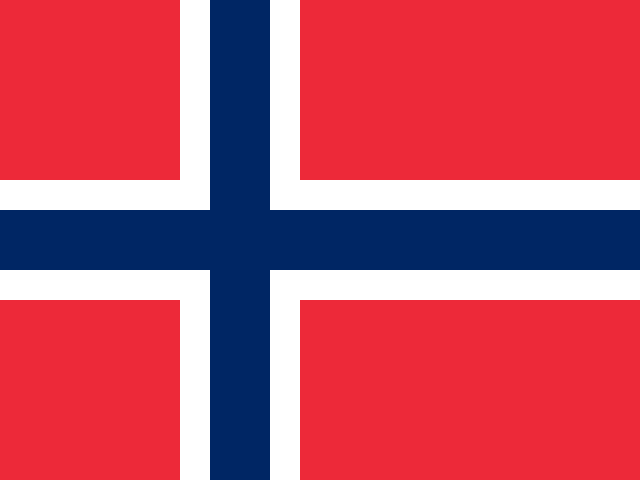
A red field with a blue Nordic cross outlined in white, its vertical arm shifted toward the hoist. Article 120 of the constitution provides only that the form and colours of the flag are determined by law, and the flag act of 1898 that it defers to gives the proportions as fractions and calls the colours only high red and dark blue, fixing no colour value and assigning no meaning. The off-centre cross is the Nordic form shared with Norway's neighbours, and the red, white and blue are conventionally read as colours of liberty.
Norway FACTS ◢
| Capital | Oslo |
|---|---|
| Continent | Europe |
| Population | 5,610,870 (2025) |
| Area | 323,807 km² |
| Population density | 17/km² |
| Currency | Norwegian krone (NOK) |
| Official language | Norwegian |
| Calling code | +47 |
| Internet TLD | .no |
| Time zone | UTC+01:00 |
| Drives on the | Right |
| ISO codes | NO / NOR |
DID YOU KNOW? ◢
- Its heavily indented coastline is famous for fjords, deep sea inlets carved by ancient glaciers.
- Parts of the country lie so far north that the sun never fully sets in summer, earning the nickname the land of the midnight sun.
- It regularly tops global rankings for quality of life and human development.
- The Nobel Peace Prize is awarded each year in its capital, Oslo.
Norway QUICK ANSWERS ◢
What is the capital of Norway?
The capital of Norway is Oslo.
What is the population of Norway?
Norway had a population of 5,610,870 in 2025.
What currency does Norway use?
Norway uses the Norwegian krone (NOK).
What languages are spoken in Norway?
The official language of Norway is Norwegian.
Think you know your flags? Play Flag Daily → · Browse all countries →
MORE ON THE FLAG ◢
The red flag with the white-edged blue cross is credited to one man: Frederik Meltzer, vice-consul in Bergen and one of its representatives in the Storting of 1821. Norway's own National Archives say he argued for it on the ground that the new flag should carry the colours of liberty, red, white and blue.
The Storting's printed record of the day he won does not say that. It quotes him at length, and where he explains the colours he argues something narrower and more practical: that Norway had been tied to Denmark and to Sweden, that borrowing either one's colours would be equally unsuitable, and that composing the colours unlike every other known flag would make the result recognisable as Norwegian on that alone.
Both accounts are published by Norwegian state institutions. The law is no help either way, because neither the constitution nor the flag act says what any of it means. What follows is what the documents actually contain.
Key Takeaways
- The flag was chosen by a vote in the Odelsting on 4 May 1821, after the competing drawings were numbered and posted up in the Storting's assembly room.
- The winning description took 40 votes. The flag committee's own design, a red and white flag with the Norwegian lion and five stars, was thrown out, and the record says its stars drew not one vote.
- Meltzer had told his electors he could not serve. The Storting overruled them and ordered Bergen's magistracy to make him attend.
- Carl Johan would not enact the Storting's 1821 flag act as law, and in 1898 Oscar II refused sanction outright. The 1898 act was promulgated as law anyway, under Article 79 of the constitution.
- The act in force today gives the flag as fractions and two colour words, high red and dark blue. It fixes no colour value and assigns no meaning.
| Instrument | Date | What it did |
|---|---|---|
| Storting vote on the union additions | 1 November 1814 | Adopted the additions that became Article 111: an own merchant flag, and a union flag at war |
| Odelsting vote | 4 May 1821 | Chose the high red flag with a white-edged dark blue cross, by 40 votes |
| Royal resolution | July 1821 | Allowed the flag in nearer waters only, without sanctioning the Storting's act |
| Royal resolution | 20 June 1844 | Added the union mark to the square nearest the flagstaff |
| Act on Norway's Flag | 10 December 1898 | Set the proportions still in force, promulgated without the king's sanction |
| Constitutional amendment | 21 November 1905 | Struck out the union-flag sentence, leaving the provision in force today, modernised and renumbered in 2014 |
Who designed the flag of Norway?
The man the archives name almost did not turn up.
The Storting's published proceedings for 1821 open by listing who attended, and Bergen's second representative was not among them. A footnote explains why. "Viceconsul Frederik Meltzer" had told the electoral assembly that he could not take the seat, "dels paa Grund af Sygelighed, dels for sin Velfærds Skyld", which is to say partly on grounds of ill health and partly for the sake of his own welfare. His electors accepted that by 11 votes to 9.
The Storting did not. It resolved unanimously "at Valgmændenes Kjendelse tilsidesættes, hvorimod Bergens Magistrat tilskrives at paalægge Repræsentanten Meltzer ufortøvet at indfinde sig i Storthinget", setting the electors' ruling aside and instructing Bergen's magistracy to require Meltzer to appear without delay. He took his seat on 6 March 1821. The proceedings spell his forename Frederik, as does Store norske leksikon. The National Archives write Fredrik Melzer. This article follows the proceedings and the encyclopaedia.
Two months later he stood up in the Odelsting and argued down the flag committee.
The attribution needs one qualification. The printed record of 4 May shows Meltzer objecting to the committee's design, and then records that the Thing voted for a different flag. It does not say in so many words that the winning flag was his. That link comes from the National Archives, which holds the royal resolution with a watercolour of the design attached, and from Store norske leksikon, which reports that eighteen proposals were in front of the Odelsting that day, that Meltzer had submitted two of them, and that the winning one arrived only on the morning before the vote.
Did Meltzer choose the colours of liberty?
Not according to the words the Storting printed.
The National Archives put it plainly on their page about the 1821 approval: "Han begrunnet forslaget sitt med at det nye flagget burde ha frihetens farger: rødt, hvitt og blått", meaning he justified his proposal on the ground that the new flag should have liberty's colours. Store norske leksikon says the same and adds a list of the flags supposed to have supplied the idea.
The proceedings quote Meltzer's speech across most of a page, and the passage where he deals with colour makes a different argument. The committee's red and white flag, he said, "synes at have for megen Lighed med det Danske, hvis Farver ere de samme", seeming too like the flag of Denmark, whose colours are the same. He then generalised: it is "ligesaalidet passende at vælge den ene som den anden af de Staters, med hvilke vi enten have staaet eller staar i Forbindelse", no more fitting to take one than the other of the states Norway had been or still was joined to.
His positive case is about telling flags apart. Compose the colours so that the flag "udmærker sig fra alle andre bekjendte Flag", he argued, and it becomes recognisable as Norwegian on that alone, with no need to put the coat of arms on it.
Freedom does not appear in the passage. Neither does France. The United States appears once, and only so that Meltzer can explain why their stars would not translate: the original thirteen stood for thirteen states independent of one another in internal affairs, so there "Stjernerne betegne Enighed og Kraft", the stars signify unity and strength, which is not what the committee's five stars would signify.
A full-text search of the digitised volume finds neither Frihed nor Frankrig on any of the four pages that carry the flag question, though Frihed turns up on dozens of other pages of the same volume. That is an argument from silence, and from an 1878 digest rather than a verbatim transcript, so it should be read as one. What can be said without hedging is that the liberty reading is asserted by two Norwegian institutions in their own voice, and that the record they are describing does not contain it.
The design the 1821 flag committee wanted
A red and white flag with the Norwegian lion and five stars, and the Odelsting threw it out.
The committee, chaired by the representative Bøckmann, set out a principle first: "de Farver bør komponere Flaget, som fra de ældste Tider, saavidt samme kan efterspores, have været brugte af Nationen som Særkjende tilsøs eller tillands", that the flag should be composed of the colours the nation had used as its mark at sea or on land from the oldest times traceable.
Working from medieval banners, it concluded that "Norges nationale Hovedfarve, til de fleste Tider Historien kan opvise, har været rød", that Norway's national main colour had been red for most periods history can show. For the second colour it gave a reason of exactly the kind the modern flag lacks: white, partly because Norwegian kings had borne it, and partly "fordi denne Farve forudsætter Begrebet om Uskyld, som medfører Oprigtighed og ærlig Fremfærd", because that colour presupposes the notion of innocence, which brings with it sincerity and honest conduct.
That is the only colour meaning assigned anywhere in the four pages the proceedings give to the flag question, and it belongs to the design that lost.
The committee also wanted the lion: "Løven, Norges Vaaben, bør formentlig findes i Flaget." Meltzer's reply was that painting arms on a flag costs money, spoils the simplicity, and when badly painted looks like any other four-footed animal, and that a merchant flag can end up hoisted on herring boats and sailing boats.
Beside the committee's design and the one that won, the record names a Danish flag with the Swedish one in the upper square, black with a red cross, red with a white saltire, and red and blue with a white saltire. All four were thrown out. Of the committee's five stars the record says simply: "Komiteens Forslag om de 5 Stjerner fik ingen Stemme."
Why Carl Johan would not sign the flag act
Because signing would have conceded who owned the question.
The Odelsting passed the flag as an act on 11 May 1821 and the Lagting on 16 May. The government recommended sanction. The record then states flatly: "Beslutningen blev imidlertid ikke af Kongen sanktioneret som Lov." The resolution was not sanctioned by the king as law.
Carl Johan's objection was constitutional. Article 111 of the constitution gave Norway the right to its own merchant flag, but he denied that this let the Storting fix the flag's form by statute, and the National Archives, describing the resolution it holds, records the same reservation: he granted the request while making clear that he was not conceding the Storting any constitutional right to decide what the national flag should be. The two state sources summarise this in opposite directions. The National Archives open by saying Carl Johan gave his sanction to a Storting resolution on a Norwegian merchant flag on 13 July 1821; Store norske leksikon says he refused sanction and permitted the flag instead. The proceedings quoted above settle it. He permitted the flag without enacting the statute, and that is the distinction the two summaries compress in opposite directions.
What he issued instead was a royal resolution permitting Norwegian merchant vessels to fly the flag in the nearer waters only. Beyond Cape Finisterre, and everywhere outside Europe, the union flag still had to be flown, because the Barbary states had not recognised a Norwegian flag. A royal resolution of 11 May 1838 extended the flag to all waters, and the record adds the condition: so long as the Barbary states had not recognised it, at the user's own risk of molestation or seizure.
The sources disagree about the date of the 1821 resolution and it is worth flagging rather than smoothing. The Storting's proceedings say a royal resolution was issued on 17 July, and Lovdata's reference list for the flag act gives the same day. The National Archives, which holds the document, and Store norske leksikon both say 13 July.
What Norway's flag law actually specifies
Fractions, two colour words, and nothing else.
The constitution does not describe the flag. Since 1905 its whole contribution has been one sentence, now numbered Article 120: "Det norske flaggs form og farger bestemmes ved lov", rendered in the official English text as "The form and colours of the flag of Norway shall be determined by law." Read on its own it looks like a referral to a rulebook full of specifications. It is not.
The law it defers to is the Act on Norway's Flag of 10 December 1898, still in force and still printed in its original spelling. Its first section says the flag shall be "et høirødt, med et mørkeblaat, og af en hvid Kant indfattet Kors, i fire retvinklede Firkanter afdelt Flag", a high red flag divided into four right-angled quarters by a dark blue cross bordered in white, with a width to length ratio of 16 to 22. The rest of the section is arithmetic: the two squares nearest the staff take 6/16 of the width, the outer panels 12/22 of the length, the blue cross 2/16, the white border 1/16.
The 1927 regulation on the use of the state and merchant flags repeats the same geometry in modern Norwegian and adds nothing about meaning. Nor does the 1933 act on flying flags from municipal buildings, which is mostly a list of what may be flown and a penalty clause: "Overtredelse av denne lov straffes med bøter eller fengsel i inntil 3 måneder."
So Norwegian law is exact about proportion and silent about symbolism.
How the union mark went on, and how it came off
The union mark went on by royal resolution in 1844 and took until 1905 to come off both flags.
The union clause was never Norway's idea. On 1 November 1814 the Swedish commissioners laid additions before the Storting that were considered a necessary consequence of the union with Sweden, and the second of them read: "Norge har Ret til at have sit eget Coffardi-Flag. Dets Orlogsflag bliver et Unionsflag." Norway has the right to its own merchant flag, and its naval flag is a union flag. A motion by Landsdommer Nansen that Norway should have a separate war flag as well was rejected by 41 votes to 36.
By royal resolution of 20 June 1844 a union mark was added to the upper square nearest the staff, and Store norske leksikon records that both kingdoms' flags took the same mark, with each country's colours taking the same area inside it. Norwegians called it the sildesalat, the herring salad, and the encyclopaedia dates the demand to remove it from the 1880s, as the appetite for independence grew.
The Storting passed the same pure flag act three times. In 1898 it went to Oscar II with the petition the constitution prescribes, and he wrote back: "Vi have ikke fundet at kunne sanktionere den fattede Beslutning." We have not found ourselves able to sanction the resolution passed. The next line disposes of the refusal: "I Henhold til Grundlovens § 79 bliver dog samme at kundgjøre som Lov." Under Article 79 it is to be promulgated as law regardless. The gazette printed the whole thing under the heading "Kongelig Kundgjørelse i Henhold til Grundlovens § 79 angaaende Lov om Norges Flag", and the merchant flag came clean on 16 December 1899.
Store norske leksikon puts the union mark out of the naval flag on 9 June 1905, months before the constitutional sentence that had required one was struck. That sentence went on 21 November 1905, when Article 111 was replaced with one line: "Det norske Flags Form og Farver bestemmes ved Lov." The provision is from 1905, and its present wording is the 2014 language reform, which modernised the text on 6 May and renumbered it as Article 120 on 27 May. So the provision governing the flag today is not from 1814 at all. It is a 1905 provision, promulgated in the name of "Den norske Regjering" rather than a king.
Why Norway has no official red
Because nobody has ever fixed one, and the one attempt was withdrawn.
The legal colour specification is two words, "høirødt" and "mørkeblaat", in the spelling of 1898, and no instrument has ever put a number behind either. Neither the 1898 act nor the 1927 regulation gives a dye, a pigment or a coordinate, and Store norske leksikon states the position directly: "Det er ikke fastsatt fargekoder for flagget", no colour codes are fixed for the flag.
The encyclopaedia also records the one attempt to supply them. Until 2018 the Ministry of Foreign Affairs carried an internal recommendation of Pantone values for printing on silk paper. Norwegian flag makers criticised it on the ground that the red was not high red enough, the ministry withdrew it and later said the guideline had been meant only for its own printed matter, and in 2018 the foreign minister asked the manufacturers to agree an industry standard between themselves. Norwegian flag makers commonly use PMS 200 C and PMS 281 C for textile flags, which the encyclopaedia notes is a more bluish red than the one it prints for itself.
So two flags that look identical on a mast can be several shades apart and both be lawful, because the only thing either of them has to satisfy is a pair of nineteenth-century adjectives.
The same absence explains where the received symbolism comes from. If you want to know what the red means, the statute book will not tell you, and the encyclopaedia is careful to introduce the strength, purity and faithfulness reading as a traditional interpretation rather than an official one. If you would rather test whether you can pick the flag out of a line-up of Nordic crosses, three guesses a day is the shorter route.
Frequently asked questions
Who designed the flag of Norway?
Frederik Meltzer, vice-consul in Bergen and one of its representatives in the Storting of 1821, is credited with the design by Norway's National Archives and by Store norske leksikon. The Storting's own printed proceedings record him arguing against the flag committee's design on 4 May 1821 and record the vote that chose the flag now in use, but they do not state in so many words that the winning proposal was his.
What do the colours of the Norwegian flag mean?
No Norwegian instrument assigns them a meaning. Article 120 of the constitution provides only that the form and colours are determined by law, and the flag act of 10 December 1898 gives the proportions as fractions and calls the colours "høirødt" and "mørkeblaat" and nothing more. The reading of red, white and blue as colours of liberty is asserted by the National Archives and by Store norske leksikon, not by any law.
Why is the cross on the Norwegian flag off-centre?
Because it follows the Nordic pattern, in which the upright arm is shifted toward the flagstaff. Meltzer's recorded argument for keeping a cross at all was that it was an old and common flag device among the northern nations, which he listed as "Svenske, Danske, Englændere og Russer". Store norske leksikon calls Norway's the first Nordic cross flag to use three colours.
Is there an official Pantone colour for the Norwegian flag?
No. The 1898 flag act and the 1927 regulation on the use of the flags give no colour value of any kind, and Store norske leksikon states that no colour codes are fixed. It records that a Foreign Ministry recommendation of Pantone values was withdrawn in 2018 after flag makers objected, with the ministry saying it had been meant for internal printed matter only.
When did Norway get its own flag without the union mark?
The merchant flag lost the union mark when the act of 10 December 1898 came into force on 16 December 1899. Oscar II had refused to sanction it, and it was promulgated under Article 79 of the constitution, the provision that, then as now, lets a bill passed unchanged by successive Stortings become law without the royal assent. The gazette records that the 1898 resolution was the same one the Stortings of 1893 and 1896 had already passed. The naval flag kept the mark until 1905.
Sources
- Lovdata, Kongeriket Norges Grunnlov, § 120 and the official English text, Article 120 - retrieved 26 August 2026.
- Lovdata, Lov om Norges Flag (flaggloven), 10 December 1898 nr. 1 - retrieved 26 August 2026.
- Lovdata, Forskrift angående bruk av statsflagget og handelsflagget, 21 October 1927 - retrieved 26 August 2026.
- Lovdata, Lov om flagging på kommunenes offentlige bygninger, 29 June 1933 nr. 2 - retrieved 26 August 2026.
- Norsk Lovtidende, 1ste Afdeling, No. 50, 1898, pp. 471 to 472, Kongelig Kundgjørelse i Henhold til Grundlovens § 79 angaaende Lov om Norges Flag, digitised by the National Library of Norway - retrieved 26 August 2026.
- Norsk Lovtidende, 1ste Afdeling, No. 58, 1905, p. 479, Grundlovsbestemmelse angaaende Forandring i Grundlovens § 111, digitised by the National Library of Norway - retrieved 26 August 2026.
- Storting, Storthings-Efterretninger 1814-1833, B. 2: Tredie ordentlige Storthing 1821, Christiania 1878, pp. 1 and 144 to 147, digitised by the National Library of Norway - retrieved 26 August 2026.
- Storting, Storthings-Efterretninger 1814-1833, B. 1: Rigsforsamlingen og det overordentlige Storthing 1814, Christiania 1874, pp. 172 to 173, digitised by the National Library of Norway - retrieved 26 August 2026.
- Arkivverket (National Archives of Norway), Godkjennelsen av det norske flagget 1821 - the live page answers a security challenge from this machine, so it was read from the Internet Archive capture of 16 November 2025 - retrieved 26 August 2026.
- Lars Roede, Norges flagg, Store norske leksikon, last updated 28 April 2025 - retrieved 26 August 2026.
PLAY ANOTHER →
Three clues, three guesses. Work out where in the world it is.
THREE CLUESDAILYOn This DayOne thing that happened today in history. Every day, a new one.
TODAY IN HISTORYDAILYDaily CodeA short message, hidden in a different cipher every day.
ONE CIPHER A DAYDAILYDaily TriviaFive questions a day. Everyone gets the same five.
FIVE QUESTIONS