
Oman
Sitting on the southeastern corner of the Arabian Peninsula, Oman blends dramatic mountains, empty deserts and a long seafaring history, and stands out in the region for its distinctive white-and-gold forts.
WHAT THE FLAG MEANS ◢
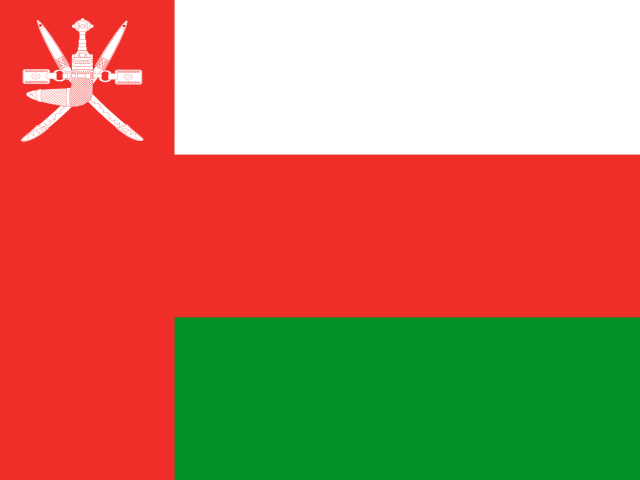
A red vertical band at the hoist carrying the national emblem in white in its upper quarter, beside three horizontal bands of white, red and green. The emblem is two crossed traditional Omani swords with the Omani khanjar between them. Article 4 of the Basic Law provides only that the law determines the flag, emblem, decorations and national anthem, and the flag law it defers to specifies the design in detail without assigning any colour a meaning. The state's own reading gives the white for peace and prosperity, the red for the battles Omanis fought to expel foreign invaders and for the older red flag it was carried over from, and the green for the fertility and greenery of the land.
Oman FACTS ◢
| Capital | Muscat |
|---|---|
| Continent | Asia |
| Population | 5,494,691 (2025) |
| Area | 309,500 km² |
| Population density | 18/km² |
| Currency | Omani rial (OMR) |
| Official language | Arabic |
| Calling code | +968 |
| Internet TLD | .om |
| Time zone | UTC+04:00 |
| Drives on the | Right |
| ISO codes | OM / OMN |
DID YOU KNOW? ◢
- It occupies the southeastern corner of the Arabian Peninsula, guarding the entrance to the Persian Gulf.
- It's dotted with hundreds of historic forts and watchtowers, several of which are UNESCO World Heritage sites.
- Frankincense from its southern Dhofar region was traded across the ancient world for thousands of years.
- The Sultan Qaboos Grand Mosque in Muscat once housed one of the largest single-piece carpets in the world.
Oman QUICK ANSWERS ◢
What is the capital of Oman?
The capital of Oman is Muscat.
What is the population of Oman?
Oman had a population of 5,494,691 in 2025.
What currency does Oman use?
Oman uses the Omani rial (OMR).
What languages are spoken in Oman?
The official language of Oman is Arabic.
Think you know your flags? Play Flag Daily → · Browse all countries →
MORE ON THE FLAG ◢
Oman's flag is three colours and a national emblem, and the question of what they stand for has one answer that is easy to find and one that is easy to miss.
The easy one belongs to the Ministry of Information. On its own portal the ministry gives the white as the Omani people's conviction in peace and prosperity, the red as a colour carried over from the older red Omani flag and standing for the battles Omanis fought to drive foreign invaders out, and the green as the fertility and greenery of the land.
The one that is easy to miss is that none of those readings appears in the flag law, its annexes or its executive regulation. Article 4 of the Basic Law hands the flag to the Law and stops there. The law it hands it to, Royal Decree 53/2004, then spends seventeen articles and three annexes on the flag, the emblem and the anthem. It specifies the cloth and its weight, two commercial colour references, five sizes, three mast heights and a term of imprisonment for insulting the flag. It never once says what any of it means.
Key Takeaways
- Article 4 of the Basic Law of the State, issued by Royal Decree 6/2021, leaves the flag, emblem, decorations and anthem entirely to the Law, and describes none of them.
- That law is Royal Decree 53/2004. Its Annex 1 fixes the fabric, the woven weight, two colour references and five sizes, and gives no colour a meaning.
- The colour readings Oman publishes are the Ministry of Information's, on its portal, not any instrument's.
- The ministry gives the green as the fertility and greenery of the land. The Jebel Akhdar reading appears in no Omani state source opened for this article.
- Article 16 of the 2004 flag law punishes deliberately insulting the flag or the emblem with three months to three years' imprisonment.
Oman's colour readings belong to the Ministry of Information
The ministry publishes the readings in Arabic and English under a heading it translates as "Explanation of colors", and the three entries are short enough to take one at a time.
The white, in the ministry's English wording, "depicts the conviction of the Omani people in peace and prosperity". The Arabic runs the same way, giving the white as the Omani people's conviction "بالسلام والازدهار", in peace and prosperity.
The red gets the longest entry, and the ministry's account of it is historical rather than abstract. Red, it says, is the dominant colour, "has been adopted from the old Omani flag (which was red)", and "symbolizes the battles fought by Omanis for the eviction of foreign invaders from the country". So the ministry is telling you where the colour came from and what it commemorates. It does not give the red an abstract virtue.
The green gets one line: it "represents fertility and greenery of the land". No landscape, region or mountain range is named.
So Oman does publish an official reading. It publishes it the way a ministry does, on a web page, rather than the way a legislator does, inside a binding text. That distinction is worth holding on to here, because the binding text is anything but silent.
Article 4 of the Basic Law gives Oman's flag one sentence, and it defers
The Basic Law of the State in force today was issued by Royal Decree 6/2021, signed by Sultan Haitham bin Tariq on 11 January 2021 and published as a special supplement to issue 1374 of the Official Gazette. Article Two of that decree, in the promulgating text rather than in the Basic Law annexed to it, repealed the two decrees behind the previous constitutional text, Royal Decrees 101/96 and 99/2011, so the 2021 instrument replaced the 1996 Basic Law outright rather than amending it.
Article 4 of the new text opens "يحدد القانون علم الدولة" and then continues through the emblem, the decorations and the anthem. The whole article renders as: the Law determines the flag of the State, its emblem, its decorations and its national anthem.
That is all of it. Article 4 neither describes the flag nor assigns anything a meaning; it nominates a legislative home for the question and moves on. It sits directly after three clauses of comparable brevity that fix the state as an Arab Islamic country with Muscat as its capital, Islam as its religion and Arabic as its official language, so the flag arrives in that sequence as one more item to be settled elsewhere.
What Royal Decree 53/2004 actually specifies
The law the Basic Law's Article 4 defers to is the Law of the State Flag, its Emblem and its National Anthem, issued by Royal Decree 53/2004 and signed by Sultan Qaboos bin Said on 22 May 2004.
Two article series run through it and they are easy to conflate. The decree itself has four articles, numbered in words, which promulgate the Law and set it going. The Law annexed to the decree has seventeen, numbered in digits, and those are the ones that describe the flag. Every numbered article in the sections that follow is the Law's unless the decree is named.
The Law's Article 2 is the closest the statute comes to interpretation, and it interprets the flag's function rather than its design: the flag is "رمز سيادة الدولة", the symbol of the sovereignty of the State, and the evidence of its existence, its independence and its official participation.
Article 3 then describes the flag in one sentence. It consists of three colours, "الأبيض والأحمر والأخضر", white and red and green, and it bears the emblem in accordance with the specifications and measurements set out in Annex 1. The colours are named and left there.
Everything else is that annex's work, and the annex is concrete in a way the articles are not. The flag is a rectangle made of one vertical unit beside the staff and three horizontal units. The vertical third of the flag alongside the staff is red, and carries the emblem in white in its upper quarter. The three horizontal units are white at the top, red in the middle and joined to the vertical unit, and green at the bottom.
Then the materials. The cloth is to be spun polyester bunting of 165 grams woven weight, which the Ministry of Information restates as "Fabric spun polyester, woven weight 165gm." The colours are given as two supplier references, which the ministry prints as "Banto-New ORM.C2X-Red" and "Banto-New ORM.CNE354 C2X-Green". No reference is given for the white, and no Pantone number appears anywhere in the annex.
Annex 1 draws the flag as well as describing it, and its three mast flags do not share one ratio
Annex 1 also carries a construction drawing, and it dimensions the flag as 350 centimetres long and 200 centimetres on the hoist, with each of the three horizontal units 66.6 centimetres deep. The division between the hoist unit and the fly carries a tick mark on the drawing's second dimension line but no figure of its own, so the one-third rule in the annex's text is what fixes it.
The annex's size table then pairs three official flag sizes with three mast heights. A 6 metre mast takes a flag given as 2 by 1 metres, a 10 metre mast one given as 3.50 by 2, and a 12 metre mast one given as 3 by 1.7. A car flag is 35 by 25 centimetres and a table flag 26 by 17. The table prints each pair without saying which figure is the length and which the hoist.
It does not have to, for the observation that matters: a proportion is the same whichever way round its two figures are read, and these are three different proportions. Two to one is 2. Three and a half to two is 1.75. Three to one and seven tenths is a shade over 1.76. So the law fixes sizes rather than a shape, and the smallest flag is the longest rectangle of the three. The construction drawing's own 350 by 200 is 1.75, which matches the 3.50 by 2 metre size exactly and neither of the others.
The mast rules read like a municipal engineering schedule. Six metre masts go up on public and secondary streets, ten metre masts on buildings from the first floor upwards, and the twelve metre masts are set on the ground in front of buildings, at airports opposite guests' aircraft, and in front of the ceremonial hall; the annex requires those masts to be permanently fixed to the ground.
An instrument that legislates where a twelve metre mast stands relative to a guest's aircraft at an airport is not one that ran out of room for the colours.
Two crossed swords with a khanjar between them
The emblem gets a chapter of its own in the 2004 law, three articles long, and only the first of the three describes it. Article 10 of the 2004 law says the emblem consists of two crossed traditional Omani swords, "يتوسطهما الخنجر العماني", with the Omani khanjar between them, in accordance with the figure in Annex 2. The other two put the emblem on the facades of government buildings and on the State's official documents, papers and seals, and restrict its commercial use.
Annex 2 is that figure, and it shows more than the sentence does. Both swords are curved and drawn inside decorated scabbards, crossed in saltire. The khanjar stands upright over the crossing point, also in its scabbard, which hooks sharply upward. A decorated belt runs horizontally behind the khanjar's hilt.
The Ministry of Information describes the same object slightly differently, as "crossed swords over a khanjar, a traditional curved dagger", and adds a placement rule the law leaves to the annex: "The emblem is placed in the upper corner near the mast on both sides."
Short descriptions of this emblem lose two details and reverse a third. On the flag it is white rather than silver or gold, and Annex 1 puts it in the upper quarter of the red band rather than at its centre. And it is the swords that cross each other. The khanjar is crossed with nothing, and sits between them.
The belt is the detail worth noticing. Annex 2 draws the khanjar complete with the fitting it is carried on, so what the emblem holds is a whole object rather than a blade abstracted into a heraldic charge.
Oman's flag is administered by the Sultan's household
Article 1 of the 2004 law defines its terms, and two of those definitions place the flag inside the Omani state in a way that is easy to overlook. The Minister, throughout the law, is the Minister of the Diwan of Royal Court. The competent authority is the Royal Protocol at the Diwan of Royal Court.
So the flag is not administered by a ministry of culture, interior or defence. It is administered by the Sultan's own household office, which is also the body that writes the rules; policing how it is flown is a separate job, and the Law gives it to the Royal Oman Police. Article Three of the decree, in the promulgating series rather than the Law's, requires the Minister of the Diwan of Royal Court to issue the regulations and decisions needed to implement the Law.
The Minister did so nine years later. Diwani Decision 29/2013, issued by Khalid bin Hilal bin Saud al-Busaidi as Minister of the Diwan of Royal Court on 30 May 2013 and published in Official Gazette 1016, is the Executive Regulation of the flag law, and it is where the flag's day-to-day etiquette lives.
Article 4 of that regulation forbids raising the flag in a demeaning manner, wearing it, or setting it up without a mast, and prohibits placing it improperly on vehicles. Its Article 6 sets the precedence rules in physical terms, for the case it names: when the flag is raised alongside the flags of military and security bodies and of private-sector organisations, it goes in the middle of them, on the right-hand side when raised with one other, and its mast is to stand at least half a metre above the rest.
The regulation's Article 7 requires a named official responsible for raising the flag at each of the bodies, places and sites listed in Article 4 of the 2004 law, and requires that name to be furnished to the Royal Protocol. Its Article 9 binds manufacturers and importers to the specifications the Law provides for, and requires their manufacturing and import licences to include an undertaking to abide by them. None of the regulation's fifteen articles assigns a colour a meaning either.
The penalties in Oman's flag law
The 2004 law ends with a penalties chapter of three articles, and two of them are why the flag's rules are more than advisory. Article 15 imposes a fine of not less than 200 and not more than 1,000 Omani rials for three things, without prejudice to any heavier penalty another law provides. One is committing the acts prohibited by Article 12, in which case the seized materials are confiscated. Another is deliberately flying a flag that is worn out, torn, in a condition unbefitting its standing, or short of the annexed specifications. The third is deliberately failing to lower the flag to half mast during official mourning.
Article 16 goes further. Deliberately insulting the flag or the emblem, whether by lowering it, destroying it, or by any other act expressing hatred and contempt, carries imprisonment of not less than three months and not more than three years.
The chapter's third article is the enforcement one. Article 17 gives the Royal Oman Police the task of following up and supervising how the flag is raised in the cases and places the Law sets out, and leaves the other military and security agencies to do the same at their own sites.
Article 12, the provision Article 15 enforces, is about the emblem rather than the flag, and it is the only article of the operative text that has been replaced in the period the Ministry of Justice decree database covers. Royal Decree 28/2018, signed on 11 November 2018 and published in Official Gazette 1268, replaced Article 12 outright. The text that stands in its place bans using the emblem as a trademark or in advertising, and bans putting it on jewellery, products or implements made locally or imported, without prior permission from the Minister of Commerce and Industry, given after the approval of the Minister of the Diwan of Royal Court. It also bans displaying or selling materials made in breach of the article in commercial premises. A second paragraph applies that protection to the emblem whether it stands alone or sits among other emblems, drawings, shapes or images, and extends it to the emblems, marks and symbols approved for government bodies and for military and security agencies wherever the emblem forms part of them.
The only other amendment on that database is not about the flag at all. Royal Decree 2/2020, of 20 February 2020, replaced item one of Annex 3, which is the words of the national anthem. Annex 3 is part of the law too, so the flag law has been amended twice in the period that database covers, and only once in an article.
The green: the ministry says fertility and greenery, not Jebel Akhdar
A green band on an Arabian flag invites a geographical explanation, and Oman offers an obvious candidate in Jebel Akhdar, whose name is Arabic for the Green Mountain. A reading tying the flag's green to those highlands is not hard to come across.
It is not in any Omani state source opened for this article. The Ministry of Information's flag page names no mountain in either of its languages, and its sentence on the green stops at "fertility and greenery of the land". Nor does one appear anywhere in Royal Decree 53/2004's seventeen articles, in Annexes 1 and 2, in the words of the anthem at Annex 3, or in the 2013 executive regulation. All of those were read as page images rather than as extracted text, because the gazette's Arabic text layer is not sound enough to argue an absence from. The thirty pages that follow the anthem's words are its orchestral parts.
That is worth stating plainly rather than hedging, because the ministry had every opportunity to say otherwise and did not. Where a state publishes a gloss of its own, a more specific version circulating elsewhere is somebody else's addition until a national source carries it.
The same test leaves the white and the red where they are, because the ministry supplies both readings itself. Peace and prosperity is its phrase, and so are the battles, in a specific form: the battles fought to expel foreign invaders, attached to a red flag that already existed.
The red came first, and the rest arrived in 1970
The Ministry of Information dates the flag's first adoption precisely. It was "adopted by a royal decree for the first time" on 18 Shawwal 1391 AH, corresponding to 17 December 1970.
The ministry's account of the red is what makes that date legible. Before 1970 the Omani flag was red. The ministry's history of the 1970 adoption gives that flag the national emblem and the three colours, white, red and green; its separate note on the colours is where the red is called the dominant one and traced back to the old flag. The historical part of this flag is the field itself. Everything arranged on it arrived together.
What could not be established from a primary source is the instrument behind the pre-2004 flag. The Ministry of Justice and Legal Affairs publishes its royal-decree database back only to the early 2010s, and its Official Gazette archive begins in 2013, so no 1970 or 1990s flag decree could be opened. Royal Decree 53/2004 does not name one either: its Article Two says only that everything relating to the flag, emblem and anthem remains valid and in force until this law takes effect, without repealing any earlier instrument by number. That is a looser transitional clause than the one in Royal Decree 6/2021, which names both of the decrees it repeals.
For a comparison inside the same neighbourhood, Bahrain's flag statute puts its symbolism in the operative text, telling you in the middle of a paragraph of fractions that the serrated line between its colours divides into five sections standing for the five pillars of Islam. The meaning of Saudi Arabia's sword and inscription arrived later than its flag law, in the preamble of a 2023 royal order that created a flag day. Oman's arrived in neither. It arrived on a ministry website, which is a perfectly respectable place for a country to say what its flag means, and a different kind of source from a statute.
Knowing which is which is most of what separates a fact about a flag from a caption about one, and it is the difference that decides whether you can trust yourself when a flag turns up in the daily three-guess flag game.
Frequently asked questions
What do the colours on Oman's flag mean?
According to Oman's Ministry of Information, the white stands for the Omani people's conviction in peace and prosperity, the red is carried over from the older red Omani flag and stands for the battles Omanis fought to expel foreign invaders, and the green stands for the fertility and greenery of the land. Those readings are the ministry's own. The flag law, its annexes and its executive regulation assign the colours no meaning.
The ministry publishes them in Arabic and English on its flag and emblem page, under a heading it renders as "Explanation of colors".
Does Omani law say what the flag's colours mean?
No. Article 4 of the Basic Law issued by Royal Decree 6/2021 says only that the Law determines the flag, emblem, decorations and anthem. Royal Decree 53/2004, the law it defers to, names the three colours in Article 3 and specifies fabric, colour references, sizes and mast heights in Annex 1, without giving any colour a meaning. Neither does the 2013 executive regulation.
The closest the statute comes is Article 2, which calls the flag the symbol of the sovereignty of the State and the evidence of its existence, its independence and its official participation. That is about the flag as a whole, not about its colours.
What is the dagger on the Oman flag?
It is the khanjar, the traditional curved Omani dagger, and it forms part of the national emblem rather than being a separate device. Article 10 of Royal Decree 53/2004 describes the emblem as two crossed traditional Omani swords with the Omani khanjar between them, and Annex 2 to the law shows the khanjar upright in its hooked scabbard over the crossing swords, with a decorated belt behind its hilt.
On the flag itself the emblem is white, and Annex 1 places it in the upper quarter of the red vertical band beside the staff rather than at its centre.
When was Oman's flag adopted?
Oman's Ministry of Information dates the first adoption of the flag by royal decree to 18 Shawwal 1391 AH, corresponding to 17 December 1970. The law now in force is later: Royal Decree 53/2004, signed on 22 May 2004, which issued the Law of the State Flag, its Emblem and its National Anthem.
The instrument behind the 1970 flag is not published in the Ministry of Justice and Legal Affairs decree database, whose online coverage begins long afterwards, so this article does not name it.
Is it illegal to disrespect Oman's flag?
Yes, and the penalties are set out in the flag law itself. Article 16 of Royal Decree 53/2004 punishes anyone who deliberately insults the flag or the emblem, whether by lowering it, destroying it, or by any other act expressing hatred and contempt, with imprisonment of not less than three months and not more than three years.
Article 15 adds a fine of 200 to 1,000 Omani rials for lesser breaches, including deliberately flying a worn out or torn flag and deliberately failing to lower the flag to half mast during official mourning. The 2013 executive regulation separately forbids wearing the flag or putting it up without a mast.
Sources
- Ministry of Justice and Legal Affairs, Sultanate of Oman, Royal Decree 6/2021 issuing the Basic Law of the State - retrieved 27 August 2026.
- Ministry of Justice and Legal Affairs, Sultanate of Oman, Royal Decree 53/2004 issuing the Law of the State Flag, its Emblem and its National Anthem - consolidated text, retrieved 27 August 2026.
- Ministry of Justice and Legal Affairs, Sultanate of Oman, Royal Decree 28/2018 amending the Law of the State Flag, its Emblem and its National Anthem - retrieved 27 August 2026.
- Ministry of Justice and Legal Affairs, Sultanate of Oman, Royal Decree 2/2020 amending Annex 3 to the Law of the State Flag, its Emblem and its National Anthem - retrieved 27 August 2026.
- Ministry of Justice and Legal Affairs, Sultanate of Oman, Diwani Decision 29/2013 issuing the Executive Regulation of the Law of the State Flag, its Emblem and its National Anthem - retrieved 27 August 2026.
- Ministry of Information, Sultanate of Oman, National Flag and Emblem - retrieved 27 August 2026.
- Ministry of Information, Sultanate of Oman, العلم والشعار - the Arabic version of the same page, retrieved 27 August 2026.
PLAY ANOTHER →
A short message, hidden in a different cipher every day.
ONE CIPHER A DAYDAILYOn This DayOne thing that happened today in history. Every day, a new one.
TODAY IN HISTORYDAILYGuess the CountryThree clues, three guesses. Work out where in the world it is.
THREE CLUESDAILYDaily CryptogramOne quote, one scrambled alphabet. Crack it before tomorrow.
CRACK THE QUOTE