
Paraguay
Paraguay is a landlocked heart-of-South-America country where nearly everyone speaks Guaraní alongside Spanish, and the mighty Paraná River does the heavy lifting for trade.
WHAT THE FLAG MEANS ◢
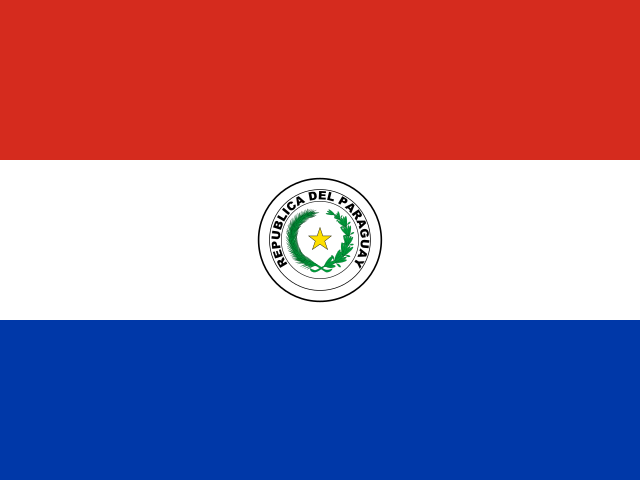
A horizontal triband of three equal bands, red, white and blue, unusual for carrying a different emblem on each face: on the obverse the national arms, a five-pointed yellow star inside a wreath of palm and olive with Republica del Paraguay lettered around it; on the reverse the Treasury seal, a seated lion with a pike behind it topped by the red Phrygian cap of liberty, and Paz y Justicia lettered above. The law of 25 November 1842 that still fixes the design describes both faces and gives the three colours no meaning.
Paraguay FACTS ◢
| Capital | Asunción |
|---|---|
| Continent | South America |
| Population | 7,013,078 (2025) |
| Area | 406,756 km² |
| Population density | 17/km² |
| Currency | Paraguayan guaraní (PYG) |
| Official languages | Guarani, Spanish |
| Calling code | +595 |
| Internet TLD | .py |
| Time zone | UTC-03:00 |
| Drives on the | Right |
| ISO codes | PY / PRY |
DID YOU KNOW? ◢
- It's one of the few countries where an Indigenous language, Guaraní, is spoken by most of the population and is co-official with Spanish.
- The Itaipú Dam, shared with Brazil, is one of the largest hydroelectric power stations in the world.
- It's one of only two landlocked countries in South America.
- The Gran Chaco, a vast, sparsely populated plain, covers much of its west.
- It generates so much hydroelectric power that it exports a large share of it to neighbouring countries.
Paraguay QUICK ANSWERS ◢
What is the capital of Paraguay?
The capital of Paraguay is Asunción.
What is the population of Paraguay?
Paraguay had a population of 7,013,078 in 2025.
What currency does Paraguay use?
Paraguay uses the Paraguayan guaraní (PYG).
What languages are spoken in Paraguay?
The official languages of Paraguay are Guarani and Spanish.
Think you know your flags? Play Flag Daily → · Browse all countries →
MORE ON THE FLAG ◢
Turn a Paraguayan flag around and the emblem changes. The side you usually see carries a yellow star inside a wreath of palm and olive, ringed by the words República del Paraguay. The side you usually do not see carries a seated lion, a pike topped with a red Phrygian cap, and the words Paz y Justicia.
Both faces are prescribed by the same instrument, and it dates from 1842. The Soberano Congreso General Extraordinario met in the Templo de la Encarnación in Asunción on 25 November 1842, passed a four-article law on the national flag, and described what goes on each side in one sentence apiece. That law has never been replaced. Article 139 of the 1992 Constitution points back at it by name.
What the 1842 law does not do, anywhere in its four articles, is say what the three colours stand for. Neither does the decree that governs the flag's rendering today. The readings you will find on a Paraguayan embassy page are the state talking, but they are not the state legislating, and the difference has been argued in Congress twice since 2024.
Key Takeaways
- The obverse has the national arms and the reverse has the Treasury seal, and the 1842 law names the two separately.
- Neither the 1842 law, the Constitution nor the 2013 decree assigns red, white or blue a meaning. The only symbolism any of them states is that the Phrygian cap stands for liberty.
- A decree of 15 July 2013 restored the 1842 rendering and removed a red border and a blue disc that historians of the Academia Paraguaya de la Historia attribute to a 1970 change under Alfredo Stroessner.
- That decree fixes Pantone values for the six colours in the two emblems and the national seal, and no value at all for the flag's own red, white and blue.
- A bill that would have written colour meanings into statute was rejected by the Senate in 2025. A similar one was filed again in July 2026.
| The instrument | Date | What it does | What it does not do |
|---|---|---|---|
| Ley del Pabellón Nacional | 25 November 1842 | Fixes three horizontal bands and describes the emblem on each face | Assign the colours any meaning |
| Constitution, article 139 | 20 June 1992 | Names the flag, the national seal and the anthem as the symbols of the Republic | Describe or interpret any of them |
| Decreto N° 11.400 | 15 July 2013 | Specifies the emblems' shape, lettering, colours and typeface | Give the flag's own colours a specification |
What is on each side of the Paraguayan flag?
The 1842 law describes the obverse in one clause: "De un lado el escudo nacional con una palma y una oliva entrelazadas en el vértice y abiertas en la superficie, resaltando en el medio de ellas una estrella". On one side, the national arms, with a palm and an olive interlaced at the base and open above, and a star standing out in the middle of them. The border, the orla, carries the words República del Paraguay.
The reverse gets one clause too: "En el lado opuesto, un círculo con la inscripción Paz y Justicia, y en el centro un león en la base del símbolo de la libertad". On the opposite side, a circle inscribed Peace and Justice, with a lion at the foot of the symbol of liberty in the centre.
Both clauses are quoted here from the 2013 decree, whose article 2 reproduces the whole of article 1 of the 1842 law. The copy of the act that the culture secretariat sent to Congress reads "una palma y una oliva" as well. The transcription published by the state news agency differs in small particulars, giving the obverse as "De un lado el escudo nacional con la palma y oliva entrelazadas". The variants swap a determiner, drop a word and move a comma. None of them changes what is on either face.
The reference to the symbol of liberty is doing quiet work there. The symbol of liberty is the Phrygian cap, and the 1842 congress evidently expected any reader to know it, because it never says so. The 2013 decree spells it out at last: the pike goes behind the lion, on the vertical diameter, finished at its upper end by "el gorro frigio rojo, símbolo de la libertad".
Paraguayan state bodies describe how rare this arrangement is, and one of them gives two different answers on one page. The Paraguayan embassy in Japan opens by calling the flag "el único del mundo con dos escudos diferentes", the only one in the world with two different emblems. Further down the same page, under its heading on the national arms, it calls the flag "una de las tres únicas banderas nacionales en el mundo" with two distinct sides, and names the other two as Moldova and Saudi Arabia.
The state news agency gives only the three-flag count, and its own description of the other two shows why the narrower claim is not the same claim. Moldova's reverse has the same arms as its obverse, with the eagle turned to face the other way. Saudi Arabia's inscription and sword are arranged so that they read correctly from either side. One device made to work on both faces is not a second device.
The law that still governs the flag was written in 1842
Article 139 of the Constitution lists the symbols and then hands the detail away: "La ley reglamentará las características de los símbolos de la República no previstos en la resolución del Congreso General Extraordinario del 25 de noviembre de 1942, y determinando su uso". The law will regulate the characteristics of the symbols of the Republic not provided for in that resolution, and determine their use.
Read that carefully and you can see how narrow the opening is. Congress may legislate on what the 1842 resolution did not provide. What it did provide stands as passed.
The 1842 text runs to four articles. Article 1 sets the design. Article 2 forbids any other flag being flown in the Republic's squares, ports, camps, forts and ships. Article 3 deals with the seals. Article 4 orders the result communicated to the government, to the Argentine Confederation and to the neighbouring states. Carlos Antonio López signed the certified copy two days later, on 27 November 1842.
Nothing in those four articles interprets anything. There is no clause about courage, none about purity, none about the sky. The document is a specification.
Where the name Treasury seal comes from
The reverse emblem is commonly called the Treasury seal, or sello de Hacienda, and that name is not a nickname invented later. It is in the 1842 law itself, in article 3, which sets out the national seal and then adds "y para sello de la Hacienda, el que se designa en otro círculo que contiene el símbolo de la libertad". And for the seal of the Treasury, the one designated in the other circle, containing the symbol of liberty.
There is a wrinkle worth knowing, because it trips people up. The national seal of article 3 is not the reverse emblem at all. It is the obverse design used on its own: "que el sello nacional sea el mismo usado hasta aquí y descrito en el artículo primero bajo el jeroglífico de una palma y oliva, una estrella en el centro y la inscripción orlada de República del Paraguay". So Paraguay has three related devices, not two. The obverse arms, the reverse arms, and the national seal, which repeats the obverse.
Modern practice keeps the two apart by user rather than by name. The Ceremonial del Estado law of 2014, Ley N° 5.209, article 5, says the star, palm and olive arms for printed material "podrá ser usado" by the branches of the state and by every public institution, national, departmental, municipal, autonomous and autarchic. That is permissive. The clause that follows is not: "El Escudo del león y el gorro frigio será utilizado por el Ministerio de Hacienda y el Banco Central del Paraguay". The lion and Phrygian cap arms are assigned by that law to the finance ministry and the Central Bank. That article still stands as it was passed: the one amending law the Congress's own law archive records against the 2014 statute, Ley N° 5.584 of 2016, rewrites four other articles and leaves article 5 alone. The 1842 name and the 2014 practice agree.
Does Paraguayan law say what red, white and blue mean?
No. Not the 1842 law, not the Constitution, and not the decree in force.
This is the honest and slightly deflating answer, and it is worth stating plainly, because a great deal of writing about this flag states meanings as though a law had fixed them. Decreto N° 11.400 of 15 July 2013, the instrument in force, runs to twenty articles plus an eight-page annex. It specifies letter colours, wreath curvature, the arc of the border in degrees and the typeface. On what the bands mean, it is silent. Its article 9 defines colores patrios purely by combination, as any use of the red, white and blue intended to evoke the national flag.
Article 3 of the same decree comes closest, and stops short. For educational and commemorative purposes, it establishes, the flag was first raised on 15 August 1812, "fecha que dio origen a sus colores definitivos". The date that gave rise to its definitive colours. That is provenance, not meaning.
The glosses do exist, and they are published by the Paraguayan state. The embassy in Japan writes that the three colours represent Paraguay's identity, "el rojo simboliza la justicia, el blanco la paz y el azul la libertad": red symbolises justice, white peace, blue liberty. That is a foreign ministry post talking about its own country's flag, so it is worth reporting, and it is worth labelling. It is a reading, not a rule, and it does not agree with every other popular reading in circulation, several of which give red to courage or heroism instead.
What changed in 2013, and what it undid
If you look at a Paraguayan flag from the 1970s or 1980s the emblems look different from the ones on the flag today. Both inscriptions sit on a red border, the obverse lettering is yellow rather than black, and the star sits inside a blue disc.
That version dates from 1970. According to Gustavo Laterza Rivarola of the Academia Paraguaya de la Historia, quoted by the state news agency IP, a Paraguayan heraldist named Harold Rönnebeck put a theory to Alfredo Stroessner that the emblems were badly drawn and that some elements should carry different colours. The dictator approved the changes. The historian Hérib Caballero has given the same account on Paraguayan radio, and puts the motive first: the 1970 change had, he said, a "motivación por una cuestión partidaria", a party-political motive, his allusion being that behind the red border lay Stroessner's membership of the Partido Colorado. The argument the regime offered, on Rönnebeck's authority, was a heraldic one, that a metallic colour could not be laid on another, meaning black lettering directly on white.
Historians of the Academia drafted the decree that reversed it, and Federico Franco signed it on 15 July 2013. Its article 6 is the operative sentence: the images of the national arms are to be circular, "sin contener otros colores que los naturales de los objetos que los conforman", containing no colours other than the natural colours of the objects that make them up. The obverse inscription goes back to black letters "en una orla sin color de fondo", on a border with no background colour, and the five-pointed yellow star "deberá ocupar el centro geométrico, sin círculo limitante". It must occupy the geometric centre, with no bounding circle.
The decree repealed two earlier ones, N° 23.136 of 26 February 1926 and N° 26.506 of 30 April 1957, and it is careful about how far it reaches. Its recitals concede that regulating characteristics not provided for in 1842 belongs to Congress under article 139, "por lo que este Decreto se limita a precisar las características de los símbolo previstos en dicha Resolución". So this decree limits itself to specifying the characteristics of the symbols provided for in that resolution. The singular símbolo is in the printed original.
The decree gives the emblems colour values and the flag none
The annex to the 2013 decree is titled Símbolos Nacionales. Aplicación de Colores, and it is the closest thing Paraguay has to a flag manual. It gives a colour grid with Pantone, offset and RGB values for six colours: red 485 C, yellow Yellow C, green 355 C, brown 478 C, ochre 4505 C and black Black C. Those are the lion's ochre, the pike's brown, the cap's red, the wreath's green, the star's yellow and the lettering's black.
There is no blue in that grid, and no white. The annex says in its own words that the palette exists for the reproduction of the escudos, and the two articles that bind it, 6 and 7, are the ones on the arms and the seal. The flag's own three bands are given no numbers anywhere in the instrument. All they get is the decree's article 5, which requires that the red and the blue be primary colours, "sin mezcla con otros colores", unmixed with any other.
That same article 5 fixes a proportion, and it is an odd one to read: the design should keep a ratio as close as possible to 1:0.55 between the longer and the shorter side of the rectangle. Flag ratios are conventionally written short side first, so that one reads back to front. Turned round, Paraguay's is 11:20, because 0.55 is exactly eleven twentieths.
The annex ends on a page you would not expect a flag instrument to carry. "La Tipografía utilizada para los símbolos nacionales pertenece a la familia de las Arial, teniendo como estilo la Black". The typeface used for the national symbols belongs to the Arial family, in the Black style. Paraguay's emblems are lettered in Arial Black by decree.
Congress has twice been asked to put the symbols' rules in a law instead of a decree
In mid-July 2024 a group of deputies filed a bill to regulate the national symbols by law rather than by decree. Its article 11, headed Simbología de los escudos nacionales, would have assigned a meaning to every element of the two emblems and then to the colours themselves: red the symbol of justice, white of peace, blue of liberty, green of hope and prosperity, and yellow of power, splendour, sovereignty, glory and greatness. The article is about the arms rather than the bands, but it reaches across to the flag in one clause, tying the white of the emblem's field to the white central band of the Pabellón de la República. The same article would have made the circle a symbol of perfection and eternity, and had it represent God, "por no conocérsele al círculo ni principio ni fin de su línea", because no beginning or end can be found in its line.
The bill would also have restored the red border. That is what sank it. The Chamber of Deputies passed it on 17 December 2024 and sent it to the Senate, where the Committee on Constitutional Affairs, National Defence and the Public Force heard from state bodies on both sides. Authorities from the Ministry of National Defence attended as guests and declared themselves in favour of the bill. The culture secretariat, the education ministry, the Academia Paraguaya de la Historia, the National Archive and the Congress's own library and central archive were among the institutions that expressed disagreement, and the committee resolved unanimously to recommend rejection. Senator Eduardo Nakayama's summary, published on the Senate's own site, was that the bill proposed changes "incorporando elementos como colores y orlas que no están contemplados en la Ley del 25 de noviembre de 1842", incorporating elements such as colours and borders not contemplated in the law of 25 November 1842. The culture secretariat sent Congress a copy of the 1842 act itself, the original minutes of that congress, which do not mention red anywhere in either emblem. The bill's backers went on arguing that the red was implicit in the act even so.
The Senate plenary rejected the bill unanimously in May 2025 and returned it. Deputies ratified their approval in August 2025. The Senate shelved it. A second, similar bill was filed on 7 July 2026 and was on the floor of the Chamber of Deputies inside a week, though the Chamber did not take it up. It had still not been voted on when ABC Color last reported on it, on 11 August 2026.
So the position today is the one the 1842 congress left. Paraguay's flag is specified in fine detail and interpreted almost not at all, and every attempt to write the popular meanings into law has been argued as a change to the flag rather than an explanation of it. If you want to test how much of that specification you could actually reproduce from memory, Flag Daily shows you one flag a day and gives you three guesses at the country, which is a far kinder exam.
Published texts of the Constitution date the founding law to 1942
One last curiosity. Article 139 of the 1992 Constitution, as published by the Biblioteca y Archivo Central del Congreso Nacional and reproduced the same way in the other transcriptions checked, dates the founding resolution to "25 de noviembre de 1942".
The congress that adopted the flag met in 1842. Every other document opened for this article says so, including the 2013 decree whose entire authority derives from that paragraph, and including the 2024 bill, whose article 1 refers to article 139 of the Constitution and then dates the resolution 25 November 1842.
So that 1942 is a hundred years adrift from the congress it points at, in the one sentence that tells you which document governs the national flag. Whether the slip is in the promulgated text or only in the copies of it is not a question this article can settle: no facsimile of the signed original could be opened.
Frequently asked questions
Why is the Paraguayan flag different on each side?
Because the law that created it said so. Article 1 of the law passed by the Soberano Congreso General Extraordinario on 25 November 1842 describes one emblem for one side and a different emblem for the other, and that law has never been replaced. The obverse has the national arms, a star inside a palm and olive wreath. The reverse has the Treasury seal, a seated lion with a pike behind it topped by a red Phrygian cap.
No Paraguayan instrument explains why the congress chose two devices rather than one. The 1842 text is a specification and offers no reasoning at all.
What do the colours of the Paraguayan flag mean?
No Paraguayan law that fixes the flag assigns them a meaning. The 1842 law sets three horizontal bands, red, white and blue, and interprets none of them. Decreto N° 11.400 of 2013 names the same three colours and interprets none of them either. The 1992 Constitution does not describe the flag at all: its article 139 names the flag as a symbol of the Republic and leaves the characteristics to statute. The only symbolism any of the three states is that the Phrygian cap on the reverse is the symbol of liberty.
Paraguayan state bodies do publish readings even so. The country's embassy in Japan gives red as justice, white as peace and blue as liberty. A 2024 bill would have put those meanings into statute, and the Senate rejected it in May 2025.
What is on the back of the Paraguayan flag?
A seated lion in profile, roaring, facing the observer's right, with a pike behind it topped by a red Phrygian cap, and the words Paz y Justicia lettered around the top of the border. The 2013 decree specifies the border as 135 degrees of the circumference, centred at the top.
That emblem is the Treasury seal, named as the sello de la Hacienda in article 3 of the 1842 law and assigned by the 2014 Ceremonial del Estado law to the Ministry of Finance and the Central Bank of Paraguay.
Did Paraguay change its flag in 2013?
It changed the emblems, not the flag. Decreto N° 11.400 of 15 July 2013 restored the way the two arms had been drawn before 1970, removing a red background from both inscriptions and a blue disc from behind the star, and returning the lettering to black on an uncoloured border.
The three bands were untouched. Historians of the Academia Paraguaya de la Historia attribute the 1970 version to Alfredo Stroessner, on the advice of the heraldist Harold Rönnebeck, and members of the same Academia drafted the decree that undid it.
What are the official colours of the Paraguayan flag?
There are none for the flag itself. The 2013 decree's annex fixes Pantone, offset and RGB values for the six colours used in the two emblems and the national seal, and fixes nothing for the red, white or blue of the bands.
The only rule the decree states about the flag's own colours is in its article 5: the red and the blue must be primary colours, unmixed with any other. The proportion is set in the same article at as close as possible to 1:0.55 between the longer and the shorter side.
Sources
- Decreto N° 11.400 del 15 de julio de 2013, scanned signed original with its annex, Digesto Legislativo del Paraguay. Retrieved 26 August 2026.
- Constitución de la República del Paraguay, article 139, Biblioteca y Archivo Central del Congreso Nacional. Retrieved 26 August 2026.
- Ley N° 5.209 que establece el Ceremonial del Estado, article 5, Biblioteca y Archivo Central del Congreso Nacional. The page prints the text as enacted in 2014, under a notice that the law has since been amended. The amending law was opened for this article and leaves article 5 as passed. Retrieved 26 August 2026.
- Ley N° 5.584 que modifica la Ley N° 5.209/14, Biblioteca y Archivo Central del Congreso Nacional, promulgated 13 April 2016. Its article 1 amends articles 1, 6, 23 and 26 of the Ceremonial del Estado law and no others. Retrieved 26 August 2026.
- Día de la Bandera Paraguaya: cinco datos interesantes, Agencia de Información Paraguaya, 14 August 2024, carrying a full transcription of the 1842 law. Retrieved 26 August 2026.
- Recomiendan el rechazo del proyecto que modifica los símbolos patrios, Cámara de Senadores del Paraguay, 28 May 2025. The live page refuses requests from outside Paraguay, so it was read from the Internet Archive capture of 17 September 2025. Retrieved 26 August 2026.
- Bandera Paraguaya, Embajada del Paraguay en Japón. Retrieved 26 August 2026.
- Stronismo e historia: ¿cuáles son los símbolos originales que debe tener la bandera paraguaya?, ABC Color, 14 August 2024, dating the first bill's filing to mid-July 2024 and carrying Hérib Caballero's account of the 1970 change. Retrieved 26 August 2026.
- Proyecto de ley plantea el diseño y uso de símbolos patrios después de 182 años, La Nación, 19 December 2024, reproducing the 2024 bill in full. Retrieved 26 August 2026.
- Rechazan introducir cambios al pabellón patrio, Hoy, 29 May 2025, on the Senate plenary's unanimous rejection. Retrieved 26 August 2026.
- Diputados insisten con símbolos stronistas, RDN, 21 August 2025, on the Chamber of Deputies ratifying its approval. Retrieved 26 August 2026.
- Esto dice el acta de 1842, ABC Color, 20 July 2026. Retrieved 26 August 2026.
- Día de la Bandera: el rojo, el blanco y el azul que Yamil Esgaib pretende vincular con el stronismo, ABC Color, 11 August 2026, on the shelving of the first bill and the status of the second. Retrieved 26 August 2026.
- Decreto N° 26.506 del 30 de abril de 1957, one of the two decrees repealed in 2013. Retrieved 26 August 2026.
PLAY ANOTHER →
A short message, hidden in a different cipher every day.
ONE CIPHER A DAYDAILYOn This DayOne thing that happened today in history. Every day, a new one.
TODAY IN HISTORYDAILYDaily TriviaFive questions a day. Everyone gets the same five.
FIVE QUESTIONSDAILYGuess the CountryThree clues, three guesses. Work out where in the world it is.
THREE CLUES