
Saint Kitts and Nevis
The smallest sovereign nation in the Americas by both area and population, Saint Kitts and Nevis is a two-island Caribbean federation where a scenic railway once hauled sugar cane instead of tourists.
WHAT THE FLAG MEANS ◢
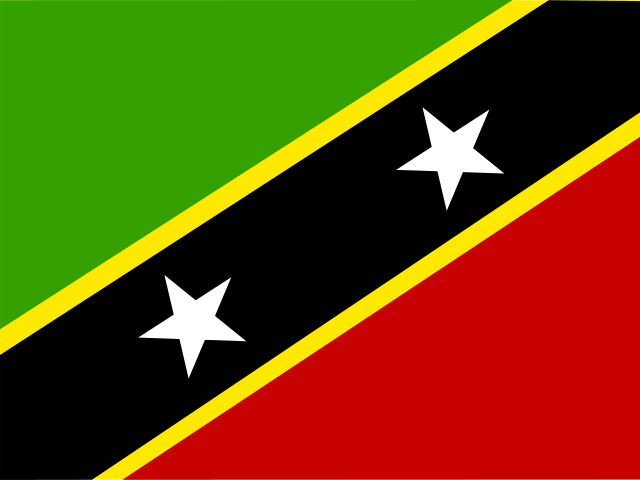
A black diagonal band edged in yellow, bearing two white stars, running from the lower hoist to the upper fly and dividing green above from red below. The constitution does not mention the flag. The Federation's own government reads the green for its fertile lands, the red for its struggle from slavery through colonialism to independence, the yellow for its year-round sunshine and the black for its African heritage, and gives the two white stars hope and liberty and nothing else. It dates the flag to independence day, 19 September 1983, and names Edrice Lewis as its designer.
Saint Kitts and Nevis FACTS ◢
| Capital | Basseterre |
|---|---|
| Continent | North America |
| Population | 46,922 (2025) |
| Area | 261 km² |
| Population density | 180/km² |
| Currency | Eastern Caribbean dollar (XCD) |
| Official language | English |
| Calling code | +1869 |
| Internet TLD | .kn |
| Time zone | UTC-04:00 |
| Drives on the | Left |
| ISO codes | KN / KNA |
DID YOU KNOW? ◢
- It's the smallest country in the Western Hemisphere by both land area and population.
- The two islands are separated by a channel called The Narrows, only about three kilometres wide.
- Brimstone Hill Fortress, a UNESCO World Heritage Site, was nicknamed the 'Gibraltar of the West Indies'.
- Its old sugar-cane railway now runs as a scenic tourist train circling the island of Saint Kitts.
Saint Kitts and Nevis QUICK ANSWERS ◢
What is the capital of Saint Kitts and Nevis?
The capital of Saint Kitts and Nevis is Basseterre.
What is the population of Saint Kitts and Nevis?
Saint Kitts and Nevis had a population of 46,922 in 2025.
What currency does Saint Kitts and Nevis use?
Saint Kitts and Nevis uses the Eastern Caribbean dollar (XCD).
What languages are spoken in Saint Kitts and Nevis?
The official language of Saint Kitts and Nevis is English.
Think you know your flags? Play Flag Daily → · Browse all countries →
MORE ON THE FLAG ◢
The government of Saint Kitts and Nevis publishes a full reading of its own flag, and the reading has a hole in exactly the place a reader will look first.
It gives every colour a meaning. Green is the fertile lands. Red is the struggle from slavery through colonialism to independence. Yellow is the year-round sunshine. Black is the African heritage. It names the designer, Edrice Lewis, and it dates the flag to 19 September 1983, the day the Federation became independent.
Then it reaches the two white stars, and it says they are symbols of hope and liberty. That is the whole of it. On a two-island federation, with two stars on the flag, the state's own account never says the stars are the islands.
Key Takeaways
- The Federation's government publishes a reading of all four colours, names the designer and dates the flag to independence day, 19 September 1983.
- It gives the two white stars hope and liberty and nothing else. No island reading appears anywhere in its account of the flag.
- All four colour readings are written in the first person plural: our fertile lands, our struggle, our year-round sunshine, our African Heritage.
- The constitution of Saint Kitts and Nevis runs to some fifty thousand words and never uses the word flag.
- Nothing found says why the band is diagonal, why it is edged in yellow, or what the flag's proportions are.
Saint Kitts and Nevis has two islands and two stars, and its symbols page joins them nowhere
The stars are the interesting part, because the obvious reading is available and the government declines it.
Saint Kitts and Nevis is a federation of two islands. Its name is both of them. Its flag carries two stars. Every instinct a reader has says the stars are the islands, and that is the reading a reader is likeliest to arrive with.
The Federation's own National Symbols page gives them something else: "The white stars are symbols of hope and liberty".
Nine words, no islands. And it is not that the page is short of room or unwilling to explain: it explains the other four colours, at length and specifically, in the same paragraph.
This is worth stating carefully, because the absence is not a denial. Nothing on the page says the stars are not the islands. What can be said is that the state, given the opportunity to gloss every element of its flag and taking that opportunity four times over, did not take it a fifth time in the one place a reader most expects.
The two readings are also not the same kind of thing. Islands are a fact about the country. Hope and liberty are aspirations, and they sit naturally beside the other four readings, which are about land, history, climate and ancestry. A star that means an island is a label. A star that means hope is a wish.
The same page gives five of the arms' charges a reason
The asymmetry is easiest to see by reading the coat of arms entry on the same page.
The arms get everything. The shield has "a lighter in full sail", which the page stops to explain is "one of the traditional means of transportation". The chevron is red and carries two poinciana flowers, which the same page's National Flower section identifies as the national flower. At the top is the head of a Carib, "supported by the fleur de lis and a rose", and the page says why both are there: "The Caribs were the early inhabitants of the islands, and the fleur de lis and rose signify the French and English influences."
Then the crest. A helmet topped with battlements, and a flaming torch "upheld by the hands of an African, European, and a person of mixed descent". The torch "signifies the struggle and quest for freedom by a people of diverse ethnic origins, but united in purpose".
Then the supporters. Pelicans with wings extended, and beside them a sugarcane plant and a coconut palm, "which are extensively cultivated throughout St. Kitts and Nevis".
Not every charge on the arms is explained. The red chevron, the poinciana flowers, the battlements and the pelicans are named and left at that. But five of them are given reasons, at length, and the reasons are specific: the lighter is a traditional means of transport, the fleur de lis and the rose are the French and English influences, the Carib head is the early inhabitants, the torch is the struggle and quest for freedom, and the sugarcane and the coconut palm are there because they are extensively cultivated throughout the country.
Beside that, the flag gets four colours explained and two stars given nine words. Whatever the page is short of, it is not a willingness to say what a device is for.
Green, red, yellow, black, in the Federation's own words
The rest of the reading is complete enough to be worth quoting rather than summarising.
"Green represents our fertile lands. Red represents our struggle from slavery through colonialism to independence. Yellow represents our year-round sunshine. Black represents our African Heritage."
Four colours, four readings, and one of them is doing far more work than the others.
The red is a compressed history. Where the summaries in circulation give it the struggle for freedom, the state gives it a named sequence with three stages: slavery, then colonialism, then independence. That is a claim about what the country came through and in what order, and it is the only element of this flag's reading that carries a chronology.
The green and the yellow are the plainest. Fertile lands and year-round sunshine are both about the place, and the second is unusually literal: not sun, not warmth, but sunshine that is there all year.
The black is African heritage, capitalised on the page, and it is the reading with the widest reach, because it is about the people rather than the ground they stand on.
Every colour reading is in the first person
Read the four sentences again and notice the pronoun.
Our fertile lands. Our struggle. Our year-round sunshine. Our African Heritage.
A state gloss on a flag can be written the other way, and one next door is. Saint Vincent and the Grenadines' own account of its flag reads "The blue represents the sky and sea. The gold is for warmth, the bright spirit of the people and the golden sands of the Grenadines." Third person throughout, no first-person possessive, and the people appear as a subject the flag is about rather than as the voice speaking. The Kittitian page is written from inside the country, by a government addressing its own people rather than describing its flag to a visitor.
It is a small thing and it changes the register completely. Drop the possessive and the sentence becomes a historical statement about a country. Keep it, as the page does, and it becomes a claim of inheritance made by a people about themselves.
The same page keeps that voice elsewhere. Its account of the coat of arms says the torch held up by an African, a European and a person of mixed descent "signifies the struggle and quest for freedom by a people of diverse ethnic origins, but united in purpose". Again the subject is the people, not the object.
The constitution of Saint Kitts and Nevis never mentions the flag
No Kittitian or Nevisian instrument behind any of this could be found, and the constitution is the first place to look.
The constitution of Saint Kitts and Nevis is scheduled to the Saint Christopher and Nevis Constitution Order 1983. It runs to some fifty thousand words. The word flag does not appear in it once, and neither does emblem, nor anthem, nor coat of arms. Governor-General, by contrast, appears two hundred and ninety-three times, counted without regard to case, which is the check that the text is being read and not merely failing to yield.
No statute could be found either. No online Kittitian or Nevisian statute book could be reached at all, so what stands in place of an instrument is a government web page. That page is doing the work a flag act does elsewhere, and rather more of it, because a flag act describes and is not obliged to explain.
Saint Vincent and the Grenadines, independent four years earlier, is in the same position on the constitutional point: nine chapters, and the word flag in none of them.
The government names the designer, which a state page need not do
The page says the flag "was designed by Edrice Lewis in a national design competition".
That is a plain sentence and it is doing something a state page is not obliged to do. A national flag can be described in full without naming anyone, and describing the winning design rather than crediting the person who drew it costs a page nothing.
The comparison worth having is with the Federation's near neighbour. Saint Vincent and the Grenadines changed its flag in October 1985. Its own government pages name the designer of the flag that was replaced, Elaine Liverpool, whose design was introduced at independence in 1979, and name nobody at all for the one that replaced it. Two Eastern Caribbean states, and one of them credits the designer of its current flag where the other credits only the designer of the flag it replaced.
The date the page gives is worth as much as the name. 19 September 1983 is not a date near independence. It is independence day, and the flag was adopted on it.
The page has been rewritten since, and the flag's reading survived it
The National Symbols page is the only source there is for what this flag means, so how stable it is matters.
The Internet Archive holds a capture of it from 12 December 2022. Setting that beside the live page shows what has moved and what has not.
| December 2022 capture | Live page | |
|---|---|---|
| The flag's five sentences | All five, word for word | All five, word for word |
| Their order | Green, yellow, black, red, stars | Green, red, yellow, black, stars |
| The Federation's motto, in the arms paragraph | "Country Above Self", below the shield | Absent |
| A ranking of the symbols | "(4) four symbols", the flag second | Absent |
The flag's reading has not moved. All five sentences are in both, word for word: "Green represents our fertile lands", "Red represents our struggle from slavery through colonialism to independence", "Yellow represents our year-round sunshine", "Black represents our African Heritage", and "The white stars are symbols of hope and liberty". The only change is the order, with the red sentence moved from fourth place to second.
The paragraph beside it has moved. The 2022 page's account of the coat of arms ends by putting the motto of the Federation, "Country Above Self", below the shield and calling it the foundation of everything else. The current version of that paragraph is rewritten and the motto is not in it at all.
The 2022 page also ranked the symbols in a way the current one does not: "St. Kitts- Nevis National symbols include (4) four symbols: The Coat of Arms, the National Flag, the National Flower, and the National Bird", with the anthem, the national dish and the national wear listed separately as other elements of significance. The flag is second on that list, after the arms.
So the page gets edited, its account of the arms has lost a motto in the last four years, and the flag's five sentences are the part of it that has been left alone.
No source found gives a proportion, an angle or a shade
For all its completeness, the reading stops at the colours and the stars, and everything about the flag's construction is left alone.
Nothing found says why the band runs diagonally rather than horizontally, which is the flag's most distinctive feature and the thing that makes it recognisable at a distance.
Nothing says why the black band is edged in yellow, or why the yellow appears twice in the design and once in the reading. The yellow edging is the only element of this flag that is given a job by the drawing and no job by the words.
Nothing gives a proportion, a ratio, an angle for the diagonal, or a shade for any of the four colours.
And nothing says why the stars are placed on the black band rather than anywhere else, though the effect is plain enough: white on black is the highest contrast available in the palette, and it is where two small charges will read from furthest away.
The absence of a specification is the ordinary condition of a flag defined by a web page rather than a statute. What is unusual here is the pairing. The state has more to say about what its flag means than about what it is, which is the reverse of the arrangement in most countries.
Jamaica's flag is another Caribbean design built on a diagonal, and it takes the idea further: a saltire rather than a single band, so the division runs both ways at once.
Frequently asked questions
What do the colours of the Saint Kitts and Nevis flag mean?
The Federation's own government gives green for the fertile lands, red for the struggle from slavery through colonialism to independence, yellow for the year-round sunshine and black for the African heritage. All four readings are published on its National Symbols page, written in the first person plural, and none of them appears in any Kittitian or Nevisian instrument opened for this article. The constitution does not mention the flag, and no statute on it could be reached.
What do the two stars on the Saint Kitts and Nevis flag mean?
The government says only that "The white stars are symbols of hope and liberty". It does not say they stand for the two islands, which is the reading a reader is likeliest to arrive with. The state's page glosses all four colours in detail and gives the stars nine words, so the omission is not for want of space.
Who designed the flag of Saint Kitts and Nevis?
Edrice Lewis, in a national design competition, according to the government's own National Symbols page. Saint Vincent and the Grenadines, by contrast, names the designer of the flag it replaced in 1985 and nobody for the flag that replaced it.
When was the Saint Kitts and Nevis flag adopted?
On 19 September 1983, which is the day the Federation became independent. The government's page gives that date directly.
Does the constitution of Saint Kitts and Nevis describe the flag?
No. The constitution scheduled to the Saint Christopher and Nevis Constitution Order 1983 runs to some fifty thousand words and never uses the word flag, or emblem, or anthem, or coat of arms. Nor could any Kittitian or Nevisian statute on the flag be reached, so the government's web page is the whole of the state's account that could be found.
Sources
- Government of Saint Kitts and Nevis, National Symbols, the Federation's own page carrying its reading of the flag, the coat of arms and the other national symbols. Retrieved live, 26 August 2026. The same reading appears in the Internet Archive capture of 12 December 2022 at
gov.kn/skn-national-symbols/. - Political Database of the Americas, Georgetown University, Constitution of Saint Kitts and Nevis, 1983, the full English text of the constitution scheduled to the Saint Christopher and Nevis Constitution Order 1983. Read in full and found to contain no flag provision. Retrieved 26 August 2026.
- The Saint Christopher and Nevis Constitution Order 1983, UK Statutory Instrument 1983 No. 881, the instrument whose schedule is that constitution. Published by legislation.gov.uk as a scanned PDF only, with no text layer. Retrieved 26 August 2026.
- Agency for Public Information, Government of St. Vincent and the Grenadines, About St. Vincent and the Grenadines, cited for the one comparative point about naming designers. Read from the Internet Archive capture of 17 December 2007. Retrieved 26 August 2026.
- Ministry of Foreign Affairs, Saint Vincent and the Grenadines, The National Flag, cited for the date of that country's 1985 flag change, for its naming no designer of the current flag, and for the third-person register of its own gloss. Retrieved 26 August 2026.
- Comparative Constitutions Project, Saint Vincent and the Grenadines's Constitution of 1979, read for the comparative point about its constitutional silence on the flag. Retrieved 26 August 2026.
- Comparative Constitutions Project, Saint Kitts and Nevis's Constitution of 1983, checked and found to carry the project's topic index for this country with no constitutional text behind it, which is why the Georgetown transcription is the one used here. Retrieved 26 August 2026.
PLAY ANOTHER →
One quote, one scrambled alphabet. Crack it before tomorrow.
CRACK THE QUOTEDAILYOn This DayOne thing that happened today in history. Every day, a new one.
TODAY IN HISTORYDAILYGuess the CountryThree clues, three guesses. Work out where in the world it is.
THREE CLUESDAILYDaily CodeA short message, hidden in a different cipher every day.
ONE CIPHER A DAY