
Thailand
The only Southeast Asian nation never colonised by a European power, Thailand runs on street-food woks, golden temples and a coastline that turned the beach holiday into an art form.
WHAT THE FLAG MEANS ◢
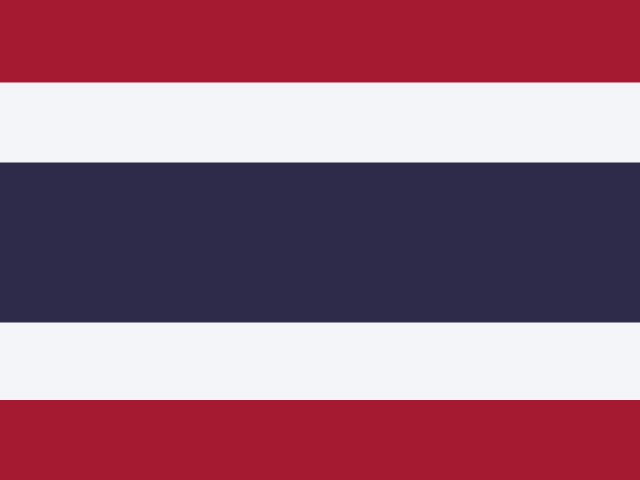
Five horizontal bands of red, white, blue, white and red, the deep blue centre band twice the width of the others, in a flag six parts wide to nine long. The Flag Act prescribes those proportions and colours; the reading of the three colours as nation, religion and monarchy is the traditional one attached to the design rather than a meaning the Act assigns.
Thailand FACTS ◢
| Capital | Bangkok |
|---|---|
| Continent | Asia |
| Population | 71,619,863 (2025) |
| Area | 513,120 km² |
| Population density | 140/km² |
| Currency | Baht (THB) |
| Official language | Thai |
| Calling code | +66 |
| Internet TLD | .th |
| Time zone | UTC+07:00 |
| Drives on the | Left |
| ISO codes | TH / THA |
DID YOU KNOW? ◢
- It was never colonised by a European power, and its old name Siam gave the world 'Siamese' cats and twins.
- Bangkok's full ceremonial name is the longest place name in the world, running to over 160 letters.
- It is one of the planet's largest exporters of rice.
- Muay Thai, its national sport, uses fists, elbows, knees and shins and is nicknamed 'the art of eight limbs'.
Thailand QUICK ANSWERS ◢
What is the capital of Thailand?
The capital of Thailand is Bangkok.
What is the population of Thailand?
Thailand had a population of 71,619,863 in 2025.
What currency does Thailand use?
Thailand uses the Baht (THB).
What languages are spoken in Thailand?
The official language of Thailand is Thai.
Think you know your flags? Play Flag Daily → · Browse all countries →
MORE ON THE FLAG ◢
Ask what the colours of the Thai flag mean and you will be told, almost anywhere you ask, that red is the nation, white is religion and blue is the monarchy. The summary at the top of this page says something close to it, hedged, because that reading really is everywhere.
It is not in the law. Thailand's Flag Act B.E. 2522, passed in 1979 and still the governing statute, describes the flag in five stripes and two numbers and assigns none of them a meaning. The 2017 constitution never mentions it: the Thai word for flag, "ธง", does not occur once in its 279 sections.
But one instrument does explain itself, and it is the one that put the blue there. The Act Amending the Flag Act, B.E. 2460, proclaimed on 28 September 1917, spends most of a gazette page saying why Siam was adding a third colour. The answer is the First World War, and the King's own birthday.
Key Takeaways
- The 1917 Act's preamble gives two reasons for the blue stripe: matching the tricolours of Siam's wartime allies, and blue being the auspicious colour of King Vajiravudh's birth day.
- The Flag Act of 1979 prescribes proportions of 6 by 9 and five stripes, and assigns the colours no meaning at all.
- Vajiravudh is credited with a reading of the tricolour published under a pen name in 1918, but it is longer than the familiar triad; the tidy nation, religion and monarchy version is traced to material collected for his successor in 1927, and to no instrument.
- The upside-down-flag flood story is attributed to a memorial volume of 1953, thirty-seven years after the event, and that is the telling later accounts cite.
- In 2017 the Prime Minister published colour figures in the Royal Gazette, in CIELAB, and called them recommended values.
| Instrument | Royal Gazette | What it prescribes | The middle stripe |
|---|---|---|---|
| Proclamation amending the Flag Act R.S. 129 | vol. 33, pp. 238-239, 26 Nov 1916 | 1 part by 1½; five stripes, red and white, for merchant and public use | Red, double width |
| Act Amending the Flag Act, B.E. 2460 | vol. 34, pp. 436-440, 30 Sept 1917 | 2 parts by 3; centre one third of the width; named "ธงไตรรงค์" | "น้ำเงินแก่", dark blue |
| Flag Act B.E. 2479 | vol. 53, p. 865, 6 Dec 1936 | 6 parts by 9; centre two sixths | "ขาบ", khap |
| Flag Act B.E. 2522 | vol. 96, pt. 67 special, p. 1, 30 Apr 1979 | 6 parts by 9; five stripes in the ratio 1:1:2:1:1 | "น้ำเงินแก่", dark blue |
Why Thailand added a blue stripe in 1917, in the act's own words
The 1917 amendment opens by recalling that Siam had declared war on Germany and Austria-Hungary and joined the allied powers, and that such a moment deserved a lasting object to remember it by.
Then it turns to the flag. The design adopted the year before, it says, was still not dignified enough for the country: "ยังไม่เปนสง่างามพอสำหรับประเทศ". A dark blue stripe should be added to make three colours, "ให้เปนสามสี", after the pattern used by most of "ประเทศที่เปนสัมพันธมิตรกับกรุงสยาม", the countries allied with Siam. The stated purpose is to show that Siam had entered into the allies' shared fortunes and stood of one mind with them.
The act then gives a second reason, in a paragraph of its own. Blue, it says, is "สีอันเปนศิริแก่พระชนมวาร", a colour auspicious to the King's birth day, and is reckoned "สีเครื่องหมายฉะเพาะพระองค์", his personal emblem colour. So it was in every way fit to be part of the flag of the nation.
Two reasons, both stated in the King's name, both printed in the Royal Gazette, and neither of them religion. The same act names the new design "ธงไตรรงค์", the tricolour flag, which is what Thais still call it. Its proclamation date, 28 September, has been Thai National Flag Day since a cabinet resolution of 20 September 2016 picked it out for the coming centenary.
Prince Damrong Rajanubhab, in his account of Thai flags published in 1933, gives the same two reasons in almost the same words: that the flag was not yet dignified enough, that three colours would match those of other nations, and that blue was the colour of the King's own birth day. He doesn't attach any symbolism to the colours either.
The flag Siam had for barely a year
Before 1917 there was a step that usually gets skipped. On 21 November 1916 Vajiravudh proclaimed a new civil flag of five horizontal stripes in red and white only, with a red centre. The elephant flag stayed on for government use.
That proclamation also explains itself, and its complaint is mundane. The old flag, seen from a distance, "เห็นผิดแผกกับธงราชการน้อยนัก", differed very little from the government flag. And the elephant on it was drawn so poorly that you could hardly tell "ว่าช้างหรืออะไร", whether it was an elephant or what.
This is a practical grievance about a hard-to-print charge, published under the King's own name ten months before the tricolour, and it is the reason the eventual flag is a plain striped design with nothing on it that can be upside down.
Ten months and a week separate the two proclamations, and the geometry of the first outlived it. The 1916 proclamation gives the flag as one part wide by one and a half long, the same ratio the 1917 act would write as 2 by 3, and puts two white stripes, each one sixth of the width, one sixth in from the top and bottom edges: that leaves a red centre two sixths wide, which is the 1:1:2:1:1 arrangement the flag still has. The 1917 act kept the arrangement and recoloured the middle band. If the pattern feels familiar, Costa Rica's flag is built the same way: five bands with a double-width centre, the colours moved around.
The flood story, and what it rests on
The best-known origin story is in none of this. It holds that in 1916 the King visited flood-stricken Uthai Thani, saw a subject's elephant flag hoisted upside down, and resolved on a design that could not be flown wrongly.
It is a good story and it may well be true. What can be checked is where later accounts get it from, and that is a memorial volume of 1953 by Chamuen Amoradarunarak, who had served in Vajiravudh's household. That is thirty-seven years after the visit it describes. A page from a Thai national flag museum, captured in 2016 before that site lapsed, is headed with that book's author and title, and the volume itself was not opened here, so nothing is claimed about what was in print before 1953.
Set beside it, the 1916 proclamation gives a different reason for the same decision, in the King's own voice, at the time, in the state gazette. Both can be true at once: a King can have a private prompt and a published rationale. But one is a contemporary document and the other is a recollection at thirty-seven years' distance, and no contemporary record of the flood incident could be reached.
The Flag Act of 1979 gives five stripes and two numbers
The current statute is the Flag Act B.E. 2522, published in the Royal Gazette on 30 April 1979. Section 5 of that Act heads a chapter called "ธงที่มีความหมายถึงประเทศไทยและชาติไทย", flags that signify Thailand and the Thai nation, and lists two of them: the national flag and the naval ensign.
Section 5(1) is the whole of the national flag's legal description. A rectangle "กว้าง ๖ ส่วน ยาว ๙ ส่วน", six parts wide by nine long. The width is divided into five stripes running the length of the cloth. In the middle sits a "แถบสีน้ำเงินแก่", a dark blue stripe, two parts wide. White stripes one part wide flank it, and red stripes one part wide sit outside those. The clause ends by noting that this flag is also called "ธงไตรรงค์".
That is all of it. No colour is glossed, no stripe is given a referent, and none of the other fifty-five sections supplies one. Searched end to end, the word "ศาสนา", religion, does not occur once. That search was run over the Act's proofread Wikisource transcription rather than over the gazette scan; sections 3, 4 and 5(1) of the two were compared word for word and agree.
This is not a statute being terse about everything. Section 43 finds room to specify that the President of the National Assembly's flag carries a constitution on a two-tiered golden salver beneath a yellow great crown, set between red kranok scrollwork. The Act describes at length. It simply never interprets.
So where does nation, religion and monarchy come from?
From Vajiravudh, but at one remove, and not in the tidy form that circulates. He did publish a reading of his own: a piece called Khrueangmai Haeng Trairong, the sign of the tricolour, written under the pen name Wannasamit and printed in a special birthday issue of the magazine Dusit Samit in 1918.
The piece itself could not be read here. Thai Wikipedia points at a Thai Wikisource text of it, but that page has never been written: the address returns a not-found, and a search of Thai Wikisource turns up no copy under another title. Its wording is taken at second hand, from the Thai Wikipedia article that cites it with pen name, magazine, volume and page. An older revision of that same article, reprinted verbatim on a Thai sub-district council website, dates the piece to 1921 instead and carries none of those details; that is one text appearing twice rather than a second account, so 1918 is the year used here.
On that account the King's own reading runs: red is blood willingly given for the nation, white is the purity of the Triple Gem and of the Dhamma, and blue is the King's personal colour. Even in his own version, none of the three is simply an institution.
The Parliament Museum, run by the Secretariat of the House of Representatives, attributes the definitions to Vajiravudh personally and prints a version that differs from that one again: red is "เลือดอันยอมพลีเพื่อธำรงรักษาชาติและศาสนา", blood willingly given to preserve nation and religion; white is the purity of religion; and blue is "สีส่วนพระองค์ของพระมหากษัตริย์", the King's personal colour.
The compressed triad has a date of its own, and it is not 1918. In 1927 King Prajadhipok called for a record on the national flag, "บันทึกเรื่องธงชาติ", to gather opinion on whether the design should change, so that it would not have to change again and again; the Royal Secretariat collected views from various quarters, newspapers included, for the King to rule on. Among the papers of those arguing to keep the tricolour, a more concise gloss appears: one colour each to nation, to Buddhism and to the King. The familiar version is documented there, in a 2003 study of the politics of the Thai flag by Chanida Phromphayak Phueaksom, reached here only through the Thai Wikipedia article that cites it. On that account the tidier reading departs slightly from Rama VI's own composition while still covering the state ideology of nation, religion and monarchy he had spent his reign instilling.
Notice what the compression does. Red carries nation and religion together in the museum's text, not the nation alone. White is the Triple Gem and the Dhamma in the King's own version, not the institution of religion. And blue in both is not the institution of monarchy but the King's own colour, which is precisely what the 1917 act had said it was. One colour to one institution is a later flattening, and by neither account is it what was written.
So the state of it is that Thailand has a widely held reading whose ideology is royal, whose tidy form is credited to other hands in 1927, whose fuller form a state museum still prints, and which no instrument has ever enacted. That is a different thing from a meaning the law assigns, and the cloth itself will not tell you which kind you are looking at. The construction is not unusual either: Laos and Costa Rica both set a double-width central band between two matching edge stripes.
Thailand published colour figures in 2017, and they are not hex codes
The flag's centenary produced something concrete. On 30 September 2017 the Prime Minister, General Prayut Chan-o-cha, issued an announcement that was published in the Royal Gazette four days later.
Its authority is section 44 of the 1979 Act, under which the Prime Minister prepares images of the flags "ไว้เป็นตัวอย่าง", as specimens. The announcement is a specimen of a flag already defined elsewhere, and once you read it that way the wording of its annexe makes sense.
The annexe gives the proportion as "สัดส่วน: 6 ส่วน : 9 ส่วน" and then a table headed "ค่ามาตรฐานการวัดสีธงชาติในลักษณะเป็นค่าแนะนำ", standard values for measuring the flag's colours, in the nature of recommended values. The figures are in the CIELAB D65 system: red at lightness 36.4 with a of 55.47 and b of 25.42, white at 96.61, minus 0.15 and minus 1.48, and blue at 18.63, 7.89 and minus 19.45. Each carries a tolerance of no more than 1.5 delta E. Footnotes specify a colorimetric spectrophotometer at 45/0 or d/8 geometry with the specular component excluded, a D65 illuminant and a ten-degree observer, and name ASTM E1164 as the corresponding standard.
The scope is narrow: the annexe's own sentence limits it to cloth flags that state agencies use, hoist or display in public. And there is no RGB value, no CMYK value and no hex code anywhere in the announcement. The hex codes that circulate as the official Thai flag colours are conversions somebody made from these CIELAB figures. They are a reasonable derivation, and they are not what the Royal Gazette published.
The legal word for the middle stripe has changed twice
One thing a specimen cannot settle is what the blue is called, and the Thai word for it has moved.
The 1917 act calls it "น้ำเงินแก่", dark blue. The 1936 Flag Act, which is where 6 by 9 first appears as the way of writing the same ratio the 1917 act wrote as 2 by 3, says instead "ตรงกลางเปนสีขาบ": the centre is khap, an older Thai colour word for a deep indigo. The word "น้ำเงิน" does not occur in that Act at all. The 1979 Act returns to "น้ำเงินแก่" for the national flag while keeping "ขาบ" for other flags in the same statute.
So across sixty-two years the geometry never moved and the colour word moved twice. That is worth knowing before trusting a modern reproduction of how the flag looked in a given decade, and it is the kind of detail you only notice when you have to redraw a flag from memory. A round of Flag Daily, which shows one flag and gives three guesses at the country, is a quick way to find out which flags you actually hold in your head and which you only think you do.
Frequently asked questions
What do the three colours of the Thai flag mean?
By the reading in general use, red stands for the nation, white for religion and blue for the monarchy. No Thai law assigns it: the Flag Act B.E. 2522 sets out the flag's proportions and stripes and gives none of the colours a meaning. King Vajiravudh is credited with a reading of his own, published under a pen name in 1918, but it is longer than that and differs from it. The compressed one-colour-one-institution version is traced to material collected for King Prajadhipok in 1927.
The Parliament Museum's version of the King's gloss differs in two places: red is blood given to preserve nation and religion, and blue is the King's personal colour rather than the institution of monarchy.
Why did Thailand add blue to its flag in 1917?
The Act Amending the Flag Act B.E. 2460 states its own reasons. A third colour would make the flag match the tricolours used by most of the countries allied with Siam, which had itself just declared war on Germany and Austria-Hungary, and would show that Siam shared their cause. Second, blue was the auspicious colour of the King's birth day and was reckoned his personal emblem colour.
Is the colour of the Thai flag officially specified?
Yes, since 2017, with a qualification the announcement itself supplies. An announcement of the Prime Minister published in the Royal Gazette on 4 October 2017 gives CIELAB D65 figures for the three colours with a tolerance of 1.5 delta E, and describes them as recommended values, for state agencies that display cloth flags in public. It publishes no RGB, CMYK or hex equivalent.
What is the Thai flag called in Thai?
"ธงไตรรงค์", Thong Trairong, meaning the tricolour flag. The name was given by the 1917 act that created the design, and the Flag Act B.E. 2522 repeats it, noting that the national flag is also called by that name.
Did the Thai flag really change because one was flown upside down?
The story is that King Vajiravudh saw an elephant flag hoisted the wrong way up during a flood in 1916 and decided on a design that could not be reversed. Later accounts go back to a 1953 memorial volume by a man who had served in Vajiravudh's household, thirty-seven years after the event, and no contemporary document recording the incident could be reached.
The proclamation of November 1916 gives a different reason at the time: the old flag looked too much like the government flag from a distance, and the elephant on it was drawn so badly it was barely recognisable.
Sources
- Royal Gazette, พระราชบัญญัติธง พ.ศ. ๒๕๒๒ (Flag Act B.E. 2522), vol. 96, part 67, special issue, p. 1, 30 April 1979 - retrieved 26 August 2026 from the Internet Archive capture of 13 August 2025, the live host being unreachable. Read as page images, with a parallel proofread transcription checked at Thai Wikisource.
- Royal Gazette, พระราชบัญญัติแก้ไขพระราชบัญญัติธง พระพุทธศักราช ๒๔๖๐ (Act Amending the Flag Act, B.E. 2460), vol. 34, pp. 436-440, 30 September 1917 - retrieved 26 August 2026 from the Internet Archive capture of 2 September 2025.
- Royal Gazette, ประกาศเพิ่มเติมแลแก้ไขพระราชบัญญัติธง รัตนโกสินทรศก ๑๒๙, vol. 33, pp. 238-239, 26 November 1916 - retrieved 26 August 2026 from the Internet Archive capture of 25 December 2022.
- Royal Gazette, พระราชบัญญัติธง พุทธศักราช ๒๔๗๙ (Flag Act B.E. 2479), vol. 53, p. 865, 6 December 1936 - retrieved 26 August 2026 from the Internet Archive capture of 11 April 2022.
- Royal Gazette, ประกาศสำนักนายกรัฐมนตรี เรื่อง รูปธงชาติตามพระราชบัญญัติธง พ.ศ. ๒๕๒๒, vol. 134, special part 245 ง, p. 1, 4 October 2017 - retrieved 26 August 2026 from the Internet Archive capture of 24 June 2024.
- Prince Damrong Rajanubhab, อธิบายเรื่องธงไทย (An Explanation of Thai Flags), 1933, proofread transcription of the printed edition at Thai Wikisource - retrieved 26 August 2026.
- Parliament Museum, Secretariat of the House of Representatives, ความเป็นมาของธงชาติไทย (The Origins of the Thai National Flag) - retrieved 26 August 2026.
- Constitution of the Kingdom of Thailand, B.E. 2560 (2017), Thai text at Thai Wikisource, searched in full: the word "ธง" does not occur in it - retrieved 26 August 2026. The Comparative Constitutions Project's English rendering was searched too, with the same result.
- Sinlapa Watthanatham (Silpa Mag), "ธงชาติไทย" เปลี่ยนมาใช้ "ธงไตรรงค์" เมื่อ 28 กันยายน 2460, for the cabinet resolution of 20 September 2016 establishing Thai National Flag Day - retrieved 26 August 2026 from the Internet Archive capture of 15 September 2025.
- Thai National Flag Museum, เหตุที่พระบาทสมเด็จพระมงกุฏเกล้าเจ้าอยู่หัว ทรงเปลี่ยนธงชาติไทย, whose page on why the King changed the flag is headed with the author and title of the 1953 memorial volume - the domain has since lapsed and been re-registered, so this was retrieved 26 August 2026 from the Internet Archive capture of 6 March 2016. Only that heading was readable: the article body is an image, and the volume itself was not opened.
- Thai Wikipedia, ธงชาติไทย (Thai national flag) - retrieved 26 August 2026. Used, and named in the text, for the two things no primary source opened here carries. Its account of Khrueangmai Haeng Trairong and of that piece's publication details is footnoted to a 1974 cremation-volume printing of Vajiravudh's daily records. Its account of the 1927 record on the national flag, and of the state ideology the tricolour's colours were meant to carry, is footnoted to Chanida Phromphayak Phueaksom, การเมืองในประวัติศาสตร์ธงชาติไทย (Politics in the History of the Thai National Flag), Matichon, B.E. 2546 (2003), pp. 96 and 101. Neither of those two works was opened. The Thai Wikisource text it links for the 1918 piece has not been written: that address returned a not-found on 26 August 2026, and Thai Wikisource does not hold a copy elsewhere either.
PLAY ANOTHER →
Five questions a day. Everyone gets the same five.
FIVE QUESTIONSDAILYDaily CodeA short message, hidden in a different cipher every day.
ONE CIPHER A DAYDAILYGuess the CountryThree clues, three guesses. Work out where in the world it is.
THREE CLUESDAILYOn This DayOne thing that happened today in history. Every day, a new one.
TODAY IN HISTORY