
The Bahamas
An archipelago of hundreds of islands and cays scattered across turquoise shallows, The Bahamas sits just off Florida and made its name on clear water, coral and pink-sand beaches.
WHAT THE FLAG MEANS ◢
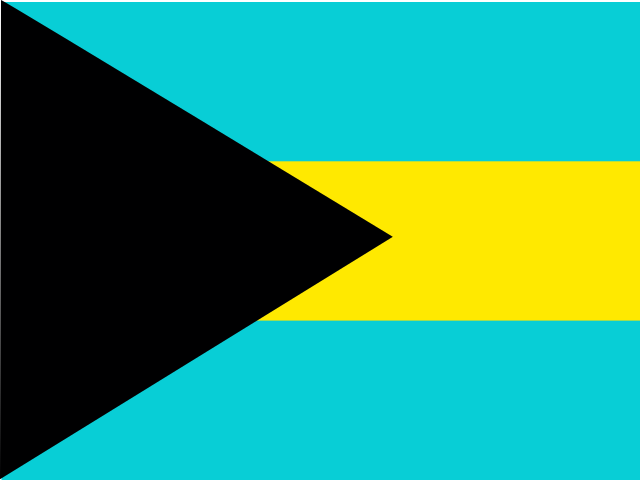
Three horizontal bands of aquamarine, gold and aquamarine with a black triangle at the hoist. The constitution has no flag provision. The Flags and Coat of Arms (Regulation) Act describes the flag in one line of heraldry, as azure with a gold fess and a black pile issuing from the hoist, and assigns no part of it any meaning. The government's own account reads the gold for the land and the aquamarine for the sea, together the resources the Bahamian people mean to develop and process, and the black for the vigour and force of a united people, with the triangle itself standing for that enterprise and determination.
The Bahamas FACTS ◢
| Capital | Nassau |
|---|---|
| Continent | North America |
| Population | 403,033 (2025) |
| Area | 13,878 km² |
| Population density | 29/km² |
| Currency | Bahamian dollar (BSD) |
| Official language | English |
| Calling code | +1242 |
| Internet TLD | .bs |
| Time zone | UTC-05:00 |
| Drives on the | Left |
| ISO codes | BS / BHS |
DID YOU KNOW? ◢
- It is made up of around 700 islands and cays, though only a few dozen are inhabited.
- Columbus made his first landfall in the Americas here in 1492.
- Its Dean's Blue Hole is one of the deepest known underwater sinkholes in the world.
- The Exumas are famous for their beach-dwelling swimming pigs.
The Bahamas QUICK ANSWERS ◢
What is the capital of the Bahamas?
The capital of the Bahamas is Nassau.
What is the population of the Bahamas?
The Bahamas had a population of 403,033 in 2025.
What currency does the Bahamas use?
The Bahamas uses the Bahamian dollar (BSD).
What languages are spoken in the Bahamas?
The official language of the Bahamas is English.
Think you know your flags? Play Flag Daily → · Browse all countries →
MORE ON THE FLAG ◢
The Bahamas describes its national flag in nine words, and they are not the nine words anyone quotes.
"Azure a Fess Or issuing from the dexter a Pile Sable."
That is the entire legal description of the flag, and it sits in the Schedule to an Act whose subject is not the design at all. The Flags and Coat of Arms (Regulation) Act is about what you may not do to the flag: mutilating it, insulting it, using it improperly. The description is there because the offences need something to attach to.
Key Takeaways
- The whole statutory description of the Bahamian flag is one line of heraldic blazon in the Schedule to the Flags and Coat of Arms (Regulation) Act, which commenced on the day of independence.
- That blazon says Azure, which in heraldry is blue. The Act never uses the word aquamarine, and neither do the Regulations made under it.
- The Act assigns no meaning to anything. Every reading of the colours comes from the government's own information pages instead, last capturable in 2002.
- Those pages give gold for the land and aquamarine for the sea, which is not the same as the reading in general circulation.
- The constitution of The Bahamas runs to about fifty thousand words and never uses the word flag.
The blazon of The Bahamas' flag, unpacked
Nine words of heraldry do a lot of work, so it is worth taking them apart.
Azure is the field, the background of the whole flag. Fox-Davies lists the heraldic tinctures as "gules (red), azure (blue), vert (green), purpure (purple)" and black, "which is known as sable", so azure is blue and sable is black.
A Fess Or is a broad horizontal band, in gold, across the middle. Fox-Davies defines it as "a broad horizontal band crossing the escutcheon in the centre" and adds that "It is seldom drawn to contain a full third of the area of the shield", so the convention is about a third and the practice is a little less. That is why the flag reads as three bands rather than as a stripe on a background. Or is gold.
Issuing from the dexter a Pile Sable is the black triangle. A pile, in Fox-Davies, is "a triangular wedge usually (and unless otherwise specified) issuing from the chief" - from the top - which is exactly why the Bahamian blazon has to say where this one comes from instead. Its shape is left open: "the angles and proportions of the pile are very much at the discretion of the artist". Dexter is not the viewer's right: "In heraldry, dexter and sinister are determined, not from the point of view of the onlooker, but from that of the bearer of the shield", so the dexter side is the viewer's left, and on a flag that is the hoist. Sable is black, per the same list.
So: a blue field, a gold band across the middle, and a black wedge driven in from the hoist. That is the flag, and that is all the Act says about it.
What the Act does not say is at least as long a list. It fixes no proportions, no ratio of height to length, no size or angle for the pile, which heraldry leaves to the artist, no exact depth for the fess, no colour standard or numeric value for any of the three colours, and no meaning for any part of it.
Azure is blue, and the flag is not
The colour word in the instrument is the one that does not survive into ordinary description.
Azure is blue. It is one of the fixed heraldic tinctures and it has meant blue for as long as blazon has existed. The word aquamarine appears nowhere in the Flags and Coat of Arms (Regulation) Act, and nowhere in the Regulations made under it.
Aquamarine is what the government itself calls the colour everywhere else. Its own description of the flag, as it reads at the most recent capture that can be obtained, from November 2002, with the live site now answering HTTP 403 to an ordinary request: "The design of the Bahamian flag is a black equilateral triangle against the mast superimposed on a horizontal background made up of two colours on three equal stripes, aquamarine, gold and aquamarine."
Two Bahamian government texts, then, and they do not use the same colour word. One is the statute and says azure. The other is the state's own account of the same flag and says aquamarine three times over.
This is not a dispute about what the flag looks like, and it is not an argument that the flag as flown is navy blue. But a blazon is a specification, and a specification that says azure has said blue, so the exact shade of the flag as flown is fixed by nothing in Bahamian law.
Notice also that the government's description gives things the blazon does not. It calls the triangle equilateral, where a heraldic pile has no fixed angle. It calls the bands three equal stripes, where the blazon leaves the fess to convention. It is a description of the object rather than a reading of the instrument.
The Bahamas put its flag in the Schedule to an Act about insulting it
The Flags and Coat of Arms (Regulation) Act is short and its priorities are visible from its arrangement of sections.
Section 3 makes it an offence to insult the National Flag. Section 4 prohibits improper use of it. Section 5 does the same for the Governor-General's Flag and the Prime Minister's Flag. Section 6 is forfeiture and section 7 is the power to make regulations. The description of the flag is not a section at all. It is Part I of the Schedule, reached only because section 2 defines the National Flag as "the Flag of The Bahamas described in Part I of the Schedule".
Its long title says the same thing: an Act to regulate the use of the flags and the Coat of Arms, and to provide for matters incidental. Not an Act to establish them.
The dates are worth having. The Act is number 20 of 1973. It was assented to on 4 July 1973 and it commenced on 10 July 1973, which is the day The Bahamas became independent. The flag got its legal description on the country's first day, in an Act about what it would be an offence to do to it.
The Schedule does four things in four Parts, and the flag is one of them. Part II is the Governor-General's Flag. Part III is the Prime Minister's Flag, blazoned as the national flag "charged in the sinister with a Mace erect counterchanged" over a sun in base (the text as published reads "Basem", which is why the last words are given here unquoted). Part IV is the Coat of Arms, which gets by far the longest entry: the Santa Maria on wavy bars, a conch shell before a panache of palm fronds, a marlin and a flamingo as supporters, and the motto "Forward, Upward, Onward Together".
The Coat of Arms is the only one of the four with a motto. The Governor-General's Flag carries lettering too, a scroll inscribed Commonwealth of The Bahamas. The other two, the national flag and the Prime Minister's, carry no words at all.
Two instruments, two blazons of the same flag
The Regulations made under the Act blazon the flag a second time, and not in the same words.
The Flags and Coat of Arms Regulations, 1991 set out the flags of the Royal Bahamas Defence Force, and among them is the Jack, blazoned in what is unmistakably the national flag's own words with one addition: "Azure a Fess or Overall a Pile issuing from the dexter Sable". The Regulations do not say the Jack is the national flag; they list it among flags for the Defence Force's use, and the identification is an inference from the blazon.
Set the two side by side.
| Instrument | Blazon of the national flag |
|---|---|
| Flags and Coat of Arms (Regulation) Act 1973, Schedule Part I, the National Flag | Azure a Fess Or issuing from the dexter a Pile Sable |
| Flags and Coat of Arms Regulations 1991, First Schedule Part IV, the Jack (which the Regulations do not identify as the national flag) | Azure a Fess or Overall a Pile issuing from the dexter Sable |
One word is in the second and not the first, and it is not a decorative one. The order moves too: in 1991 "issuing from the dexter" sits after the pile rather than before it, which settles what it attaches to. In the 1973 wording it sits between the fess and the pile and could in principle attach to either.
In blazon, Overall places a charge across everything beneath it, so the 1991 version says explicitly that the black pile lies over the gold fess. Fox-Davies uses the phrase in blazons throughout and never stops to define it, which is a fair measure of how settled it is. The 1973 version leaves that relationship to be inferred from the order of the words.
The same divergence appears again in the same Regulations, in the White Ensign, which carries the national flag in its first quarter and blazons it "Azure a Fess or overall a Pile issuing from the dexter Sable".
Nothing turns on it for anyone flying the flag. It is worth recording because these are the only two distinct descriptions of this flag in the whole of Bahamas Laws On-Line, searched under Flag, Coat of Arms, National Symbol, Emblem and Anthem, they were made under the same Act eighteen years apart, and they are not the same sentence.
Nine words on the design, and pages on the conduct
The proportion of the Act given to each thing is the point, and it is easiest to see by weighing them.
Nine words describe the flag. Everything else in the Act and its Regulations is about how people must behave towards it.
Section 3 makes it an offence to mutilate, cut, tear or burn the flag, or to deface it "whether by writing, printing or stamping thereon or otherwise", or "by any spoken words" to insult it or bring it into contempt or ridicule. The penalty is a fine of up to five hundred dollars, or six months' imprisonment, or both. The defence is on the accused: he escapes only if he "can prove that the act was done with lawful justification or excuse", or that the words were spoken without intent to insult.
Section 4 makes it an offence to put the flag, or the Coat of Arms, or any part of either design, on goods you make or sell, or to import goods carrying it, or to use it in a trade in a way suggesting you are authorised to. The Regulations supply the licence form for doing any of that lawfully, and it expires on the 31st of December after it is issued.
The 1991 Regulations then go a long way into ordinary conduct. The flag is to be flown between sunrise and sunset, subject to a proviso letting the Minister permit otherwise, and if flown at night it must be "properly illuminated". It must be kept clean and in a reasonable state of repair. Flown alongside other flags it is to be in a more prominent position than they are, except where regulation 9(3) applies. Regulation 9 is the foreign-flags rule: no flag of any foreign nation may be flown in The Bahamas unless the Bahamian flag is flown too, though regulation 9(2) disapplies that for flags flown at a foreign nation's embassy, consulate, mission or military establishment. Where foreign flags are flown alongside the national flag, regulation 9(3) puts them on separate staffs at the same height and at about the same size.
And there is one rule that reads oddly against section 3 until you see how the two fit. Regulation 4(3): when the flag "becomes worn, faded or otherwise unfit for use it shall be disposed of privately by burning".
Burning the flag is named in the first offence the Act creates and is the only disposal the Regulations permit. Nothing in either instrument reconciles them. The obvious reading is that a regulation requiring burning supplies the lawful excuse section 3 leaves open, and that "privately" is what keeps it clear of the conduct section 3 is aimed at, but neither text says so and no case was found that settles it.
Nobody in the Act says what any of it means. The government does
The Act assigns no meanings, and the Regulations assign none either. Every reading of the Bahamian flag's colours comes from somewhere else, and the somewhere else is the government's own information pages, in the state they were in when they were last capturable.
Its account of the flag continues: "Black, a strong colour, represents the vigour and force of a united people; the triangle pointing represents the enterprise and determination of the Bahamian people to develop and process the rich resources of land and sea, symbolised by gold and aquamarine, respectively."
The last word decides it. Respectively. Land and sea, gold and aquamarine, in that order. Gold is the land, and aquamarine is the sea.
That is not the reading in general circulation, which usually gives the gold to the sand or the sun. Sand is a beach, which is where land meets sea. The government's reading is broader than that and it is about resources rather than scenery. The whole sentence is about developing and processing what the land and the sea hold.
The black gets two things and neither is a place. It is "a strong colour" standing for the vigour and force of a united people, and then the triangle itself, as a shape, stands for enterprise and determination.
That second reading is unusual on this beat. A state gloss that reads a geometric figure rather than a colour is not what this subject usually turns up, and the meaning this one attaches is forward-looking: not what the country is, but what its people intend to do. A flag that means a resolve rather than a place is rare enough to be worth noticing.
None of it is in the Act. The government published it and no Bahamian instrument enacts it. Whether the wording still stands could not be checked here: the government's site answers an HTTP 403 to an ordinary request, and the last capture of that page is from 2002.
The constitution never mentions the flag
The Bahamas has a written constitution and the flag is not in it.
The instrument is the constitution scheduled to the Bahamas Independence Order 1973, read here in the Comparative Constitutions Project's transcription, and it runs to about fifty thousand words. The word flag does not appear in it once. Neither does emblem, nor anthem, nor coat of arms. As a check that the text is being read properly rather than failing to extract, Governor-General appears in it two hundred and eight times.
That is the ordinary pattern for a Commonwealth Caribbean constitution of the period. Saint Vincent and the Grenadines, independent six years later, is in the same position: its constitution runs to nine chapters and never uses the word flag either.
Which leaves the Bahamian flag described twice and explained never, at least by anything with legal force. If you want the design, read nine words of blazon. If you want the meaning, read a government web page. There is no document that does both.
Another Caribbean flag built the same way, from horizontal bands with a triangle driven in from the hoist, is Cuba.
Frequently asked questions
What do the colours of the Bahamian flag mean?
No Bahamian statute says. The Flags and Coat of Arms (Regulation) Act describes the flag in nine words of heraldry and assigns no meaning to any part of it. The government's own information pages do assign meanings: gold for the land and aquamarine for the sea, taken together as the rich resources the Bahamian people intend to develop and process, and black for the vigour and force of a united people.
What does the black triangle on the Bahamian flag mean?
The government gives it two readings at once. The colour black, described as a strong colour, stands for the vigour and force of a united people. The triangle as a shape stands for the enterprise and determination of the Bahamian people to develop and process the resources of land and sea. Neither reading is in the Act, which calls the triangle a Pile Sable and stops.
What law describes the flag of The Bahamas?
The Flags and Coat of Arms (Regulation) Act, Act 20 of 1973, at Part I of its Schedule. The description is one line of heraldic blazon: Azure a Fess Or issuing from the dexter a Pile Sable. The Act was assented to on 4 July 1973 and commenced on 10 July 1973, the day of independence. Its own subject is offences and improper use rather than design.
Is the Bahamian flag blue or aquamarine?
The statute says Azure, which in heraldry is blue, and the word aquamarine appears nowhere in the Act or in the Regulations made under it. The government's own description of the flag says aquamarine. So the shade of the flag as flown is not fixed by any Bahamian instrument opened for this article.
Does the constitution of The Bahamas describe the flag?
No. The constitution scheduled to the Bahamas Independence Order 1973 runs to about fifty thousand words and never uses the word flag, or emblem, or anthem, or coat of arms. The flag is left entirely to the Flags and Coat of Arms (Regulation) Act.
Sources
- Government of The Bahamas, Flags and Coat of Arms (Regulation) Act, Chapter 32, Act 20 of 1973, sections 1 to 7 and the Schedule, from Bahamas Laws On-Line, the government's own legislation portal. Retrieved 26 August 2026.
- Government of The Bahamas, Flags and Coat of Arms Regulations, 1991, S.I. 89 of 1991, made under section 7 of the Act, carrying the second blazon of the national flag as the Defence Force Jack. Retrieved 26 August 2026.
- Government of The Bahamas, The Flag of The Bahamas, the government's own description and reading of the flag. Read from the Internet Archive capture of 15 November 2002, the live site being unreachable. Retrieved 26 August 2026.
- Government of The Bahamas, National Symbols, the index those pages belonged to, listing the flag, the coat of arms, the anthem, the pledge, the national song, tree, fish, bird and flower. Read from the Internet Archive capture of 8 February 2002. Retrieved 26 August 2026.
- Comparative Constitutions Project, Bahamas (The)'s Constitution of 1973, the constitution scheduled to the Bahamas Independence Order 1973, read in full and found to contain no flag provision. Distributed by constituteproject.org, Oxford University Press. Retrieved 26 August 2026.
- Arthur Charles Fox-Davies, A Complete Guide to Heraldry, Project Gutenberg's transcription of the 1909 edition, for the tinctures ("gules (red), azure (blue), vert (green), purpure (purple)" and black, "which is known as sable"), the fess ("a broad horizontal band crossing the escutcheon in the centre... seldom drawn to contain a full third of the area of the shield"), the pile ("a triangular wedge usually (and unless otherwise specified) issuing from the chief", whose "angles and proportions ... are very much at the discretion of the artist") and dexter ("determined, not from the point of view of the onlooker, but from that of the bearer of the shield"). Retrieved 26 August 2026.
- Comparative Constitutions Project, Saint Vincent and the Grenadines's Constitution of 1979, read for the one comparative sentence and found, like the Bahamian constitution, to contain no flag provision. Retrieved 26 August 2026.
- Government of The Bahamas, Bahamas Laws On-Line, index of legislation by alphabetical order, used to establish that the Flags and Coat of Arms (Regulation) Act and its 1991 Regulations are the only Bahamian instruments on the subject. Retrieved 26 August 2026.
PLAY ANOTHER →
One quote, one scrambled alphabet. Crack it before tomorrow.
CRACK THE QUOTEDAILYDaily CodeA short message, hidden in a different cipher every day.
ONE CIPHER A DAYDAILYDaily TriviaFive questions a day. Everyone gets the same five.
FIVE QUESTIONSDAILYGuess the CountryThree clues, three guesses. Work out where in the world it is.
THREE CLUES