
The Gambia
The smallest country on mainland Africa, The Gambia is essentially a ribbon of land wrapped around its namesake river, almost completely surrounded by Senegal.
WHAT THE FLAG MEANS ◢
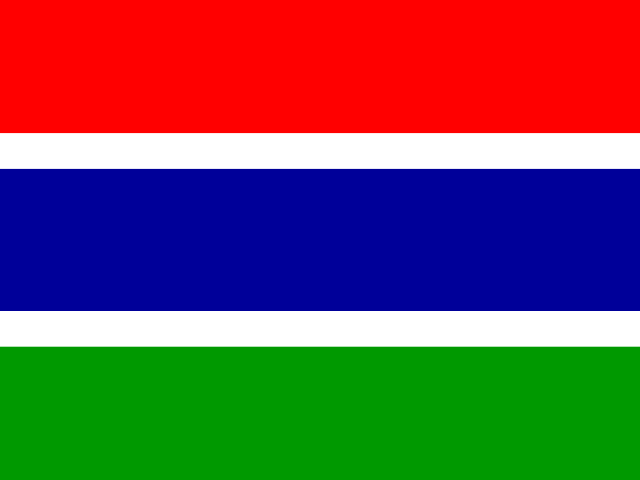
Red, blue and green horizontal bands separated by thin white stripes. Schedule 1 to the constitution sets the flag at twenty-seven units across by eighteen down and gives each stripe its width from the top - red six units one third, white one, blue four units one third, white one, green six units one third - and assigns no colour a meaning. Those five widths sum to nineteen units, one more than the depth the same schedule gives the flag, and nothing in it resolves the difference. The colours are conventionally read as red for the sun and savannah, the central blue band for the River Gambia, green for the land and forests, and the white lines for unity and peace, and none of those readings is in any Gambian instrument.
The Gambia FACTS ◢
| Capital | Banjul |
|---|---|
| Continent | Africa |
| Population | 2,822,093 (2025) |
| Area | 11,300 km² |
| Population density | 250/km² |
| Currency | Dalasi (GMD) |
| Official language | English |
| Calling code | +220 |
| Internet TLD | .gm |
| Time zone | UTC±00:00 |
| Drives on the | Right |
| ISO codes | GM / GMB |
DID YOU KNOW? ◢
- It is the smallest country on the African mainland.
- The nation is a narrow strip following the River Gambia and is enclosed by Senegal on nearly every side.
- It is one of Africa's top destinations for birdwatchers, with hundreds of species recorded in a tiny area.
- The river that names it is navigable far inland, historically making it a key trade artery.
The Gambia QUICK ANSWERS ◢
What is the capital of the Gambia?
The capital of the Gambia is Banjul.
What is the population of the Gambia?
The Gambia had a population of 2,822,093 in 2025.
What currency does the Gambia use?
The Gambia uses the Dalasi (GMD).
What languages are spoken in the Gambia?
The official language of the Gambia is English.
Think you know your flags? Play Flag Daily → · Browse all countries →
MORE ON THE FLAG ◢
The Gambia's constitution is precise about its flag, and it never once says what the flag means.
Section 3(1) is one line: the National Flag shall be a flag of the design set out in Schedule 1. Turn to that schedule and you get a specification, in units. The flag is twenty-seven units across and eighteen units down. Each of its five horizontal stripes gets a colour and a width, listed from the top.
Then add the five widths up. The schedule gives red six units one third, white one unit, blue four units one third, white one unit, and green six units one third. That comes to nineteen units, in a flag the same schedule has just fixed at eighteen units down.
Key Takeaways
- Section 3(1) of The Gambia's constitution defines the flag by reference to Schedule 1, which gives its dimensions in units and assigns no colour any meaning.
- The five stripe widths as the schedule writes them sum to nineteen units. The same schedule sets the flag at eighteen units down.
- Several one-number changes to the schedule would close it and nothing in it chooses between them, so what the drafters meant cannot be recovered from the text.
- The Gambia's independence constitution of 1965 contained no flag provision at all. The schedule first appears with the Second Republic.
- The Final Draft Constitution of 2020 would have deleted the schedule and defined the flag by reference instead. It did not become law, so the schedule and its arithmetic stand.
The Gambia's constitution draws its flag and explains nothing
Chapter I of the constitution is headed The Republic and it runs to three sections. The first declares The Gambia a sovereign secular republic. The second is the Public Seal. The third is the National Flag and the anthem.
Two of those three symbols are defined by pointing at something that already exists. The Public Seal "shall be the seal in existence immediately before this Constitution comes into force". The National Anthem "shall be the anthem in use immediately before this Constitution comes into force". Neither is described and neither is explained.
The flag is the exception. It is the one symbol of the three that the constitution actually draws, and Schedule 1 holds the drawing.
The schedule opens by announcing that "The National Flag of The Gambia shall be a flag of the following design", then gives the size: the flag "shall measure twenty-seven units across and eighteen units down". Then it says the flag "shall be divided into horizontal stripes which shall have the following Colours and dimensions from the top to the bottom", and lists five of them: "Red- six units one third", "White- one unit", "Blue- four units one third", "White- one unit", "Green- six units one third".
That is the whole of it. Five colours in order, five widths, an overall size, and not a word about what any of them stands for. No sun, no river, no savannah, no peace. The constitution treats the flag as a drawing to be reproduced rather than as a symbol to be read.
Notice also what the schedule is called. Section 3(1) points at "the design set out in Schedule 1", and the schedule's own heading is DIMENSIONS OF THE NATIONAL FLAG. It is announced as a design and titled as measurements, and what follows is measurements.
Nineteen units in an eighteen-unit flag
Take the schedule at its word and do the arithmetic.
Six units one third, plus one unit, plus four units one third, plus one unit, plus six units one third. The three fractions make one whole unit between them. The whole numbers make eighteen. Nineteen.
| Stripe | Width in the schedule |
|---|---|
| Red | six units one third |
| White | one unit |
| Blue | four units one third |
| White | one unit |
| Green | six units one third |
| Total | nineteen units |
| The schedule's own depth for the flag | eighteen units |
The five stripes together are one unit deeper than the flag they are dividing. Something in the schedule does not close.
There is a reading that would rescue it, and it fails on one line. Suppose "six units one third" means six units, which is one third. Six is indeed a third of eighteen, and so red would work, and so would green. But blue is given as four units one third, and four is not a third of eighteen. Under that reading the blue stripe contradicts itself in five words.
More than one small change to the schedule's own numbers would close it, and nothing in the schedule chooses between them.
Drop the three fractions and the widths become six, one, four, one, six, which comes to exactly eighteen. Or keep the fractions and change a single number: the blue at three units one third closes it, and so does the red at five units one third, and so does the green. Each of those single-number changes is a one-word edit and each produces a visibly different flag, because a band that loses a whole unit out of eighteen loses an eighteenth of the flag's depth.
There is a fifth way, and it is the only one that changes no stripe at all: read the flag as nineteen units down rather than eighteen. That has the schedule's stripes exactly as written and contradicts its own second sentence, and it also gives a flag of twenty-seven by nineteen, where twenty-seven by eighteen is the clean three to two the flag is drawn at. It closes the arithmetic by breaking the shape.
The schedule fixes no shade, no variant and no meaning
Beyond the arithmetic there is a longer list of things a specification of this kind would normally carry and this one does not.
It does not name a shade. Red, white, blue and green are given as bare colour words, with no reference to any colour standard and no numeric value.
It does not say which edge is the hoist, though with horizontal stripes running the full width that matters less than it would on a flag with a device.
It does not describe a variant of any kind: no ensign, no presidential standard, no rule about flying the flag at half mast, and no offence for misusing it. Compare the Public Seal one section earlier, which gets an express prohibition on anyone else using its design or anything resembling it. The constitution does not protect the flag that way.
And it assigns no meaning. That is the answer to the question people actually ask about this flag, and it is a firm answer rather than a silence about a silence: the instrument that specifies the flag to the third of a unit declines to say what the red, the white, the blue or the green are for.
The readings in general circulation give red for the sun or the savannah, the central blue band for the River Gambia, green for the land and its forests, and the white lines for peace and unity. The river reading is the one with the strongest claim on common sense, since the country is a strip of land either side of that river.
None of the four is in the constitution, and none is on the government's own page either, which carries two headings, a picture of the flag, a picture of the arms and no prose at all.
Another flag built from five horizontal stripes, with two thin white lines separating a narrower centre band from two broad ones, is Botswana.
The constitution names three national symbols and leaves out the coat of arms
Chapter I gives The Gambia three symbols: the Public Seal, the National Flag and the National Anthem. It does not give it a coat of arms.
The anthem is named and left undescribed. The arms are not named at all: the words coat of arms appear nowhere in the constitution, in either of the two texts read here.
The country does have arms. The government's own portal has a page headed National Flag & Symbol, and what that page holds is two headings with a picture under each and no prose at all. Both pictures were downloaded from the archived page and opened. The first, under the heading National Flag, is the flag: red, white, blue, white and green in that order. The second, under a heading mistyped Code of Armd, is the arms of The Gambia, two red lions holding a green shield charged with a crossed axe and hoe, an oil palm above the helm, and a scroll below reading PROGRESS, PEACE, PROSPERITY.
So the arms are pictured on a state page, with a motto on them, and named nowhere in the state's founding document. The flag is in both.
The 2020 draft would have changed that too. Its section 4(1) lists four national symbols rather than three, and the Coat of Arms is the one it adds.
So the symbol chapter as it stands does three different things with three symbols and a fourth thing with a fourth. It draws the flag. It points at the seal and the anthem. And it passes over the arms in silence.
One more thing in the copy the Ministry of Justice publishes settles whether anyone has been back to Schedule 1. That copy marks its amendments in the margin, and the only amending act it ever names is Act No. 6 of 2001. The marker appears forty-one times, two of them printed with a zero for the o in of. Nine of those records are deletions rather than edits, covering six provisions: sections 51 to 57 struck out as a block, sections 179 and 181, two subsections and a paragraph. Three of the six are recorded twice, once on the contents page and once in the body, which is why the records outnumber the provisions.
Schedule 1 carries no marker at all. Neither does the constituteproject text, which is prepared from a different source and published as the constitution of 1996 with amendments through 2018. On the evidence of both copies, nobody has been back to the flag schedule since it was enacted.
The Gambia's independence constitution had no flag provision at all
The schedule is younger than the flag.
The Gambia became independent on 18 February 1965 under The Gambia Independence Order 1965, a United Kingdom statutory instrument whose schedules carried the independence constitution. That instrument runs to about forty thousand words. The word flag does not appear in it once, and neither does emblem or anthem.
So for the first three decades of independence the flag had no constitutional description. It was flown, and its design was known, and the document that founded the state said nothing about it.
The specification arrives with the Second Republic. The constitution that carries it was approved in 1996 and came into force in 1997, and its Chapter I is the one described above, with the seal and the anthem defined by reference and the flag by schedule.
The arithmetic is still there in both current texts. The text published by the Comparative Constitutions Project as the constitution of 1996 with amendments through 2018 carries the schedule with the same five widths, and so does the copy the Ministry of Justice publishes as the 1997 constitution at its 2002 revision. Two independently produced texts, prepared from different sources, and the same nineteen units in both.
They are not identical files, which is worth saying because it makes the agreement meaningful rather than circular. They differ in small ways elsewhere, and on this line the constituteproject text prints "four unit one third" where the Ministry's copy prints "four units one third". Neither difference touches a number.
The 2020 draft would have deleted the schedule, and it did not become law
The Gambia came close to removing the specification altogether.
After the change of government in 2017 a Constitutional Review Commission was established, and it delivered a Final Draft Constitution on 30 March 2020. Section 4 of that draft is headed National symbols and it takes the opposite approach to the one in force.
It lists four national symbols: the National Flag, the National Anthem, the Coat of Arms and the Public Seal. Then, in subsection (2), it defines three of them in a single clause: "The National Flag, National Anthem, and Coat of Arms, shall be those in existence immediately before this Constitution came into force."
No schedule. No units. No stripe widths at all. The draft would have done to the flag exactly what the 1997 constitution does to the seal and the anthem, and the nineteen-unit sum would have gone with it.
The Commission published a twenty-three page Explanatory Memorandum alongside the draft, and it does not mention the flag or the national symbols anywhere. Whatever the reasoning was for dropping the schedule, it was not set out there.
The draft did not become law. The constitution the Ministry of Justice publishes as the country's own is still the one of 1997, and the current text the Comparative Constitutions Project carries is still the 1996 constitution as amended through 2018. Schedule 1 and its five widths stand.
Ethiopia's constitution takes a third approach. Article 3 names the flag's three colours, sets them horizontally in equal dimension, and requires a national emblem at the centre. Then it does the thing The Gambia's never does: article 3(2) says what the emblem is for, giving it the hope of Ethiopia's peoples and religious communities to live together in equality and unity.
Frequently asked questions
What do the colours of The Gambia's flag mean?
No Gambian instrument says. The constitution specifies the flag's dimensions in Schedule 1 and assigns none of its colours a meaning, and it is the only Gambian text that describes the flag at all. The readings in general circulation, red for the sun or the savannah, blue for the River Gambia, green for the land and forests and the white lines for peace and unity, have no constitutional source.
What does the blue stripe on The Gambia's flag stand for?
By common reading it is the River Gambia, which runs the length of the country and gives it its name and its shape. That reading is not in the constitution, which gives the blue stripe a width of four units one third and no meaning at all.
What are the proportions of The Gambia's flag?
Schedule 1 to the constitution sets the flag at twenty-seven units across and eighteen units down, which is three to two. It then gives the five stripes as six units one third, one unit, four units one third, one unit and six units one third, which sum to nineteen rather than eighteen. The widths in general use for drawing the flag are six, one, four, one and six, which sum to eighteen exactly.
Does The Gambia's constitution describe the flag?
Yes, and in more detail than most constitutions attempt. Section 3(1) defines the National Flag as the design set out in Schedule 1, and that schedule gives the flag's overall size in units and a width for each of its five stripes in order from the top. It is the only one of the three national symbols in Chapter I that the constitution describes rather than defines by reference.
When did The Gambia's flag get into the constitution?
Not at independence. The Gambia Independence Order 1965 never uses the word flag. The schedule of dimensions arrives with the constitution of the Second Republic, approved in 1996 and in force from 1997, and it carries no amendment marker in either current text. The Final Draft Constitution of 2020 would have removed it and did not become law.
Sources
- Ministry of Justice, Republic of The Gambia, The Gambia Constitution 1997 (2002 revision), section 3 and Schedule 1. The Ministry's own published copy. Retrieved 26 August 2026.
- Comparative Constitutions Project, Gambia (The)'s Constitution of 1996 with Amendments through 2018, English text distributed by constituteproject.org, Oxford University Press. Used as an independent check on the Schedule 1 wording. Retrieved 26 August 2026.
- Constitutional Review Commission of The Gambia, Final Draft Constitution, 30 March 2020, section 4. Published by the Ministry of Justice. Retrieved 26 August 2026.
- Constitutional Review Commission of The Gambia, Explanatory Memorandum to the Draft Constitution, 30 March 2020, 23 pages, checked for any treatment of the flag or the national symbols and found to have none. Retrieved 26 August 2026.
- The Gambia Independence Order 1965, UK Statutory Instrument 1965 No. 135, whose schedules carried the independence constitution. Read in full and found to contain no flag provision. Retrieved 26 August 2026.
- Government of The Gambia, National Flag & Symbol, the government portal's own flag page. Read from the Internet Archive captures of 21 September 2019 and 5 December 2020. Both carry two headings, National Flag and Code of Armd, with a picture under each, and no prose about either symbol. Retrieved 26 August 2026.
PLAY ANOTHER →
Three clues, three guesses. Work out where in the world it is.
THREE CLUESDAILYDaily CodeA short message, hidden in a different cipher every day.
ONE CIPHER A DAYDAILYDaily TriviaFive questions a day. Everyone gets the same five.
FIVE QUESTIONSDAILYDaily CryptogramOne quote, one scrambled alphabet. Crack it before tomorrow.
CRACK THE QUOTE