
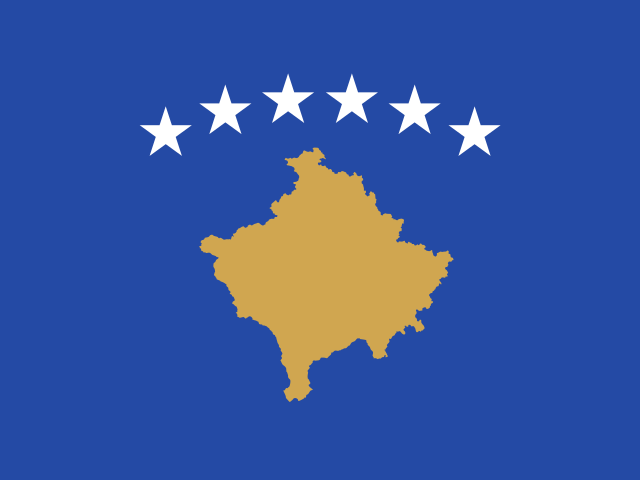
Kosovo
One of the youngest countries in the world, Kosovo declared independence in 2008 and promptly filled its capital with a giant NEWBORN monument. It's a land of young people and mountain villages.
WHAT THE FLAG MEANS ◢
A blue field bearing a golden map of Kosovo below an arc of six white five-pointed stars. Article 6 of the constitution says the flag is a state symbol reflecting the country's multi-ethnic character and leaves its appearance to law. The law leaves it again, to a determination of the Assembly, so neither instrument ties the six stars to anything. They are conventionally read as the six major ethnic communities.
Kosovo FACTS ◢
| Capital | Pristina |
|---|---|
| Continent | Europe |
| Population | 1,576,876 (2025) |
| Area | 10,909 km² |
| Population density | 145/km² |
| Currency | Euro (EUR) |
| Official languages | Albanian, Serbian |
| Calling code | +383 |
| Time zone | UTC+01:00 |
| Drives on the | Right |
| ISO codes | XK / XKS |
DID YOU KNOW? ◢
- It declared independence in 2008, making it one of the world's newest countries.
- It has one of the youngest populations in Europe, with a median age in the twenties.
- The capital Pristina is home to a landmark 'NEWBORN' typographic monument unveiled on independence day.
- The Accursed Mountains along its border offer some of the Balkans' most dramatic hiking.
Kosovo QUICK ANSWERS ◢
What is the capital of Kosovo?
The capital of Kosovo is Pristina.
What is the population of Kosovo?
Kosovo had a population of 1,576,876 in 2025.
What currency does Kosovo use?
Kosovo uses the Euro (EUR).
What languages are spoken in Kosovo?
The official languages of Kosovo are Albanian and Serbian.
Think you know your flags? Play Flag Daily → · Browse all countries →
MORE ON THE FLAG ◢
Six stars, six communities. That is the answer everybody gives, and neither the constitution nor the symbols law says it.
What it does not tell you is how far that goes. The statute the constitution delegates the flag to runs to nineteen articles and never names a colour, a star, a shape or a ratio for the flag itself. It hands the design on again, to a document the Gazette's record of the Act does not carry. And then it fines you for departing from it.
What Kosovo's law does have is a rule about what its flag must accomplish, written before either of those instruments and carried over from a United Nations document with the category term changed.
Key Takeaways
- The word flag appears twice in the whole Kosovo constitution, both times in Article 6, and neither occurrence describes it. Its second paragraph sends the appearance, use and protection of the state symbols to law, and the law delegates again.
- The Law on the Use of State Symbols contains no description either. Its Article 3 hands the shape, the dimensions and the colour rules to the Assembly and makes that determination part of the law by reference.
- Article 17 of the same law fines a legal person between 500 and 1,000 euro for using the flag in a form not determined by that law and the provisions in force, and the determination it points at is not published on the Gazette's record of the Act.
- The multi-ethnic requirement did not originate with Kosovo. Article 6.1 carries it over from Article 1.7 of the 2007 Comprehensive Proposal for the Kosovo Status Settlement, with the category term changed from national to state.
- The popular reading gives the six stars to six communities. Article 64, the one place the constitution counts them, names seven, all of them non-majority communities, before the Albanian majority is added at all.
Article 6 is the only place the constitution says flag
The Constitution of the Republic of Kosovo was published in the Official Gazette on 9 April 2008. Search the whole document for the Albanian word for flag and you get two hits, both inside Article 6, headed [Simbolet]. The first is the opening clause:
"Flamuri, stema dhe himni janë simbolet shtetërore të Republikës së Kosovës të cilat pasqyrojnë karakterin shumetnik të saj."
The flag, the coat of arms and the anthem are the state symbols of the Republic of Kosovo, which reflect its multi-ethnic character. Then the second paragraph, which is two sentences:
"Pamja, mënyra e përdorimit dhe mbrojtja e flamurit dhe të simboleve të tjera shtetërore rregullohen me ligj. Mënyra e përdorimit dhe e mbrojtjes së simboleve kombëtare rregullohet me ligj."
The appearance, manner of use and protection of the flag and of the other state symbols are regulated by law. The manner of use and of protection of national symbols is regulated by law. Hold on to that second sentence; it comes back.
Those two paragraphs are the entire constitutional treatment, and the two hits are the two occurrences of the word flag inside them. The constitution has been amended five times since it was published, twenty-six amendments between 2012 and 2020, and not one of them touches Article 6. The word for flag does not appear in any of them either. There is no blazon, and the flag is given no colour. The word for six occurs elsewhere in the 2008 text seven times, and not one of them describes anything: a deputy's absence in months, the limit on an acting presidency in months, six of the electoral commission's eleven members, and the number of parliamentary groups that name them, and three times over the transitional composition of the constitutional court. Those last three went with Article 152 in 2012, so four remain. The word for star does not occur at all.
The Albanian flag carries the charge Kosovo's design most conspicuously avoids, and is worth reading beside this one.
The law that governs the flag describes no flag
Article 6 sends you to a law, and the law is Law No. 03/L-038 on the Use of State Symbols of Kosovo, adopted by the Assembly on 20 February 2008 and published in Official Gazette 26/2008 on 2 June 2008.
Its second article lists the symbols: the flag, the coat of arms and the anthem. Its third article is where a description would go, and instead it says this:
"Forma, përmasa e flamurit dhe stemës, përmbajtja e tekstit dhe partitura e himnit, përcaktohen nga Kuvendi i Republikës së Kosovës."
The form and the dimensions of the flag and the coat of arms, the content of the text and the score of the anthem, are determined by the Assembly of the Republic of Kosovo. The next paragraph adds that the geometric rules of appearance and of colour for forming the flag and the arms, and the text and notation of the anthem, as determined by the Assembly, "do të jenë pjesë përbërëse e këtij ligji", will be a constituent part of this law.
So the shape is in a document the Act points at rather than in the Act. That by itself is a normal drafting move, since a drawing fixes a shape better than a paragraph can. What is unusual is how completely the Act stays out of it. Across all nineteen articles the word for colour appears once, in that referring paragraph. Star, six, white, blue and map do not appear at all. The word for dimensions appears three times, and only the one in article 3 is about the flag's own shape. The other two are comparative: the state flag may not be smaller than flags flown beside it, and flags flown with it must match it.
The third paragraph of Article 3 is the one that gives the game away. The original of the symbols, it says, is kept in the archive of the Assembly. The flag's authoritative form is an object in a filing system.
The Act fines you for departing from a determination its own Gazette record does not carry
Article 17 of the same law sets the penalties, and its second limb is the one worth reading twice. A legal person is fined between 500 and 1,000 euro if it uses the coat of arms or the flag:
"në formë apo përmbajtje, e cila nuk është përcaktuar me këtë ligj si dhe me dispozitat ligjore në fuqi"
in a form or content which is not determined by this law as well as by the legal provisions in force. The responsible official of that legal person is fined between 250 and 500 euro, as is a responsible person in a state body, and a natural person is fined between 150 and 300 euro.
That closing limb matters, and it is the one usually left off. The offence is not defined by this Act alone; it reaches out to whatever else is in force, which by article 3.2 includes the Assembly's geometric and colour rules. The drafting is sound, and every reference in it points at another instrument.
What is missing is the last link. Article 3 sends you to a determination of the Assembly; article 17 punishes departing from it; and the determination itself is not published on the Official Gazette's record of the Act, whose only listed subsidiary instruments are two presidential decisions of 2017 and 2018. A citizen can read the whole statute, follow every cross-reference it gives, and still not find the thing they may be fined for departing from.
The multi-ethnic clause was written before either Kosovo instrument
The most-quoted clause of Article 6, the multi-ethnic one, is not Kosovan drafting. It arrives from outside, and it arrives first: just under eleven months before the statute and just over a year before the constitution.
The Comprehensive Proposal for the Kosovo Status Settlement, the document usually called the Ahtisaari plan, was circulated to the United Nations Security Council on 26 March 2007 as S/2007/168/Add.1. Its first article, on general principles, includes this:
"Kosovo shall have its own, distinct, national symbols, including a flag, seal and anthem, reflecting its multi-ethnic character."
That document is dated 26 March 2007. The symbols law was adopted on 20 February 2008 and the constitution published on 9 April 2008. Set the Settlement's clause beside Article 6 and the requirement comes over intact, with the category term changed. The Settlement says Kosovo shall have its own, distinct, national symbols; Article 6.1 says the flag, the arms and the anthem are the state symbols. The comparison runs between official texts in two languages, the Settlement in English and the constitution in Albanian, which is worth saying out loud. The Settlement names the statute twice and not the same way both times. Its legislative agenda asks for a "Law on National Symbols and Public Holidays"; its vital-interest list, which is the clause Article 81.1(8) carries over, says "Laws on the use of symbols (including Community symbols) and on public holidays". What Kosovo enacted was a Law on the Use of State Symbols, which follows the second and not the first. That is not a wrinkle. National symbols are a separate category in Kosovo law, and the symbols statute gives national flags an article of their own.
The clause immediately after it in the Settlement explains what the requirement was defending against:
"Kosovo shall have no territorial claims against, and shall seek no union with, any State or part of any State."
Read 1.7 and 1.8 together and the shape of the brief is hard to miss. A flag required to reflect a multi-ethnic character, for a state forbidden to seek union with any other, is being fenced away from the flag of any one community and from the flag of a neighbour. That is a specification for what the flag may not be, arrived at without one word about what it should look like.
Kosovo law protects your right to fly a different flag
The other half of the same design sits in the last sentence of the constitution's Article 6 and in Article 6 of the symbols law, and it is the part usually left out.
Here is the second sentence of Article 6.2 again: the manner of use and of protection of national symbols is regulated by law. State symbols and national symbols are two different categories in Kosovo law, and the second means the symbols of the communities.
The symbols law spells it out:
"Qytetarët e të gjitha komuniteteve në Republikën e Kosovës kanë të drejtën, në mënyrë individuale apo si komunitet, të përdorin flamujt kombëtarë në pajtim me këtë ligj dhe me standardet ndërkombëtare"
Citizens of all communities in the Republic of Kosovo have the right, individually or as a community, to use national flags, in accordance with this law and with international standards. The state flag has articles of its own on either side of this one, at 4 and 5 and again at 7 to 9. The right to fly a community's flag sits in the middle of them.
That right is protected structurally as well, and the Act says so itself. Its enacting formula opens "Në mbështetje të Kapitullit IV neni 65 pika 1 si dhe neni 81 pika 1 paragrafi 8 të Kushtetutës së Republikës së Kosovës", on the basis of Chapter IV article 65 point 1 and article 81 point 1 paragraph 8 of the Constitution of the Republic of Kosovo. Article 81 lists the laws of vital interest, and paragraph 8 of that list is laws on the use of symbols, including the symbols of the communities. Passing, amending or repealing one takes a double majority: a majority of the Assembly's deputies, and a majority of those holding the seats guaranteed for non-majority communities. That is the wording as amended in 2012; as published in 2008 it counted deputies present and voting, and reached reserved as well as guaranteed seats.
The Act itself did not go through that. It was adopted on 20 February 2008 and the constitution it cites did not enter into force until 15 June, and the 2008 text's Article 149 provided that vital-interest laws were to be adopted initially by a majority of those present and voting. That article was repealed in 2012, its work done. The entrenchment does not depend on that citation either way: Article 81.1(8) is a subject-matter test, so a law on the use of symbols is a vital-interest law whether or not it says so on its face. What follows is that the Act cannot now be amended without the communities' own votes, and no referendum can touch it.
So what are the six stars?
Nothing in Kosovo's constitution, its symbols law, or the Settlement the clause came from says.
The reading that the six stars stand for the six main communities is the standard one, and it fits the multi-ethnic requirement of Article 6 so neatly that it hardly seems worth checking.
It is worth checking, because the constitution does enumerate Kosovo's communities. It did it twice as published in 2008, in Article 64 and again in the transitional Article 148 that governed the first two electoral mandates, and both lists had seven names. Article 148 was repealed in 2012 along with the rest of the supervised-independence provisions, so Article 64 is now the only one, and its seven names are unchanged. It guarantees twenty of the Assembly's hundred and twenty seats to the communities that are not in the majority, and then names them:
| Community | Guaranteed minimum |
|---|---|
| Serb | 10 |
| Roma | 1 |
| Ashkali | 1 |
| Egyptian | 1 |
| Bosniak | 3 |
| Turk | 2 |
| Goran | 1 |
A further seat goes to whichever of the Roma, Ashkali and Egyptian communities polls highest. Those are floors rather than caps: a community whose parties win more seats in the open election keeps them, so twenty is the guaranteed minimum for the seven together, not their ceiling.
Count the names. Seven communities, before you add the Albanian majority. The list the stars are usually said to stand for, Albanians, Serbs, Turks, Bosniaks, Roma and Gorani, is six, and it is not the constitution's list: it folds in the majority and leaves out the Ashkali and the Egyptians, whom Article 64 names and gives seats.
So the neat version is not merely unsourced. It counts differently from the place the constitution counts. Article 6 of the symbols law points the same way: it treats communities as an open set with the right to their own flags, rather than as a fixed six the state flag totals up.
What holds is that the stars are six, that they are unexplained, and that the silence looks deliberate. The Serbian flag is the one the Settlement's two clauses, read together, fence this design away from most directly. The North Macedonian flag is another flag in the region that had to be designed rather than inherited, and is worth reading beside this one.
Frequently asked questions
What do the six stars on the Kosovo flag mean?
Neither instrument that mentions the flag says. Article 6 of the constitution describes nothing about it, and Law No. 03/L-038 on the Use of State Symbols contains no reference to stars anywhere in its nineteen articles.
The reading in circulation is that they stand for the six main communities, Albanians, Serbs, Turks, Bosniaks, Roma and Gorani. It is stated in neither the constitution, nor the symbols law, nor the 2007 settlement the multi-ethnic requirement came from, and it does not match the place the constitution counts communities: Article 64 names seven non-majority communities and sets a guaranteed minimum of seats for each, twenty between them.
Does the Kosovo constitution describe the flag?
No. The word flag appears twice in the whole document, both times inside Article 6, which says the flag, the coat of arms and the anthem are state symbols reflecting Kosovo's multi-ethnic character, and that their appearance, use and protection are regulated by law.
The constitutional text gives the flag no colour, no shape, no proportion and no charge. Its one use of the word for colour is Article 24's bar on discrimination.
Which law describes the flag of Kosovo?
None that this article could open. Law No. 03/L-038 on the Use of State Symbols governs the flag, but its Article 3 delegates the form, the dimensions and the colour rules to a determination by the Assembly of Kosovo, which it then makes a constituent part of the law by reference.
The Act itself contains no description, and Article 3.3 records that the original of the symbols is held in the Assembly's archive.
Why does Kosovo's flag avoid Albanian symbols?
No instrument says so in terms, and the reading follows from two clauses of the settlement Kosovo's constitution was built on. Article 1.7 of the 2007 Comprehensive Proposal for the Kosovo Status Settlement says Kosovo "shall have its own, distinct, national symbols, including a flag, seal and anthem, reflecting its multi-ethnic character", and article 1.8 says Kosovo "shall have no territorial claims against, and shall seek no union with, any State or part of any State". Read together they fence the design away from any one community's flag and from a neighbour's.
Article 6 of the constitution carries the first of those over, changing national symbols to state symbols.
Can a community in Kosovo fly its own national flag?
Yes. Article 6 of the Law on the Use of State Symbols gives citizens of all communities the right, individually or as a community, to use national flags in accordance with that law and with international standards. What it forbids is the public display of one that is worn out or damaged. Flags of foreign states are a separate matter: article 9.4 governs when one may be placed beside the state flag in public offices, and the law does not equate the two categories.
Article 81 of the constitution also makes any law on the use of symbols, including community symbols, a law of vital interest, so it cannot be changed without a majority of the Assembly's deputies and a majority of those holding the seats guaranteed for non-majority communities. The symbols law's own enacting formula cites that provision.
Sources
- Kushtetuta e Republikës së Kosovës, Articles 6, 64, 81, 139, 148, 149 and 162 - Gazeta Zyrtare e Republikës së Kosovës, published 9 April 2008, Albanian text. This is the text as first published; the five amending instruments below are what has changed since. Retrieved 30 August 2026.
- The five constitutional amendments, all Gazeta Zyrtare e Republikës së Kosovës, Albanian text, retrieved 31 August 2026: amendments 1 to 22, 7 September 2012, which ended supervised independence, reworded Article 81(1), repealed Articles 143, 146 to 154 and 157 to 160, including 148 and 149, replaced Article 161 with a new transitional provision, and moved Articles 144, 145, 155 and 156 elsewhere in the text rather than deleting them; amendment 23, 26 March 2013 on the amnesty power; amendment 24, 5 August 2015 adding the Specialist Chambers article; amendment 25, 11 March 2016 on the Judicial Council; and amendment 26, 30 September 2020 adding the Istanbul Convention. None of the twenty-six mentions the flag or Article 6.
- Ligji Nr. 03/L-038 për përdorimin e simboleve shtetërore të Kosovës, enacting formula and articles 2, 3, 4, 5, 6, 7, 9 and 17 - Gazeta Zyrtare e Republikës së Kosovës 26/2008, adopted 20 February 2008, published 2 June 2008, Albanian text. Retrieved 30 August 2026.
- Comprehensive Proposal for the Kosovo Status Settlement, Articles 1.7 and 1.8 - United Nations Security Council document S/2007/168/Add.1, 26 March 2007. Retrieved 30 August 2026.
- What could not be found: the Assembly determination that Article 3 of Law No. 03/L-038 makes a constituent part of the law, containing the flag's form, dimensions and colour rules. It is not published on the Official Gazette's record of that Act, whose only listed subsidiary acts are two presidential decisions of 2017 and 2018. Checked 30 August 2026.
PLAY ANOTHER →
Five questions a day. Everyone gets the same five.
FIVE QUESTIONSDAILYDaily CryptogramOne quote, one scrambled alphabet. Crack it before tomorrow.
CRACK THE QUOTEDAILYDaily CodeA short message, hidden in a different cipher every day.
ONE CIPHER A DAYDAILYOn This DayOne thing that happened today in history. Every day, a new one.
TODAY IN HISTORY