
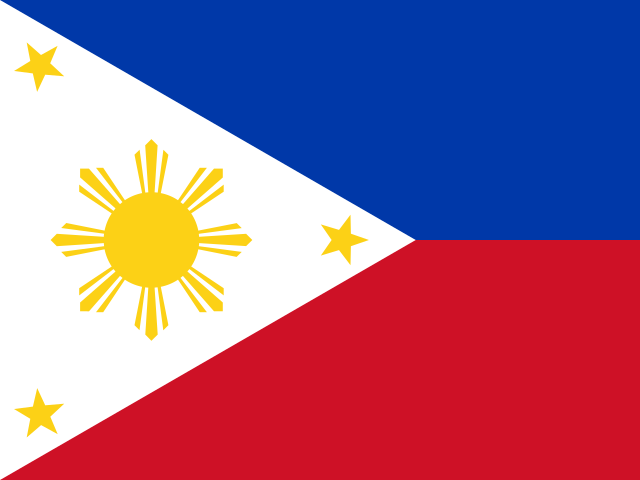
Philippines
The Philippines is an archipelago of over 7,000 islands strung across the western Pacific, where jeepneys, Spanish-era churches and some of the world's richest reefs all share the map.
WHAT THE FLAG MEANS ◢
Horizontal blue over red with a white equilateral triangle at the hoist framing a golden-yellow eight-rayed sun and three five-pointed stars. Section 4 of the Flag and Heraldic Code names only the colours, the eight-rayed sun and the three stars, and assigns no meanings, but section 10 legislates the flag's best known feature: flown from a flagpole the blue field is on top in time of peace and the red field on top in time of war. The 1898 declaration of independence, which did assign meanings, gives the three stars to Luzon, Mindanao and Panay and says the blue, red and white commemorate the flag of the United States. The familiar reading of blue for peace and justice, red for patriotism and valour, white for equality and the third star for the Visayas is the flag maker's, not the state's.
Philippines FACTS ◢
| Capital | Manila |
|---|---|
| Continent | Asia |
| Population | 116,786,962 (2025) |
| Area | 300,000 km² |
| Population density | 389/km² |
| Currency | Philippine peso (PHP) |
| Official languages | English, Filipino |
| Calling code | +63 |
| Internet TLD | .ph |
| Time zone | UTC+08:00 |
| Drives on the | Right |
| ISO codes | PH / PHL |
DID YOU KNOW? ◢
- It's made up of more than 7,600 islands, though a large share are uninhabited.
- It's one of the world's biggest exporters of coconut products, and the leading exporter of coconut oil.
- The Philippine eagle, one of the largest and rarest eagles on Earth, is its national bird.
- The Chocolate Hills of Bohol are over a thousand near-identical mounds that turn brown in the dry season.
- The Puerto Princesa Underground River flows through a spectacular limestone cave system, a UNESCO World Heritage Site.
Philippines QUICK ANSWERS ◢
What is the capital of the Philippines?
The capital of the Philippines is Manila.
What is the population of the Philippines?
The Philippines had a population of 116,786,962 in 2025.
What currency does the Philippines use?
The Philippines uses the Philippine peso (PHP).
What languages are spoken in the Philippines?
The official languages of the Philippines are English and Filipino.
Think you know your flags? Play Flag Daily → · Browse all countries →
MORE ON THE FLAG ◢
Blue for peace, red for valour, white for equality, and the three stars for Luzon, the Visayas and Mindanao. Neither the Constitution of the Philippines nor its flag statute says any of it. Both describe the flag and then stop.
A Philippine document did assign it meanings, on the day the flag was first unfurled. At Cavite Viejo on 12 June 1898, Ambrosio Rianzares Bautista read out the declaration of independence, held the new flag up to the assembled chiefs and delegates, and told them what each part of it was for.
Two of his answers are not the answers taught today. The three stars are Luzon, Mindanao and Panay. And the colours commemorate the American flag, in gratitude.
Key Takeaways
- The 1898 declaration gives the three stars to Luzon, Mindanao and Panay, three islands where it says the revolt broke out, and not to Luzon, the Visayas and Mindanao.
- It says the blue, red and white commemorate the flag of the United States, as a mark of gratitude for American protection.
- Republic Act 8491, the flag law in force, describes the flag in one sentence and gives no part of the flag a meaning.
- Section 10 of that law is the famous one: blue field on top in time of peace, red field on top in time of war.
- The Philippines has had three official blues since 1955, and the one in force is a colour reference number rather than a name.
| Element | The 1898 declaration | Republic Act 8491 | The familiar reading |
|---|---|---|---|
| Three stars | Luzon, Mindanao and Panay | "three five-pointed stars" | Luzon, the Visayas and Mindanao |
| Eight rays | Eight named provinces in a state of war | "eight-rayed golden-yellow sun" | The first eight provinces to revolt |
| White triangle | The emblem of the Katipunan | Named twice, never explained | Equality |
| Blue, red, white | Commemorating the flag of the United States | Fixed as cable numbers | Peace, valour, equality |
Luzon, Mindanao and Panay
The declaration survives as a handwritten manuscript in the National Library of the Philippines, whose facsimile runs to twenty-one pages. The flag passage sits just past the middle, after the grievances and immediately before the signature list, which fills the rest of the manuscript.
On the sheet itself the sentence about the stars is legible without ambiguity: "representando las tres estrellas las tres principales islas de este Archipiélago, Luzon, Mindanao y Panay en que estalló este movimiento insurreccional".
Sulpicio Guevara's translation, published by the National Historical Commission in 1972, renders it as "the three stars, signifying the three principal Islands of this Archipelago-Luzon, Mindanao, and Panay where this revolutionary movement started".
Panay is one island. The Visayas are a region of hundreds. The declaration is not naming an island group and getting the name wrong. It is naming three islands, one at a time, and giving a reason that only fits islands: this is where the fighting broke out.
The Visayan version is not a later corruption either, which is the part that makes this hard to tidy up. It comes from the woman who sewed the flag, Marcela Mariño de Agoncillo, whose own description is where the classroom reading comes from. The two accounts have never been reconciled.
The colours commemorate the American flag, and the document says so
The clause that follows is the harder one to place.
The manuscript continues: "conmemorando los colores azúl, rojo y blanco lo de la bandera de los Estados Unidos de la America del Norte". Guevara gives the whole thought: the colours commemorate the flag of the United States "as a manifestation of our profound gratitude towards this Great Nation for its disinterested protection which it lent us and continues lending us".
That gratitude was not rhetorical when it was written. Emilio Aguinaldo's own memoir, published the following year, has Admiral Dewey assuring him that the United States would recognise Philippine independence. Dewey then advised him to have a Filipino national flag made at once, and said he would recognise and protect it in front of the other nations whose squadrons were anchored in Manila Bay. Within a year the two countries were at war with each other.
Aguinaldo's memoir also records the admiral's reaction to the finished flag: "It has a triangle, and is something like the Cubans'". Cuba was then fighting its own war against Spain, and the Cuban flag was the emblem of that struggle. Dewey, by Aguinaldo's account, asked for a Philippine one as a memento.
So the flag of the United States got written into the founding document of another country as a thing to be thanked rather than a thing to be resisted. It did not stay that way.
Which eight provinces, and why the lists disagree
The declaration names them. The manuscript reads "simbolizándo los ocho rayos de aquel las ocho provincias Manila, Cavite, Bulacan, Pampanga, Nueva Ecija, Bataan, Laguna y Batangas declaradas en estado de guerra apenas se inició la primera insurrección".
Manila, Cavite, Bulacan, Pampanga, Nueva Ecija, Bataan, Laguna, Batangas. The reason given is not that they revolted first, but that they were declared in a state of war as soon as the first rising began.
The list is not stable in later accounts. The National Historical Commission of the Philippines, writing about a 1970s campaign to add a ninth ray, reports the historian Teodoro Agoncillo's list as Manila, Cavite, Bulacan, Pampanga, Nueva Ecija, Tarlac, Laguna and Batangas. Tarlac stands where the manuscript has Bataan.
That campaign is worth knowing about. A bill from the first district of Lanao del Sur asked for a ninth ray for the Muslim Filipinos and cultural minorities who had fought the Spanish, and other groups asked for a crescent beside the sun. The commission records the historians' answer: that Aguinaldo had eight provinces in mind, and that one of the three stars already stands for the Muslim Filipinos and their lands. Neither change was made. Republic Act 8491 still says eight rays and mentions no crescent.
What the flag law of the Philippines actually says
The current law is Republic Act 8491, the Flag and Heraldic Code of the Philippines, approved 12 February 1998. Its description of the flag is a single sentence.
Section 4: "The flag of the Philippines shall be blue, white and red with an eight-rayed golden-yellow sun and three five-pointed stars, as consecrated and honored by the people."
That is the entire design provision. It counts the rays and the points of the stars, and it never mentions the triangle. The white in that sentence is a colour, not a shape.
The white triangle appears exactly twice in the whole code. Once in section 27, as a measurement: "The width of the flag, 1; the length of the flag, 2; and the sides of the white triangle, 1." Since the flag's width and the triangle's sides are both 1, that is what makes the triangle equilateral. And once in section 24, the rule for draping a casket, where "the white triangle shall be at the head". Neither passage says what it is for.
Article XVI, section 1 of the 1987 Constitution is shorter still, and lists the colours the other way round. The flag "shall be red, white, and blue, with a sun and three stars, as consecrated and honored by the people and recognized by law". The statute it points to says blue, white and red. No instrument opened for this article accounts for the difference in order.
Neither text assigns a meaning to anything. Neither mentions Luzon, the Visayas, Mindanao, Panay or any province. The nearest the code comes to saying anything more about the eight rays is section 41, and that section is about the coat of arms rather than the flag; its language is heraldic rather than symbolic, blazoning "the sun rayonnant with eight minor and lesser rays".
Blue on top in peace, red on top in war
What the code legislates is not a meaning but a use, and it is the rule the flag is best known for.
Section 10: "The flag, if flown from a flagpole, shall have its blue field on top in time of peace and the red field on top in time of war; if in a hanging position, the blue field shall be to the right (left of the observer) in time of peace, and the red field to the right (left of the observer) in time of war."
Two things follow that are easy to miss. This is not an inverted flag. The two stripes are the same shape, so swapping them leaves the sun and the stars upright and the triangle at the hoist. And the hanging rule carries its own left and right, written out twice from the observer's side.
The code goes on at length about display. Section 16 says which way the blue field points when the flag hangs across a street. Section 34 forbids using it as a tablecloth, a pennant on a car, a costume or a trademark, and forbids adding "any word, figure, mark, picture, design, drawings, advertisement, or imprint of any nature on the flag". A worn flag, under section 14, "shall be solemnly burned".
Three official blues, and the one in force is a reference number
Section 28 fixes the colours by number rather than by name: "The blue color shall bear Cable No. 80173; the white color, Cable No. 80001; the red color, Cable No. 80108; and the golden yellow, Cable No. 80068." Section 28 names no authority for those numbers. The National Historical Commission, discussing the older Cable No. 80077, attributes that designation to the Reference Guide of the Color Association of the United States.
Those numbers are recent, and the blue in particular has moved. The National Historical Commission's account runs like this. The shade the flag wore from 1919, standardised by an executive order in 1936, is the one the commission calls national flag blue, Cable No. 80077, and the commission says it was apparently made official on 24 January 1955. In the 1970s historians began questioning that shade. The National Historical Institute then concluded it was inaccurate, referring to a Philippine flag that had belonged to Aguinaldo, a sketch by Juan Luna, and other documents and reminiscences.
On 25 February 1985 President Ferdinand Marcos issued Executive Order 1010, which the commission quotes as declaring that "the shade of the color blue was lighter than the present dark blue" and instructing the National Historical Institute "to take the necessary steps to restore the original color of the First Philippine Flag". The order named no shade. The institute took three months to name one, and settled in late May on cable number 80176, oriental blue.
For a year the country flew three blues at once, which is the commission's own framing of the episode. The phase-out was overtaken by the events of February 1986. President Corazon Aquino never repealed the order but went back to the older blue in practice, a 1996 report recognised royal blue, and Republic Act 8491 wrote a number for it into statute in 1998.
The descriptions the argument turned on are worth reading beside the reference numbers. Aguinaldo, interviewed by Teodoro Agoncillo, said the blue was "bughaw", and that it was neither "azul oscuro" nor "azul marino". Mariano Ponce, writing to Ferdinand Blumentritt, called it as blue as the sky. Salvador Vivencio del Rosario, in 1899, called it "color celeste". None of those is a specification, and the argument ran for decades before it ended in a cable number written into statute.
The twelve years the flag was a crime to fly in the Philippines
In 1907 the American colonial government banned the flag without naming it.
Act No. 1696 of the Philippine Commission was enacted on 23 August 1907. It prohibited exposing to public view any flag used during the late insurrection to identify those in armed rebellion against the United States, any flag adopted at any time by the public enemies of the United States in the islands, and "any flag, banner, emblem, or device of the Katipunan Society or which is commonly known as such". The National Historical Commission reads that as forbidding Filipinos to display the Philippine flag anywhere. The prohibition reached a person's own premises, and section 4 extended it to uniforms.
The penalty was not nominal: "a fine of not less than five hundred pesos nor more than five thousand pesos, or by imprisonment for not less than three months nor more than five years", or both.
The commission's history says the ban held until 1919, when Senator Rafael Palma sponsored the repealing bill and Governor General Francis Harrison signed it, as Act No. 2871, on 24 October. No copy of that act could be opened for this article, so its number and date rest on the commission's account rather than on the text.
The meaning everybody knows came from the woman who sewed it
If the state never assigned the colours a meaning, someone did, and the commission names her.
Marcela Mariño de Agoncillo sewed the first flag in Hong Kong, with her daughter Lorenza and with Delfina Herbosa Natividad, from a sketch Aguinaldo made himself. Five days of work, and it was delivered to him before he returned to the Philippines on 17 May 1898.
The commission quotes her own description of what she had made. The white triangle stood for the hope of equality, the blue "for peace, truth and justice", the red "for patriotism and valor", the eight rays for the first eight provinces to take up arms against Spain, and the three stars for Luzon, Visayas and Mindanao.
That is the reading most people are taught, and it is tidier than the declaration's. It is also the maker's rather than the state's, and it is at odds with the document read out on the day the flag was first unfurled.
The flag itself is gone. In a letter of 11 June 1925 Aguinaldo said it had been lost during the retreat north, somewhere in Tayug, Pangasinan.
Frequently asked questions
What do the three stars on the Philippine flag stand for?
The declaration of independence of 12 June 1898 assigns them to three islands: Luzon, Mindanao and Panay, described as the three principal islands where the revolt broke out. The reading taught today gives the third star to the Visayas as a region, which is how the flag's maker described it. Neither the Constitution nor Republic Act 8491 adopts either version; the statute calls them "three five-pointed stars" and stops.
Why is the Philippine flag flown upside down during a war?
It is not upside down. Section 10 of Republic Act 8491 provides that the flag flown from a flagpole "shall have its blue field on top in time of peace and the red field on top in time of war". The two stripes are the same shape, so reversing them leaves the sun and stars upright. The same section gives a matching rule for a flag in a hanging position.
What do the eight rays of the sun mean?
The 1898 declaration names eight provinces: Manila, Cavite, Bulacan, Pampanga, Nueva Ecija, Bataan, Laguna and Batangas, and says they were declared in a state of war as soon as the first rising began. Later accounts vary. The National Historical Commission of the Philippines reports Teodoro Agoncillo's list with Tarlac in place of Bataan. Republic Act 8491 says only "eight-rayed golden-yellow sun".
Who made the first Philippine flag?
Marcela Mariño de Agoncillo sewed it in Hong Kong, assisted by her daughter Lorenza and by Delfina Herbosa Natividad, from a sketch by Emilio Aguinaldo, according to the National Historical Commission of the Philippines. It took five days and reached Aguinaldo before his return to the Philippines on 17 May 1898. The original was lost during the war with the United States.
What shade of blue is the Philippine flag?
Section 28 of Republic Act 8491 fixes it as Cable No. 80173, a royal blue, and has done since 1998. Earlier official shades were different: a darker national flag blue, and an oriental blue announced by the National Historical Institute in 1985 after Executive Order 1010 required a lighter one. Aguinaldo himself described the original only as "bughaw".
Sources
- Republic Act No. 8491, the Flag and Heraldic Code of the Philippines, approved 12 February 1998, sections 4, 10, 14, 16, 24, 27, 28, 34 and 41. The Lawphil Project, Arellano Law Foundation. Retrieved 14 August 2026.
- Constitution of the Philippines, 1987, Article XVI, section 1. The Lawphil Project, Arellano Law Foundation. Retrieved 14 August 2026.
- Acta de la proclamación de independencia del pueblo Filipino, 12 June 1898, manuscript facsimile, National Library of the Philippines Digital Collection RB01.RB120120411. The Spanish quotations here were read off pages 12 and 13 of that facsimile and checked against the page-by-page transcription below. Retrieved 14 August 2026.
- Page-by-page transcription of the same facsimile, Spanish Wikisource, proofread pages 12 and 13. The accents in the quotations follow this transcription's reading of the 1898 hand. Retrieved 14 August 2026.
- Philippine Declaration of Independence, translated by Sulpicio Guevara, from The Laws of the First Philippine Republic (The Laws of Malolos), Manila: National Historical Commission, 1972, pages 203 to 206. Retrieved 14 August 2026.
- Chris Antonette Piedad-Pugay, The Controversial Philippine National Flag, National Historical Commission of the Philippines, 5 September 2012. The link goes to the Internet Archive capture of 13 April 2025, which is the copy read here; the commission's own site was unreachable at the time of retrieval. Retrieved 14 August 2026.
- 1985: A Year of Three Shades of Blue, National Historical Commission of the Philippines, 29 May 2021. The link goes to the Internet Archive capture of 30 May 2021, which is the copy read here. Retrieved 14 August 2026.
- Act No. 1696, enacted 23 August 1907, in Acts of the Philippine Commission, Nos. 1-1800, pages 805 to 806. Retrieved 14 August 2026.
- Emilio Aguinaldo, True Version of the Philippine Revolution, 1899, page 31. Retrieved 14 August 2026.
PLAY ANOTHER →
One quote, one scrambled alphabet. Crack it before tomorrow.
CRACK THE QUOTEDAILYDaily CodeA short message, hidden in a different cipher every day.
ONE CIPHER A DAYDAILYDaily TriviaFive questions a day. Everyone gets the same five.
FIVE QUESTIONSDAILYGuess the CountryThree clues, three guesses. Work out where in the world it is.
THREE CLUES