
Eswatini
A tiny landlocked kingdom tucked between South Africa and Mozambique, ruled by one of the world's last absolute monarchies and famous for its exuberant traditional festivals. Eswatini changed its name in 2018 to stop being confused with Switzerland.
WHAT THE FLAG MEANS ◢
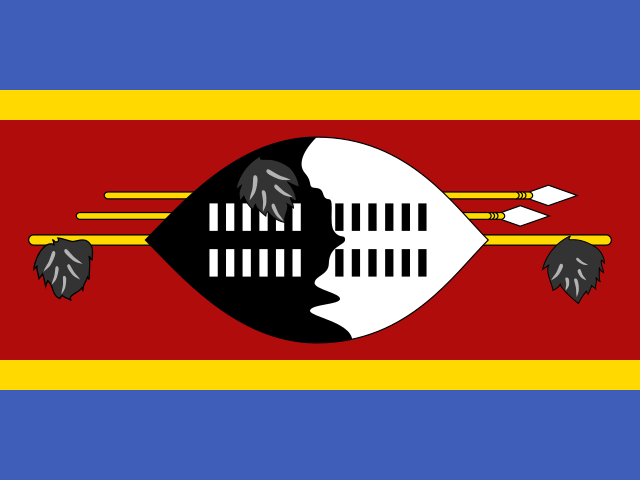
A central red band edged in yellow between two blue bands, with a black-and-white ox-hide shield of the Emasotsha regiment, two spears and a tasselled staff laid across the centre. Eswatini's government gives red for past battles, blue for peace and stability, yellow for the country's resources, the shield and spears for protection, and the shield's black and white for white and black people living together peacefully. No law assigns those meanings; the 1968 Act prescribes the flag with a drawing.
Source: drive.google.com · eswatinilii.org · constituteproject.org
Eswatini FACTS ◢
| Capital | Mbabane |
|---|---|
| Continent | Africa |
| Population | 1,256,174 (2025) |
| Area | 17,364 km² |
| Population density | 72/km² |
| Legal tender | Lilangeni (SZL) and South African rand (ZAR) |
| Official languages | English, Swazi |
| Calling code | +268 |
| Internet TLD | .sz |
| Time zone | UTC+02:00 |
| Drives on the | Left |
| ISO codes | SZ / SWZ |
DID YOU KNOW? ◢
- It's one of the last remaining absolute monarchies in the world.
- It was known as Swaziland until it was officially renamed Eswatini in 2018.
- Its Umhlanga, or Reed Dance, is one of Africa's most colourful traditional ceremonies.
- It's one of the smallest countries in Africa, landlocked between South Africa and Mozambique.
Eswatini QUICK ANSWERS ◢
What is the capital of Eswatini?
The capital of Eswatini is Mbabane.
What is the population of Eswatini?
Eswatini had a population of 1,256,174 in 2025.
What currency does Eswatini use?
Eswatini uses the Lilangeni (SZL) and South African rand (ZAR).
What languages are spoken in Eswatini?
The official languages of Eswatini are English and Swazi.
Think you know your flags? Play Flag Daily → · Browse all countries →
MORE ON THE FLAG ◢
The flag of Eswatini is five horizontal bands, blue and yellow either side of a wide red centre, with a black and white shield and two spears lying across the middle. Its government gives a short answer on what those parts mean. Red stands for past battles, blue for peace and stability, and yellow for the country's resources. The shield with two spears behind it stands for protection from the country's enemies. That wording comes from the Corporate Identity Manual which the Ministry of ICT launched on 30 October 2024.
One line in that manual rarely survives into summaries of the flag. The shield's colour, it says, is meant to show that white and black people live in peaceful coexistence in Eswatini.
What you will not find is a law saying any of it. Read the Act that prescribes the flag and you find a drawing with no description attached.
Key Takeaways
- Section 4 of the Swaziland Flags and Coat of Arms Act, 1968 prescribes the flag as one that "shall be as depicted in Part III of the Schedule". Part III is a drawing.
- The same Act sets out the coat of arms in full heraldic wording, so the silence around the flag looks deliberate.
- Section 3(1) of the 2005 Constitution defines the flag as whichever flag was lawfully in use at the time.
- Government publications carry the meanings instead: red for past battles, blue for peace, yellow for resources, black and white for coexistence.
- King Sobhuza II gave the design to the Swazi Pioneer Corps in 1941. Renaming the country in 2018 changed nothing on it.
What do the colours on the flag of Eswatini mean?
Three colours, three meanings, and the government has published them the same way in two documents.
The 2024 Corporate Identity Manual is the latest official statement as of August 2026, and it treats the shield as a fourth carrier of meaning rather than as decoration: shield and spears for protection from the country's enemies, and the shield's black and white for white and black people living together peacefully.
An earlier government publication puts it almost identically. Flags of the World reproduces a government leaflet called "The Swaziland Flag", undated but written before the 2018 renaming, since it calls the country Swaziland. It ends by giving crimson for battles of the past, yellow for the wealth of the resources the country possesses, and blue for peace.
Notice what neither text says. Both talk about resources in general, not minerals in particular. Flags of the World traces the narrower "mineral wealth" reading not to Eswatini but to a European reference work, Pedersen's lexicon of 1980.
Does any law say what the colours mean?
No, and the way the law avoids saying so is the interesting part.
Parliament passed the Swaziland Flags and Coat of Arms Act, 1968, assented to on 13 November that year. Its long title promises an Act to prescribe the national flag, the coat of arms and His Majesty's Royal Standard. Section 4 discharges that promise in one line: the National Flag "shall be as depicted in Part III of the Schedule". Turn to Part III and you find a drawing; in the consolidated text, which reproduces Parts I and II in full, the page carries no text beside it.
Compare Part II, which handles the coat of arms in careful words: "Azure surmounting and to the dexter of two spears points upward a Swazi shield proper", ensigned by the headdress of the Emasotsha Regiment, with a lion and an African elephant as supporters and the motto Siyinqaba. Part I sets out the Royal Standard in words too.
Nor does the Constitution of 2005 fill the gap. Section 3(1) says the anthem and flag shall be those lawfully in use when the Constitution commenced, or whatever may later be prescribed. Red, blue and yellow go unmentioned.
That habit persists online. As of August 2026 the government's National Symbols page explains the lion, the elephant and the motto, then gives the flag a thumbnail and no explanation.
Where did the design of the flag of Eswatini come from?
From an army, and from one specific gift.
King Sobhuza II granted a military flag to the Swazi Pioneer Corps in 1941, during the Second World War, to remind them of the nation's military traditions. Eswatini's own 2024 manual names that flag as the basis of the national design, so the ox-hide shield lying on its side and the weapons behind it arrived as regimental insignia rather than as symbolism invented for independence.
The rest happened quickly. The flag flew for the first time on 25 April 1967, the day the King took the pledge of oath. The College of Arms in London registered it on 30 October 1967, and Eswatini adopted it as the national flag on 6 October 1968, a month after independence.
One caution on those dates. The manual says the flag first flew in April 1967, then calls the October registration day the first official hoisting, so the government's own account is not consistent.
What are the shield, the spears and the tassels on the flag?
None of them is generic.
The shield is an ox-hide combat shield of the traditional Emasotja regiment, laid horizontally across the red band. Two assegais sit above a staff, which is a Swati fighting stick. Hanging from the staff are injobo, tassels made from the feathers of the widowbird and the lourie, and the 2024 manual notes that those feathers are reserved for the King.
That regiment does reach the statute book, just not through the flag: Part II of the 1968 Act builds the coat of arms around the headdress of the Emasotsha Regiment. Government spelling has drifted since, the Act writing Emasotsha and the 2024 manual Emasotja.
A shield with weapons behind it is rare on national flags. Kenya carries one with crossed spears, and Lesotho, the other kingdom in southern Africa, carries a Basotho hat instead.
Did the flag change when Swaziland became Eswatini?
It did not. The name changed and the flag stayed exactly as it was.
The United Nations records the change: following a communication of 30 May 2018 from the permanent mission, the country name became the Kingdom of Eswatini, replacing the Kingdom of Swaziland, effective 19 April 2018. Nobody touched the flag. Two quieter changes did happen either side of it: the tassels turned black in 2011, and the 2024 manual fixed the official colours in Pantone.
| Date | What happened | What changed on the flag |
|---|---|---|
| 1941 | Sobhuza II grants a flag to the Swazi Pioneer Corps | The design is born as regimental insignia |
| 25 April 1967 | The King takes the pledge of oath | The flag flies for the first time, per one passage of the 2024 manual |
| 30 October 1967 | The College of Arms in London registers it | Design fixed in a registered form |
| 6 October 1968 | Eswatini adopts it as the national flag | Nothing; the design is already settled |
| 29 November 1968 | Act 36 of 1968 commences | Nothing; the Act prescribes it by drawing |
| 2011 | Tassel colour revised, per the 2024 manual | Tassels turn black, matching the widowbird |
| 19 April 2018 | Swaziland is renamed Eswatini | Nothing at all |
| 30 October 2024 | Corporate Identity Manual issued | Official colours fixed in Pantone |
Its two neighbours, South Africa and Mozambique, fly nothing like it. Try picking it out in the daily flag game.
Frequently asked questions
When was the flag of Eswatini adopted?
The government's 2024 Corporate Identity Manual gives 6 October 1968, a month after independence from Britain. That manual is not consistent about the first flying: one passage puts it at 25 April 1967, while another calls the College of Arms registration of 30 October 1967 the first official hoisting. The governing Act commenced later still, on 29 November 1968.
Is the flag of Eswatini the same as the Royal Standard?
Nearly, and one animal separates them. Part I of the Schedule to the 1968 Act specifies the King's Royal Standard as "The Flag with a lion d'or statant in the centre of the topmost horizontal azure stripe", meaning the national flag with a standing gold lion in the upper blue band. Section 6 also bars the Minister from amending Part I without the King's prior written concurrence.
What are the tassels on the flag of Eswatini?
They are injobo, tassels of widowbird and lourie feathers hanging from the staff behind the shield. Eswatini's 2024 Corporate Identity Manual records that those feathers are used only by the King, and that their colour was revised to black in 2011 to match the widowbird's plumage.
Does any law say when the flag of Eswatini may be flown?
Not in the Act itself, which delegates the question. Section 7 empowers the Minister to make regulations prescribing where and when the flag may be flown, prohibiting torn or dirty flags, and controlling anything made to resemble the flag, the coat of arms or the Royal Standard. A King's Order-in-Council of 1973 set the maximum penalty for breaching such a regulation at four hundred rand or one year's imprisonment, and that penalty is the only amendment the consolidated text of the Act records. The Schedule carrying the flag drawing is untouched.
What are the official colours of the flag of Eswatini?
The Corporate Identity Manual issued in October 2024 fixes them as Pantone 542 C for the blue, Pantone 803 C for the yellow and Pantone 157 C for the red, alongside black and white. The undated government leaflet quoted by Flags of the World specified them differently, in the British Admiralty colour system, listing chart numbers such as T816 for crimson.
Sources
- Government of the Kingdom of Eswatini, Corporate Identity Manual - circulated by the Ministry of ICT, on Google Drive rather than a government domain. It is the source for the colour meanings, the coexistence line, the 1941 origin, the dates, the tassel change and the Pantone values. Retrieved 12 August 2026.
- Parliament of the Kingdom of Eswatini, The Ministry of ICT Launches a Corporate Identity Manual and Government Email - reports the launch of that manual on 30 October 2024, which fixes its date and its publisher. Retrieved 12 August 2026.
- Laws.Africa Legislation Commons, Swaziland Flags and Coat of Arms Act, 1968 - a Laws.Africa reproduction rather than a gazette scan, and a point-in-time consolidation as at 1 December 1998 rather than the text as enacted in 1968. The only amendment it records falls in section 7. Retrieved 12 August 2026.
- Constitute Project, Constitution of the Kingdom of Swaziland Act, 2005 - retrieved 12 August 2026.
- Government of the Kingdom of Eswatini, National Symbols - retrieved 12 August 2026.
- United Nations, Eswatini - retrieved 12 August 2026.
- Flags of the World, eSwatini - retrieved 12 August 2026.
PLAY ANOTHER →
A short message, hidden in a different cipher every day.
ONE CIPHER A DAYDAILYGuess the CountryThree clues, three guesses. Work out where in the world it is.
THREE CLUESDAILYDaily CryptogramOne quote, one scrambled alphabet. Crack it before tomorrow.
CRACK THE QUOTEDAILYOn This DayOne thing that happened today in history. Every day, a new one.
TODAY IN HISTORY