
Finland
A northern land of some 188,000 lakes and endless forest that keeps topping global happiness rankings, invented the sauna as a way of life, and turns winter darkness into a spectator sport. Finland is quietly excellent at almost everything.
WHAT THE FLAG MEANS ◢
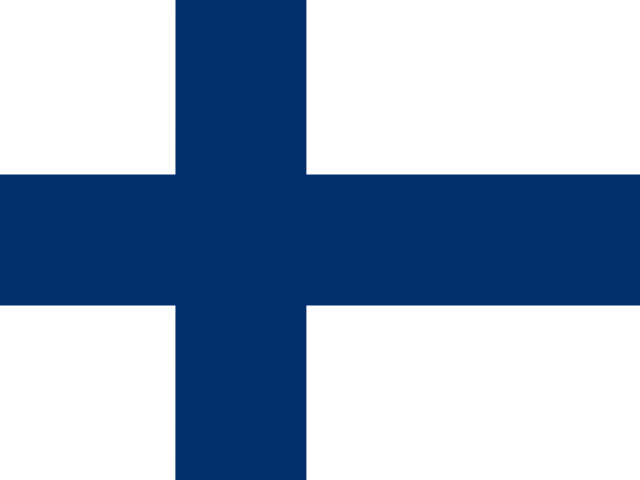
A white field with a blue Nordic cross, set nearer the hoist than the fly. The Act on the Finnish Flag (380/1978) describes only that, and fixes the proportions at 11 units high by 18 long with cross arms 3 units wide; the shades are set separately by government decision 827/1993, which specifies the blue by CIE colour coordinates and gives PMS 294C only as an approximation. Neither text assigns the colours any meaning. The familiar reading traces to Zacharias Topelius, who argued for blue and white in Helsingfors Tidningar in 1863: his blue stood for the inland lakes and the surrounding sea, and his white for the country's colour through six months of the year and for the youth of its people.
Source: finlex.fi
Finland FACTS ◢
| Capital | Helsinki |
|---|---|
| Continent | Europe |
| Population | 5,646,436 (2025) |
| Area | 338,478 km² |
| Population density | 17/km² |
| Currency | Euro (EUR) |
| Official languages | Finnish, Swedish |
| Calling code | +358 |
| Internet TLD | .fi |
| Time zone | UTC+02:00 |
| Drives on the | Right |
| ISO codes | FI / FIN |
DID YOU KNOW? ◢
- It's often called the Land of a Thousand Lakes, though it actually has around 188,000 of them.
- It has repeatedly been ranked the happiest country in the world.
- There are roughly as many saunas as households, making it a genuine national institution.
- In its far north, the sun doesn't fully set for weeks during summer, a phenomenon known as the midnight sun.
Finland QUICK ANSWERS ◢
What is the capital of Finland?
The capital of Finland is Helsinki.
What is the population of Finland?
Finland had a population of 5,646,436 in 2025.
What currency does Finland use?
Finland uses the Euro (EUR).
What languages are spoken in Finland?
The official languages of Finland are Finnish and Swedish.
Think you know your flags? Play Flag Daily → · Browse all countries →
MORE ON THE FLAG ◢
Finland's flag law runs to ten sections, and not one of them says what the colours stand for. Section 1 of the Act on the Finnish Flag gives the whole design in a single sentence: Suomen lipussa on valkoisella pohjalla sininen risti, the Finnish flag has a blue cross on a white ground. Then it moves straight on to who may fly which version.
The blue itself is pinned down elsewhere, and pinned down hard. A 1993 government decision fixes it by colour coordinates measured on a named spectrophotometer, and caps how far a manufactured flag may drift from that reading. Even there, nothing about lakes.
So the reading you usually see is not law. It is one writer's argument, made in a newspaper, and he named the sea rather than the sky.
Key Takeaways
- The Act on the Finnish Flag (380/1978) describes a blue cross on a white ground and assigns the colours no meaning; decision 827/1993 fixes the blue by measurement, with Pantone 294C only an approximation.
- The Constitution of Finland does not mention the flag anywhere. The rules sit in ordinary statute.
- The lakes reading traces to Zacharias Topelius, who argued for blue and white in Helsingfors Tidningar in 1863. His blue meant the lakes and the surrounding sea, not the sky, and his white meant both the winter and the youth of the Finnish people.
- Parliament approved the blue and white cross flag on 28 May 1918, drawn up by the artists Eero Snellman and Bruno Tuukkanen.
The Act recognises four versions.
| Version | Who flies it | What is different |
|---|---|---|
| National flag | Anyone, under Section 4 | Plain blue cross on white, 11 units high by 18 long |
| Rectangular state flag | Parliament, ministries, the supreme courts, the Bank of Finland | Adds the coat of arms in the square formed by the cross arms, inside a yellow border |
| Swallow-tailed state flag | Defence Forces staffs, units and vessels | One unit longer, with the fly cut into three tails |
| President's flag | The President of the Republic | The swallow-tail, with a blue and yellow Cross of Liberty in the upper hoist field |
What do the colours on the Finnish flag mean?
Officially, nothing. No Finnish legal text assigns them a meaning.
The Act describes the flag. The 1993 decision measures its colours. The Ministry of the Interior, which is responsible for the flag, publishes the proportions and colour values and interprets neither. Search the Constitution and the flag is not there at all, so there is no higher text to appeal to.
What does exist is an attributable origin. Zacharias Topelius spent years arguing that Finland's colours should be blue and white, and in June 1863 he put the case in Helsingfors Tidningar under his pen name Undecumque. The scholarly edition of his works, in Swedish, summarises his reasoning: white is the country's colour for six months of the year, and the colour of youth, the Finnish people being young and its history an unwritten page. Blue stood for the many inland lakes and for the surrounding sea. The line the edition quotes, in translation, is that white and blue are youth and hope.
Note what is absent. Topelius named the sea, not the sky. The same commentary reports the historian Matti Klinge, Finlands blåvita färger (1988), reading those justifications as camouflage and supposing Topelius had been drawn to the blue St Andrew's cross on the Russian naval ensign. Either way, the gloss is a writer's, not the statute's.
How does the law define the Finnish flag?
Tightly, and entirely in geometry.
Section 2 sets the national flag at 11 units high and 18 long. The cross arms are 3 units wide. The four fields are 4 units high, the two next to the hoist are 5 units long, and the outer two are 10. Those numbers alone reconstruct the flag exactly.
That offset cross, nearer the hoist than the fly, is the shared feature of the Nordic family. Denmark, Norway, Sweden and Iceland all use it. The design is often called a Scandinavian cross, though Finland is Nordic rather than Scandinavian. Of the five Nordic national flags, Finland's is the only one on a white field, which is the first thing to look for in a flag quiz.
The Ministry of the Interior draws out a consequence the Act leaves implicit. Because the Act defines the flag abstractly, by proportion and colour rather than by cloth, the Ministry's position is that any figure satisfying those rules is the Finnish flag, its own example being a printed sticker. Section 6 forbids adding any device the Act does not itself provide for, and Section 8 makes damaging or misusing the flag punishable by a fine.
How exactly is the blue specified?
To a degree that would satisfy a paint laboratory.
Section 7 of the Act does not set the colours itself. It hands that job to the government, which acted in decision 827/1993, given on 16 September 1993 and in force from 1 January 1995. The decision applies only to flags and flag cloth made or imported after that date.
For the blue, Section 3 of the decision gives a luminance factor Y of 5.86 with chromaticity coordinates x 0.1856 and y 0.1696, under CIE standard illuminant D65. The reading is taken on a Minolta CM-1000 spectrophotometer, in the geometry the decision writes as d/2°: diffuse light in, the reading taken almost square-on to the cloth. Its Sections 4 and 5 add approximations in two other systems, NCS 4060-R90B and PMS 294C, and its Section 6 caps the permitted deviation at 4 ΔE*ab units, the colour difference the CIE defined in 1976.
Pantone 294C is the number usually quoted for Finland's blue. Under Finnish law it is the convenient approximation, not the definition.
Where did the blue and white come from?
From a student festival, a Swedish spa town and a lost argument about yellow.
Before independence Finland flew Sweden's flag, then Russia's under imperial rule. The Grand Duchy had its own lion arms, whose red and gold became a sort of national colouring by use. When Maamme was first performed at Kumtähti field outside Helsinki in 1848, students carried a banner bearing those arms on white, and the flag debate started there.
Topelius drafted the first stanza of his poem Finlands flagga at Marstrand on 2 July 1862, where Finnish spa guests in a regatta needed colours to race under and ran up an improvised flag of white above blue with Finland's arms in the corner. Rival proposals in the press favoured the yellow and red of the arms, which Topelius rejected as reading Swedish and Russian.
Independence briefly went the other way: a red lion flag raised at the Senate building on 6 December 1917 came close to official status. Parliament settled the matter in spring 1918, approving the constitutional committee's blue and white cross design on 28 May. Snellman and Tuukkanen supplied the drawing. The 1978 Act dates the resulting law to 29 May 1918, repeals it, and keeps its design.
Frequently asked questions
Does Finnish law say what the blue and white mean?
No. The Act on the Finnish Flag (380/1978) describes a blue cross on a white ground and assigns the colours no meaning, and government decision 827/1993 specifies the exact shades without interpreting them. The Constitution of Finland does not mention the flag at all.
What is the exact blue used on the Finnish flag?
Government decision 827/1993 defines it as a luminance factor of 5.86 with chromaticity coordinates of x 0.1856 and y 0.1696, measured under CIE illuminant D65. PMS 294C and NCS 4060-R90B appear in the same decision as approximations, and a flag may deviate by at most 4 ΔE*ab units.
Is damaging the Finnish flag an offence?
Yes. Section 8 of the Act on the Finnish Flag names the offence as desecration of the Finnish flag and sets the penalty at a fine. Section 8 names three acts: publicly damaging the flag, using it disrespectfully, and taking down without permission a Finnish flag that has been put on public display.
When was the Finnish flag adopted?
Parliament approved the blue and white cross design on 28 May 1918, from a drawing by the artists Eero Snellman and Bruno Tuukkanen. The 1978 Act repealed the 1918 law and kept that design, but the colours have been set afresh since: decision 827/1993 replaced a government decision of 1925 on the model colour samples for the flag.
What is the difference between Finland's national flag and its state flag?
The state flag adds Finland's coat of arms in the square formed by the cross arms, inside a yellow border one fortieth of the cross width. Anyone may fly the national flag, while the state flag is restricted to the authorities listed in Section 5 of the Act.
Sources
- Finlex, Laki Suomen lipusta 380/1978 - retrieved 12 August 2026.
- Finlex, Valtioneuvoston päätös Suomen lipun väreistä 827/1993 - retrieved 12 August 2026.
- Ministry of the Interior of Finland, Tietoa Suomen lipusta - retrieved 12 August 2026.
- Ministry of the Interior of Finland, Suomen lipun historia - retrieved 12 August 2026.
- Svenska litteratursällskapet i Finland, Zacharias Topelius Skrifter, Finlands flagga, with editorial commentary - retrieved 12 August 2026.
- Constitute Project, Finland 1999 (rev. 2011) Constitution - retrieved 12 August 2026.
PLAY ANOTHER →
One quote, one scrambled alphabet. Crack it before tomorrow.
CRACK THE QUOTEDAILYDaily TriviaFive questions a day. Everyone gets the same five.
FIVE QUESTIONSDAILYDaily CodeA short message, hidden in a different cipher every day.
ONE CIPHER A DAYDAILYOn This DayOne thing that happened today in history. Every day, a new one.
TODAY IN HISTORY